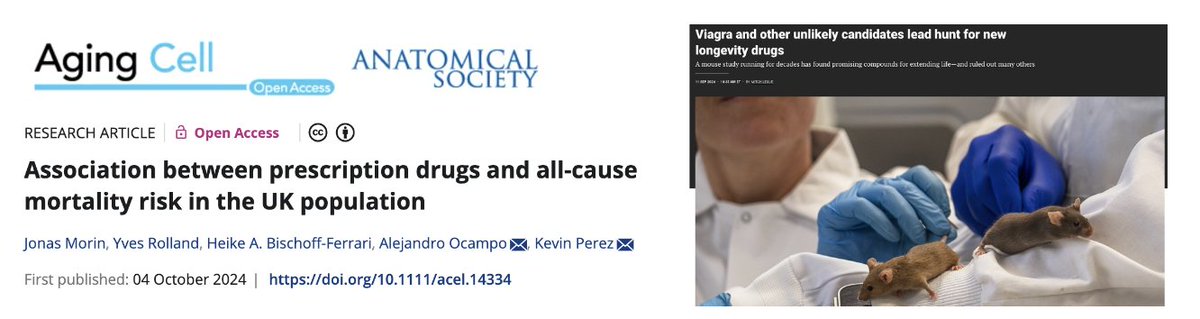
Happy to share the first manuscript coming out of @epiterna_ ! In this work we examine the association between more than 400 commonly prescribed medications and all-cause mortality risk in half a million participants of the UK Biobank.
https://t.co/5mVdyNTNwV
NEW STUDY: Ocampo Lab publishes reprogramming cocktails that reduce DNA damage & extend lifespan of worms up to 42%.
The race is on to test them in humans 🚀
Excited to share our new publication! We previously showed that age reversal can be achieved using transcription factor-based reprogramming. Now, we demonstrate that it can also be done with chemical cocktails to achieve lifespan extension!
https://t.co/hxgIhAOW0U
What if the path to slowing aging wasn’t a drug, but replacing worn out parts?
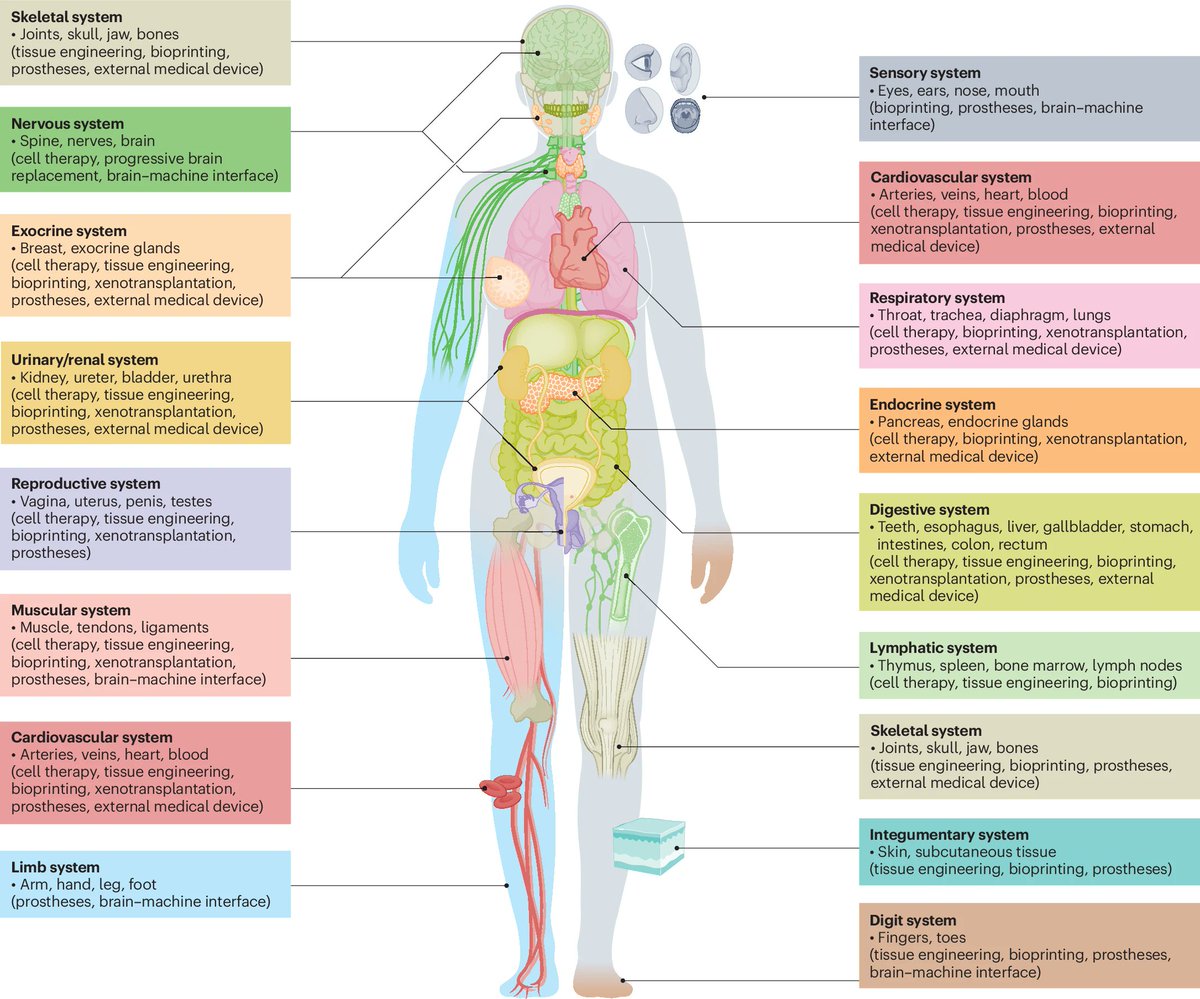
Our new paper out today in @NatureAging shows how this could one day work. We map a unified framework—from scaffolds & bioprinted tissues to pacemakers, xenotransplants & brain machine interfaces—for extending healthy lifespan through replacement-based approaches. Read the thread to learn more about what replacement means for the aging field! https://t.co/eqWdJEPBU4 🧵👇(1/10)
0/ It sounds wild, but low-dose Cialis (tadalafil) and Viagra (sildenafil) are both drawing attention for longevity benefits.
Recent clinical evidence indicates the use of either correlates to longer survival in men, in addition to their potential for heart health, metabolism, and even brain function.
A new retrospective study evaluated the longevity potential of 407 prescription drugs in over 200,000 participants, with both Cialis and Viagra being among the surprising promising hits in men (yet to be evaluated in women, since the retrospective studies only cover existing drug use for established indications).
Sildenafil will soon be tested in the NIA’s ITP, the most credible pre-clinical longevity drug testing program in mice.
Two new papers from our group published in
@AgingCell today 🎉!
Aging clocks in dogs
https://t.co/RwNRO7Ck0J
Lifespan-extending drugs in worms
https://t.co/tBcngKhw7Z
Happy to share that I’ve started a new position as Junior Group Leader @ChariteBerlin ! Our aging research group is interested in identifying therapeutics to extend lifespan, prevent age-related diseases and frailty in humans.
https://t.co/tGCHu6F0mU
We leverage public biobanks to identify drugs associated with lower all-cause mortality in the general population, and validate their effects on lifespan and healthspan in model organisms (e.g., worms, flies or mice).
@ZelarCity's final summit is this weekend and I’m incredibly proud and in awe of what we've co-created over these 6 weeks.
We’re bringing together some of the brightest minds pushing the boundaries of what's possible in longevity and we’re thrilled to announce that @geochurch, a true pioneer in genetics and synthetic biology, will be sharing his insights.
This is a rare opportunity to hear directly from one of the leading visionaries in the field.
Don’t miss it. Sign up here 👇
https://t.co/MoBab8x8sA
A big shout-out to my incredible team for their hard work and dedication: @longevion@strygah@EliasSchlie@ElenaMishina15 @ZivaPecjak and everyone contributing. You rock!
Our manuscript on the association between prescription medications and all-cause mortality in the UK population was just published in @AgingCell !
https://t.co/ngI5XnBpsi
See thread 👇
Happy to share the first manuscript coming out of @epiterna_ ! In this work we examine the association between more than 400 commonly prescribed medications and all-cause mortality risk in half a million participants of the UK Biobank.
https://t.co/5mVdyNTNwV
Glad to share our second manuscript coming out of @epiterna_!
https://t.co/x26IDoilK9
In this study, we evaluated some of the most commonly reported lifespan-extending molecules in C. elegans, examining their effects on lifespan with different diets, strains, and starting age. By performing combinatorial testing, we identified combinations of molecules with synergistic effect and dramatic lifespan extension. Lastly, we performed a small proof-of-concept screen with more than 200 molecules, and identified novel lifespan extending drugs in C. elegans.
Lastly, in a small proof-of-concept screening of ~200 molecules, we identified new compounds extending lifespan in C. elegans, including safinamide and fenbendazole.