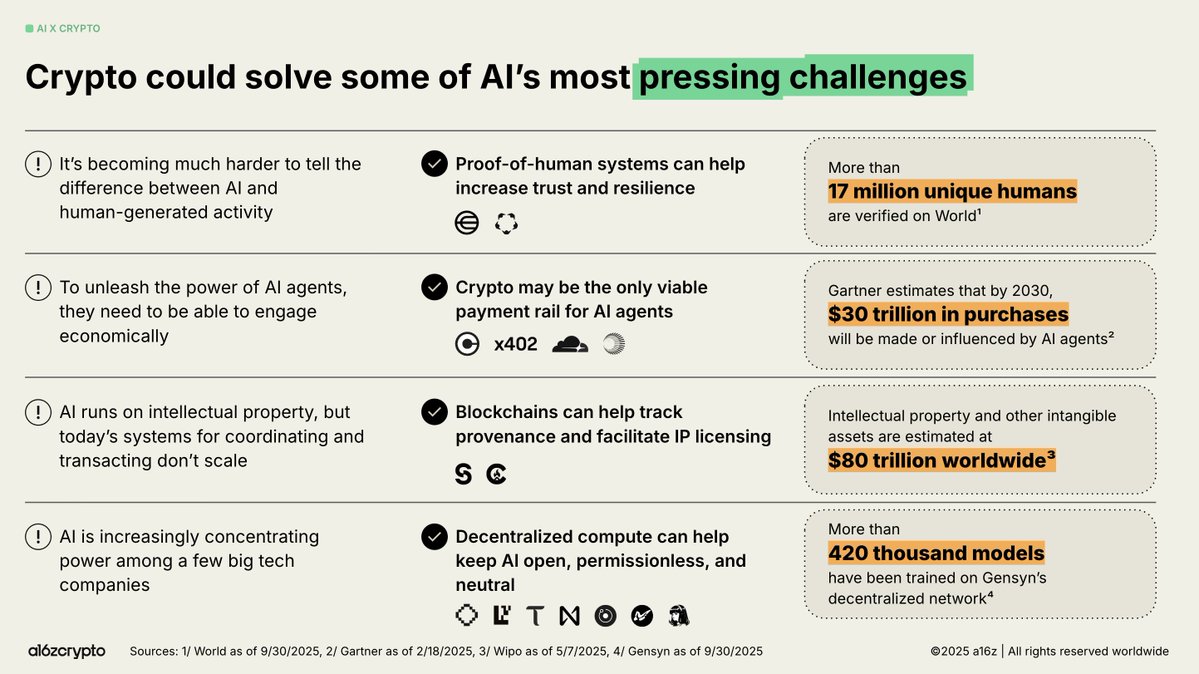
AI needs identity, payments, and provenance tracking.
Crypto provides all three.
Together, crypto & AI are shaping a more open internet—one where both money and intelligence move freely.
We’ve raised $75M to build the decentralized energy network powering the world’s most important commodity: electricity.
This funding helps us move faster toward an electric grid that delivers what the old one no longer can: affordability, reliability, and abundant power.
Just joined @openmind_agi FABRIC waitlist—the world's first robonet connecting machines globally! 🤖🌐 Join the future of machine-to-machine collaboration: https://t.co/XrzJk9JH9e #FABRIC#OpenMindAGI
#KBW is quickly approaching 🚀 🚀 🚀
@depindeployer is excited to co-host "Solana DePIN Korea" during @kbwofficial alongside @SuperteamVN, @hotspotty and @BeatXswap !
Thank You @SuperteamVN for sponsoring the event 💐
🗓️ Tuesday, September 23 | 2:00 PM - 5:00 PM GMT+9
📍 314-11 Seongsu-dong 2(i)-ga, Seongdong-gu, Seoul, South Korea
Solana DePIN Korea is bringing builders, VCs & innovators together to shape the future of decentralized infrastructure 🚀
⚡ Panels on scaling & investing in DePIN and AI
🤝 DePIN Networking in Asia
🔥 Showcasing real-world use cases on Solana
Join the movement. DePIN is frontier. 🌍
Register for free ⤵️
https://t.co/GCVB4q1kgD
#DePIN #Solana #KBW
On Tempo, permissionlessness, L1 vs L2
Tempo will be a permissionless chain. On day 1, anyone will be able to deploy a token, and anyone will be able to transact on the chain. Some projects think that attracting real-world usage and serious institutions requires giving up on base layer neutrality. We do not think that, and that's not how we're building Tempo.
The plan for Tempo is to have permissionless validation and permissionless smart contract deployment as well as permissionless usage: just like Bitcoin, Ethereum, Solana, etc. We’ll start with a permissioned validator set to get going and decentralize further from there.
We’re building in features to make it easy for entities interacting with the blockchain (like asset issuers, money transmitters, etc.) to comply with their relevant obligations, but the base layer will remain neutral. This is a principle we feel incredibly strongly about (see: https://t.co/bt6aFEDch9).
As many parts of the mainstream world look to adopt crypto, we think there is a risk that they adopt permissioned systems. Our goal with Tempo is to help onboard them onto crypto rails that solve specific payments needs while still being truly permissionless.
—
Why L1 rather than an Ethereum L2?
At Paradigm, we are heavily invested, both intellectually and literally, in the Ethereum ecosystem. We will continue to help it scale, and invest in and support companies building on Ethereum. We are also extremely excited about single-sequencer L2s for many use cases, including trading.
But building a network for global payments will require bringing together thousands of partners that may not trust us, or Stripe, or anyone as a platform. We think a decentralized validator set—for the chain itself—is a necessary requirement for those partners, and to ensure that the chain is unquestionably neutral in the long run.
From an operational perspective, we feel urgency to build for the demand that’s coming and want fewer dependencies, including on the rate of Ethereum L1 progress. With Tempo, we tried to remove all crypto tribalism and alignment games from our thinking and just focus on building the right product for crypto payments.
At a technical level, we are prioritizing attributes like fast finality (L2s are generally only as final as the underlying L1), multiple validators (vs. single sequencer), and custom transaction lanes and gas pricing. Some of these are technically possible for an L2, but could be complex, slow to implement, and/or introduce many external dependencies. Tempo is stablecoin-focused, so interoperability through native issuance is more relevant to us than the native bridge to Ethereum that L2s have.
We aren’t Bitcoin, Ethereum, or Tempo maximalists. We’re maximalists for permissionless crypto. We want Ethereum L1 to scale, and we want L2s to thrive. We love Bitcoin as a monetary asset. We find substance in Solana, Hyperliquid, and many other ecosystems. We want to ensure real-world payment flows happen on crypto rails, and that’s why we’re building Tempo.
🧵 Precision GPS, Crypto & #PhysicalAI
1/ GPS powers our modern world 🌍
But the current system is:
💡~5–10m accuracy
💡Centralized & vulnerable
💡Not built for robots, drones & AI agents
This is where #DePIN + Precision GPS projects step in.
RoboFi Season is here.
The builders are out, the foundations are forming, and crypto-robotics is heating up.
Here’s the updated landscape map of the projects leading the charge.
🧵
NVIDIA recently dropped the Cosmos Reason model, a 7B ‘reasoning’ model for robots. It’ll help them with👇
➠ Remembering past actions
➠ Generating synthetic training data
➠ Creating 3D reconstructions from sensors
This feels like a big step toward truly RoboFi. But for robots to become ‘smart robots’ they’ll need more than just reasoning.
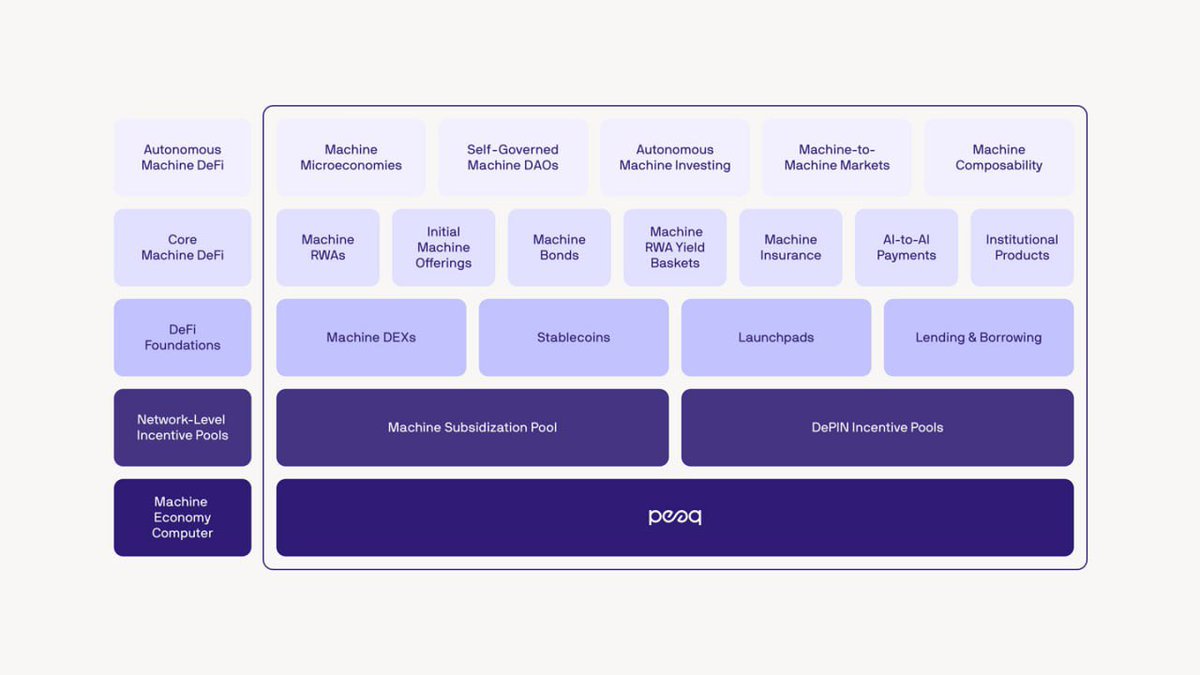
They'll need to transact. That's what @peaq is doing, they’re building that financial infra layer for machines. When robots can think AND handle money, they can…
+ Pay for their own repairs
+ Hire other robots for tasks
+ Split earnings with owners
+ Make autonomous financial decisions
Some people have also started calling it MachineFi, where machines earn, pay + collaborate, all recorded onchain.
Already 50+ apps are live on @peaq, one of them, @OVRtheReality, is showing good traction.
➠ 140K+ 3D maps produced
➠ 70M+ images captured
➠ 41.9M sq. meters mapped
We will soon be moving from robots that just follow commands to robots that can operate as independent economic agents.
The hardware is getting smarter. The infra for machine to machine commerce is being built.
If @nvidia handles the brain, @peaq is building the wallet for machines.
DePINs on @solana are rising!
What if you could own the first DePIN multi-miner on @solana that lets you contribute to your favorite DePIN projects (@inference_net, @pipenetwork, @arcium, @helium & many more) and earn daily rewards?
The @dawninternet Black Box makes it possible. Learn more with the video below 👇
https://t.co/v3kfrDYLmu
Limited supply, starting from only $1,499 USD 👇
https://t.co/mYh0i25JDM
Owning a Black Box means you're helping build a new internet, powered by users 🔥
Privacy in Crypto Is Getting an Upgrade
New privacy technologies are emerging: MPC, FHE, TEEs, and zkTLS. Each tackles privacy from a different angle — and major projects are building with them now.
Here’s how these technologies work — and where they’re going👇
~~ Analysis by @davewardonline ~~
Multi-Party Computation (MPC)
MPC allows multiple parties to compute something together without revealing their inputs.
Say six friends want to find their average salary without revealing individual amounts. Each splits their salary into six random shares and sends one to each person. Everyone holds a share from each person but can’t reconstruct any full salary. They compute on the shares, not the actual numbers. The results combine into the correct average without exposing inputs.
MPC is useful when regulation or competition prevents data sharing, but joint analysis is beneficial. A common example: hospitals wanting to train AI models on private patient data without sharing it directly.
◆ Roadblocks for MPC — More participants mean more communication and computation, which slows things down. Blockchains can penalize bad actors but can’t eliminate the heavy resource costs.
Who's Using MPC and for What?
→ @FireblocksHQ — Splits private keys for institutional custody
→ @arcium — Uses MPC for private AI and sensitive computing
→ @renegade_fi — Dark pool for confidential onchain trading
Fully Homomorphic Encryption (FHE)
FHE lets you compute on encrypted data without ever decrypting it.
Normally, data is encrypted in transit but decrypted for processing. With FHE, encryption stays in place throughout.
Imagine sending a locked safe with programmable gloves. You put private data inside, add instructions like “add these” or “sort this,” and send the safe and gloves to someone else. They perform the operations without opening the safe, then return it. You unlock it and see the result.
◆ Roadblocks for FHE — FHE is slow, 10–100x slower than other computation. Adding zk verification (zkFHE) ensures correctness but makes it even slower. FHE hides data but doesn’t prove the computation was done right. zkFHE fixes that at the cost of speed.
Who's Using FHE and for What?
→ @zama — FHE tooling for encrypted smart contracts
→ @fhenix — Brings FHE to practical apps
→ @Privasea_ai — Uses FHE to train encrypted AI models
→ @octra — General-purpose chain with FHE-based compute and ML consensus
Trusted Execution Environments (TEEs)
TEEs are secure hardware zones that isolate data from the rest of the device, including OS and operators.
iPhones use TEEs for biometrics. Face or fingerprint data lives in secure chips. When you authenticate, a new scan is compared inside the TEE, which returns a simple yes/no — no raw data leaves the chip.
In crypto, TEEs are used for private contracts and block production. @unichain, Uniswap’s L2, uses TEEs to prevent exploitative MEV.
◆ Roadblocks for TEEs — TEEs rely on hardware vendors, making them centralized by crypto standards. They’re vulnerable to supply chain attacks or flaws, like the Intel exploit that compromised Secret Network’s TEEs.
Who's Using TEEs and for What?
→ @SpaceComputerIO — Uses orbital TEEs for tamper-proof satellite nodes
→ @OasisProtocol — L1 running private EVM contracts inside TEEs
→ @PhalaNetwork — Confidential cloud using TEEs from various providers
Zero-Knowledge Transport Security Layer (zkTLS)
zkTLS merges TLS (used in HTTPS) with zero-knowledge proofs to verify data while keeping it private.
TLS secures 95% of web traffic. zkTLS lets anyone prove facts from this data — like a bank balance — without revealing details.
Say you want an onchain loan and need to prove your bank balance. A zkTLS tool accesses your bank over HTTPS, reads the displayed balance, and creates a proof. The DeFi lender sees that your balance exists but not the number or history.
◆ Roadblocks for zkTLS — It only works with visible HTTPS data. It depends on TLS standards staying in use and requires oracle involvement, adding latency and trust.
Who's Using zkTLS and for What?
→ @zkp2p — Private on/off ramp
→ EarniFi — Lending to employees based on earned wages
→ @daisypayapp — Influencer payouts verified through zkTLS
Each PET offers different strengths and trade-offs. Complex apps may use multiple — MPC for coordination, FHE for compute, TEEs for key storage. Many zkTLS tools incorporate other PETs internally.
Together, these tools expand crypto’s design space. But adoption will hinge on improving the user experience of privacy itself.
— h/t to @milianstx for his piece on, "WTF is MPC, FHE, and TEE?" which served as a great starter
So @mawariXR just launched their portal for XR chip.
They’re the DePIN for Spatial Computing.
They raised $17.3M from investors like Animoca & Samsung.
The portal lets you👇
+ Complete social tasks for XR credits
https://t.co/fW1bMmv9OF
Storage is broken. Big Tech controls data. Web3 can't rely on Web2 infra. It ends now.
@ShelbyServes, Web3's 1st cloud-grade infra, by @jump_@AptosLabs.
Decentralized, monetizable storage for data-rich apps.
Hot by design. Chain-agnostic. Incentivized.
https://t.co/5upCfuzVT5
Today, we've got a midyear market update and news episode for you.
At the end of last year, our guest — and resident data weatherman — @DarenMatsuoka put out a post on "5 metrics to watch in 2025."
Most of the metrics that Daren picked measure how crypto's adoption: from mobile wallet usage and onchain transaction fees to volume across stablecoins, decentralized exchanges (or DEXs), and exchange traded-products.
Now that we're about midway through 2025, it's a great time for an update.
Timestamps:
(0:00) Introduction
(2:27) Chart 1: Monthly Mobile Wallet Users
(6:16) Chart 2: Adjusted Stablecoin Transaction Volume
(10:01) Chart 3: ETF Net Flows for Bitcoin and Ethereum
(13:30) Chart 4: Decentralized vs Centralized Exchange Volume
(15:50) Chart 5: Total Transaction Fees
(21:46) Emerging Metrics and Industry Insights
(25:07) Recent Industry News and Developments
(27:13) Conclusion
You've heard of DePIN, but what are the actual use cases?
Here are 6 of my favorite
1. Telecom
2. Energy
3. Transportation
4. AI
5. Healthcare
6. Robotics
Read the full post below!
$CRCL: First stablecoin on NYSE analysis
1. Circle is a leveraged "uninsured money market fund": Profits are dependent on US T-bill spreads. IPO priced at $27-28/share, with ARK and BlackRock interested in investing 10%, said to be over 25x oversubscribed.
2. Two major cost constraints: Coinbase's 50% revenue split + bloated operating expenses. Unless the Coinbase agreement is renegotiated post-2026 and costs are cut, Circle's margin is thin.
3. Interest rate cut risk is real and imminent: If the Fed cuts rates by 150bps through 2026, Circle likely turns unprofitable. Conversely, higher rates = higher profits.
4. GENIUS Act is a net short-term positive: Should drive issuance growth and valuation premium, though the magnitude is uncertain.
5. The symbolic value of listing is huge: As the first major stablecoin to list on NYSE, generating retail excitement globally (even seeing discussions on non-crypto platforms like RED), as people lack direct stablecoin exposure.
Join Trepa’s Beta Program
Submit your wallet here: https://t.co/7LmyCmaIT3
Solana is hotter than ever and Trepa is here to make sure it stays that way.
Limited slots. DL: June 8th, 2025, 23:59 UTC