@diego_gg95 Honestly, I don't know much about crypto. But reading your story I would definitely recommend you to scale up security wise. Don't use browser extensions for such sensitive information. Don't download software from places you don't know. If you need to do, always test it in a VM.
@diego_gg95 Windows has free VMs with Hyper-V (you just need to install the optional feature), otherwise use VMware Workstation or VirtualBox. You can also try Sandboxie (Plus) that might be easier to use, but is no full VM.
With great audience comes greater responsibility #DSA
As there is a risk of amplification of potentially harmful content in 🇪🇺 in connection with events with major audience around the world, I sent this letter to @elonmusk
📧⤵️
Ten months ago, we launched the Vesuvius Challenge to solve the ancient problem of the Herculaneum Papyri, a library of scrolls that were flash-fried by the eruption of Mount Vesuvius in 79 AD.
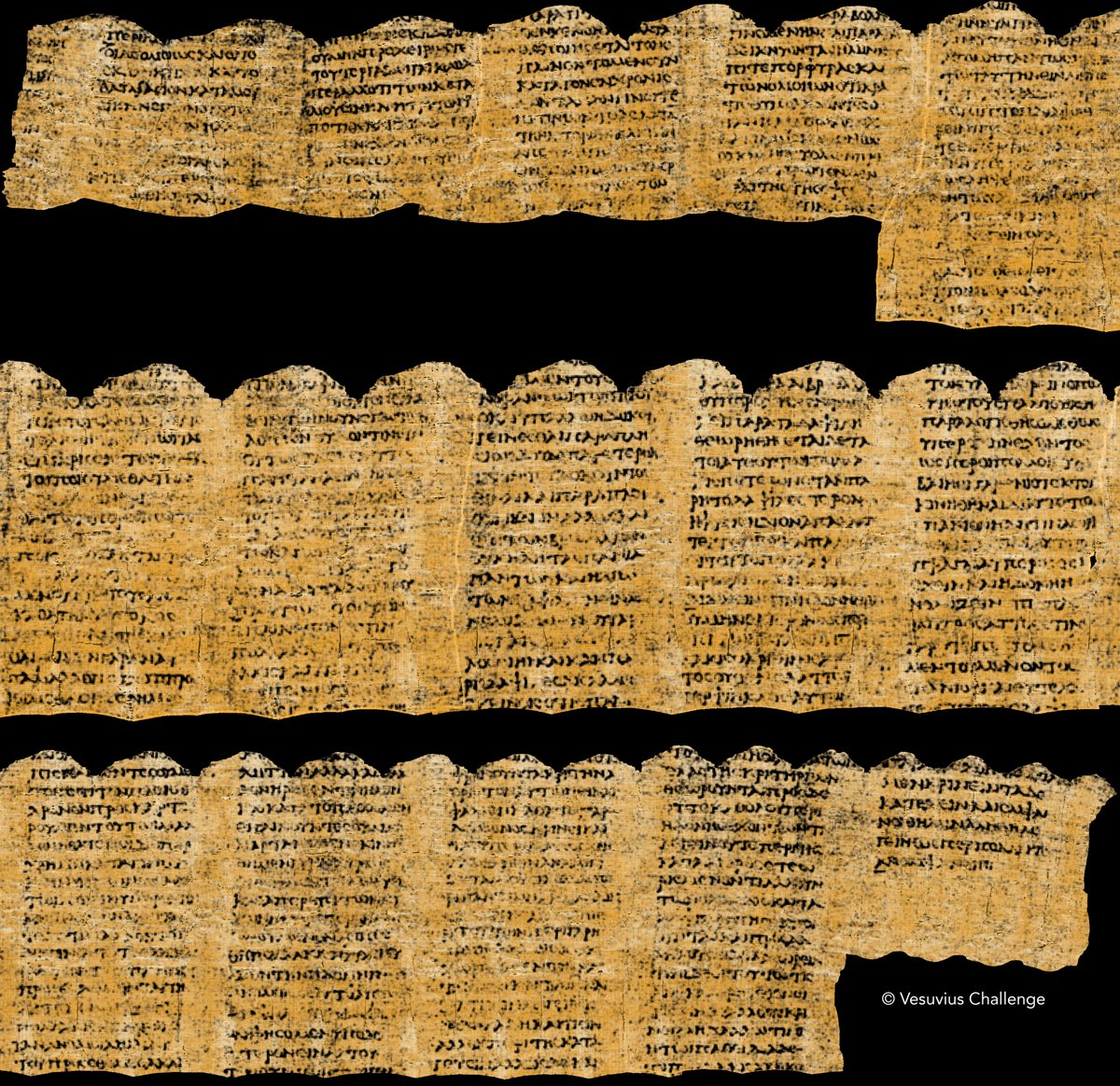
Today we are overjoyed to announce that our crazy project has succeeded. After 2000 years, we can finally read the scrolls:
This image was produced by @Youssef_M_Nader, @LukeFarritor, and @JuliSchillij, who have now won the Vesuvius Challenge Grand Prize of $700,000. Congratulations!!
These fifteen columns come from the very end of the first scroll we have been able to read and contain new text from the ancient world that has never been seen before. The author �� probably Epicurean philosopher Philodemus – writes here about music, food, and how to enjoy life's pleasures. In the closing section, he throws shade at unnamed ideological adversaries – perhaps the stoics? – who "have nothing to say about pleasure, either in general or in particular."
This year, the Vesuvius Challenge continues. The text that we revealed so far represents just 5% of one scroll.
In 2024, our goal is to from reading a few passages of text to entire scrolls, and we're announcing a new $100,000 grand prize for the first team that is able to read at least 90% of all four scrolls that we have scanned.
The scrolls stored in Naples that remain to be read represent more than 16 megabytes of ancient text. But the villa where the scrolls were found was only partially excavated, and scholars tell us that there may be thousands more scrolls underground. Our hope is that the success of the Vesuvius Challenge catalyzes the excavation of the villa, that the main library is discovered, and that whatever we find there rewrites history and inspires all of us.
It's been a great joy to work on this strange and amazing project. Thanks to Brent Seales for laying the foundation for this work over so many years, thanks to the friends and Twitter users whose donations powered our effort, and thanks to the many contestants whose contributions have made the Vesuvius Challenge successful!
Read more in our announcement: https://t.co/rUlrdGXBMs
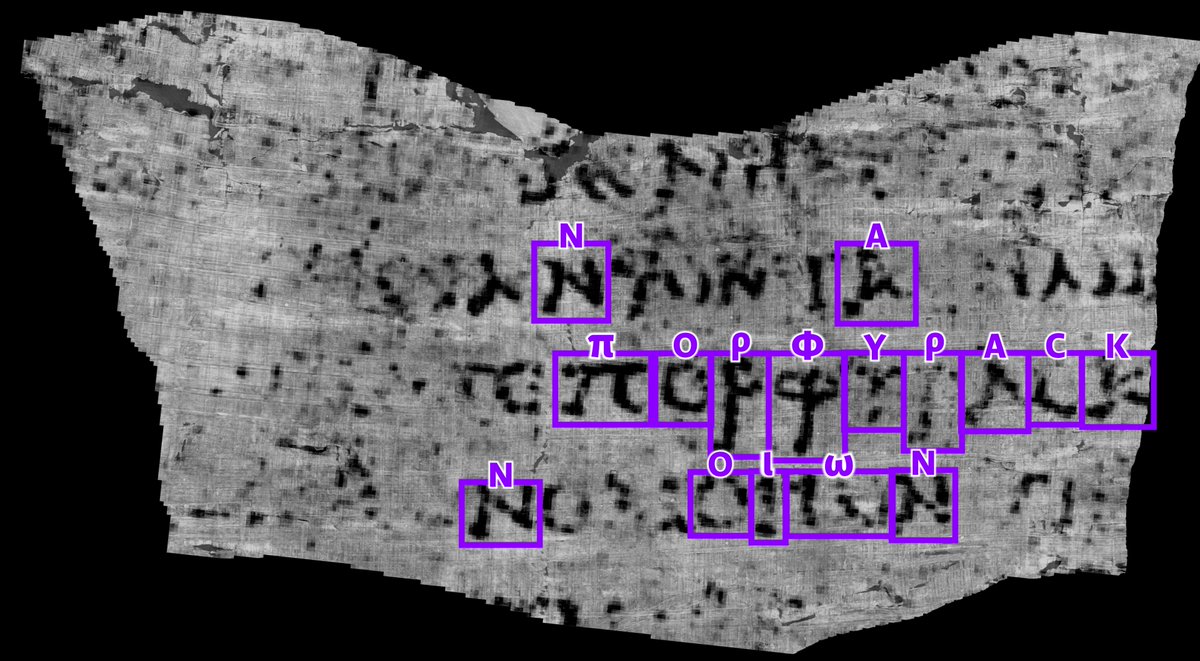
Today we are announcing a major breakthrough in the Vesuvius Challenge: we have read the first word from an unopened Herculaneum scroll.
The word is "πορφυρας" which means "purple dye" or "cloths of purple."
https://t.co/mSbHtzNbAl
Congratulations to 21yo computer science student @LukeFarritor who is the first person to see this handwriting in nearly 2000 years. He has won the $40,000 First Letters prize for this world-historical achievement.
We are also awarding a $10,000 First Ink prize to @CJHandmer who was the first person to see ink and multiple letters within an unopened scroll. His work was the basis of Luke's ML model.
And @Youssef_M_Nader has won a $10,000 second-place First Letters prize for producing the clearest and most comprehensive images from inside a scroll yet.
This has been the dream of many people since the scrolls were first discovered in the 1750s. It is also the result of 20 years of work from Dr. Brent Seales and his team at EduceLab, whose years of dedicated work have made this last mile possible.
The $700,000 Vesuvius Challenge Grand Prize is now in sight. Who will claim it?
Every week, we ask these three questions to keep us focused, make sure we're working on the right things, and make sure we actually ship.
What are you aiming to get done this week?
Specific, measurable things we want to be able to call done by the end of the week. The wording here matters — "get done" is very different from "work on". It forces you to break things down into smaller problems, and get better at sequencing work in large projects.
Sometimes it's hard to answer this question, and that's when it's most important. Weeks without a plan are the ones where you're most likely to find yourself at the end of the week telling yourself "I felt like I was busy all week but I don't have anything to show for it".
How are your projects going so far this week?
A chance to share your work in progress, talk about interesting problems you've run into so far, and step back to assess whether you're on track to meet your goals. This one really helps us all on the team feel connected to what everyone is working on, and is an awesome way to get exposed to new things and keep learning.
It's also really helpful for leadership just to know how things are going and to be able to provide any helpful direction or suggest ways to cut scope to avoid spinning our wheels.
What did you accomplish this week?
Not what did you work on, what did you get done. A chance to celebrate what we each shipped, compare our progress to what we planned at the beginning of the week, and fine-tune our own expectations of ourselves for next week.
Getting stuff done feels awesome and gives you energy, and this little piece of accountability helps us stay focused on shipping, instead of letting long, murky projects drag out forever without locking in progress at thoughtful milestones.
—
Getting serious about answering these questions every week has made my life 100x better as a leader, and as an individual contributor. Everyone on the team answers these questions (including leadership), and it gives us all so much more confidence in what we're doing.
No more feeling of "lost weeks", and so much clarity about how to get started when cracking open the computer in the morning.
@DEFCONWSALERTS Wait what? I can't find any sources and it sounds highly unlikely that Germany plans on developing nuclear weapons. I suppose that's false for Japan as well.
Working on a project just for the fun of it tends to bleed into the product
I think there's a beauty in that..
ex: had some fun with the otherwise boring "home" button in https://t.co/4erzsWay2Y