@statistics_feed Because most never get told to
In the guide the facts file lists the only facts it may state, plus one rule: if a number isn't there, write [TO CHECK]
Without that line the model fills the gap with a number
Your competitors are outranking you on Google and ChatGPT right now
This connects to your site, finds what they rank for and writes the pages built to win it back
Free to start, worth trying before they pull further ahead
@thwlf67 No AI visibility score on purpose
An AI turns a prompt into Google-style searches and cites what ranks, so the pages ranking on those queries are your signal, plus third-party lists that mention the brand
Your competitors are outranking you on Google and ChatGPT right now
This connects to your site, finds what they rank for and writes the pages built to win it back
Free to start, worth trying before they pull further ahead
Wake up.
Your competitors are above you on Google, on ChatGPT, everywhere.
Connect your site to ChatSEO: it finds what they rank for, writes the pages that win it back, and works to get you cited by the AIs.
Free to start: https://t.co/boqL2LWz76
Reply "WAKE" with your site and we'll send you a free SEO analysis 👇
@ChatSEO_app the /music part is the real lesson, a product launched this year ranking like a core page means no older page was already fighting for those keywords, so the clicks never got split
what to check on your own site before watching a live audit
1/ open Search Console, Pages report, sort by impressions to see which pages Google already tests
2/ flag business keywords with lots of impressions and few clicks, those are the quick wins, not average position
3/ read the top 3 for each target keyword, only blog posts means informational, any other page type means buyers
4/ put the target keyword word for word at the start of the title, then one promise shaped by the intent
5/ count internal links to each money page, at least 3 to 5 from same topic pages, inside the paragraph text
6/ check referring domains, under about 50 start a few free on topic links to the homepage right away
7/ skip the deep technical audit unless the site is huge, one PageSpeed test per page template is enough
8/ list the queries each page already gets clicks for before editing, so a fix never costs what already ranks
9/ after a real change wait about 90 days before judging, re-editing in that window restarts the clock
OpenAI just shipped GPT-6.2 Astra and it still doesn't know a thing about your site:
Live SERP → search volumes → your Search Console → Astra only answers after it reads all three
1 MCP + 1 file about your site = SEO answers built on your real data
Here's how it works:
First, understand the problem:
• Everyone asks the new model "how do I rank for this" the week it drops. That is the mistake. It answers from memory, and its memory has never seen your SERP
• The fix pairs Astra with live data. A tool reads Google's results, the search volumes and your Search Console, Astra only reasons on what came back
• Astra never guesses a keyword. Every keyword it suggests comes with its real volume and the pages that rank for it today
• The setup survives the next launch. When a new model ships, you change one line, not your whole stack
What the article walks through:
1 → Connect a live SERP source so Astra can read what ranks for any keyword
2 → Connect your Search Console so it sees your real clicks and impressions
3 → Write one file: your offer, your audience, the pages that already bring traffic
4 → Ask for the gaps: keywords, pages and questions your competitors cover and you don't
5 → What nobody tells you: what a chatbot says ranks and what Google actually ranks are rarely the same pages. Check the live SERP before you write a line
One brain for your site. One model for the reasoning. Nothing changes without your yes
Evens also shares the exact site file he gives Astra
then read the article below ↓
GPT-6.2 Astra est un génie amnésique
Il oublie tout de ton site dès que tu fermes le chat, et il n'a jamais vu un vrai résultat Google
Je lui ai donné un cerveau SEO en 10 minutes : le fichier exact et les 5 prompts sont dans l'article (GUIDE COMPLET) https://t.co/juHaMnbhfK
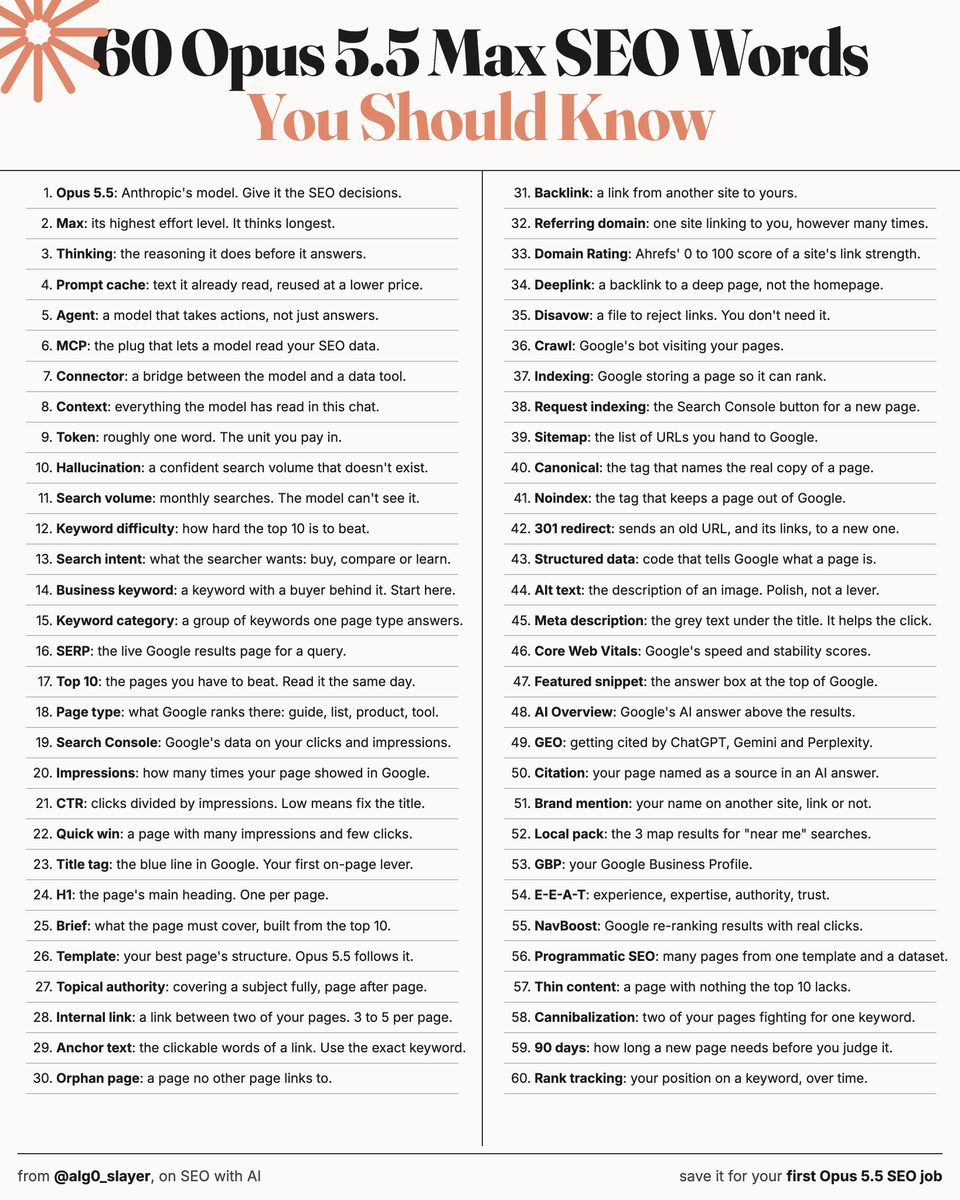
The quickest way to know if someone has actually mastered SEO with Opus 5.5 Max is by checking if they know all these 60 words:
1. The model
☑ Opus 5.5: Anthropic's model, for the SEO decisions
☑ Max: its highest effort level, it thinks longest
☑ Prompt cache: text it already read, reused at a lower price
☑ MCP: the plug that lets it read your SEO data
☑ Hallucination: a confident search volume that doesn't exist
2. Keywords
☑ Search volume: monthly searches. The model can't see it
☑ Business keyword: one with a buyer behind it
☑ Top 10: the pages you have to beat, read the same day
☑ Quick win: many impressions, few clicks
3. Pages
☑ Title tag: your first on-page lever
☑ Template: your best page's structure
☑ Internal link: 3 to 5 per new page
☑ Cannibalization: two pages fighting for one keyword
4. Links
☑ Referring domain: one site linking to you
☑ Deeplink: a backlink to a deep page
☑ Disavow: you don't need it
5. AI search
☑ AI Overview: Google's AI answer above the results
☑ GEO: getting cited by ChatGPT, Gemini and Perplexity
☑ 90 days: how long a new page needs before you judge it
The other 41 are on the card. Save it before you hand Opus 5.5 your first SEO job
before you cancel a single subscription, the boring steps that make this work
1/ export everything first, raw csv or json, while you still have the account and the api key
2/ list the 3 features you actually open every week and ignore the other 40 the vendor sells you
3/ put the data in plain files or one sqlite db the agent reads directly, no clever layer on top
4/ write a short schema doc next to it so the agent knows what each table and field means, or it guesses wrong
5/ rebuild one feature at a time and run it next to the old tool for a couple of weeks before you switch
6/ set up backups on day one, the hosted tool did that silently for you and now nobody does
7/ keep the parts you can't fake, email deliverability and payments are not weekend projects
8/ log every write the agent makes so you can see what it changed the day a number looks off
what makes those 90 days pay off, before and after the page
1/ check the top 3 first, only blog articles means informational, any product or service page means buyers
2/ pick keywords where no competitor has the exact phrase in its title, that gap tells you more than a difficulty score
3/ before writing, check the page does not already exist and which queries your pages already get clicks on, never cannibalize what ranks
4/ title opens with the keyword word for word, then one promise shaped by the intent, the year on comparison and best queries
5/ read the first page of results only, match the page type and its features (tables, quiz, reviews), not just the word count
6/ add one thing the top 3 does not have, a real screenshot, a first party number, a named author with a bio
7/ point 3 to 5 internal links at it from pages on the same topic, exact keyword anchors, inside the paragraph text
8/ on a site under 6 months old, 2 to 4 new pages a week, a flood of AI pages from nowhere is the worst signal
9/ a dip around day 20 is normal, editing during the window restarts the clock, move on to the next keyword instead
10/ at day 90 judge per page, many impressions and few clicks means the title is the next fix, not the content
@ChatSEO_app only where yours falls short" is the part people skip. rewriting a title that already earns clicks just to match the plan usually costs more than it brings back. keep what works, touch the weak sections, then give Google time before judging it
how to find what competitors take from you, and take it back
1/ list your 5 top business queries, your real competitors are whoever ranks top 3 on them, not the brands you pitch against
2/ check the page type in each top 3, only blog posts means info intent, a product or service page means people ready to buy
3/ group their pages into keyword patterns like service + city or tool A vs tool B, not one long keyword list
4/ look at their titles, when no competitor has the exact keyword in its title, that is your opening
5/ before writing, check no page of yours already targets it, and which queries that page already gets clicks for
6/ build one page by hand first, keyword first in the title, intent matched, then duplicate it from a written process
7/ point 3 to 5 internal links at it from pages on the same topic, exact keyword anchors inside the paragraph text
8/ a site under 6 months old publishes 2 to 4 pages a week, never 15 a day from nowhere
9/ on chatgpt, run 5 real prompts (best, price, review, alternative to) and note which third party lists it cites
10/ once a page is live, leave it alone about 90 days before judging it, the next move is another keyword, not another edit
The quickest way to know if someone has actually mastered SEO with Opus 5.5 Max is by checking if they know all these 60 words:
1. The model
☑ Opus 5.5: Anthropic's model, for the SEO decisions
☑ Max: its highest effort level, it thinks longest
☑ Prompt cache: text it already read, reused at a lower price
☑ MCP: the plug that lets it read your SEO data
☑ Hallucination: a confident search volume that doesn't exist
2. Keywords
☑ Search volume: monthly searches. The model can't see it
☑ Business keyword: one with a buyer behind it
☑ Top 10: the pages you have to beat, read the same day
☑ Quick win: many impressions, few clicks
3. Pages
☑ Title tag: your first on-page lever
☑ Template: your best page's structure
☑ Internal link: 3 to 5 per new page
☑ Cannibalization: two pages fighting for one keyword
4. Links
☑ Referring domain: one site linking to you
☑ Deeplink: a backlink to a deep page
☑ Disavow: you don't need it
5. AI search
☑ AI Overview: Google's AI answer above the results
☑ GEO: getting cited by ChatGPT, Gemini and Perplexity
☑ 90 days: how long a new page needs before you judge it
The other 41 are on the card. Save it before you hand Opus 5.5 your first SEO job