Haiwang Yong lives in the ultrafast lane. He uses #UltrafastSpectroscopy to observe the motion of atoms and electrons in femtoseconds. Last year, Yong received an @ENERGY award and a grant from the W.M. Keck Foundation to support his work. https://t.co/lM38Hptnyl @UCSDChemBiochem
Congrats to UC San Diego's newest Sloan Research Fellows, including @Mattia__Serra and Fleur Ferguson. The fellowships acknowledge researchers whose innovation and research accomplishments set them apart as the next generation of leaders. https://t.co/JNhmdUPlcX @SloanFoundation
A molecule has its own unmistakable tone, but the voices of single molecules are so faint that traditional infrared spectroscopy can't detect them. @UCSDChemBiochem prof Shaowei Li has found a way to hear a single molecule sing. https://t.co/6mfNRJAI01
Huge congratulations to Prof. Shaowei Li and team on their @ScienceMagazine paper! 🎉
Single-molecule infrared spectroscopy with STM captures vibrational modes with atomic precision, opening a new era in bond-specific chemistry.
@UCSanDiego@UCSDPhySci
https://t.co/vSFNnruxmo
🔋 New work from @KentJGriffith reveals lithium and sodium intercalation with multielectron redox in vacancy-ordered and vacancy-disordered cation-deficient materials, advancing our understanding of next-generation electrodes.
@UCSanDiego@UCSDPhySci
https://t.co/Axve0bz8ow
🚨 New paper out in @JPhysChem Lett.! 🚨
We are excited to share our latest work:
👉 https://t.co/yvJVGgQet3
Interfacial #water behaves very differently from bulk #water. 🌊 At charged interfaces, interpreting vibrational sum-frequency generation (#vSFG) spectra becomes particularly challenging. ⚡️ The key question is:
🤔 What is truly “surface-specific” (χ²), and what originates from bulk field-induced contributions (χ³)?
In this study, we combine:
✅ Our #datadriven #manybody MB-pol potential
✅ Temperature-elevated path-integral coarse-graining (Te-PIGS) to include #NuclearQuantumEffects
✅ Layer-resolved heterodyne-detected #vSFG simulations to provide a molecular-level separation of χ² and χ³ contributions at charged graphene oxide/water (#GO/#water) interfaces
Our findings:
🎯 The prominent ~3200 cm⁻¹ band observed experimentally is not primarily surface-specific. It is dominated by field-induced bulk χ³ mixing associated with the electrical double layer.
🎯 In contrast, the strictly interfacial structure is encoded in χ².
🎯 This explicit χ²/χ³ decomposition clarifies how surface and bulk responses combine to shape measured #vSFG spectra at charged aqueous interfaces.
Beyond #GO, this framework provides a general strategy to interpret vibrational spectra at charged and nanoconfined aqueous interfaces, with implications for:
• Membrane science
• Electrochemical systems
• Sensing platforms
• Interfacial reactivity
Congratulations to #Toheeb and #Richa for leading this exciting collaboration between our groups at @UCSanDiego and @LSU! 🙌
Excited to see how heterodyne #vSFG experiments will further test these predictions. 🚀
@UCSDPhySci@UCSDChemBiochem@HDSIUCSD@SDSC_UCSD@LSU_Chemistry
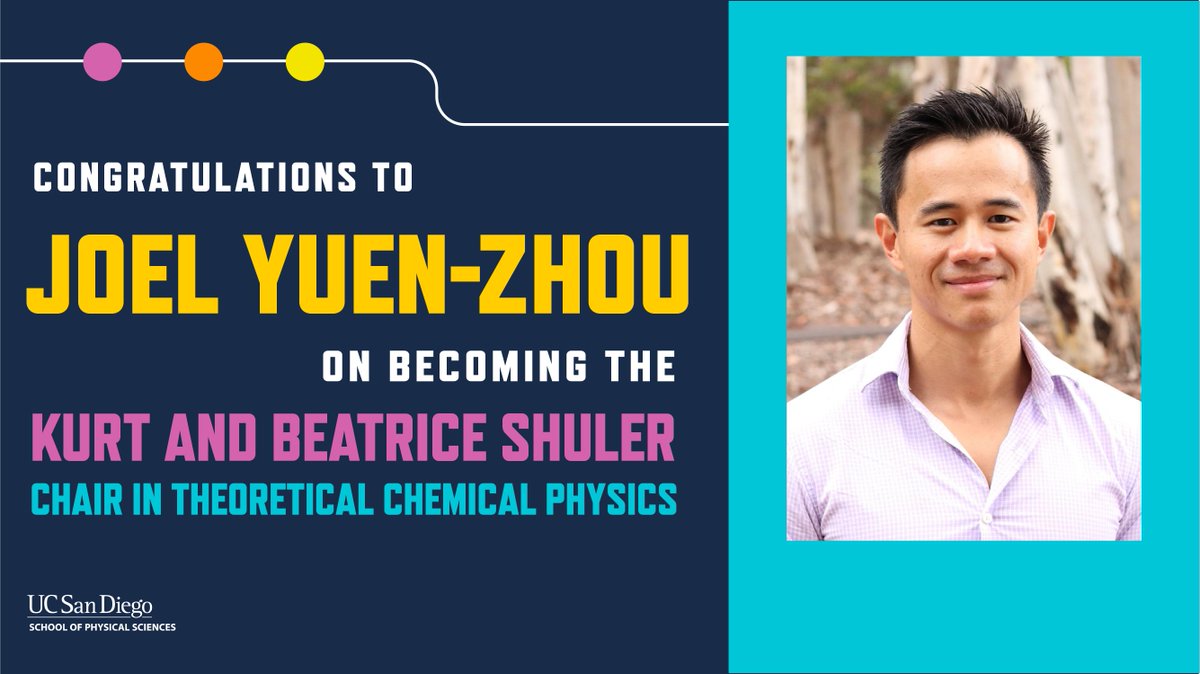
Congratulations to @UCSDChemBiochem Professor Joel Yuen-Zhou on being appointed the inaugural Kurt and Beatrice Shuler Chair in Theoretical Chemical Physics. Learn more about Joel in this Q&A: https://t.co/f7odCpMGe0 @ucsd_yuen#FacultySpotlight#TheoreticalPhysics
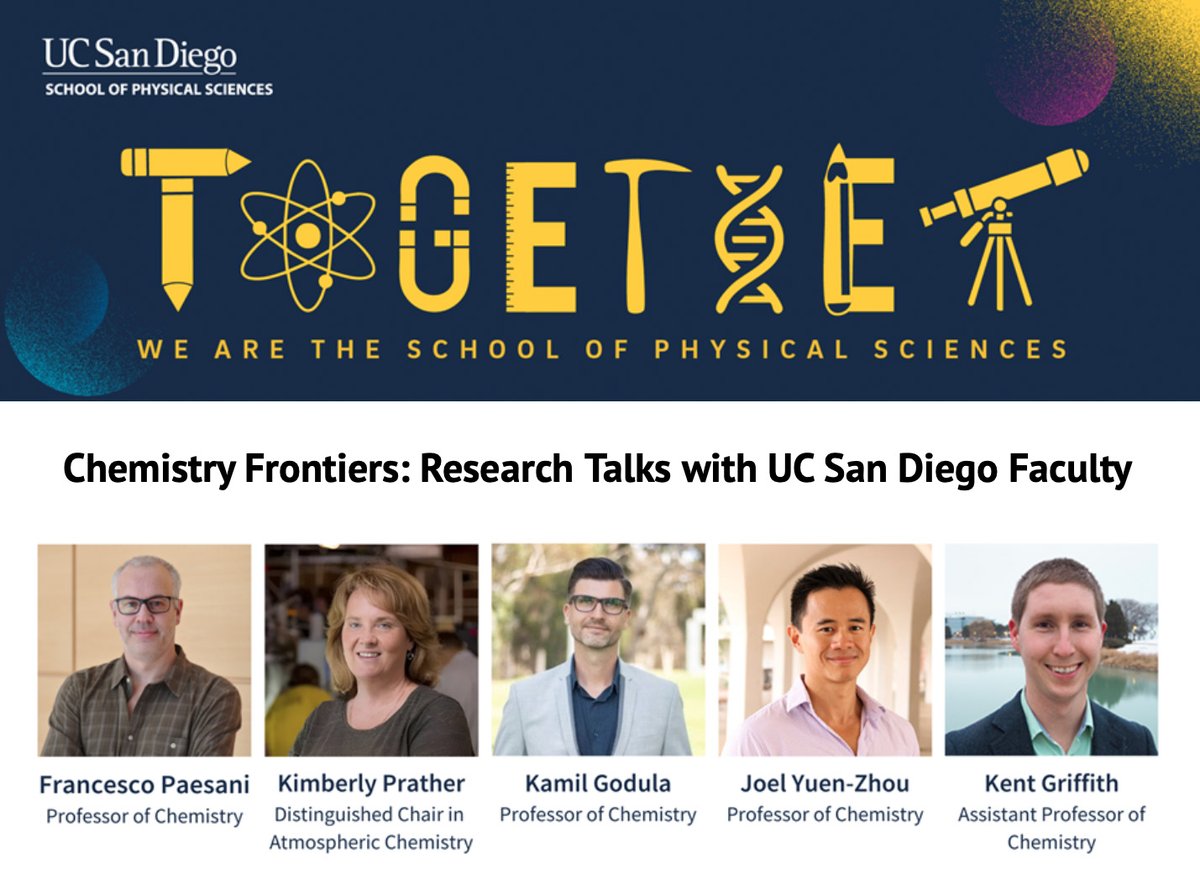
Join UC San Diego's @UCSDChemBiochem on Feb. 25 for a virtual coffee chat showcasing the breadth and impact of our research. From atmospheric chemistry to quantum science and everything in between--we do it all! Register today: https://t.co/TLIRA6RQ5Z
🔋@Tech_Networks quotes Prof. Kent Griffith on why low-field solid-state NMR with fast spinning is ideal for paramagnetic battery materials and enables measurements that high-field methods struggle to access. 🔬⚡
@UCSanDiego@UCSDPhySci
https://t.co/JoCB5bnqus
💡 New @J_A_C_S from the Romero Group (@R2G_UCSD): visible light drives “cut-and-paste” functional-group transposition in chalcones (against thermodynamics!) to reach transposed 1,2-diaryl enones. Uphill chemistry, made easy. 😎
@UCSanDiego@UCSDPhySci https://t.co/wTZxQLPqwB
Distinguished Professor Kim Prather (@kprather88) testified before the CA Senate on new #TijuanaRiver evidence: airborne toxics impacting #SouthBay communities. 🫧 Proud of her team for elevating this crisis statewide. 🚨
Watch: https://t.co/t6iYAPhUhs
@UCSanDiego@UCSDPhySci
Huge congratulations to Prof. Julia Stauber on receiving a prestigious @NIH MIRA award for her project “Precision, Functional Glyconanoassemblies through Supramolecular Design”! Stay tuned for more exciting science!
@UCSanDiego@UCSDPhySci
Congratulations to Prof. Joshua Figueroa, recipient of the 2026 F. Albert Cotton Award in Synthetic Inorganic Chemistry from @AmerChemSociety! This prestigious ACS National Award recognizes his groundbreaking contributions to organometallic chemistry.
@UCSanDiego@UCSDPhySci
Congratulations to Prof. Akif Tezcan, recipient of the 2026 Alfred Bader Award in Bioinorganic or Bioorganic Chemistry from @AmerChemSociety! This prestigious ACS National Award recognizes his pioneering research at the interface of chemistry and biology.
@UCSanDiego@UCSDPhySci
🙌Thank you to all #ACIN participants for sharing your research and being part of the progress towards a sustainable future!
🏆Congratulations to the Poster Prize winners!
As the American Conference on Inorganic Nanoscience concludes, we celebrate a week of discoveries, discussions, and collaborations. Thanks to all participants for advancing the frontier of nanomaterials and inspiring the future of inorganic nanoscience.
📸A remarkable gathering at the inaugural American Conference on Inorganic Nanoscience #ACIN in Vermont
👉A week of discoveries,deep discussions and community building driving innovation in quantum dots,nanomaterials & the future of inorganic nanoscience
https://t.co/VWjGRNHEeR
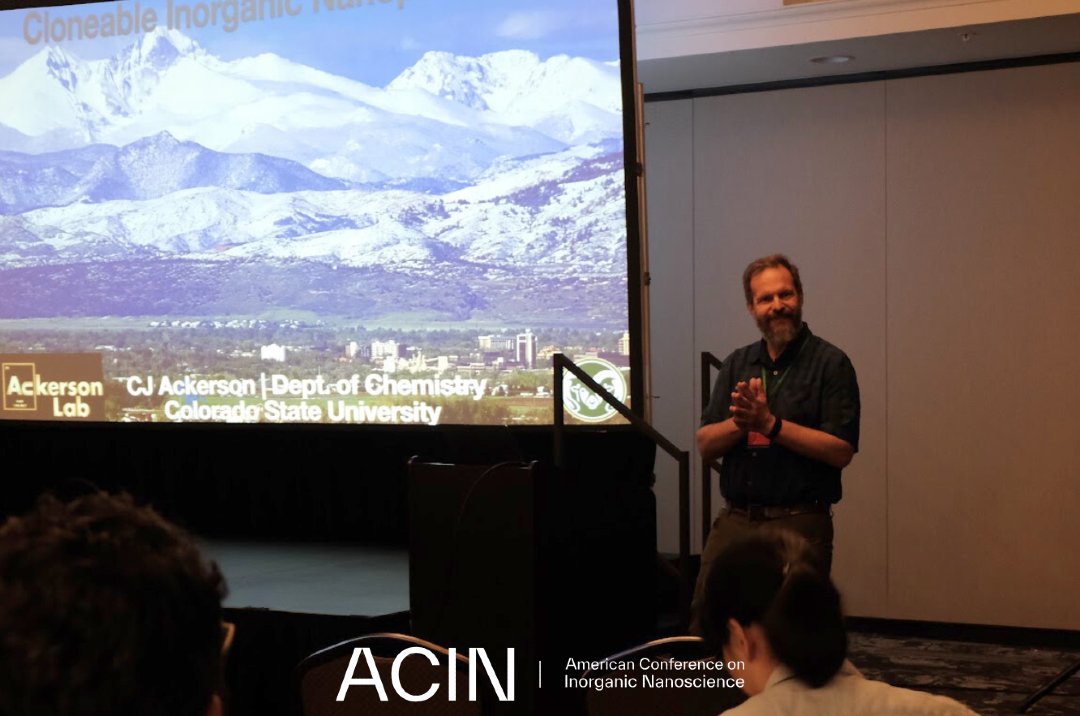
At #ACIN, experts discuss precision synthesis of semiconductor nanoclusters, surface chemistry of porous nanomaterials, and cloneable inorganic nanoparticles, pushing boundaries in inorganic nanoscience.
👉 https://t.co/VWjGRNHEeR