SGLang pays special attention to fair, rigorous, and reproducible comparisons.
We’ve seen prefill comparisons that put GB300 results alongside DeepInfer’s published B300 numbers. Comparing across different hardware and parallelism configurations makes it difficult to isolate improvements from the inference engine itself.
We reran DeepInfer on both B300 and GB300. On our B300 hardware, it achieved higher prefill throughput than its published results at several configurations. We used its fastest tested configuration at each point as our baseline, with both engines on the same hardware and matching DP/EP configurations.
Against this stronger baseline, SGLang matches or exceeds DeepInfer’s prefill performance. We provide full reproduction details, including the remaining methodological differences, and plan to submit to AgentX soon.
DeepInfer deserves full credit. Fair comparisons and verifiable results should be the standard across the community.
BREAKING NEWS🚨🚨: TODAY META CONFIRMS THEY ARE RUNNING TPU INFERENCE IN PRODUCTION. What does this mean for the CUDA moat?
For those who read our public newsletter, this is not a surprise, as on Nov 28, 2025, we publicly wrote that Meta is a TPU customer & has lots of engineers working on TPUs. Our accelerator supply chain model has details about Meta's TPU procurement!
Muse Spark Open is built to plan, act, and use computer across agentic tasks for life and work.
You can now build a powerful personal AI agent with an open stack, and SGLang to make it:
- Ultra-responsive with NVFP4 MegaMoE and sequence parallelism
- Faster for agentic and coding tasks with our DFlash2 draft model
- Customizable for specialized use cases via fine-tuning with Miles
We’re incredibly proud to have made this possible with @AIatMeta, @NVIDIAAI, @AIatAMD, @intel, and @radixark!
The full technical report for Miles is now available.
Miles is built for production-level post-training, with stability, efficiency, and flexibility at its core. The report covers its system design and how it works in practice.
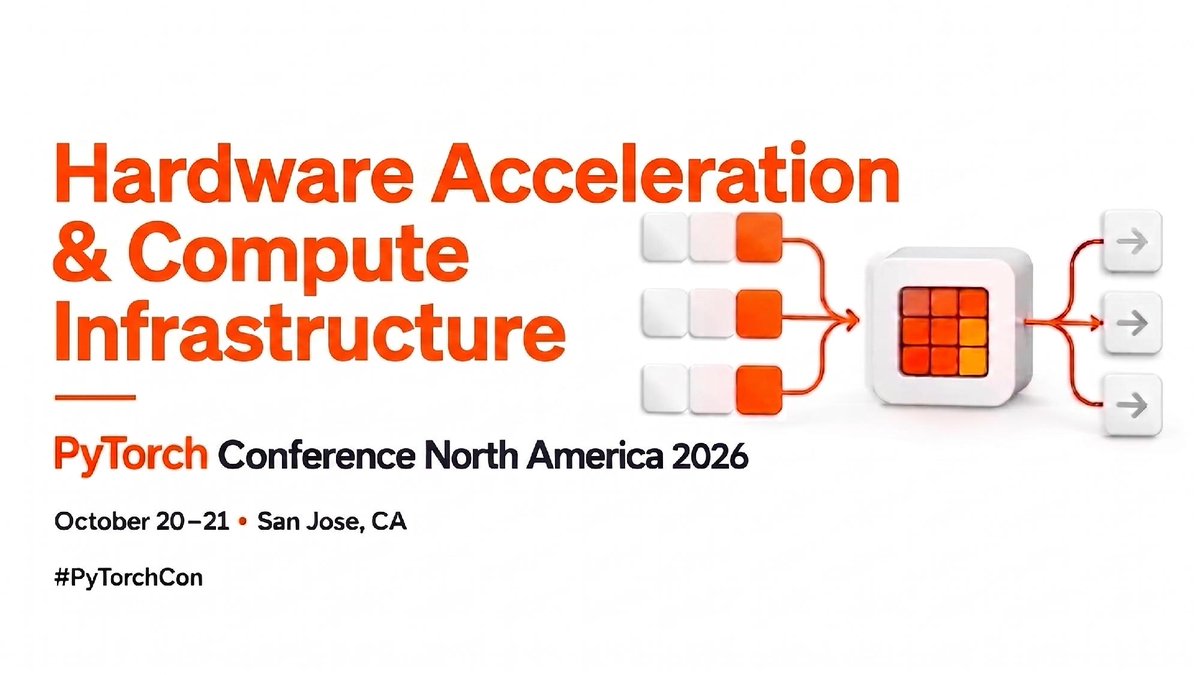
Hardware heterogeneity is no longer an edge case - it is the default.
Join us at PyTorch Conference North America 2026 (Oct 20–21, San Jose) for deep dives into kernel engineering, custom compiler backends, and performance optimization across GPUs, TPUs, NPUs, and custom ASICs.
Featured speakers include:
@AWS / AWS Annapurna Labs / Annapurna ML: Maen Suleiman, Yahav Biran, Esha Lakhotia, Pinak Panigrahi
@Arm: Kavya Sri Chennoju, Thomas Cottenier
@Google: Sandeep Pokkunuri, Chris Jones, Rob Mulla, Claudio Basile
@Huawei: Jiahao Chen, Jiahao Tan
@huggingface: Michael Benayoun
@IBM/ @IBMResearch: Takeshi Yoshimura, Olivier Tardieu, Matthew Arnold, Thomas Parnell, Prasanth Chatarasi, Bardia Mahjour, Viji Srinivasan, David Grove, Antoni Viros Martin, Avery Blanchard
@intel: Yu Guangye, Eikan Wang, Panagiotis Kourdis, Tanima Dey, Huma Abidi, Ashok Emani, Qiacheng Li
@Meta: Richard Zou, Mergen Nachin, Digant Desai
@RedHat: Markell Rawls
Beijing Academy of Artificial Intelligence: Yonghua Lin
@Fujitsu_Global / Fujitsu Research of India: Abhishek Jain, N Maajid Khan
Register here and stay for AGNTCon + MCPCon that same week: https://t.co/1USn92lIA5
Read the Hardware Acceleration & Compute Infrastructure Sessions guide: https://t.co/0rXkJ6dgwz
#PyTorchCon
@qubitium SGL has been working on a fast recovery framework and we are working very hard on further productioning this! take a look: https://t.co/GrZsWnA66n