This work is now officially out in @SfNJournals where we show that the language representations in the cerebellum seem to be exclusively conceptual semantic information. https://t.co/5mGWTTHU7n
Excited to share this work from @AmandaLeBel3 on a detailed breakdown of language representations in the cerebellum! Take-away 1: it represents language! But data are consistent with cerebellum ONLY representing the HIGHEST-LEVEL, MOST CONCEPTUAL aspects of language.
Check out our paper ‘Ignoring the cerebellum is hindering progress in neuroscience’ in @TrendsCognSci! With @BangjieWang and @AmandaLeBel3 we quantify the extent of cerebellar exclusion in the neuroimaging literature and discuss reasons/fixes https://t.co/EdnSlha1T3 🧵⬇️
The best part of collaborations is hosting amazing scientists like @AmandaLeBel3 and having an excuse to get a tex-mex lab dinner. Thanks @gallantlab and @ivryrich for sharing her!
Human neurons are incredibly complex and Purkinje cells are, by far, the largest in our brain. We give a detailed characterization of their dendrite and spine morphology and distribution across cerebellar regions compared with mouse. Check it out!
I don’t think I’ve ever stayed up til 2 am multiple nights in a row to just excitedly discuss all of the interesting perspectives and opinions from a conference before. Thanks so much to all of the organizers!
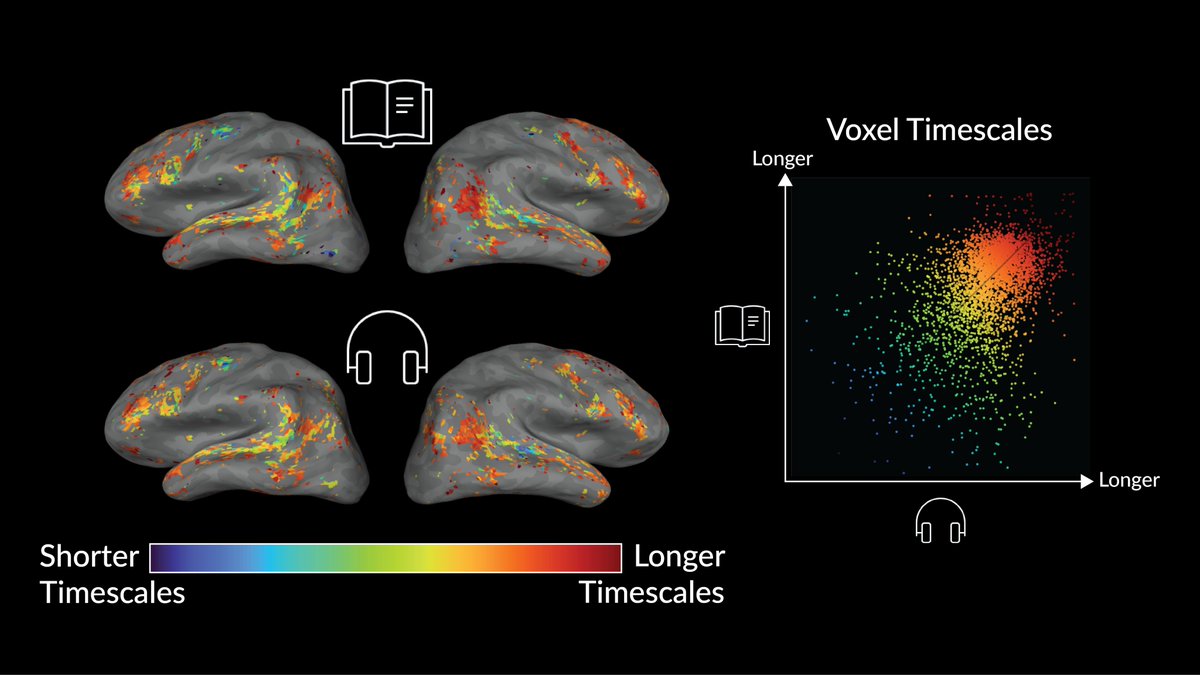
Do brain representations of language depend on whether the inputs are pixels or sounds?
Our @CommsBio paper studies this question from the perspective of language timescales. We find that representations are highly similar between modalities! https://t.co/xVaMHKcCOi
1/8
I’ll be presenting this work at the #NeurIPS2023 5pm poster session on Wednesday — come by to chat about the relationship between language and vision in the brain!
Four days left to donate! All funds raised will provide research opportunities for underrepresented students to get one on mentoring on a research project. Learn more about the program by visiting the fundraising page!
@alex_ander Yes I wonder if this could be due to the fact that in most language studies the whole cerebellum is not included in the field of view so the meta data might be missing the more traditional semantic cerebellar regions in posterior crus I and crus II
If JT’s mentorship of undergraduate students and his peers is indicative of his potential as a PI, then his future graduate students are going to be really lucky to work with him
I am recruiting PhD students & postdocs at @CarnegieMellon as an assistant professor in #Psychology for fall 2024!
Looking for folks passionate about motor learning - the way we acquire, adapt, and retain skilled movements.
https://t.co/ahxGWuYvSd
Want to know more about the cerebellum’s involvement in language? 🧐 🧠Check out our new review, written with the incredible @AmandaLeBel3, out now in Current Opinions in Behavioral Science. https://t.co/mCeq9KJNyX
And thanks again to @aniladmello for inviting me to help write this and hopefully heres to more collaborations figuring out what exactly the cerebellum is doing
I am super excited to share my new review paper cowritten with the great @aniladmello where we cover all the recent work on the potential role of the cerebellum in language processing (hint think semantics) https://t.co/AFa0037bMb
I am really excited in how functional cerebellar work can integrate some of the current research on variability in the cerebellar cellular circuit to come up with better models on what exactly the cerebellum is doing in these cognitive tasks like language