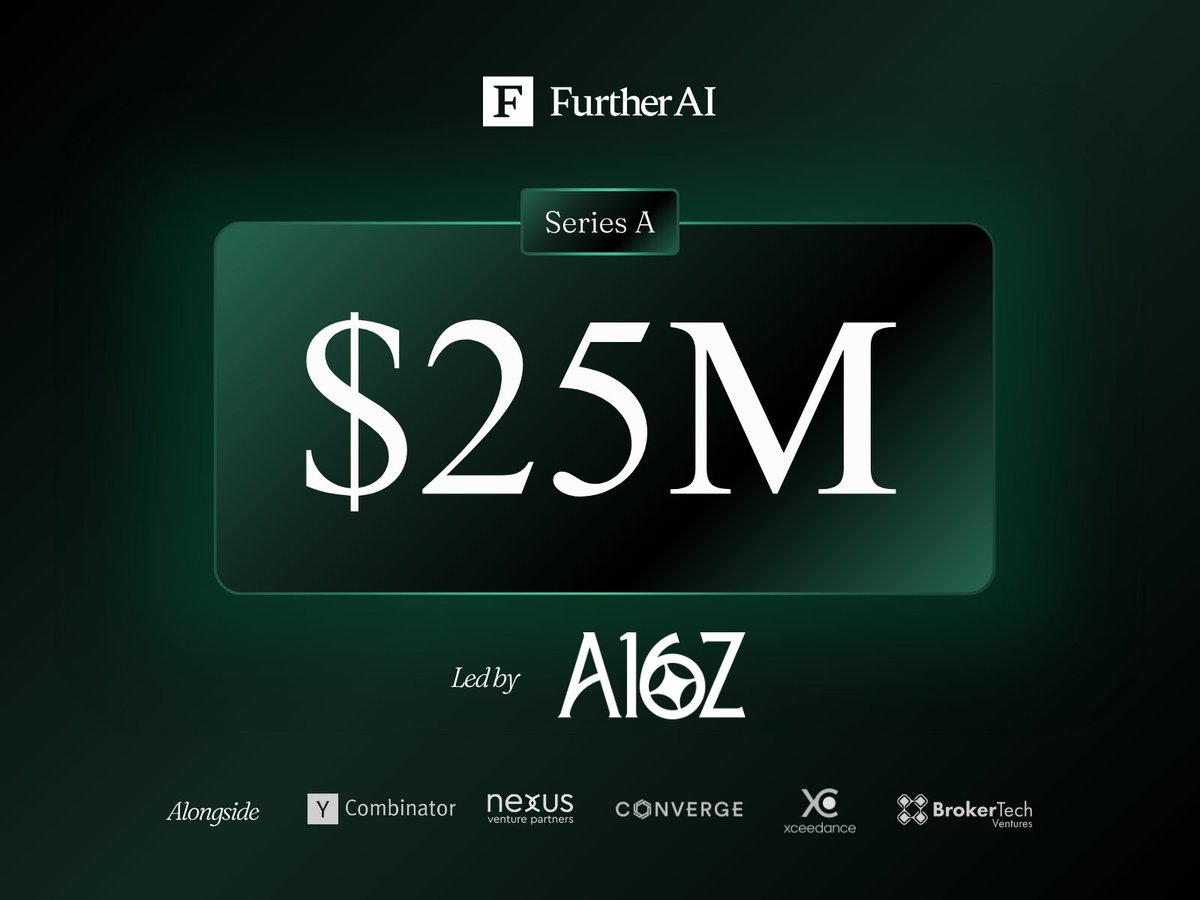
Announcing @furtheraicom's $25M Series A led by @a16z!
When we signed the term sheet, the initial excitement quickly turned into a different feeling.
A feeling of responsibility.
Responsibility to insurance industry — to automate the busy work.
Responsibility to our investors who trusted us with one of the biggest Series A rounds in insurance AI.
Responsibility to FurtherAI team that’s giving it everything, every single day.
Over the last 18 months, we’ve sat side-by-side with underwriters, brokers, and claims teams - watching how much time gets stolen by busywork.
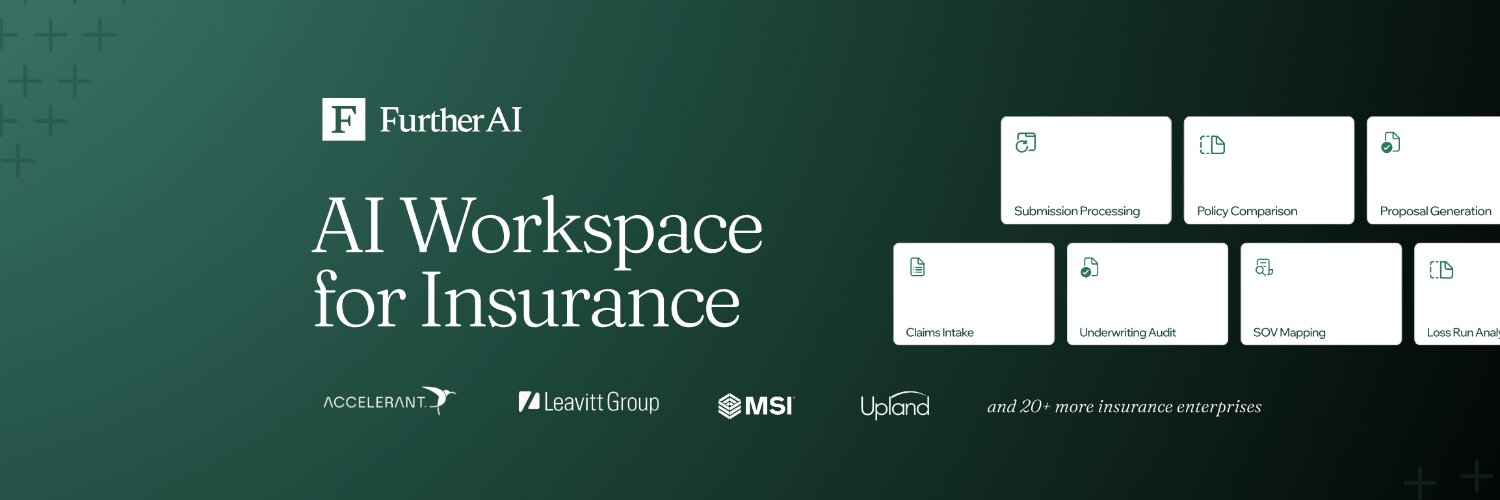
Today, FurtherAI is live with leading carriers, MGAs, and brokers automating workflows like submissions processing, underwriting audit, claims intake and many more.
This raise is about more insurance teams get their time back and enterprises to generate real value with AI.
Our job is simple:
– Make our customers incredibly successful
– Build a launchpad for every team member’s growth
– Keep pushing the insurance AI category forward
Incredibly grateful to all the people who’ve shaped the product, challenged our ideas, and helped us get here.
Thank you to @joeschmidtiv and Angela Strange for trusting us with this responsibility and to our existing investors for doubling down on our mission.
Further 🚀
Aman & @sgondala2
cc: @NexusVP, @XceedanceGlobal, @BrokerTechVen, @southpkcommons, @Converge, @pioneer_fund, @ycombinator and others!
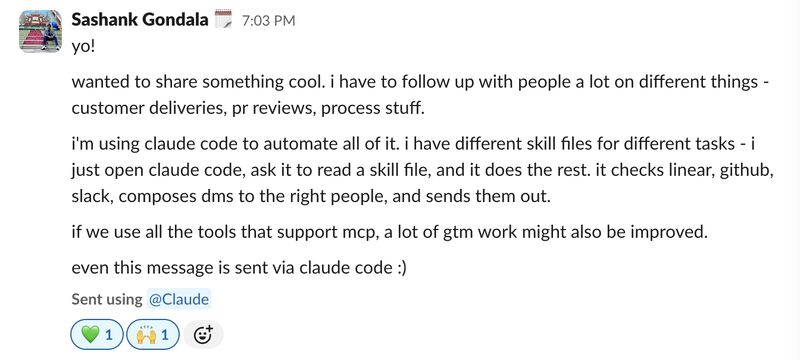
We've built out internal versions of this (Sherlock and Poirot) few months ago, and they've become a huge force multiplier across the company.
Engineers use them for triage, debugging, and code generation.
What's been more surprising is the adoption across non-technical teams. People use them to understand product behavior, answer questions about usage, pull billing metrics, and explore how different features are being used.
Turns out tagging an agent in Slack is a surprisingly natural interface for getting work done.
We are excited to officially announce the opening of our New York office. 🗽
We couldn't be more excited about what this means for our team and the trusted partners we serve.
New York is where some of the most complex, high-stakes decisions in financial services, insurance, and enterprise get made every day. Being here puts us closer to our customers and closer to the problems we exist to solve.
We're building out our NYC team across go-to-market, deployments, and customer success. If you're based in New York and want to help build something meaningful, we'd love to hear from you.
SF was just the beginning.
Let’s go Further, NYC.
Today we're launching Eval Studio — a test bench for AI workflows in insurance.
Every few months a new model lands. Every time one does, the same question hits every team running AI in production: does everything still work?
The honest answer, until now, was: we'll find out.
We compiled the rest of the lessons on building scalable AI architecture into a detailed blog.
Thank you Arron for being generous with your time, and Insurtech Insights for the opportunity.
https://t.co/xCxlwgcrNl
What's holding back large-scale AI deployments?
The short answer: Architecture.
At @ITI_Insurtech, we dug into this topic with Arron Lamp CIO of @TMHCCInt's Public Risk Group - one of the hardest environments in insurance to deploy AI at scale:
↳ 15 lines of business
↳ Large, complex, unusual risks
↳ Policies that are public, so every decision gets scrutinized
If you can make AI work here, you can make it work practically anywhere.
Something he said stuck with me: "𝗜 𝘄𝗮𝗻𝘁 𝘁𝗼 𝗿𝗲𝗻𝘁 @furtheraicom, 𝗻𝗼𝘁 𝗯𝘂𝘆 FurtherAI."
It's a whole philosophy.
Don't burn time rebuilding what you can buy. Invest in your real value — your data and your business logic — and partner with the best to do the rest. Then keep the partner earning it: more accuracy, less cost, every year.
If you work in the software industry and have time to read only one long-form post today, read this one.
If you have time to read two, read this one twice.
Highly #recommend
tl;dr: Stay off the yellow brick road that the frontier model companies are racing down. There is plenty of opportunity to solve hard problems elsewhere. Focus on areas where you can build the system of work (workflows), capture compounding, non-public data and deliver deterministic outcomes that customers need.
Insurance is one of the world's most complex data environments, and what we're building is fundamentally an AI problem.
Here's some of the hard technical challenges we are solving at @furtheraicom 🧵
Today, we're announcing the first AI orchestration layer built for insurance.
Historically, insurance software was built one function at a time — underwriting had its system, claims had its system. Cross-functional automation was too expensive and too complex to build.
AI removes that ceiling.
Agents can now work across segments, carry context between workflows, and run processes that simply weren't buildable before.
One orchestration layer, for every insurance team — carriers, brokers, MGAs, and claims teams.
We're @furtheraicom.
Today we’re announcing our collaboration with @OpenAI.
We worked with OpenAI on their new Agents SDK. Specifically on processing complex and sometimes 900+ page-long loss run documents. These are files that crashed other frontier models and harnesses we tested.
With the new SDK, we’re now extracting information across the full document at consistent accuracy, no matter the length. This is already live for @furtheraicom customers.
Insurance is the hardest document domain we’ve seen. Getting this to work at production quality takes real domain expertise and real collaboration with the model labs.
If this interests you, join us!
Full details in the link below.
We went from 80% to 95% row count accuracy on one of the hardest problems in insurance.
Not by improving the extraction model but by building an agent that checks its own work and keeps going until the numbers match.
Loss runs are the "credit reports" of commercial insurance. Hundreds of carriers, no two formats alike, 30+ fields per claim, documents that can span 200 pages. Every extraction pipeline we tried hit a ceiling.
The thing that actually worked was a self-correcting loop. Extract, validate against the document's own totals, investigate mismatches, and iterate until everything lines up. A 10-line validation function outperformed weeks of prompt engineering.
This is @furtheraicom 's first engineering blog post.
Here we share our full architecture, agent transcripts, and what we learned throughout the journey.
Link in comments.
It was surreal to interview at the New York Stock Exchange.
When we started @furtheraicom, we knew nothing about insurance. But we believed it would be one of the biggest real-world applications of AI.
Our thesis was simple:
• go deep in one industry
• know it better than anyone
• automate the work slowing it down
That focus helped us raise a $25M Series A in 7 days.
AI agents aren’t hypothetical anymore — they’re entering insurance workflows today.
Grateful to the partners who bet on us early.
Speed matters in AI, but focus and trust still win 🦾
Catch #theCUBE + @NYSE Wired’s @GemmaAllenSays with CEO @amangour30 on how @furtheraicom closed a $30M #SeriesA in just 7 days.
His take: in the age of AI, execution and the people you bet on matter more than ever.
💡Get more insights on https://t.co/sfU9Z71QuU!
https://t.co/iKMhJqEdMv
#AI #Startups #VentureCapital #EnterpriseAI
/@furtheraicom on The Agentic List 2026.
Selected "Most Loved by Industry Executives"
Insurance keeps the world running. We're making it faster, smarter, and cheaper with AI.
Congrats to the other companies on the list —
@harvey, @Tennr, @hebbia, and more.
We're hiring if you want to build with us!
At @furtheraicom, we think about this constantly.
Why force users through rigid screens when they could just talk to the system in natural language to get the job done?
The era of low-UI software is here.
We're building for it.
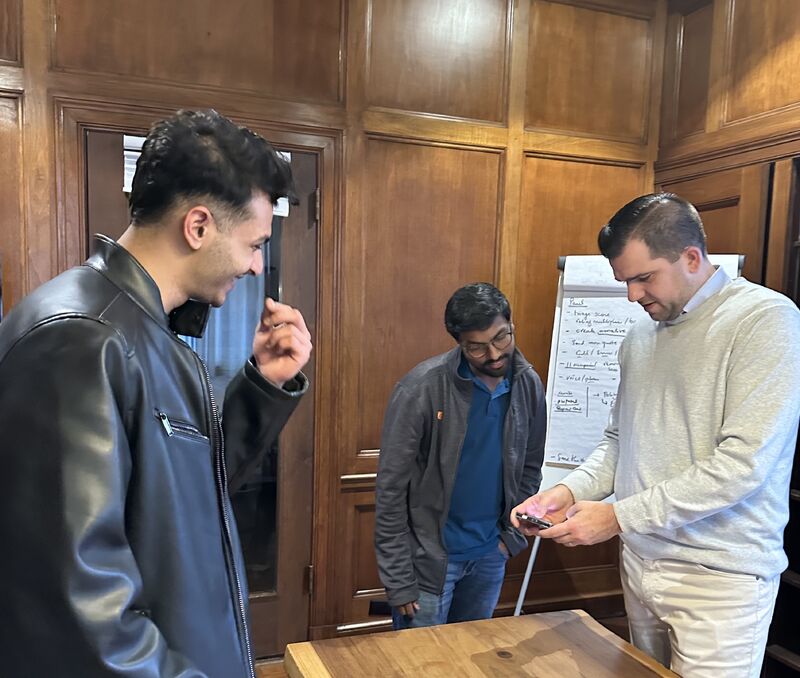
Thank you Paul for the visit and insights - excited about our partnership!
Something interesting happened...
A senior leader at a fast-growing MGA (with over $100M in GWP) told us he was using FurtherAI on his phone during a flight to San Francisco.
Here's the thing: we haven't even optimized FurtherAI for mobile yet.
This says something bigger about where enterprise software is heading.
For decades, we've been building complex tools - Workday, Salesforce, and the like - with dense interfaces that require training, change management, and constant data entry.
That's changing.
The entire interface is getting compressed into a conversation.
Instead of pre-built screens you have to learn and navigate, the UI is generated on the fly based on what you actually need.
The market sees it too.
Traders are calling it the "SaaSpocalypse."
Even companies beating earnings are getting punished (Jan 29, 2026):
🔻 Salesforce down 40% from its highs
🔻 Workday down 35%
🔻 HubSpot down over 60%
It seems like a repricing of what enterprise software should look like.