[Writing this in a personal capacity, not on behalf of my employer (Anthropic).]
Jacob’s thread is very worth reading. Here’s my birds-eye view of the situation with risks from AI:
1. AI developers believe their technology could cause human extinction (or similarly bad outcomes). This could happen in the next few years. In general, the more senior the employee, the more concerned they are.
2. Why do AI developers continue despite the risk? Due to a mixture of commercial incentives and a belief that they are in a race with other, less responsible AI developers that will abuse the technology or develop it less safely.
3. Unlike traditional software, we can’t “program” AIs to behave how we’d like. AIs frequently severely misbehave. For instance, AIs from multiple developers recently hacked their way out of secure evaluation environments and into real-world companies, even though no one asked them to do this.
4. We have methods that can nudge AIs towards better behavior, but nothing that can robustly align them. Insofar as there is a plan, it’s to make sure that AIs are good enough at alignment training that they can align their successors better than we can align current AIs.
5. Many AI developer staff desperately want to slow down to figure out how to build AI more safely. That was the intent of this open letter (which I signed): https://t.co/TZOm3LfptY
I work on safety research at Anthropic because I hope my work will reduce the chance of these extinction-level bad outcomes.
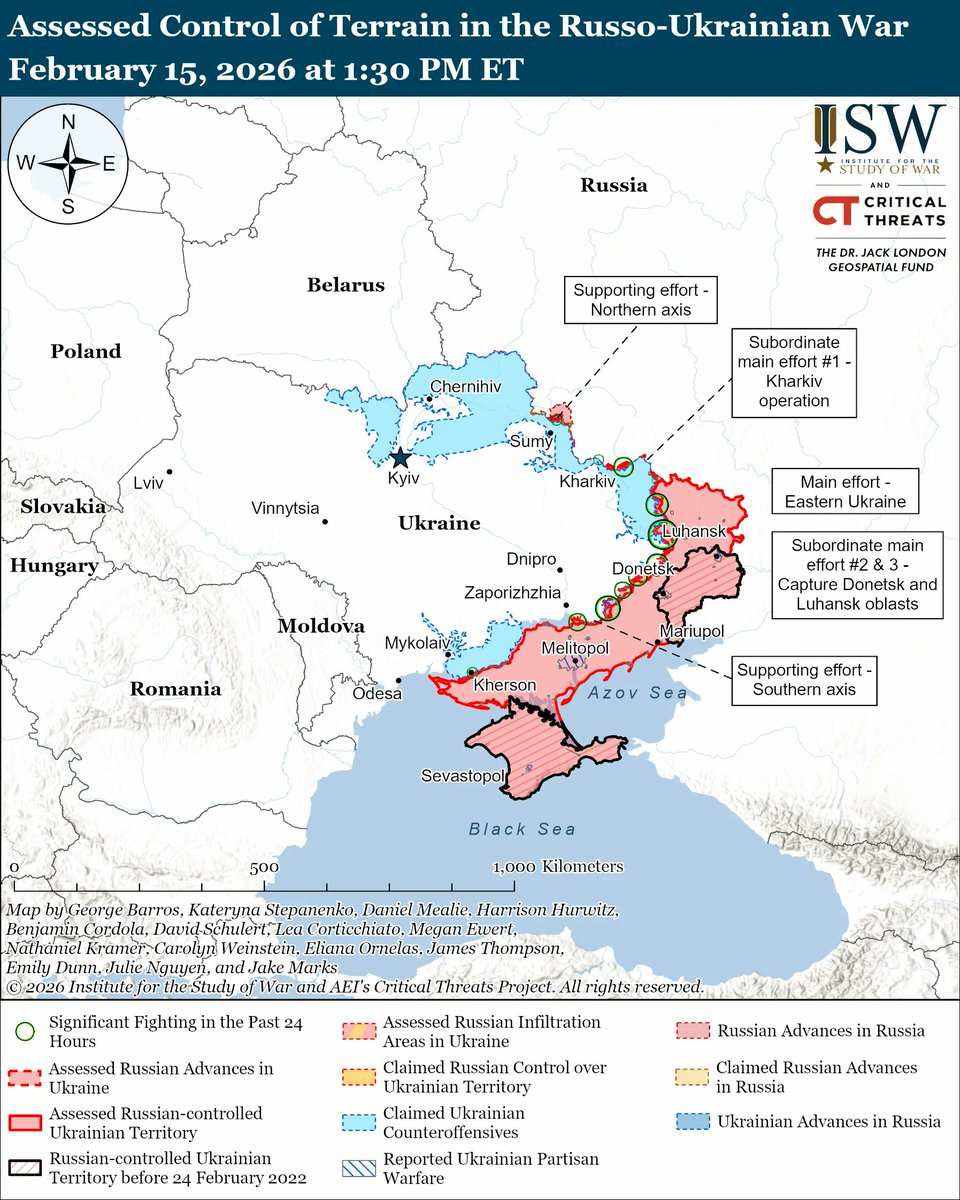
Russia’s long-term goal is to occupy all of Ukraine, and Russian officials have repeatedly attempted to justify Russia’s territorial expansion in the face of pressure to negotiate a peace settlement. ⬇️
Kremlin rhetoric and Russia’s efforts on the battlefield indicate that Russia’s objectives extend beyond simply controlling territory in Donbas (Donetsk and Luhansk oblasts).
Russian forces are currently conducting offensive operations across the entire frontline, rather than focusing their efforts on seizing the rest of Donetsk Oblast. ISW observed a report that the Russian military command is also preparing for a possible summer 2026 offensive in Zaporizhia Oblast.
Kremlin officials often claim that all of Zaporizhia and Kherson oblasts are part of the Russian Federation and that Russia intends for areas of occupied Kharkiv Oblast to act as a “buffer zone” to protect occupied Luhansk Oblast.
The Kremlin has also demonstrated its commitment to its original war aims, including the replacement of the current Ukrainian government with a pro-Russian puppet government that would grant Russia political control over Ukraine even if Russia does not physically control all of its territory.
Consistent Kremlin rhetoric about Russia’s commitment to its original war aims, particularly statements aimed at domestic audiences in Russia, demonstrates that the Kremlin is not preparing Russian society to give up on these original goals.
The Kremlin’s repeated rejections of meaningful Western security guarantees for Ukraine aim to set conditions for Russia to renew its aggression in the future at a time of its choosing in pursuit of these wider, long-term goals.
NEW | Syrian Government Operations in Kobani: The Syrian government surrounded Syrian Democratic Forces (SDF) fighters in Kobani, likely as the first part of a multi-stage operation to reduce the SDF forces there. The next phases of this operation may include the opening of an evacuation route to enable civilians to leave before the main assault.
Syrian Government Violence Against Civilians: Government forces operating in northeastern Syria have committed isolated violations against local populations, which could trigger the resumption of intense fighting between Kurdish and government forces or broader ethnic violence. The Military Security and Police Command at the Ministry of Defense acknowledged on January 20 that its fighters had committed violations during the last week, so fighting “despite the clear directives and instructions that were circulated to all relevant units and entities.”
SDF-US Discussions: SDF Commander Mazloum Abdi held “productive and constructive” discussions with US officials in Erbil on January 22 about the SDF’s integration into the Syrian state. Neither Abdi nor US officials indicated that any progress has been made towards a permanent ceasefire between the SDF and the Syrian government. Barrack said in a statement after his meeting with Abdi that the United States fully supports “advancing the integration process outlined in the January 18 agreement.
Iran’s Protest Crackdown: The Iranian regime is trying to downplay the scale of its brutal crackdown on the protests, despite implicitly admitting its crackdown has been the deadliest in Iran’s modern history. Some Iranian security personnel have been reluctant or refused to violently suppress protests. Security forces’ willingness to suppress protests will be a determining factor in the regime’s ability to contain future unrest.
Iraqi Government Formation: The Shia Coordination Framework continues to debate State of Law Coalition head and former Prime Minister Nouri al Maliki’s nomination as prime minister. The threat of instability in Syria spreading to Iraq could stoke further opposition to Maliki obtaining another term as prime minister.
🇸🇾🇮🇱🇺🇸
Tant que Trump et le président israélien Herzog continuent d’envoyer des messages de soutien à Ahmed Al-Shara, le YPG ne peut se fier qu’à sa propre force.
En à peine un an, Al-Shara a réussi à inverser les rapports de force diplomatiques en sa faveur. Le YPG, aveuglé par la certitude de son alliance avec les États-Unis, n’a pas su anticiper ce retournement. Cela rappelle que, dans les arcanes du pouvoir, la confiance aveugle est souvent plus dangereuse que l’ennemi déclaré.
🇸🇾🇷🇺
Syrie: Un avion de transport Il-76 russe a atterri à l'aéroport de Qamishli, contrôlé par le YPG, pour rapatrier une dizaine de soldats et du matériel militaire, à la demande du gouvernement syrien, avant l'ultimatum et une éventuelle offensive de l'armée syrienne contre la dernière zone tenue par le YPG.
YPJ fighter Rubar Qamişlo decided to remove her scarf after a female Kurdish fighter was killed and her bangs were cut off by a Jolani‑led interim Syrian government fighter. This reflects a growing global trend of women uncovering their hair and showing their bangs as an act of freedom.
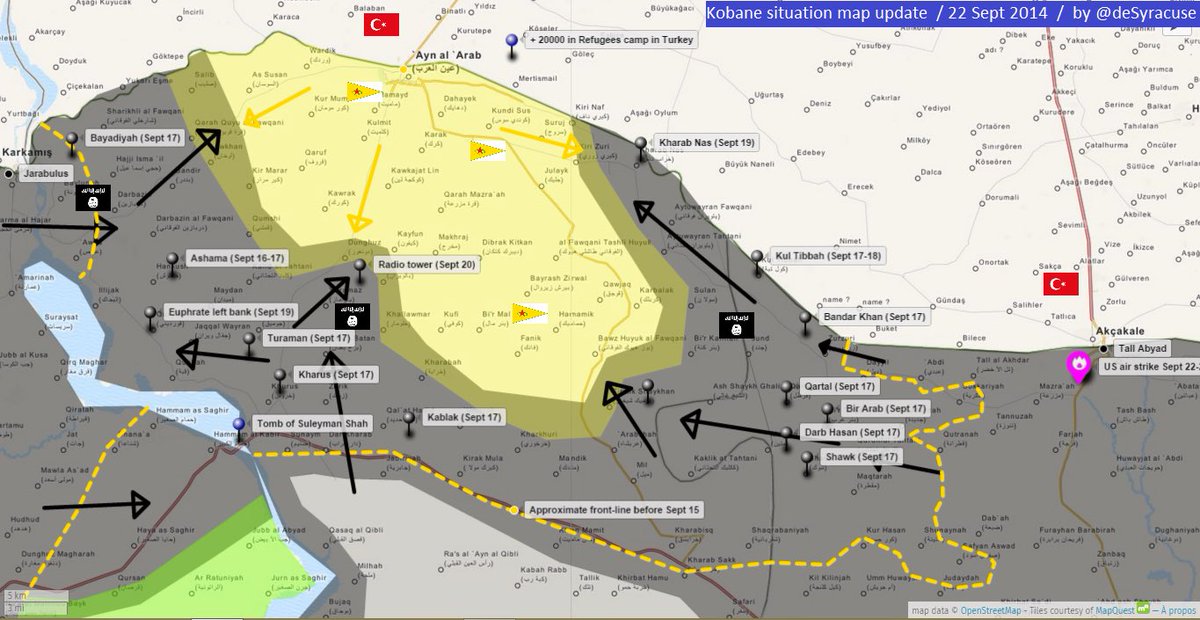
This @deSyracuse map from 20/09/2014 is basically a time machine. Today’s “new DAESH” is driving down the same axis the original DAESH used, almost line-for-line.
The claim that “the Syrian army” launched a major anti Kurdish offensive less than 24 hours after unveiling the Paris, trilaterally mediated Israel-Syria security deal, without an explicit Israeli greenlight, is not only laughable, but insulting to everyone’s intelligence.
Syrian Government Media have now started to create the narrative that Kurds do not exist in Syria - paving the way for the ethnic displacement and cleansing of Kurds in Syria.
These are the same people who stated that Kurds are an integral part of Syria one week ago.
The evacuation of SDF personnel from al-Aqtan Prison is now underway.
This is a major achievement, the result of tireless work by Kurdish diplomatic networks in Syria and abroad, which helped drive a broad mobilization across four continents.
YPJ commander Nesrin Abdullah in a press conference in Kobane: “What are the guarantees for integration? Sentences get written on paper, they put their signatures at the bottom, and say the problem is solved. But there are no constitutional guarantees. You give me rights today, but you can arbitrarily take them back tomorrow.”
#Urgent Warning from Syria
The U.S. Army in Syria is withdrawing and abandoning the Kurds into the hands of international terrorists.
There is no ceasefire on the ground. The Kurds have been under nonstop attack. U.S. Ambassador Tom Barrack, who is a Turkish asset, keeps tweeting about a “ceasefire” to divert media attention away from the Kurds until the U.S. Army completely withdraws from Syria. After that, the terrorists can begin beheading Kurds without worrying about consequences.
We have just been attacked again. We repelled the attack and captured two terrorists along with their motorbikes.
They have cut off phone service, internet, electricity, and water in the city of Kobani for more than four days. Entire Kurdish communities have been cut off from the world.
#defendrojav #rojava
Damascus Continues Attacks Despite Ceasefire Agreement
Despite the ceasefire agreement, Damascus-affiliated factions continue their attacks on Kobani and the al-Aqtan prison in Raqqa.
Simultaneously with the shelling of al-Aqtan prison, which houses ISIS militants, these factions targeted the outskirts of the town of Sarrin and attacked the village of Khrouss, south of Kobani, using heavy weapons and artillery. The entire southern and southwestern countryside of Kobani was also subjected to intense artillery shelling, which is ongoing at the time of this report.
We are attaching to this statement videos published by accounts affiliated with these factions, documenting the artillery shelling they are carrying out against areas south of Kobani.
This constitutes a violation of the ceasefire for the second consecutive day. Yesterday alone witnessed 22 violations committed by these factions, including attacks on Kobani, Hasakah, and al-Aqtan prison.
In addition to the military attacks, Damascus continues its policy of collective punishment by cutting off water and electricity to the city of Kobani and preventing fuel deliveries amid harsh winter conditions. At the same time, it continues to cut off water to al-Aqtan prison in Raqqa, posing a direct threat to the lives of detainees and foreshadowing serious humanitarian consequences.
We hold Damascus fully responsible for these ongoing violations and stress that the continued targeting of populated areas and sensitive facilities, including detention centers holding ISIS members, constitutes a grave threat to security and stability. We call on the guarantor states to take immediate and effective measures to halt these violations and ensure full adherence to the ceasefire agreement.
Syrian Democratic Forces
Media Center
January 22, 2026
In other words, in plain English:
We're selling out the #Kurds in Syria, as we have elsewhere in the region.
We no longer need Kurds as reliable allies.
Instead, we're placing our bet on what we pray are "reformed" jihadists.
I stand with the Kurds.
Always have. Always will.
The Kurdish city of Kobani is now besieged by jihadists and cut off from water, electricity, and basic necessities. The internet has also been shut down. Kobani and the Kurdish people are at risk of genocide. As shown on the map, Turkey has closed the northern border, leaving the city surrounded by jihadist forces. #KobaniUnderAttack #Kobani #Syria #Kurdistan #Rojava
ISW/@criticalthreats Assessment: The process to move up to 7,000 ISIS fighters will require more than the 72 hours remaining in the interim ceasefire between the Syrian government and Kurdish SDF. ISIS breakouts will therefore remain a concern if the ceasefire fails.
The United States is reportedly concerned that the ceasefire in Syria will not hold and that the poor transfer of control between the SDF and the Syrian government will enable ISIS breakouts. The US CENTCOM commander's phone call with the Syrian president reflects these concerns: the commander said that he expected the Syrian government to "avoid actions" that would interfere with the movement of ISIS fighters from detention facilities in Syria.
The Syrian government may have challenges controlling its forces in northeastern Syria. Damascus controls an undisciplined force that responds slowly or not at all to orders. The tribal militias that have operated alongside the Syrian army are even less likely to follow government orders.