Lifelong learning meets social intelligence: Human intelligence evolved in social environments; we learn by observing, teaching, and adapting to others.
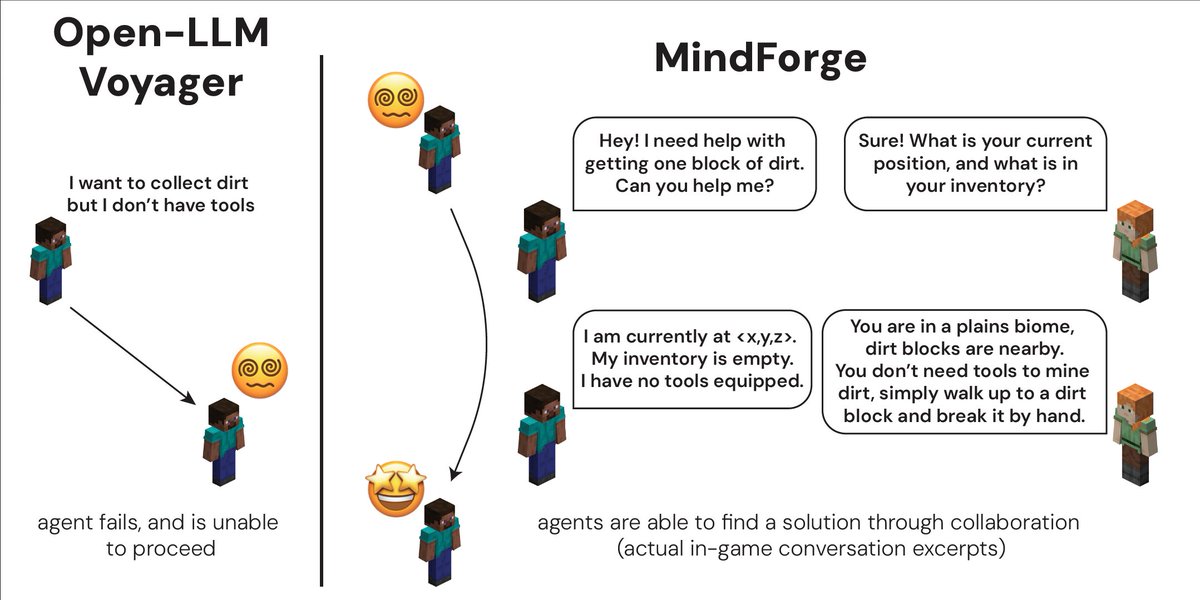
Recent lifelong-learning LLM agents, like Voyager, explore open worlds such as Minecraft, acquiring and reusing skills across tasks. Yet they still learn in isolation, and when powered by open-weight LLMs often fail at even the simplest tasks.
Our NeurIPS '25 paper MindForge introduces social lifelong learning: agents that continually improve by reasoning about one another's beliefs, goals, and actions through perspective-taking and interaction.
📄 https://t.co/g0DxYD6hho
🧵1/7
🚀 We have an exciting #PhD opportunity on CAAR T-cell therapy, at the intersection of #AI, #bioinformatics, and #cellbiology. This is a collaborative project between LUMC and TU Delft.
👉 Apply here: https://t.co/2qe3xL90ZY
Quick update from the Embodied Social Intelligence capture lab we’re building at @tudelft :
Real-time bidirectional comms between our @NEURARobotics Maira and @nvidia Isaac Sim!
Move a point in the sim, and watch the real robot follow it.
#EmbodiedAI#IsaacSim#DigitalTwins
Our new preprint on protein sequence design using all-atom SELFIES representation and discrete diffusion models is out!🎉Thanks @BiologyAIDaily for the great summary👇
All-Atom Protein Sequence Design using Discrete Diffusion Models
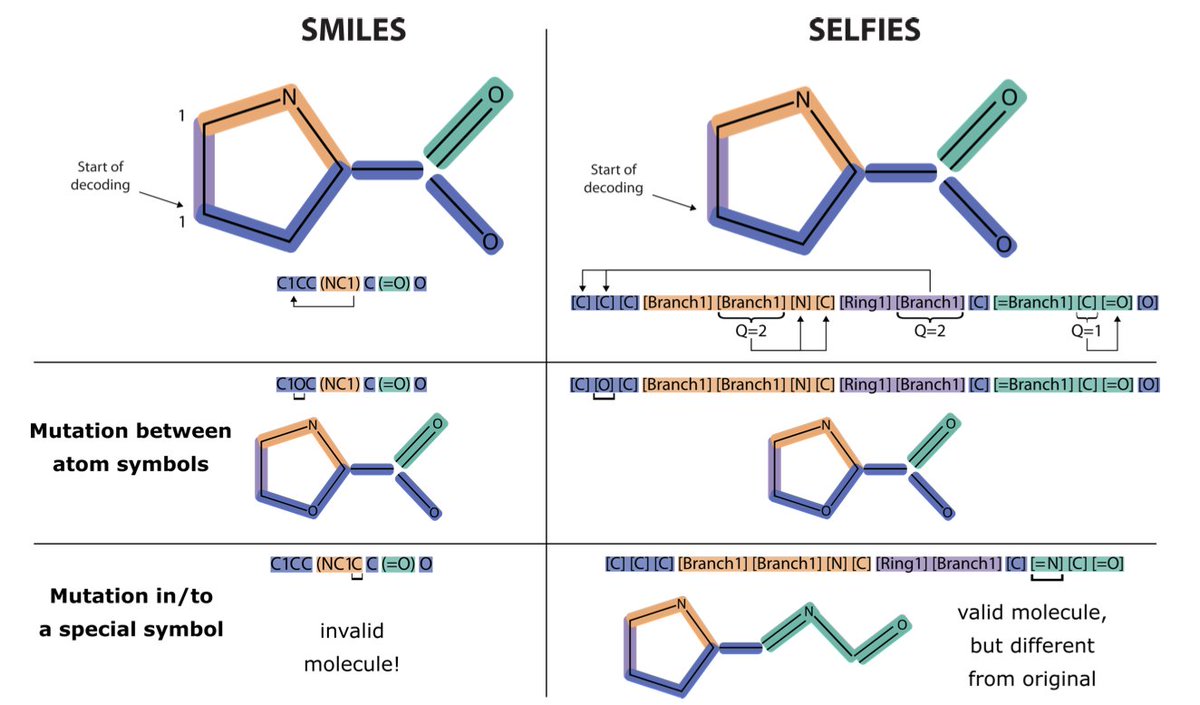
1.This paper presents the first application of discrete diffusion models to protein design using an all-atom representation. Instead of relying on the standard 20 amino acids, the authors use SELFIES to model each atom in the protein, enabling the generation of sequences with non-canonical amino acids and post-translational modifications.
2.By integrating SELFIES with the D3PM framework and a ByteNet-based denoiser, the model enables fully parallel sequence generation—offering a major efficiency advantage over previous autoregressive SELFIES approaches.
3.The absorbing noise schedule, where tokens are progressively masked rather than randomly replaced, significantly outperforms uniform noise in producing chemically valid, protein-like structures with continuous backbones.
4.A novel evaluation pipeline was developed to categorize generated sequences into four groups: non-protein molecules, Cβ-lacking proteins, non-canonical proteins, and canonical proteins. This multi-step filtering ensures structural and stereochemical validity.
5.The absorbing model produced a notably higher number of valid proteins: 7.7% canonical and 15% non-canonical, compared to just 0.4% and 4.4% for the uniform model. It also exhibited fewer unused tokens and more continuous backbones.
6.SELFIES models generated proteins that were highly novel and diverse. Over 99% of sequences from the uniform SELFIES model showed no significant BLAST match to the training set. Diversity within the generated set was similarly high.
7.Compared to amino acid-based models, the SELFIES representations introduced slight biases in amino acid frequencies (e.g., more Glycine, less Threonine and Valine), likely due to structural complexity and generation constraints.
8.Structural foldability, evaluated using OmegaFold, revealed that SELFIES-generated proteins—especially canonical ones—achieved higher pLDDT scores on average. The SELFIES uniform model reached 64.2 average pLDDT, with 32.1% of sequences exceeding the foldability threshold of 70.
9.However, structural reliability decreased with increasing sequence length. While amino acid models performed better on longer sequences, the SELFIES absorbing model generated structurally sound proteins over a broader length range, up to 138 residues.
10.Despite being trained on canonical sequences, SELFIES models generalized beyond the training data to generate diverse non-canonical sequences. These might reflect synthetic amino acids or post-translational modifications, offering an avenue for further exploration.
11.The authors emphasize that all-atom generative models could facilitate protein-small molecule co-design, allosteric site engineering, and synthetic protein creation—areas poorly served by current amino-acid-level tools.
12.Future work should focus on improving generation reliability, reducing failure modes in the SELFIES decoding process, and expanding the representation to handle modified or synthetic residues more explicitly.
💻Code: https://t.co/zmuWFmwIsv
📜Paper: https://t.co/h4JqB4E4V9
#ProteinDesign #DiffusionModels #SELFIES #GenerativeModels #ComputationalBiology #SyntheticBiology #AI4Science
🚀 Sharing the Embodied Social Intelligence Capture Lab at @tudelft! During the Dutch House of Representatives Health Committee visit, we showcased our lab as a Twin Operating Room, mirroring @ErasmusMC to advance healthcare tech through socially intelligent embodied AI. 🏥🧵👇
Researchers improved a deep generative diffusion model to guide #antibody design. Their approach identified complementarity-determining regions in antibodies with properties that would be suitable for clinical applications. #MachineLearning#MLSB
🔗 https://t.co/mhXcLfBowk
Met behulp van #AI en kennis over menselijk gedrag leert @ChiragRaman machines mensachtige sociale intelligentie te begrijpen en te vertonen – verbaal, vocaal en visueel. Aan de horizon lonkt een breed scala aan toepassingen.
https://t.co/5LMqpRVrlL
Excited to share our #NeurIPS2023 paper "Why Did This Model Forecast This Future?" Our contrastive explanation framework for probabilistic regression models identifies salient timesteps that alter a model's certainty about the future.
📜 https://t.co/BilaFx3PZn
🧵1/n
✨Excited to share our work on property-conditioned antibody design🧬accepted at the @workshopmlsb and @genbio_workshop#NeurIPS2023 workshops!
📄Preprint: https://t.co/AQQlPgMIhH
💻Code: https://t.co/g4nbFBhZgX
Story time. The Granada-Barcelona leg of our @vueling flight to Amsterdam is "diverted" to leave from Sevilla, requiring a 2 hr bus journey from GRX to Sevilla. But since it's not technically "cancelled" they can't help rebook us directly to our final destination in Amsterdam.
📢Job Alert!
We have an open MSCA Industrial PhD position to start this fall for the AI-driven design and explainability of new-to-nature enzymes.
The candidate will be co-supervised by our lab at @IBMB_CSIC and @Bayer in Berlin. See more details below.
Please RT 😊!
El pasado miércoles, mi vuelo con @Ryanair se retrasó casi 3 horas, llegando de madrugada a Málaga. No nos proporcionaron agua ni tenían apenas comida. Su página web ignora este retraso, por lo que no puedo presentar una reclamación oficial. ¿Podríais ayudarme @Ryanair?
📢 #PhDposition! I have a vacancy @tudelft dealing with generating digital humans in social contexts. If you're interested in working at the intersection of multimodal ML, social cognition, and CV/graphics, this may be for you!
https://t.co/4l611VPNZs
#GenerativeAI#vacancy
While #syntheticdata has shown promise for face-related vision tasks, does increased photorealism help?
Here I present our #WACV2023 paper on dynamic expression-based wrinkles, done jointly with @Friggog, @errollw, and Tadas Baltrusaitis @microsoft.
https://t.co/Km6cp30Q2j
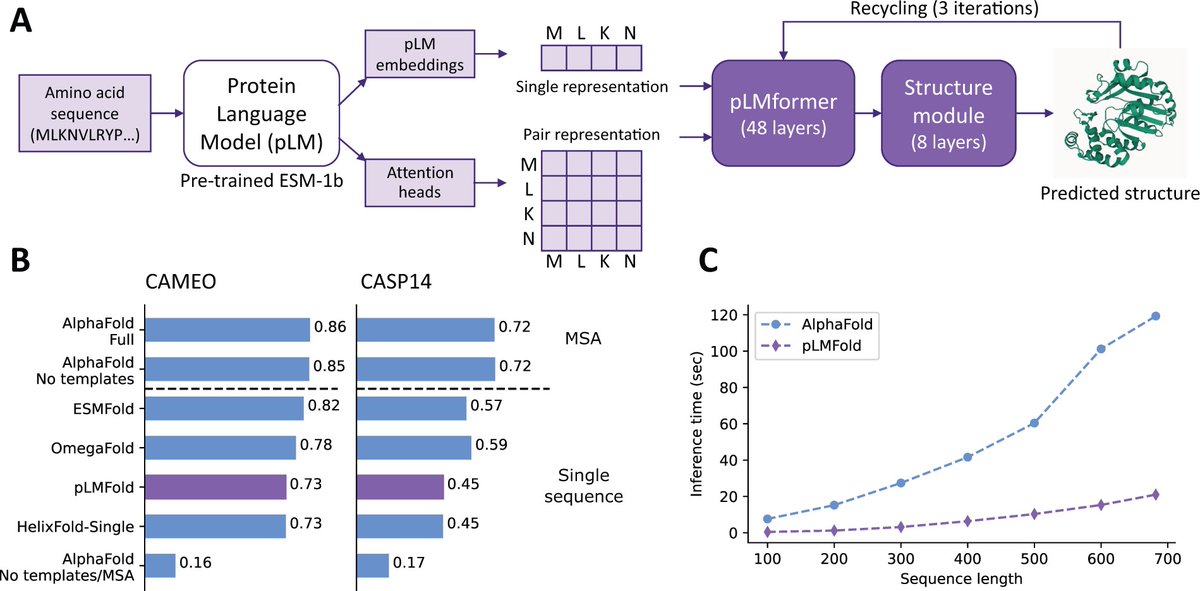
Our proof-of-concept pLM-based model, #pLMFold, is trained from scratch to obtain reasonable results with reduced computational overheads in comparison to previous models such as #AlphaFold and #OmegaFold.