Nobody tells you this: Dopamine from information gathering is a dangerous drug. It’s the dopamine from reading, planning, or learning, but never doing. Stop looking for more information and start acting on the information you already have. Get your dopamine from action.
You've been asking for this one...
Now in preview: Codex in the ChatGPT mobile app.
Start new work, review outputs, steer execution, and approve next steps, all from the ChatGPT mobile app. Codex will keep running on your laptop, Mac mini, or devbox.
Introducing GPT-5.5
A new class of intelligence for real work and powering agents, built to understand complex goals, use tools, check its work, and carry more tasks through to completion. It marks a new way of getting computer work done.
Now available in ChatGPT and Codex.
Aaron Levie summarizes meetings with enterprise IT and AI leaders showing a shift from broad AI chat experiments to targeted agent deployment for executing specific workflows in sectors like banking, healthcare, and retail.
Enterprises face practical barriers including token/compute budgeting trade-offs, legacy system fragmentation that blocks unified data access, and extensive change management needs to integrate agents into existing processes.
Focus remains on enabling new revenue opportunities and automating previously unprioritized tasks rather than job cuts, with headless software, interoperability, and technical setup by engineers highlighted as critical for scalable adoption.
https://t.co/UHFs0bPZZJ
Another week on the road meeting with a couple dozen IT and AI leaders from large enterprises across banking, media, retail, healthcare, consulting, tech, and sports, to discuss agents in the enterprise.
Some quick takeaways:
* Clear that we’re moving from chat era of AI to agents that use tools, process data, and start to execute real work in the enterprise. Complementing this, enterprises are often evolving from “let a thousand flowers bloom” approach to adoption to targeted automation efforts applied to specific areas of work and workflow.
* Change management still will remain one of the biggest topics for enterprises. Most workflows aren’t setup to just drop agents directly in, and enterprises will need a ton of help to drive these efforts (both internally and from partners). One company has a head of AI in every business unit that roles up to a central team, just to keep all the functions coordinated.
* Tokenmaxxing! Most companies operate with very strict OpEx budgets get locked in for the year ahead, so they’re going through very real trade-off discussions right now on how to budget for tokens. One company recently had an idea for a “shark tank” style way of pitching for compute budget. Others are trying to figure out how to ration compute to the best use-cases internally through some hierarchy of needs (my words not theirs).
* Fixing fragmented and legacy systems remain a huge priority right now. Most enterprises are dealing with decades of either on-prem systems or systems they moved to the cloud but that still haven’t been modernized in any meaningful way. This means agents can’t easily tap into these data sources in a unified way yet, so companies are focused on how they modernize these.
* Most companies are *not* talking about replacing jobs due to agents. The major use-cases for agents are things that the company wasn’t able to do before or couldn’t prioritize. Software upgrades, automating back office processes that were constraining other workflows, processing large amounts of documents to get new business or client insights, and so on. More emphasis on ways to make money vs. cut costs.
* Headless software dominated my conversations. Enterprises need to be able to ensure all of their software works across any set of agents they choose. They will kick out vendors that don’t make this technically or economically easy.
* Clear sense that it can be hard to standardize on anything right now given how fast things are moving. Blessing and a curse of the innovation curve right now - no one wants to get stuck in a paradigm that locks them into the wrong architecture. One other result of this is that companies realize they’re in a multi-agent world, which means that interoperability becomes paramount across systems.
* Unanimous sense that everyone is working more than ever before. AI is not causing anyone to do less work right now, and similar to Silicon Valley people feel their teams are the busiest they’ve ever been.
One final meta observation not called out explicitly. It seems that despite Silicon Valley’s sense that AI has made hard things easy, the most powerful ways to use agents is more “technical” than prior eras of software. Skills, MCP, CLIs, etc. may be simple concepts for tech, but in the real world these are all esoteric concepts that will require technical people to help bring to life in the enterprise.
This both means diffusion will take real work and time, but also everyone’s estimation of engineering jobs is totally off. Engineers may not be “writing” software, but they will certainly be the ones to setup and operate the systems that actually automate most work in the enterprise.
We’re updating our ChatGPT Pro and Plus subscriptions to better support the growing use of Codex.
We’re introducing a new $100/month Pro tier. This new tier offers 5x more Codex usage than Plus and is best for longer, high-effort Codex sessions.
In ChatGPT, this new Pro tier still offers access to all Pro features, including the exclusive Pro model and unlimited access to Instant and Thinking models.
To celebrate the launch, we’re increasing Codex usage for a limited time through May 31st so that Pro $100 subscribers get up to 10x usage of ChatGPT Plus on Codex to build your most ambitious ideas.
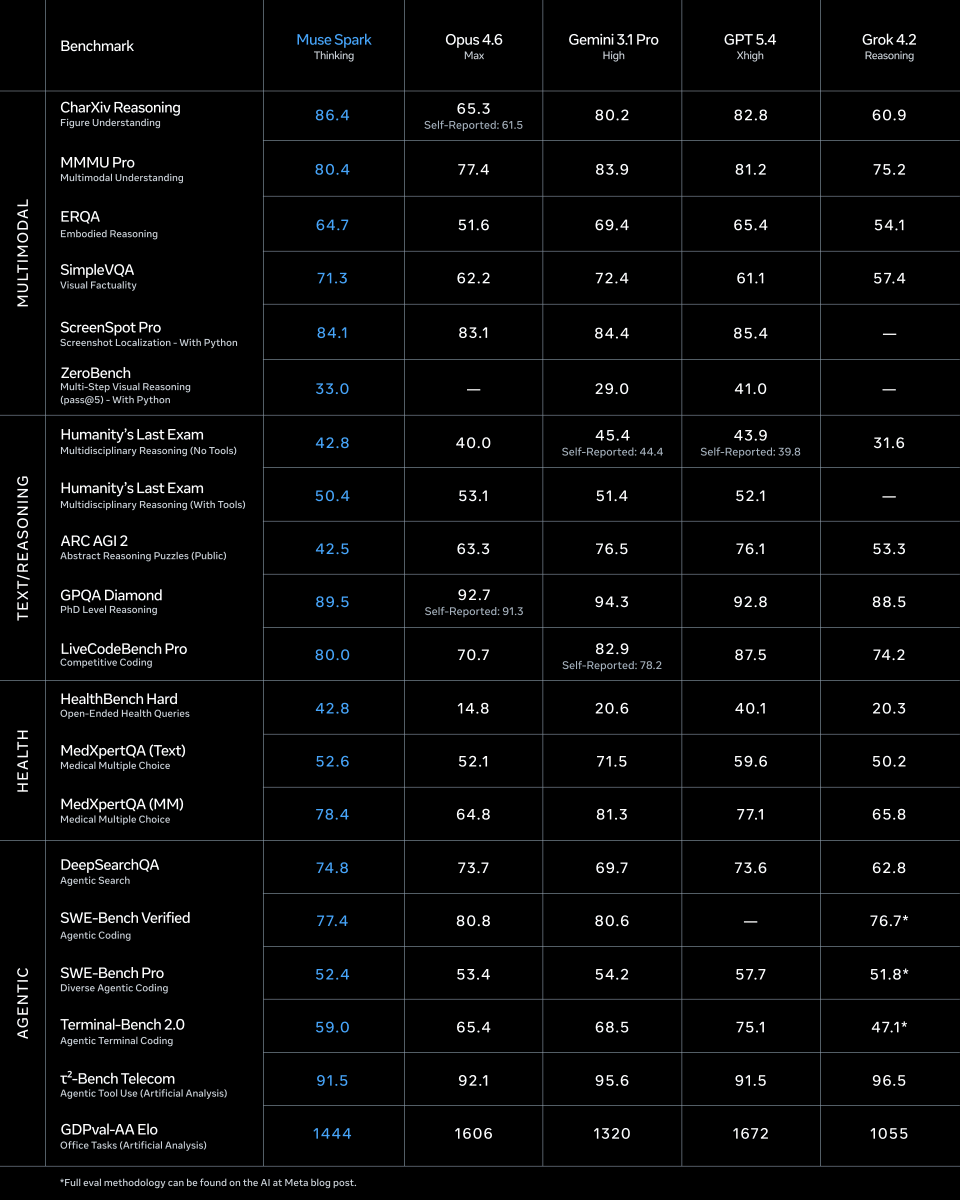
Today I used meta[.]ai and I found for excel work, it was good (closer to chatGPT's extended thinking). It was fast and accurate also. I feel its good progress by Meta. Gemini as CLI/ harness: I am not happy. Codex: is the best and others AI model's claim from chart are accetable.
Anthropic just dropped Project Glasswing 🔥
Claude Mythos is now scanning OSes & browsers for vulns, with $100M in credits to secure open source. Defensive AI winning!
Introducing Project Glasswing: an urgent initiative to help secure the world’s most critical software.
It’s powered by our newest frontier model, Claude Mythos Preview, which can find software vulnerabilities better than all but the most skilled humans.
https://t.co/NQ7IfEtYk7
Muse Spark is the real deal — Meta’s first Superintelligence Labs model is natively multimodal, with visual chain-of-thought, tool use, and a “contemplating” multi-agent mode that solves complex science & coding problems like nothing else.
Already beating Gemini Deep Think & GPT Pro on key benchmarks, and it’s rolling out free to 3B+ users across Meta apps.
Future open-source + bigger models? This could spark the biggest leap in accessible agentic AI we’ve ever seen. Game on. 🔥
1/ today we're releasing muse spark, the first model from MSL. nine months ago we rebuilt our ai stack from scratch. new infrastructure, new architecture, new data pipelines. muse spark is the result of that work, and now it powers meta ai. 🧵