Jack Ma once said, 'When Selling to close friends and family, no matter how much you're selling to them, they will always feel you're earning their money, no matter how cheap you sell to them, they still wouldn't appreciate it.'
There will always be people who do not care about your Costs, Time, Effort, they rather let other people cheat them, allowing others to earn, then supporting someone they know. Cause in their heart, they will always be thinking, 'How much did he earn from me?' instead of "How much did he SAVE/MAKE for me?"
This is a classic example of a poor person's mentality!
Jack Ma on Sales: 'When doing Sales, the first people who will trust you will be Strangers, Friends will be shielding against you, fair-weather friends will distance from you. Family will look down upon you.'
The day you finally succeed, paying the bill for every get-together dinner, entertainment, you will realised: Everyone else is present except the Strangers.
Dario has written that we need to “pace the frontier,” and Sam has agreed. People may be surprised by my response: go ahead.
You guys are the frontier. By any reasonable metric — market share, revenue growth, model capability — the two of you have a duopoly on frontier intelligence. You’ve also claimed the lead is widening because of recursive self-improvement.
I don’t see what you see in the lab. If the unreleased models are scary enough that you think you should slow down, I support your decision to be responsible.
But stop pretending you need anyone else’s permission. Stop pretending antitrust law has to be suspended so you can form a cartel. Stop pretending you need a regulatory approval process that supersedes product liability. Stop pretending METR is independent when it is intertwined with Anthropic’s investors and staff. Stop pretending you need those same evaluators to police competitors who aren’t even at the frontier.
Most of all, stop pretending the motivation to slow down is purely altruistic. You face massive product-liability exposure if your products enable a truly damaging cyberattack. The market already punishes models that behave in unpredictable or unauthorized ways. After the Hugging Face episode, it is simply good business for OpenAI and Anthropic to trade some raw power for reliability and predictability. Call it alignment if you want. It is also just giving customers what they want.
Pacing the frontier would also create breathing room for a more intelligent conversation about regulation than Bernie Sanders’ “shut it all down.” China is very unlikely to join a global agreement, as you know, and that has to be taken into account as well.
So go ahead and pace the frontier. You are the ones setting it. The easiest way not to build superintelligence is for you to agree not to build it. Demanding your preferred regulatory framework as the price of that will look like blackmail of the public and the political system. So just do it.
If you do, you’ll buy goodwill for the next conversation. If you don’t, we’ll know this was just another bid for regulatory capture — or an election-season psyop.
I was just in Mumbai, and I have to give them credit for the progress they’re making on infrastructure. The new Aqua Line metro is phenomenal. But the amount of work India still has to do on basic cleanliness and sanitation and it is hard to understand until you see it yourself. Would love for more westerners to go just to understand how wealthy they are, but that's a different point.
Mumbai is completely surrounded by water, yet there are almost no places where people can actually enjoy the water. The beaches are filled with trash, the water is badly contaminated, and almost nobody swims, even when it’s brutally hot outside. Walking on the beach is just mud and trash meeting filthy water on the horizon.
There are much poorer places around the world where people can still use the beaches. This is not just about money. India has gone decades without adequate trash collection, sewage treatment, or enforcement for a population of more than a billion people. At this point, the scale of the problem feels almost impossible, and the oceans around the world are paying the price for Indias garbage output as well.
I like the direction Modi is taking the country, but India needs to treat cleanup like a national emergency. Stop with the small campaigns and organize a full scale blitz.
Offer unemployed people paid work picking up trash, clearing drains and waterways, cleaning beaches, and maintaining public spaces. Give them proper equipment and supervision. Then build the collection and waste processing systems needed to stop everything from becoming filthy again a week later.
India has shown that it can build metros, airports, highways, and digital infrastructure. Clean streets and usable water should be treated as infrastructure too.
Mumbai should have one of the greatest waterfronts in the world. Instead, it's has basically an irrelevant feature of the city and feels surrendered to sewage and garbage.
After four years in India, it is time for me to move on to my next posting in Beijing.
There is much to look back on during my time here.
Auf Wiedersehen, India - I will be back again! 🇮🇳🇩🇪✈️
The clearest 11 minutes I have heard on why the AI capex boom may not pay off. @ChrisBloomstran at the Zurich Project on the depreciation wall, ~$650B of off-balance-sheet SPV debt, and the circular financing between Nvidia, OpenAI, and the hyperscalers.
This @HedgieMarkets post illustrates where the infinity scalable asset-light technology model meets the physical realities of an asset-heavy business that faces an upward sloping supply curve.
We have long argued that AI compute is just another bit-atom commodity (like crypto) that uses a lot natural resources to create a valuable (unlike crypto) virtual asset.
On the bit side, Big Tech is a price-maker with fat margins. On the atom side, a price-taker.
Big Tech grew up in bits — search, social, e-commerce, office software: asset-light, infinitely scalable, natural monopolies. Build once, serve billions, watch costs fall every year. So they assume AI is the same game and will spend whatever it takes to own the market.
But inference is also atoms, i.e. land, critical minerals and electrons, which are mostly molecules. In the commodity world, competition drives price to marginal cost: P = MC, which is upward sloping as volume rises. The better the models get, the faster they compete their own margins down to the physical floor which rises with volume.
You can already see it. Microsoft just cancelled Claude Code because the cost to run it exceeded the value it returned — demand retreating the moment price met real cost. The irony: the customer pulling back was itself a hyperscaler. In April, Uber confirmed once again that AI compute demand is price elastic.
Bottom line: they assumed AI costs would keep falling like they always did on the bit side; however, on the atom side, there is a hard floor that likely rises in the short run.
I am not denying that the margins are still fat. But it’s not the same model. These guys are running towards obsolescing their own pricing power. Why did Rockefeller stop at the gas station and not vertically integrate into cars?
Bernstein: India’s Ambitions are Hollow Without R&D Investments
1. No nation in history became a developed economy with R&D @ 0.65% of GDP
2. Labor Arbitrage Economy: Demand broken as wages stagnate for 10 yrs. You raise wages, you can’t compete. AI dents it further.
INSIGHTS:
R&D Intensity (% of GDP)
2000s
Korea: 3.12%
Taiwan: 2.7%
China: 1.32%
India: 0.82%
2010s
Korea: 4.29%
Taiwan: 3.3%
China: 2.11%
India: 0.75%
2020-25
Korea: 5.21%
Taiwan: 4.0%
China: 2.8%
India: 0.65%
Widening Innovation Gap: China’s GDP is 5X of India. Its R&D budget is 4X in % of GDP. So, in dollar terms, China is 5x4 = 20X of India’s R&D every year.
Labourers vs. Innovators
a. India’s Top 10 Companies: Combined R&D Expense 2025 (Thinking in Quarters): Below $1B
b. China Companies R&D Expense 2025 (Thinking in Decades): BYD $8B; Huawei $14B; Xiaomi $5B
c. Korea: In 1970s, private to government R&D share was 20:80. In 1990s, the ratio became 80:20. Korean government forced private sector to invest in R&D, reject short-termism, and massively incentivized firms with export credits and R&D tax credits.
d. Taiwan: In 1980s, the government funded research labs for semiconductors. The “seed” was sown by the government; the “scale” was led by private sector. Today a single company TSMC controls 70% world market share in semiconductor pure-play, driven by AI demand.
e. China: In 1980s, India and China had similar R&D investments. China realized that technology was their only guarantee of national survival. The government and private sector formed a combined “war machine” to become the “IP owner” and not just the “world’s factory” for tech goods.
India’s Scarcity Mindset
a. While Korean and Chinese companies operate in a culture that rewards global innovation, Indian companies operate in a culture that rewards bowing down before bureaucrats and ministers.
b. To grow in India, you don’t need to build world-beating products. You just need to operate in those areas of the domestic economy where government policy favours Indians over foreign businesses.
c. Think of a student whose father owns the school, and no other students are allowed to sit in the exam. What will be his capability? While other countries demand global dominance as a point of national pride, Tata, Reliance, and Adani cannot even make a candy that sells in the world market.
d. Curse of Cheap Labor: Indian IT companies realized that when you can make 20% margin by selling cheap labor, why build a semiconductor factory that requires $20 billion CapEx? They kept distributing lakhs of crores in dividends (mainly to promoters) while the world invested in AI and chips.
e. The GCC Paradox: India now has over 50% of the world's Global Capability Centers (GCCs). From Google to Walmart to Mercedes, the world’s best tech innovation and research is happening in India, but the Intellectual Property (IP) belongs to other countries. So, we remain only “cheap labour” for others.
Low Wages; Broken Consumption
a. Labour arbitrage economies enjoy GDP growth till wages keep rising. But wage growth stalls when other poor economies like Bangladesh or Philippines catch up with lower wages. That’s when their dream of becoming a “developed economy” gets a reality check.
b. From 2015 to 2025, real wages in India have stagnated. Rural wages have seen a negligible CAGR of 0.1%, and entry-level IT salaries have famously remained stuck at ₹3.5 LPA. China’s real wages (inflation-adjusted wages) have grown at 8 to 9% CAGR during the same period.
c. Indian companies continue to operate in low-complexity, me-too product/service segments where low wages are a competitive advantage. But now AI is the new emerging threat to IT sector and GCCs.
Endpiece
In absence of an urgency to shift from Labour Arbitrage to Innovation Premium, India risks falling into the Middle Income Trap. India’s demographic dividend is ending by 2040. Without investing patient capital in R&D, India will squander its opportunity to achieve a developed nation status by 2047.
@arabicatrader
🚨🚨🚨
A Geneva-Based Secret Ruler of Pakistan
Controls India’s Banking Roots
The unpaid Serena Hotel bill wasn’t just Pakistan’s humiliation — it was India’s wake-up call.
Inside story only in @BWBusinessworld@anuragbatrayo
https://t.co/e6aGRmhkMR
*Sanju Samson*: "
When people talk about my journey, they usually start with stadiums.
*For me, it always begins with a bus.*
I was eleven. My kit bag felt heavier than me. *I would leave home in Vizhinjam before the sun came up, change two buses, and reach the Medical College ground by 6 in the morning. Some days I was sleepy. Some days I was sore. But I don’t remember ever wanting to skip it* .
After practice, I would bathe under a small tap at the corner of the ground. No dressing room. Just cold water, a towel in my bag, and a quick change into my school uniform. Then I’d walk to catch another bus to St Joseph’s. School, homework, and then back again for evening nets.
That was my life. Every day
I didn’t think of it as a sacrifice. I just thought — this is what it takes.
*My grandfather was a fisherman. Watching him, I understood something early. You can’t control the sea. You can only control how prepared you are when you go out. Some days you come back with nothing. But you still wake up the next morning and go again. That stayed with me* .
There were phases when I felt close to my dream. And phases when I felt very far from it. Being dropped. Sitting out. Hearing opinions. Smiling outside but questioning yourself inside.
I won’t lie, it hurts. I’m human.
*But every time I feel that doubt, I go back in my mind to that small tap at the ground. To the buses. To my parents adjusting their lives around my practice. I remind myself that this journey was never built on comfort. It was built on consistency* .
When I play in Thiruvananthapuram and hear the crowd shout my name, it feels personal. They didn’t just see me succeed. They saw me grow. They saw the process.
I am still that boy from Vizhinjam. I still love batting the same way. I still get nervous. I still want to prove myself. The only difference is the stage.
*The fight hasn’t stopped. It probably never will* .
*Because for me, cricket was never about fame* .
*It was about a dream I chose , and keep choosing : every single day* . "
*~ Sanju Samson*
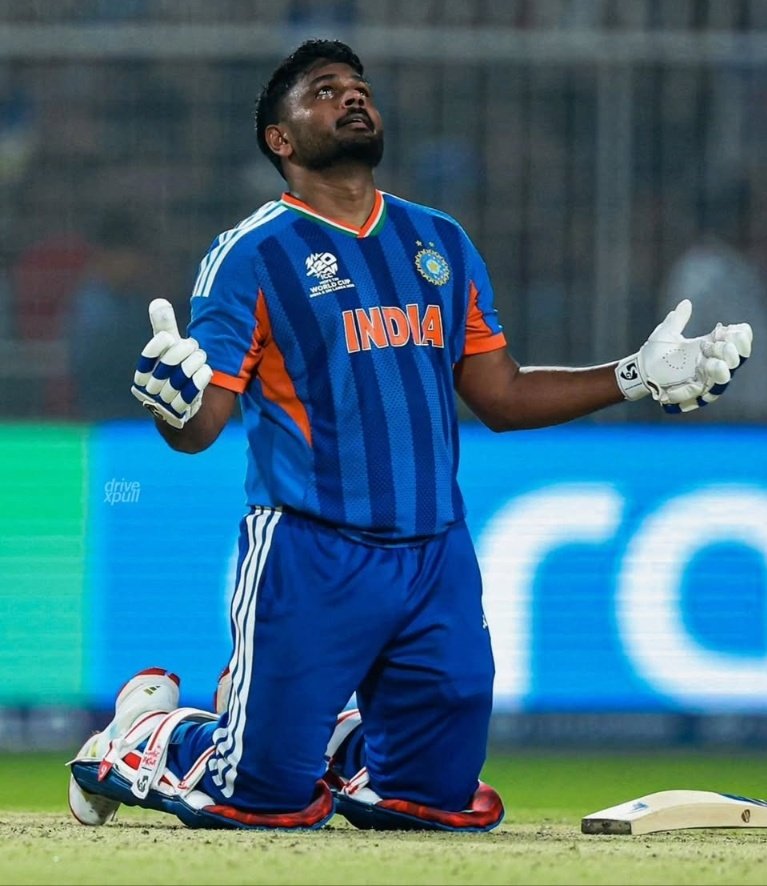
When anyone ever said “don’t worry, God always has a plan,” I never bought it. Thought it was pure crap people say to make themselves feel better. I’ve always lived by “your life is what you make of it”. For me it's write your own destiny or shut up. But tonight my belief was shaken. I saw visuals that proved God really does have a script… and it’s brutal as hell.
Life and cricket are cruel poets. They hand you chances wrapped in hope, then shatter you in ways nothing else can. I still remember when Ishan tore into this side from his own wilderness and dismantled Sanju’s place with ruthless brilliance. Abhishek was soaring so high nothing seemed beyond him. Meanwhile the forgotten man of Indian cricket was dumped once again, right on the edge of the World Cup. One last shot at India colours slipping away, queue of explosive openers waiting to replace him forever.
Then came the twist no one saw coming. First ball of the tournament and Abhishek’s form evaporated. The golden boy who could do no wrong suddenly could do nothing right. God's plan was in action. India, desperate and cornered, had no choice but to turn back to the very outcast they’d discarded. The captain who once laughed off questions about playing him in press conferences? Had to swallow every bit of that arrogance and recall the man he’d sidelined.
Sanju knew it wasn’t just India’s do-or-die match in this world cup - but his entire career as an Indian cricketer was hanging by a razor-thin thread. In the post-match conference he admitted it straight up - he was shattered, dreams completely broken when they left him out. In those darkest lows he reached out to Sachin Tendulkar, asking for help. Sachin being Sachin, guided him, got his head right and be ready when the moment does come for him.
It felt different this time. Those gates of unmatched potential had flew open. He wasn't self doubting himself anymore when entering his 20s. Sanju Samson wasn't Sanju Samson anymore. Wave after wave of what he was always capable of started coming through. He took a team that got absolutely drubbed by South Africa on a four-match tear straight to the summit. Changed the look of the side overnight. Gave India back the swagger it had lost.
The outcast is now the darling of this cricket crazy nation. The wheel has finally for once turned in his favor. This world cup will be remembered for India's dominance in international cricket but more so it will be remembered for when Sanju Samson finally became Sanju Samson.
To every underachiever out there grinding through your lowest lows - hang in there, find your guiding light. Savor this moment with me. Cheer loud for a fellow underdog who finally broke the curse tonight. Keep pushing, keep believing. Because the script can flip in a heartbeat… and when it does, those peaks? They’re going to be fucking beautiful.