Prime Minister Benjamin Netanyahu in a conversation with the Indian pilot from the flight from Dubai, Captain Smit Machchhar:
"You are a hero for Israel, India, and the entire world. I invite Prime Minister @NarendraModi and you to light a flame on Israeli Independence Day." 🇮🇱🇮🇳
During the emotional conversation that took place this evening, the Prime Minister asked Captain Machchhar how it all started, and Machchhar revealed new details about the terrifying moments in the cockpit.
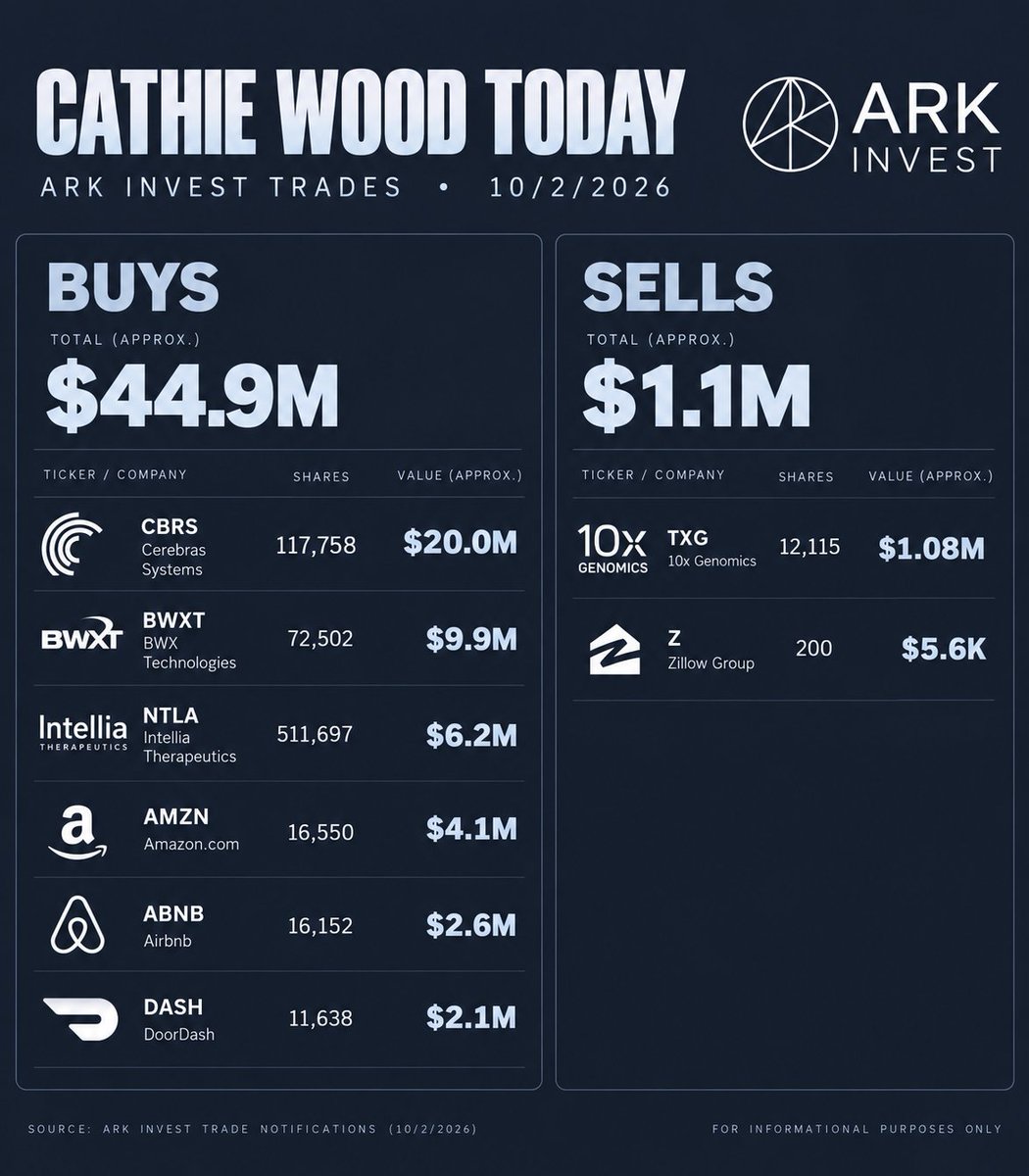
Cathie Wood bought about $20M of $CBRS yesterday before OpenAI CEO Sam Altman called them a "close partner," making it $ARKK largest buy of the day.
Overall, ARK bought about $44.9M of stock versus just $1.1M sold, so she was a net buyer by more than 40x.
Join us for Odisha AI Conference on 10th October,2026 Making Odisha the AI Intellectual Capital of the World
Let’s put Odisha on the global map for AI talent, ideas, and innovation. Together, let’s build the future of Odisha with AI
I am honestly disappointed with a lot of investors and popular accounts.
They clearly didn't do their homework on $CBRS and were talking absolute rubbish.
Let me clear this out.
1. Insider selling:
The claim that the CEO sold 99.8% of his shares is flat wrong.
Class A is what you and I trade. Class B is what founders hold, and it only converts to Class A when they sell.
So the CEO shows just 17,659 Class A shares but still holds ~13.9M Class B. Did people actually read the second table?
Since the IPO, insiders sold ~$400M, under 1% of the company. About 80% was pre-planned sales of old options bought at $1-8, and the rest came from VC board members and forced tax sales.
Stake each still holds
- CEO Feldman ~98%
- CFO Komin ~97%
- CTO Lie ~87%
- COO Mallick ~50%, the only outlier
The real short-term scare is the lockup, with ~39M shares (~16%) unlocking on Oct 14 and Oct 28.
These are old shares that can now trade, not new ones. That's pressure on the stock, not dilution.
2. $NVDA competition:
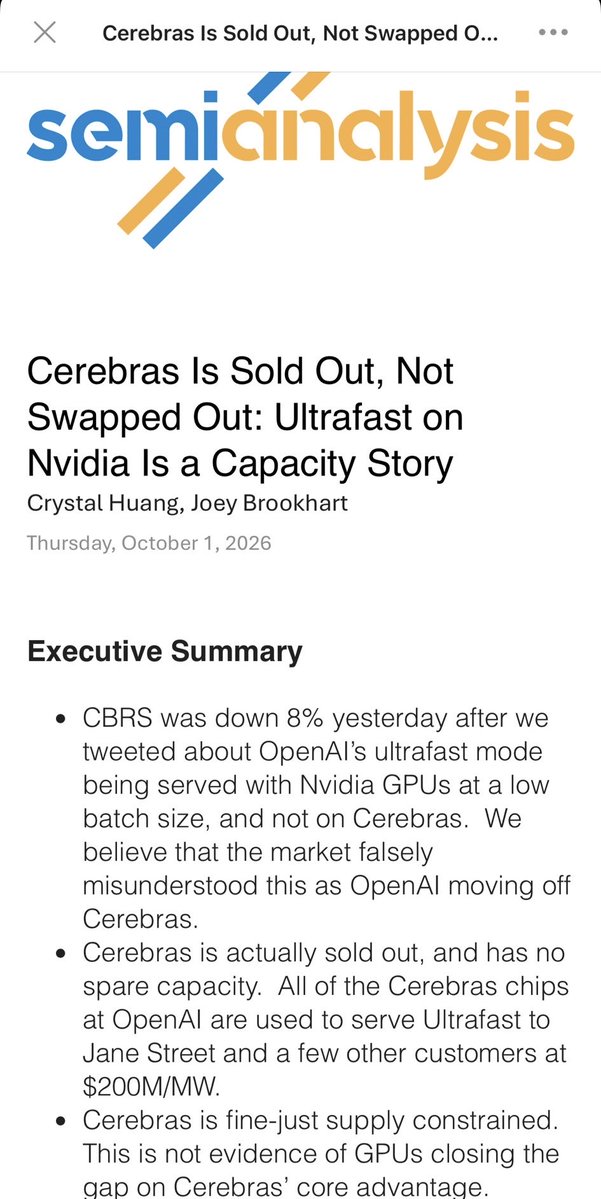
People are saying Nvidia just launched OpenAI's "Ultrafast" mode on Blackwell, so Cerebras is done. That's not the whole picture. Every AI chip trades speed against volume.
Nvidia wins on volume. One GPU holds 288GB of memory, so it serves lots of users at once, the cheapest way to run big models for the masses.
The catch with $NVDA is speed. Its memory sits next to the chip, not on it, so every token has to travel back and forth. To go fast anyway, Nvidia runs each GPU with only a few users, which wastes most of the chip. That's why Ultrafast costs 6x the normal price and still tops out around ~300 tokens/sec.
Cerebras wins on speed per user. The whole model sits on the chip, and data moves thousands of times faster (21 PB/s vs ~8 TB/s on a GPU). Cerebras ran OpenAI's Ultrafast at 750 tokens/sec in August, on a smaller model, and the new CS-4 does 4,400+.
The catch with $CBRS is memory and bandwidth. Each wafer holds 44GB, so big models get split across many wafers that talk to each other slowly, about a sixth of one Nvidia GPU.
That's likely part of why the new tier went to Nvidia. But CS-4 links wafers 6x faster per rack, and more memory is coming. And speed is where a lot of the demand is heading, not just scale. AI agents work for one user or one task at a time, and every second they wait is lost work. Companies will happily pay for that.
That's why $AMZN and $AMD pair Cerebras with their own chips instead of replacing it. Theirs reads the question, and Cerebras writes the answer.
3. OpenAI and concentration:
Yes, OpenAI is the biggest customer, with a $20B+ deal through 2028 and about a third of last quarter's revenue.
One launch on Nvidia doesn't cancel a multi-year contract though. And the list is growing with Amazon, AMD, $META, Mistral, Perplexity, Cognition, $CRWD and more.
Wall Street already expects ~$3B of revenue and the first real profit in 2027, then ~$7.5B of revenue and ~$3B of free cash in 2028, with ~60% gross margins long term.
4. The $450M loss:
$377M was stock comp, and $274M of that was a one-time IPO catch-up. It's non-cash, and without it the business lost only ~$7M.
Stock comp keeps engineers from leaving for Nvidia, OpenAI or Google, and should run ~$100M+ per quarter until ~2028. The cost is dilution from new grants, roughly 1-2% a year, not cash.
Where I land:
Long term, Cerebras owns a specific job in the AI stack that gets more valuable as demand for fast AI grows.
I'd love to see more chip sales, since ~61% of revenue is cloud today, plus the memory and bandwidth upgrades.
The risks are real, but none of those break the story.
- OpenAI is most of the backlog today, but it won't stay the only big customer.
- Nvidia could get "fast enough" with the Groq technology it licensed, but the market is too big for just one winner.
- Dilution is real, and the lockup plus Q3 earnings could bring short-term volatility.
Do your homework before you panic.
Not financial advice.
There is some speculation about our partnership with Cerebras.
Cerebras is a close partner, and we have a deep engagement pushing on the frontiers of speed.
The $CBRS / OpenAI / $NVDA / ‘Ultrafast' commotion on here is getting out of hand. Here’s what we know, or might reasonably assume:
- Up until GPT-5.6 Sol Ultrafast launched on Cerebras hardware in limited preview in August, OpenAI were using 100% of their Cerebras capacity internally and they love it (and have publicly said as much)
- GPT-5.6 Sol is widely taken to be around 2 to 2.5T parameters
- We don’t know the parameter count for GPT-6 Astra, but it’s obviously a larger model, potentially of the order of 5T, as numerous pundits are suggesting
- As such, just to store the weights on the minimum CS-3 footprint, Astra might require twice as many systems as GPT-5.6 Sol
- Cerebras’ inference capacity is maxed out and remains extremely constrained while they continue to ramp
- To immediately switch from serving GPT-5.6 Sol to GPT-6 Astra might double the required footprint, which for obvious reasons would be uneconomical given the trade-offs, especially if there was a better option right around the corner…
- Assuming therefore that GPT-6.1 Sol is a similar size to 5.6 Sol, it would make far greater sense to make that switch
- OpenAI have said 6.1 Sol ultrafast is 'coming soon', so we’ll see
- In the meantime, 6 Astra ‘ultrafast' is running at 300 tok/s on Nvidia, which numerous pundits are dramatically taking to mean that Cerebras has been displaced. The problem is that 300 tok/s isn’t even ultrafast by any reasonable up-to-date standard. I think Cerebras would be pretty embarrassed to serve models that slow. So it feels like a marketing language slip-up by OpenAI, having already reserved ‘fast mode’ for an even slower service
- In any case, Cerebras is gearing up to start serving the significantly more capable CS-4 at scale which, in combination with disaggregation, will be much better suited for serving very large models to high numbers of users at 1000+ tok/s. The indications are that Cerebras switches into this gear from Q4 2026 onwards.
There is some speculation about our partnership with Cerebras.
Cerebras is a close partner, and we have a deep engagement pushing on the frontiers of speed.
REALITY CHECK OF ODISHA’S ANNOUNCEMENTS.
Must read article. Some more information below:
Deras Seafood Park, Odisha: a ₹466 Cr promise from 2017
In 2017, Odisha announced 20 seafood-processing projects at Deras.
📍 20 companies
💰 ₹466 Cr proposed investment
🐟 90,860 MTPA capacity
👷 7,214 projected jobs
Other major announcements followed:
• 2017: Darvesh Group proposed a ₹500 Cr export-oriented fish-processing unit.
• 2017: Kader Investment & Trading received approval for a ₹55 Cr, 10,000 MTPA processing unit.
• 2019: IDCO allotted land to Sabri Foods and Coastal Corporation.
• 2023: Phase-II expansion of the Seafood Park was initiated under the SIDBI Cluster Development Fund.
The bigger question is implementation.
The park was designed as a major seafood-processing and export hub, but official records show that even today only a limited number of units are operational.
@raznkash A senior of mine in Bangalore who is a software engineer and hails from Cuttack asked, “why are there power plants in Talcher when they don’t have any river nearby”.
That’s the state of education.
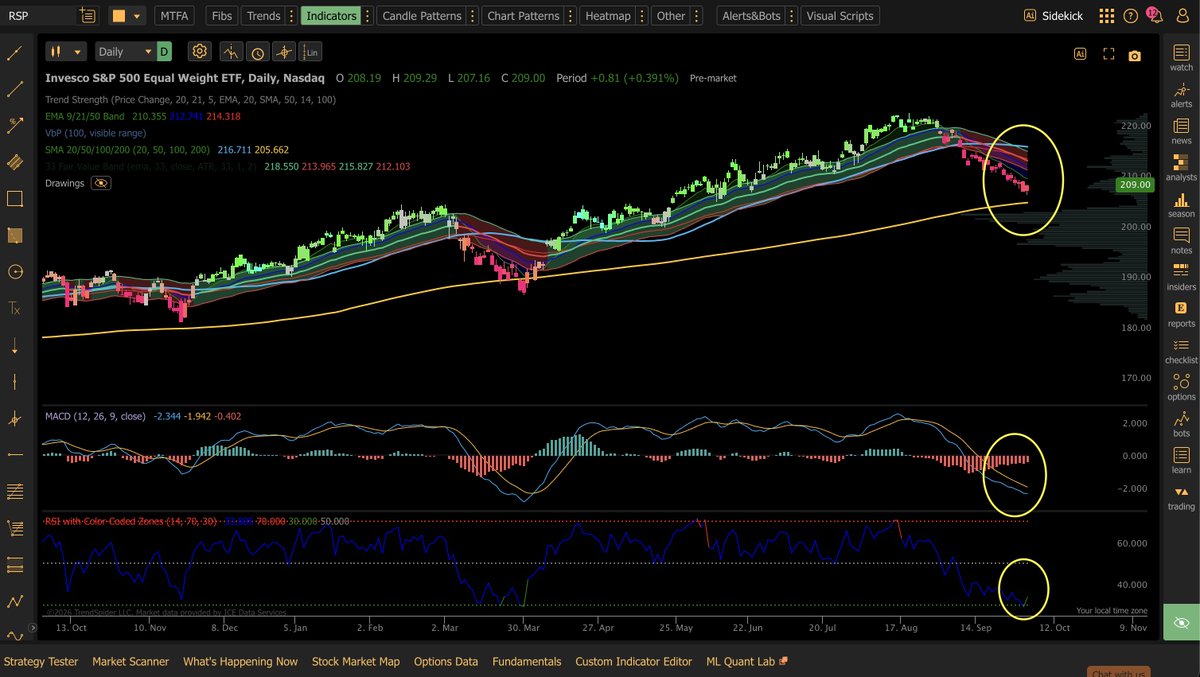
We have a K-shaped stock market right now.
Most of equity gains are being powered for the AI names.
Equal Weighted SP500:
$RSP has actually been in retreat for quite a bit. Its about to hit the 200 day MA and RSI and MACD are hitting oversold levels.
Market Cap Weighted SP500:
$SPY has top 20 of companies weighted at 50% of the index.
Even if the AI theme starts to slow down next year or the year after, there could likely be a powerful upward move in the rest of the market thus buffering any major downturn.
The key driver for the rest of the market to pick up would be centered around AI Capex Growth moderation + Iran War resolution. That could drive down yields and boost valuations for Non-AI trade companies.
Introducing FLUX 3 Image.
Control every pixel.
Make precise multi-turn edits without changing any other pixel.
Lay out the image exactly how you want using bounding boxes.
Generate in up to 4K to preserve details.
Use up to 10 references to compose an image.
Commercial Weights available for companies running image generation at scale.
Open Weights version of FLUX 3 Image is launching in the coming weeks.
@amesabuodia This goes for all people across the world.
Why do you think immigrants flourish everywhere?
People who haven’t seen the world always speak shit like this.
I believe the two companies best position to win the AI race are Google and Meta, not OpenAi or Anthropic.
The first reason is simple: Google and Meta both have different businesses to indefinitely fund their AI effort without taking out debt. This allows them to undercut the pricing of Anthropic and OpenAI to gain user adoption and market share.
The next is distribution and friction: ChatGPT and Claude need to ask for your permission and have you log in to grant access to gmail, drive, calendar, etc. Google owns all of these properties and will make it frictionless to integrate into Gemini's agent.
Meta has to ask for permission as well, but Meta has a level of consumer distribution that OpenAI and Anthropic could only dream of - 3.6 billion people using their service every day. Meta can out-spend without debt while pushing Muse day in and day out for user adoption.
I share more about this thesis in the full episode today.
https://t.co/SL0qwynVVM
I’m sorry, but is this not how an airport works with or without any “Abhiyan” ?
Is this account a literal joke? Why is @aaibpiairport boasting about doing their fundamental duties?
Am so confused.
As part of Yatri Sewa Abhiyan, timely announcements regarding boarding gate changes are ensured to keep passengers informed and facilitate smooth boarding operations.
#YatriSewaAbhiyan2026
We have a Stitch MCP. We have a Stitch SDK. But, we don't have a Stitch CLI. Well, not until now.
Introducing the @google/stitch CLI:
🔷 Connect to your local coding agents
🔷 Generate screens and design systems
🔷 Send a local dev server snapshot to Stitch
Do it all without leaving the terminal or better yet, ask your favorite harness like @antigravity 😎
Learn more 👇