Was a really negative person in my early 20’s. When I left finance for tech, MD in exit interview told me “When you go to a dance, nobody wants to dance with the guy standing around. All the women want to dance with the guy who’s having fun and dancing. Always be dancing”
The temptation for smart and hard-working people is to "brute-force" problems with their brains, muscles, and hearts.
- Brains brute-forcing: spend your brain cycles on clever/complex solutions or solving problems "because you can" instead of asking, delegating, prioritizing, or just doing what worked for others. Over-engineering, reinventing the wheel, and busywork fall in this category.
- Muscles & Heart brute-forcing: you get things done by spending more effort on them: longer hours, fewer breaks, "doing what others wouldn't do," etc.
Since these two approaches make you succeed where average people would fail, it doesn't feel like brute forcing. It feels like the way it's supposed to work.
And it does work. But it's still brute forcing. It's still inefficient. It requires effort that is sustainable as long as your responsibilities are smaller than your brain and heart, but don't scale beyond that.
This is problematic for several reasons:
- Your bosses know that. They are afraid that if they increase your responsibilities, you will have to either drop some balls or burn out.
- Your over-engineered solutions may be okay for you, your brain can handle that, but they will be hard to get adopted by others, whose brains may have less free capacity than yours.
- Your time-intensive tactics are fine when you're 24, in your prime, single, and with lots of free time, but you will face hard constraints when you get older and start growing a family.
But most importantly:
- Because you brute force using your brain, muscles, and heart, you do not prioritize. This is fine as long as your responsibilities are tiny and you get to still work on the one important task. But as your responsibilities grow, you will find yourself unable to focus on the one important task. And that is bad. Moreover, you may not have developed the sense for what is the one important task. Which means you may be putting your brains, muscles, and heart to use on tasks that do not matter that much after all.
And you will not see it, because to you, you're doing what used to work, and if it did work in the past, it must still be working now, mustn't it?
But it doesn't. What works is to work on the one thing. And freeing as much time as possible for you to work on the one thing. But of course, you cannot realistically decide to just not do a lot of tasks which fell into your circle or responsibility. Hence, the importance of learning to do things "good enough but efficiently." Which, paradoxically, is sometimes easier when you have fewer brains and muscles and heart, so brain-intensive and effort-intensive alternatives are precluded.
This is why it's important, as a young graduate, to learn to direct your brains and muscles and heart to the one thing, and not to use them too much on everything.
(Note that I wrote this having in mind precisely the type of person who is prone to making this mistake; others may make the opposite mistake, and underuse their brains and muscles and heart, not even on the one thing. Also, I'm deliberately using exaggerated language; reality is more nuanced. The idea is that this post will help you understand if you're committing the directional errors mentioned, and if so, adjust one or two steps in the appropriate direction, without taking everything literally.)
https://t.co/qxUNGJF6mj
The most manipulative but effective thing I’ve ever done in my life was when I read an article about how children moderate their behavior to protect their self-identity, so if a child believes he’s smart, for example, he’ll intentionally study and try to do well to protect his image of himself.
Anyway, I would pull kids aside with behavioral issues at church and tell them, “David (obviously fake name), you’re such a kind person and such a good listener. I can see that in you. Thank you for always listening.” “Little Annie, thank you for taking such good care of the babies around you. You’re going to be such a good big sister. Can you be in charge of watching Sally?”
They would ALWAYS behave afterward. ALWAYS. Worked like a charm. Morally questionable because it wasn’t initially true, but I kind of willed it into existence. Tbf, I did think that they had that in them or I wouldn’t have tried.
Will publish longitudinal results of this method once my kid is old enough to report back.
I sometimes speak at career events for 22- to 24-year-olds.
A common pattern I see among the ambitious ones is that they try to become “all-rounder problem solvers” for their bosses. I was one myself 15 years ago.
A better approach, though, both for your career and for your life outside work, is to become your boss’s problem solver for the one problem that is at the top of their mind.
One reason is, obviously, Pareto. But there are two more that are especially non-intuitive yet useful for recent graduates:
- It forces you to understand how businesses work.
- It forces you to stop using time, effort, and general smarts as your main leverage points. Those work well in entry-level roles, but they do not scale.
There is a certain type of person everywhere now, especially online.
He consumes endless information every day: philosophy, psychology, productivity, spirituality, neuroscience, business, self-improvement, history.
He knows a little about everything and deeply experiences almost nothing.
His entire identity becomes built around understanding instead of living.
He watches videos about confidence instead of speaking confidently. Reads about discipline instead of becoming disciplined. Studies relationships instead of learning how to love. Consumes motivational content instead of taking action.
He feels intelligent because he is constantly mentally stimulated. But stimulation is not transformation.
Most of the time, knowledge becomes emotional protection. Reality is unpredictable. Reality humiliates. Reality exposes weakness. Books and ideas do not.
Inside information, he can continue imagining himself as intelligent, deep, insightful, different from ordinary people. So he remains trapped in preparation.
He constantly feels as if he is "becoming" someone, while his real life remains strangely untouched. He develops sophisticated language for problems he never confronts directly. He can explain human behavior beautifully while being unable to handle ordinary discomfort, rejection, uncertainty, loneliness, or risk.
He slowly turns life into observation instead of participation.
The internet rewards this personality heavily. He receives validation for sounding aware rather than becoming capable.
Eventually, he begins confusing self-analysis with growth and information with wisdom.
But beneath the intelligence usually exists the same thing: fear. Fear of failure. Fear of embarrassment. Fear of reality answering back.
Because action destroys fantasy. The moment he truly acts, he can no longer hide inside potential.
The older I get, the more I realize the power of always having something on the calendar you're excited about. It can really be anything. Difficult physical challenge, big project, fun trip, ambitious goal, whatever. It creates energy and gets you through the lows. Life hack.
This is free advice from an expensive psychologist. If you’re an anxious person, do everything for fun. Go to a job interview for fun. Submit documents for fun. Start a blog for fun. Anxiety feeds on importance. Don’t make everything a matter of life and death.
I say this to my kids all the time. Do it for the plot. Do it for the story. Tell yourself if it all goes wrong it will just be a funny story. Ironically job interviews, dates, and public speaking go better anyway if you're just happy to be there and not overthinking it!!
Let me be very real with you and break this down psychologically.
You can be on a yatch in 3 ways
1) You buy the yacht (Billionaire status)
2) You rent the yacht (Millionaire status)
3) By associating and knowing the people that are on the yacht
Chefs, Bartenders, Mechanics, etc... Are all on these yachts enjoying the prestige and luxury, just because they are associates of the people on the yatch.
The chefs might not be billionaires. The bartenders might be on a 4,000 USD per month salary... But they are on that yatch, laughing and joining in on discussions and music... With the elites present there
.
.
.
Realistically, the easiest way to access luxury is to associate with the owners.
In Nigeria, a man called "Ola of Lagos" did this. He started with car spotting in Lagos. And that gradually built his association with the wealthy elites of Nigeria.
Then he started doing private luxury car reviews in these elites homes.
Today, he flies on Private Jets, goes on yachtes, travels the world together with these elites.
.
.
SuperCar Blondie also did this too and it gave her access
The school of Hard knocks is also a good example of this. He interviews the elites and that gave him association gradually.
And this guy that asks luxury car owners "what do you do for a living"
.
.
My point is that, the rich/elite loveeeee exclusivity.
They want to feel particular and singled out.
You have to brand yourself in a way that offers them this exclusivity. And they will gradually associate with you.
For instance..
These yatch owners will rather hire a person that says "I am a chef and I have worked on 4 yatches and 2 cruise ships"
Than the person that says "I am a chef and I have 20 years of experience and 50 intercontinental recipe knowledge"
Both chefs are experienced, but one brands himself as more exclusive for that particular experience. And he will get the hire eventually.
.
.
.
So if you know you don't have inheritance in Billions. And you don't have that head start to investing 30 million USD in stocks at age 18...
The most effective privilege you have is information and access (which social media has made soooo easy already)
Brand yourself exclusively and super niche down.
Do this and you will build the associations that will eventually get you on luxuries like these yachtes without even having a bank balance of 5k USD
.
.
Many of these elites have places they hang out in.
To get into those places will cost a lot, but it will worth it.
An Instagram photographer guy went to Beverly Hills where a lot of Hollywood celebrities hang out at. And he started taking random photos of them and call to show them afterwards.
He took of Dembele the footballer. He took The Rock
Tom Cruise
Jamie Foxx
Etc...
And some of them collected his Instagram handle and commented when they saw the guy post their photos.
.
.
That's exactlyyyyy what I'm taking about.
Go where they are and offer exclusive value.
If you know you have a lot of value to offer, than rebrand yourself so wellll.
And remember, hardly will they look for you. And it would even be worse if you don't make yourself visible enough.
So put yourself out there. Brand yourself well. And just enjoy new experiences and meeting people.
This is how association is built overtime
This is how to be on a yacht without ever owning one.
.
.
✍️ Vincent the Therapist
The best people I know at cold emailing will spend two entire days reading every single paper a person has written, and then a third day writing the email itself
I think this is one of the most unconventional advice on cold emailing: be extremely intentional with who you want to reach out to, and seriously put the work to make yourself noticed
Young UK people are being sold a lie that they need to be investing in stocks at 22.
Stock portfolios are nearly useless to most people in their twenties because the amounts they can realistically invest are too small to matter.
£100 a month in an ISA over 5 years grows to maybe £7,000 — not life-changing money, a few months of rent.
What actually moves the needle in your twenties is increasing the salary the £100 came out of. Going from £30K to £60K in 5 years isn't unusual for somebody who deliberately invested in their skill set. That's an extra £18,000-£20,000 of after-tax income, every year, for the rest of your career.
The maths is brutal: every hour you spend optimising a small investment portfolio is an hour you didn't spend learning the skill that would double your earning capacity.
Stocks are a tool for the wealth you've already built. Skills are how you build the wealth in the first place.
Most 22-year-olds reading personal finance Twitter would be much better off ignoring it entirely for 5 years and putting that focus into becoming worth 3x more in the labour market. Compound interest on a skill compounds harder than compound interest on £100 a month.
Let me explain this for people who do not do research for a living.
Research papers are not written like novels. They are structured from the start with the view that most people will selectively read its content based on their needs. Most will glance at the abstract to find out what are the question, method, main results. Others will go further and read specific sections in details. Almost no one will read the entire paper.
There are use cases of citations that involve a low effort in reading. If you want to know if your results align with others, you don't need to understand the nuance of footnote 8 in the online appendix. You just read about the method, the data, and the key results. It's minutes, not hours. Another example is when you use a method that was introduced by a paper or a series of papers. You just need to know if the method is there. That takes seconds.
Now, there are other use cases where you have to read all the fine prints. If you extend the analysis of paper, criticize it, or want to contrast your results to theirs, nuances are not optional. That can be measured in hours or even days.
Most of the problems with citations that you will find are about the first situation, not the second. So, the situation isn't that people are not engaging deeply with imagined content they did not read. The situation is laziness or, sometimes, limited knowledge spread errors.
For instance, a few people misinterpret a result and erroneously cite a paper for it. You then come across 10 people who claim that X found Y. You should spend a few minutes to go check that it is true, but some people do not and repeat the claim. The error can also enter later. A few people might say that X found Y, but a few rounds of telephone game later Y became Z because people loosely interpreted each other instead of going back to the source every time. Again, all of them should check directly, but not everyone does.
A more excusable type of error involves the attribution of origin. No one knows the full set of all relevant papers on a topic, so it's possible to misattribute origin in good faith without being lazy. I gave an example of that recently with Jorda and local projections -- they date back to Dufour and Renault (1998), as far as I know.
Now that you all the lay of the land, let's go back to what happened here. She lazily repported what others repported without double checking. We're very far from using the hallucinated references made up by a chat bot or from arguing with strawmen instead of other papers.
I don't know about her field, but I have never caught anyone getting into a detailed response to papers they did not read in my field -- economics. If you believe otherwise you're a dumbass. Also, that would be amusingly hypocritical if you did not read as many papers as I did before making that bold claim. The errors that do slip through tend to be annoying, but ultimately inconsequential -- i.e., answers to important questions are unaffected.
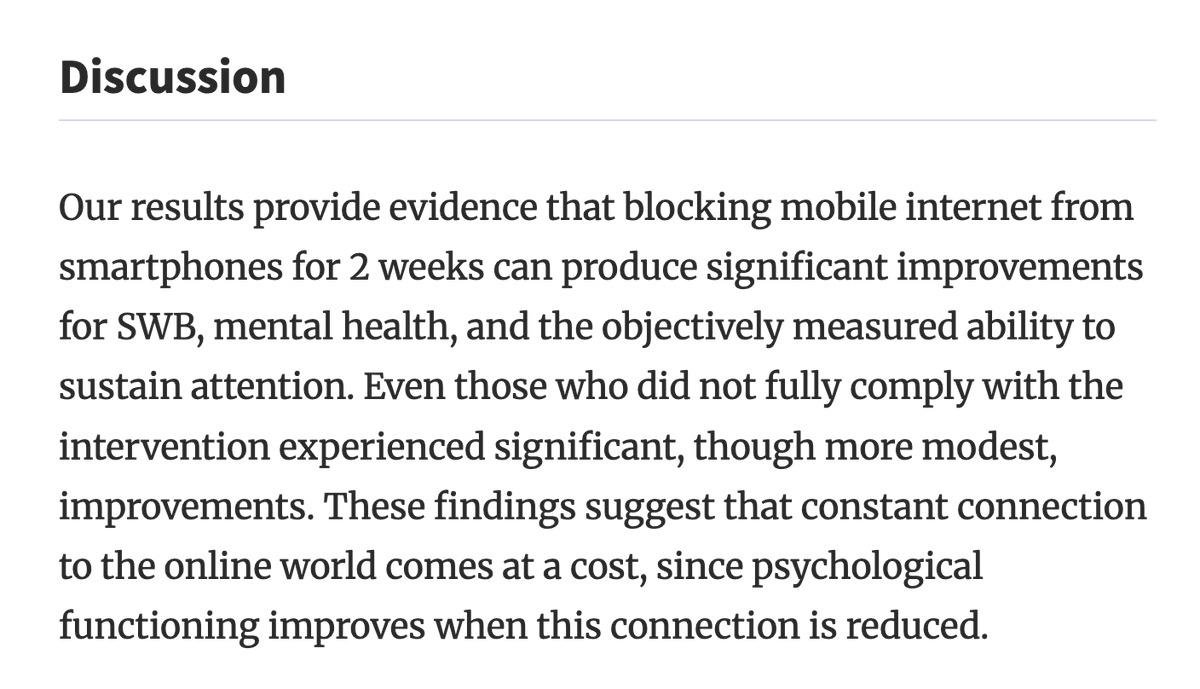
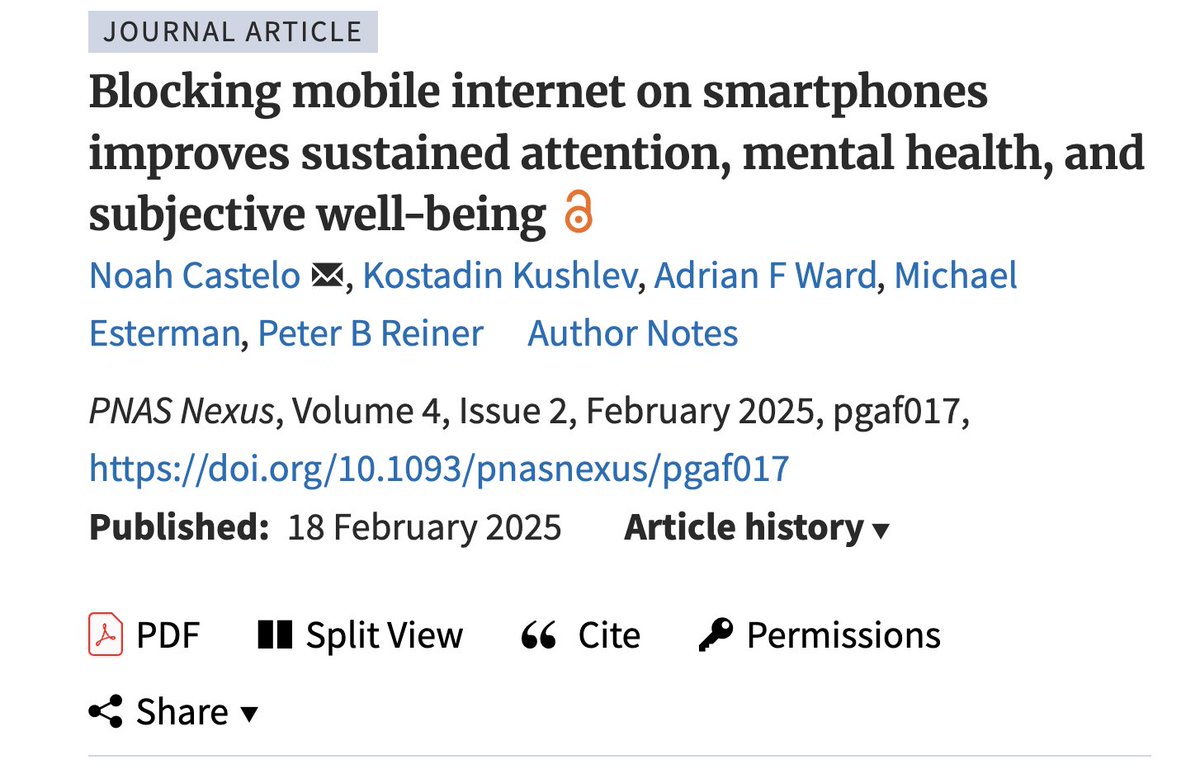
In adults, limiting smartphone functionality to texting and calls and blocking all social media and mobile internet for 2 weeks significantly improved attention, self-reported well-being and mental health. 90% of participants experienced a benefit.