‼️💥
With all of the political maddness going on, I forgot to post about our latest preprint.
A short thread with link at the end:
1/5
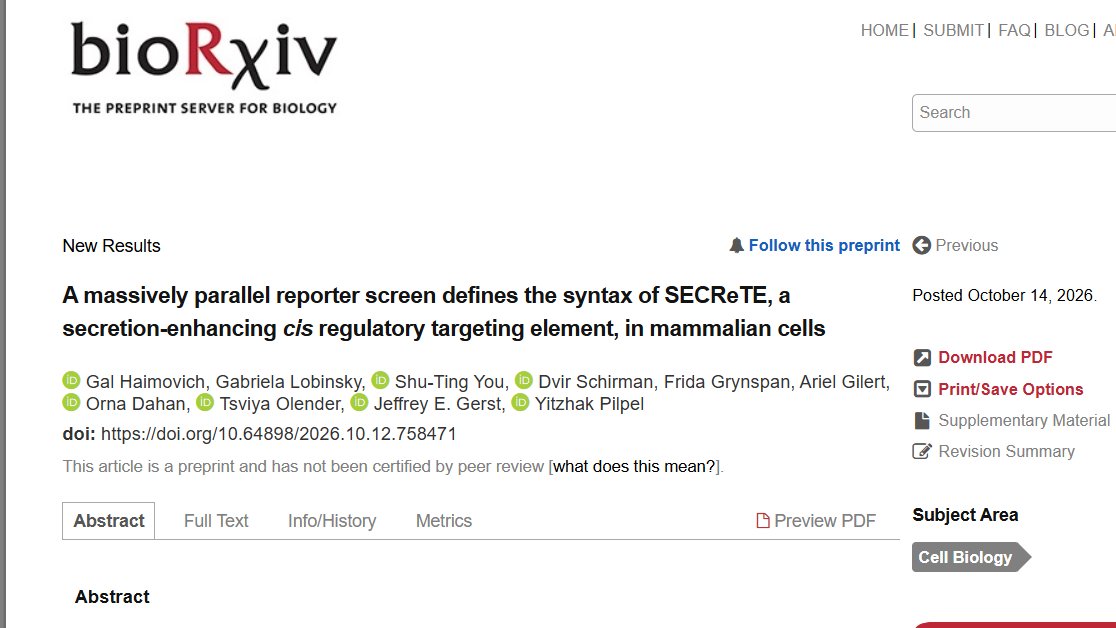
This work was a collaboration with @TPilpel. Years ago, our two labs discovered SECReTE, a cis-element that is enriched in mRNAs encoding secreted or membrane proteins (secretome). SECReTE is a degenerate motif, defined as at least 10 consecutive NNY or NYN triplets (N – any nucleotide, Y – U or C). This motif enhances mRNA localization to the endoplasmic reticulum (ER) and promotes higher levels of the secreted protein product.
>>
@LinkedIn@LinkedInHelp Try to fix your login workflow. It always shows an error. I don't have access to my old phone to recover my account. Your login system doesn't offer me any other options, like email. Your manual ID checker for identity verification also doesn't work.
Hot take: I don’t care.
I work to treat Alzheimer’s and ALS, among other neurodegenerative diseases.
Any of these companies wants to do it for me?
I’ll take it. Heck, I’d pay them.
We, the Weizmann Institute of Science community, deeply mourn the passing of Prof. Ada Yonath of the Institute’s Chemical and Structural Biology Department. Prof. Yonath pioneered the study of the ribosome, the cell’s protein factory, and was awarded the 2009 Nobel Prize in Chemistry for her research in this field. Her decades-long scientific journey led to an understanding of how various antibiotics work, helping pave the way for the development of new antibiotics and the fight against antibiotic-resistant bacteria.
Yonath, the first Israeli woman scientist to win a Nobel Prize, also received dozens of other awards and honors, including the Israel Prize in Chemistry and the Wolf Prize in Chemistry. Prof. Yonath exemplified how scientific vision, the courage to choose a major scientific question and unwavering dedication to its pursuit can lead to extraordinary achievements and expand the boundaries of knowledge for the future of humanity.
May her memory be a blessing.
https://t.co/HXKGqen1k5
🆕 review with @jp_unfried out in @NatureSMB 🧐. Direct roles of lncRNAs in transcriptional activation. What do we understand about how lncRNAs lure Pol2 and set the stage for RNA production, and what do we still miss? https://t.co/iYJQ7Rbb9d
🚨Why can’t mammals regenerate limbs like frog tadpoles or salamanders?
In our new paper in @ScienceMagazine, we show that species-specific oxygen sensing acts as a gatekeeper for initiating limb regeneration 🐭🐸
🔗 https://t.co/oTjoiiJyBj #EvoDevo
Supervisors who invest in positive mentoring relationships with their PhD candidates also reap the benefits for their own research
https://t.co/r0oyhUwRZv
ERC Starting Grant for Juliane Glaser to study role of epigenetic mechanisms, specifically the control of transposable elements, in mammalian embryonic development.
Read all details here: https://t.co/1h6yXuBgpS
Congratulations🥳 @GJuliane_@ERC_Research#ERCStG
Researchers are studying why mitochondria are moving between cells and whether the process can be harnessed to treat cancer and other diseases
https://t.co/Zl4HCuw0V8
💡 Cancer cells don’t just mutate—they reorganize their DNA in 3D space.
Our new study shows how the genome’s folding pattern shifts as tumors progress, cell by cell 🧩🧬.
It’s the first 3D genome atlas of cancer progression.
Thread 👇
I am excited to share that I will join the Friedrich Miescher Institute @FMIscience in Basel as a group leader, starting in March 2026 🎉
We will explore cell fate regulation during organogenesis, with a focus on how cell elimination underlies the emergence of functional tissues.
We’re looking forward to welcoming @BatkiJulia as a new Junior Group Leader in Multicellular Systems! Excited for the fresh perspectives and expertise the Batki lab will bring to our research community 🧬