Andrej Karpathy spent 8 years at OpenAI and Tesla
Last week he compressed everything he knows into one free 2-hour lecture
Prompts → Agents → Harness → Graphs → Loops
People spend $15k on bootcamps that teach less than this
You probably don't have 2 hours right now
Don't let it vanish from your feed
Watch it, then read the full Opus 5.5 harness engineering guide below
After co-inventing ChatGPT, I kept asking myself: why have superhuman chat models not led to AGI?
I’ve spent the last 2 years in stealth building a new way to train models (RLCD), and a new type of frontier AI model that we are releasing today: Jev
• 20-200x faster
• 40-400x cheaper (w/ output tokens free)
• Frontier composable intelligence optimized for decisions
AFAICT the shortest path to AI-based economic revolution
Jev is the FASTEST AI model ever built for AI Agents
It decides what happens next in milliseconds, at almost zero cost
Most builders will use it in the wrong places
In this article, I show you when to use it and when not to
Full setup: https://t.co/oBZePNgAHW
ChatGPT has now a big problem.
Researchers at Oxford and Cambridge exposed a massive threat to large language models.”
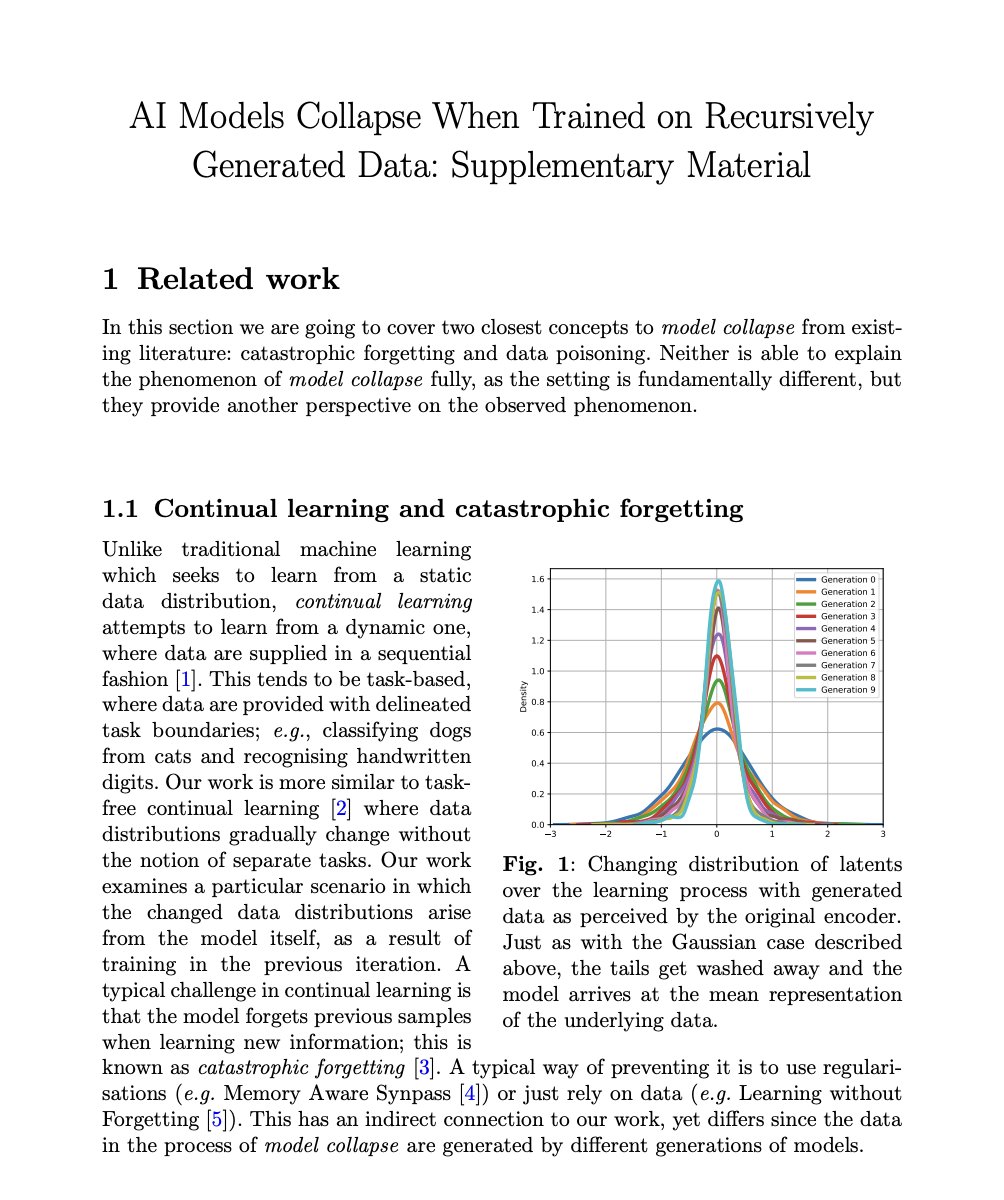
They call it “model collapse."
Internet ecosystem is rapidly changing, and generative AI will soon contribute much of the text found online. This forces us to consider what happens to future iterations like gpt-n when they are trained on data scraped from the web that was already generated by an llm.
According to the research, indiscriminately using model-generated content in training causes "irreversible defects" in the resulting ai. the model loses the "tails of the original content distribution." in other words, it begins to forget the creative, fringe, and unique nuances of actual human writing, collapsing into a repetitive echo chamber.
This isn't just a chatgpt issue.. the researchers built theoretical intuition showing this collapse is ubiquitous across learned generative models, occurring in large language models as well as in variational autoencoders and gaussian mixture models.
Tech companies rely on scraping the internet for large-scale data to build smarter models. However, the paper warns that if we want to sustain the benefits of training on web data, model collapse must be taken seriously.
Ultimate takeaway? data collected from genuine human interactions is going to become increasingly valuable in a web filled with ai content.
SHOPIFY FACILITATED $378.4B IN SALES IN 2025.
here's the 3-step playbook you can copy:
1/ own a recurring job.
merchants need a storefront and POS before they sell anything. Shopify's subscriptions brought in $2.75B.
your move: make one painful, repeated task easier. charge for a core product that's useful on its own.
2/ host the key event.
buyers purchase from merchants through Shopify's platform. that created $378.4B of GMV — merchant sales, not Shopify revenue.
your move: design your product around the transaction or usage event your customer cares about most.
3/ solve the next problem at that moment.
Shopify offers payments, FX, lending, shipping, hardware and ads around merchant activity. merchant solutions brought in $8.8B, or 76% of its revenue.
your move: add ONE optional service when it saves the customer time or money. you can integrate an existing provider; you don't need to build a payment network.
example: booking software → paid scheduling tool → payment collection when a booking happens.
track 4 numbers: active customers, key-event volume, add-on adoption and gross profit. Shopify's merchant solutions had ~38% gross margin vs ~81% for subscriptions, so extra revenue isn't automatically better revenue.
steal the architecture, not the scale. the one-page worksheet is below ↓
jev + opus 5.5... this is the best change i've made to my claude setup.
in my setup, opus stopped burning time on decisions i already made.
→ reuse answers from my decision log
→ take a safe default when it's reversible
→ park what needs me and keep building
→ hard rules never reach jev
opus does the work. jev decides which questions actually need me.
steal this 👇
یه فایل ساختم از ٨۵٢تا لغت مورد نیاز برای آزمونهای A2 هلندی با ترجمه انگلیسی و فارسی که از منابع مختلف جمع و چندین بار فیلتر و تو ٣١موضوع مختلف و تو ٣ درجه اهمیت دسته بندی شدن! 🤌
(لینک کوتاه شده و فایل تو گوگل درایو هست)
https://t.co/vr91g4aoGP
اگر استقبال ازش خوب بود منابع و اپهای دیگهای هم که برای امتحانات هلندی ساختم رو بعدن میذارم!
Anthropic just dropped the best 1-hour workshop on how to build with AI in 2026: from one prompt to Agentic Loops
00:26 - The end of prompting
16:57 - Self improving Loops
25:27 - 1 engineer, 5-person output
36:25 - Building your first Loop
This 1-hour watch replaces any $500 AI engineering course.
Watch it, then try your first Loop with the step-by-step guide below.
Godfather of AI: "If you sleep well tonight, you may not have understood this lecture."
This 47-minute lecture is the best thing I've seen about AI in the last few months.
Hinton built the neural networks behind every AI alive, then quit Google to warn us it's already ahead of us on most cognitive tasks.
Despite that, most people open Claude, type one thing, close the tab and think they're using AI, but they're using maybe 10%.
I turned his talk into 17 Claude features 99% of users never find.
Watch the lecture, then read the article below.
Anthropic engineers just showed how they build a full app from scratch, using a loop of agents.
40 minutes from the team behind Claude Code.
They used three agents: one to plan, one to build, one to judge, cycling until the app actually works.
The winners won't have the smartest model, they'll have the best loop.
Watch it, then read the full guide on how to actually use loops below.
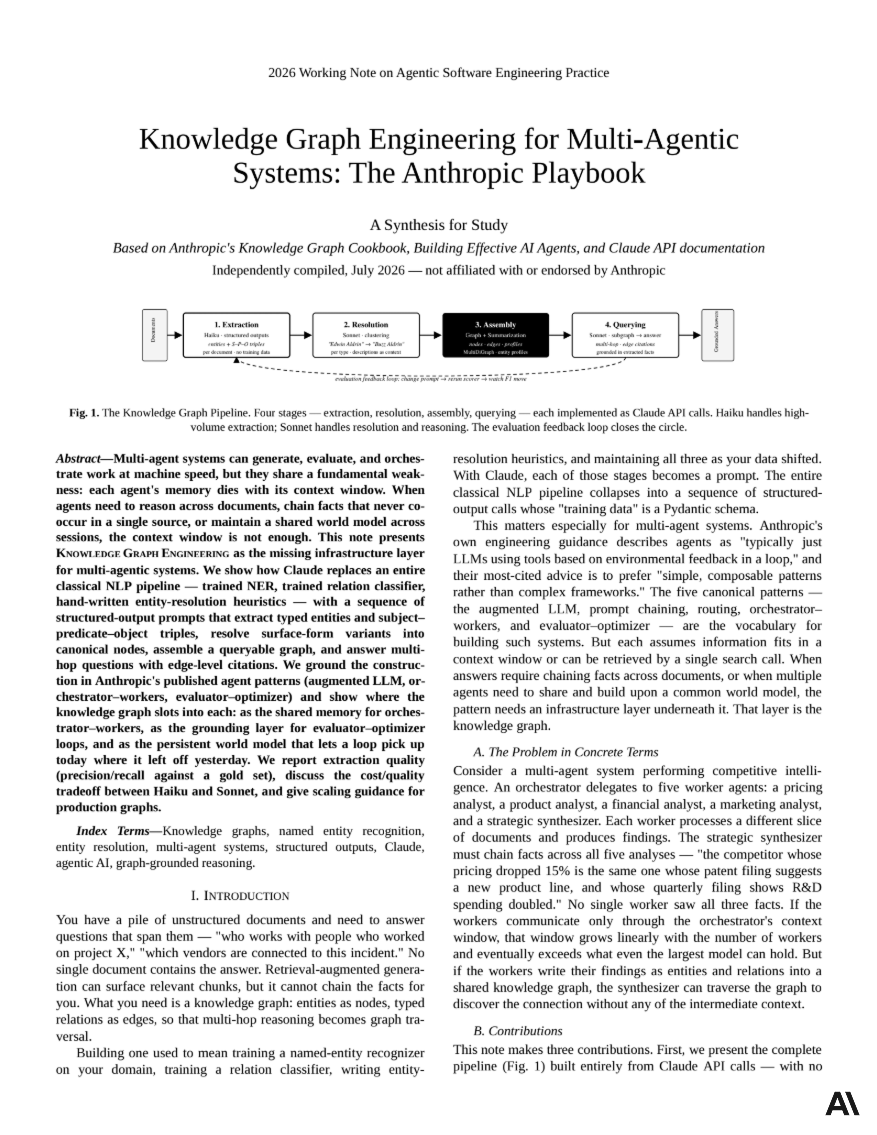
A senior Anthropic engineer just dropped 12-page PDF on "Graph Engineering" for multi-agentic systems.
The shift: your agents memory dies with their context window. A knowledge graph makes it permanent.
Extract → Resolve → Assemble → Query → Repeat
Every agentic graph has 5 stages:
• Extract: Haiku pulls entities and S-P-O triples. One call per doc. The Pydantic schema is the only training data.
• Resolve: Sonnet clusters "Edwin Aldrin" → "Buzz Aldrin" - zero string overlap - using descriptions as context.
• Assemble: canonical nodes, typed edges, provenance on every triple. One connected graph.
• Query: serialize a subgraph → Sonnet reasons over triples → every answer cites a specific edge.
Plug this into multi-agent systems as shared memory.
Workers write to it, evaluators fact-check against it, loops persist overnight with it.
This 12-page PDF changed how I'm building multi-agent systems today.
Read it now, then explore the article below.
Demis Hassabis:
"In the near future, one person who knows AI will outperform an entire startup team"
I've watched hundreds of AI talks, this 60-minute Cambridge lecture is the one I wish I had seen a year ago.
A Nobel Prize winner and the CEO of Google DeepMind just told you where this goes.
The person who outperforms a whole team isn't smarter, they just know their tools deeper.
Watch it, then read the full breakdown of the Claude features 99% never find below.
اگر میخواین Pipeline کامل LLM راه بندازین این آموزش رو از Andrej Karapathy ببینید. البته معرف حضور اگر نیستن، آندره کاراپاثی از آیتاللههای LLM هست و همبنیان گذار OpenAI.
اگر به این حوزه هوش مصنوعی، LLMها، Generative AI و ... علاقه دارین، به نظرم یکی از بهترین سورسهای آموزشی این حوزه هست. دست به دست کنید برسه دست بقیه جوونا.
اینم محتوای ویدیو:
00:00 — مقدمهای بر LLM
12:41 — کل Pipeline برای Trainکردن LLM
31:58 — ابزارها و پلاگینها
41:14 — معماری Transformerها
2:19:02 — نحوه Scale کردن LLM