How do brains “infer” the world’s state from noisy sensory data—and do so “dynamically?”
Our new theoretical framework bridges these two perspectives in a brain-inspired model👉🧵[1/n]
w/ amazing co-lead @dekelgalor & polymath mentor @jcbyts
📜preprint: https://t.co/xmjFLintZb
Hopfield networks are a foundational idea in both neuroscience & ML 🧠💻
The latest video introduces the world of energy-based models and Hebbian learning 📹
A first step to covering Boltzmann/Helmholtz machines, Predictive coding & Free Energy later :)
https://t.co/sq8obkIpLy
"Functional connectivity" is simply a measure of correlation/covariance of signals. Does not measure communication between systems because we know that correlation can come about for lots of (too many) uninteresting reasons. Terrible name but stuck, other areas are using it too.
@JamesMHarrison_@PessoaBrain Our findings might also be in line with the whole entangled brain idea @PessoaBrain; the "energy saving" extends across both sensory and higher cognitive networks.
@JamesMHarrison_@PessoaBrain CMRO2 is the cerebral metabolic rate of oxygen consumption (in µmol/100g of GM tissue/min), which we measured with multiparametric quantitative BOLD, combing imaging of hemodynamics and oxygen extraction (2/2)
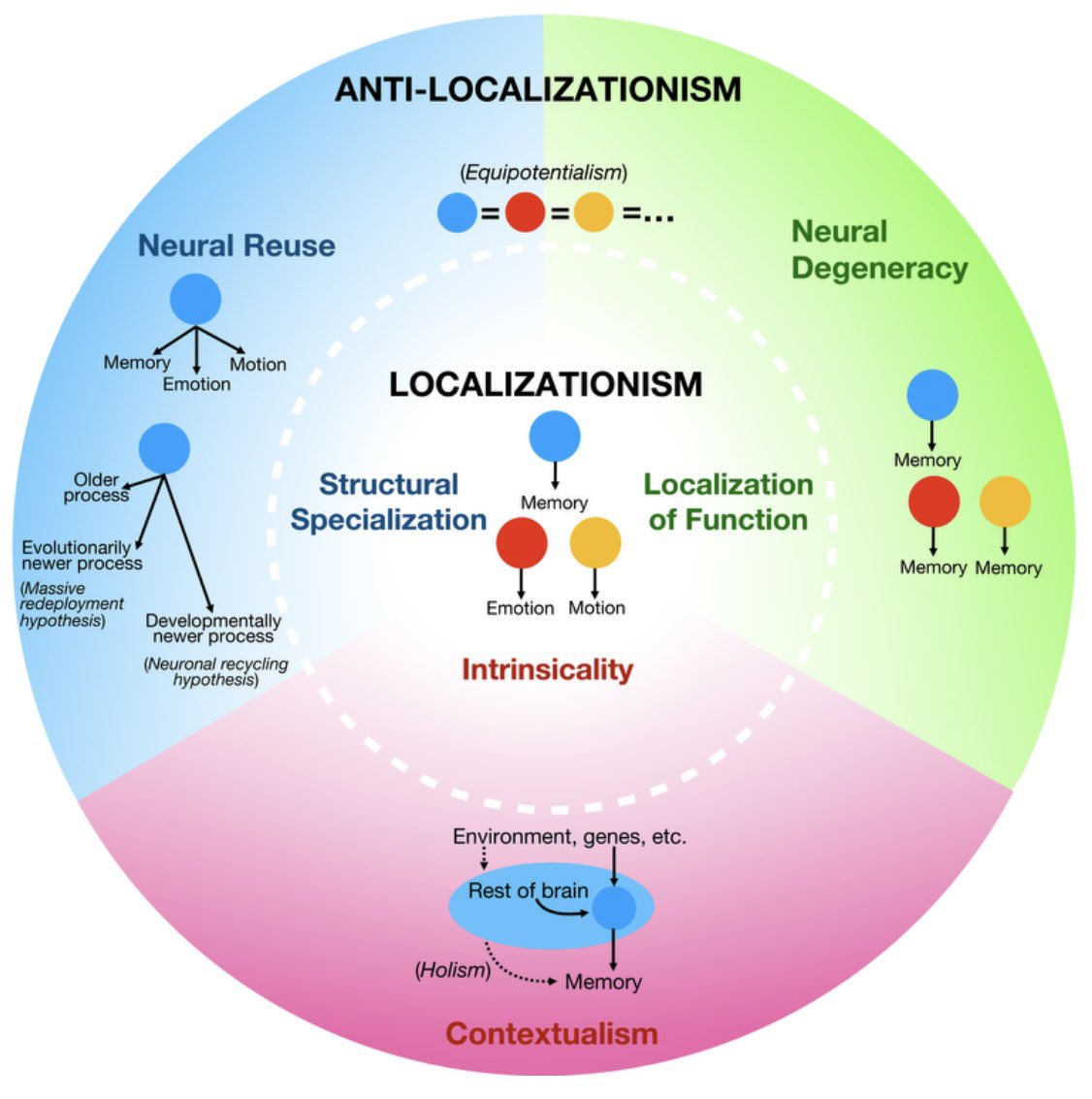
𝗧𝗵𝗲 𝘁𝗶𝗽 𝗼𝗳 𝘁𝗵𝗲 𝗶𝗰𝗲𝗯𝗲𝗿𝗴: 𝗔 𝗰𝗮𝗹𝗹 𝘁𝗼 𝗲𝗺𝗯𝗿𝗮𝗰𝗲 𝗮𝗻𝘁𝗶-𝗹𝗼𝗰𝗮𝗹𝗶𝘇𝗮𝘁𝗶𝗼𝗻𝗶𝘀𝗺 𝗶𝗻 𝗵𝘂𝗺𝗮𝗻 𝗻𝗲𝘂𝗿𝗼𝘀𝗰𝗶𝗲𝗻𝗰𝗲 𝗿𝗲𝘀𝗲𝗮𝗿𝗰𝗵
Happy to contribute a little to piece led by
@sNeuroble@psychonetrics@DScheinost
https://t.co/JXV8PPjDxI
The next chapter about transformers is up on YouTube, digging into the attention mechanism: https://t.co/TWNXiWM2az
The model works with vectors representing tokens (think words), and this is the mechanism that allows those vectors to take in meaning from context.
After 25 years of fMRI I no longer know how to analyze data... In more continuous paradigms at times all the brain "responds". ALL 85 threat-related regions got engaged when player runs away from chasing threat (t < 0) and enters safety (t > 0).
3 clusters of region responses:
Many people have heard the "in from three to eight years we'll have a machine with the general intelligence of a human being" quote from 1970, but much fewer have read the article it came from. It's a great read!
@KordingLab@ProfData Once a model generates the correct results from a paraphrased description of background and methods (instead of an indirect classification based on weights), the timepoint might come closer.
@ProfData@ken_lxl@ProfData: How likely do you think it is that the model learned the subtleties of human language when building up a certain type of result? Might a more powerful test be not to compare original vs. changed, but two paraphrased versions?




![hadivafaii's tweet photo. How do brains “infer” the world’s state from noisy sensory data—and do so “dynamically?”
Our new theoretical framework bridges these two perspectives in a brain-inspired model👉🧵[1/n]
w/ amazing co-lead @dekelgalor & polymath mentor @jcbyts
📜preprint: https://t.co/xmjFLintZb https://t.co/S3SkQhHNY2](https://pbs.twimg.com/media/GbBbIrZbQAATwUG.jpg)