Microsoft Scout is a new AI personal assistant built on OpenClaw. Scout is Microsoft’s "first real personal assistant," and you can download the desktop app today. Full details 👇https://t.co/ucR7KxMulX
Super excited to announce seven new world-class MAI models today. They represent what we consider a new era in AI designed to keep you in control and on the frontier.
First is our text foundation model, MAI-Thinking-1, exceptionally strong on reasoning and SWE tasks.
- It’s a 35B active parameter MoE with a 256K context window. Independent human raters on Surge prefer it for overall quality in blind side-by-sides versus Sonnet 4.6, and it’s achieved 97% on AIME 2025, the key measure of its general-purpose reasoning abilities.
- It's at 53% on SWE Bench Pro, placing it right alongside Opus 4.6 on one of the toughest coding benchmarks.
- And since we co-designed our models with our own silicon, MAI-Thinking-1 is optimized on our MAIA 200 chip. Benchmarking head-to-head against the GB200, we see 30% better performance per dollar as well as a 1.4x performance-per-watt gain when running our MAI models on the MAIA 200 end-to-end.
Next is MAI-Image-2.5 and its Flash variant. Two super strong models now at #2 on the leaderboards, surpassing the score of Nano Banana 2 on image editing.
Last for now is MAI-Code-1-Flash, our new inference efficient coding model, especially tuned for VS Code and GitHub Copilot CLI.
- Code-1-Flash achieves 51% on SWE Bench Pro, despite having just 5B parameters, putting it closer to Haiku in size but cheaper in cost.
All of this is the foundation for Microsoft Frontier Tuning. It lets you customize our models to create custom, company-specific agents that only you control. You can make our model, your model. Your data. Your agents. Your moat.
Early adopters are already seeing a difference. When we tuned our models for McKinsey’s tasks, MAI delivered the highest win rate, outperforming GPT-5.5 on quality, while being 10x lower on cost.
Also really excited to be collaborating with the amazing team at Mayo Clinic to jointly train a new frontier AI model for healthcare.
Our announcements today mark another milestone on the road to humanist superintelligence. You can learn more and about our other new models in our latest blog: https://t.co/v65eop5Ixq
Jeff Bezos: “People who are right a lot change their mind a lot”
“Because of AI, new technologies, and all the dynamism in the world, so many things are changing — and they’re changing rapidly,” Jeff observes.
The best solution he’s found for dealing with this rapid change is “thinking long-term” because it forces you to ask yourself, “What are the points of stability?” and “What is not going to change?”
He continues:
“One of the things that changes very slowly is customer needs. So you can build a strategy around customer needs. That will have durability.”
When building Amazon, for example, Jeff built the company around the customer needs of fast delivery, low prices, and vast selection.
“The technologies will change. Your competitive set will change. Everything will change, except those customer needs,” Jeff argues.
And it’s this idea that is behind Jeff’s core idea of “Be stubborn on the vision, and flexible on the details.”
He explains:
“You have to be [flexible on the details] because the world is changing and so you change your mind. I’ve noticed that people who are right a lot change their mind a lot. People who are wrong a lot are very stubborn on the details.”
Source: @reuters (Oct 2025)
My conversation with @RickRubin
0:00 Less Is More But Harder
2:00 Def Jam From The Dorm Room
4:00 Capturing Club Energy On Record
6:00 Going Deep On Influences
12:30 Why Reduced By Rick Rubin
14:00 Beatles Structure Meets Rap
16:00 The Ruthless Edit
19:30 Eminem: The Most Obsessive Artist
22:00 Lazy Workaholic
25:30 Protecting The Moment Of Magic
29:00 Dana White And Becoming A Podcaster
32:30 Professional Listener
44:00 Fishing And Showing Up
47:00 Johnny Cash And Constraints
55:30 Church Business vs. Banking Business
58:50 Run On Intuition Alone
1:01:00 Jay-Z vs. Eminem Process
1:04:30 In Service Of The Artist
1:09:00 Work As Diary Entries
1:13:30 Four Ways Success Destroys You
1:16:00 How To Sustain Success
1:21:00 The House On The Mountain
Includes paid partnerships.
📣 @GoogleAI’s Gemini 3.5 Flash is now generally available and rolling out in GitHub Copilot.
Early testing shows
➡️ It has strong tool use, fast response times, and high cache efficiency
➡️ It is it well-suited for fast, iterative agentic coding workflows
Try it out in @code. ⬇️
https://t.co/NvRNgYlKwm
Personal update: I've joined Anthropic. I think the next few years at the frontier of LLMs will be especially formative. I am very excited to join the team here and get back to R&D. I remain deeply passionate about education and plan to resume my work on it in time.
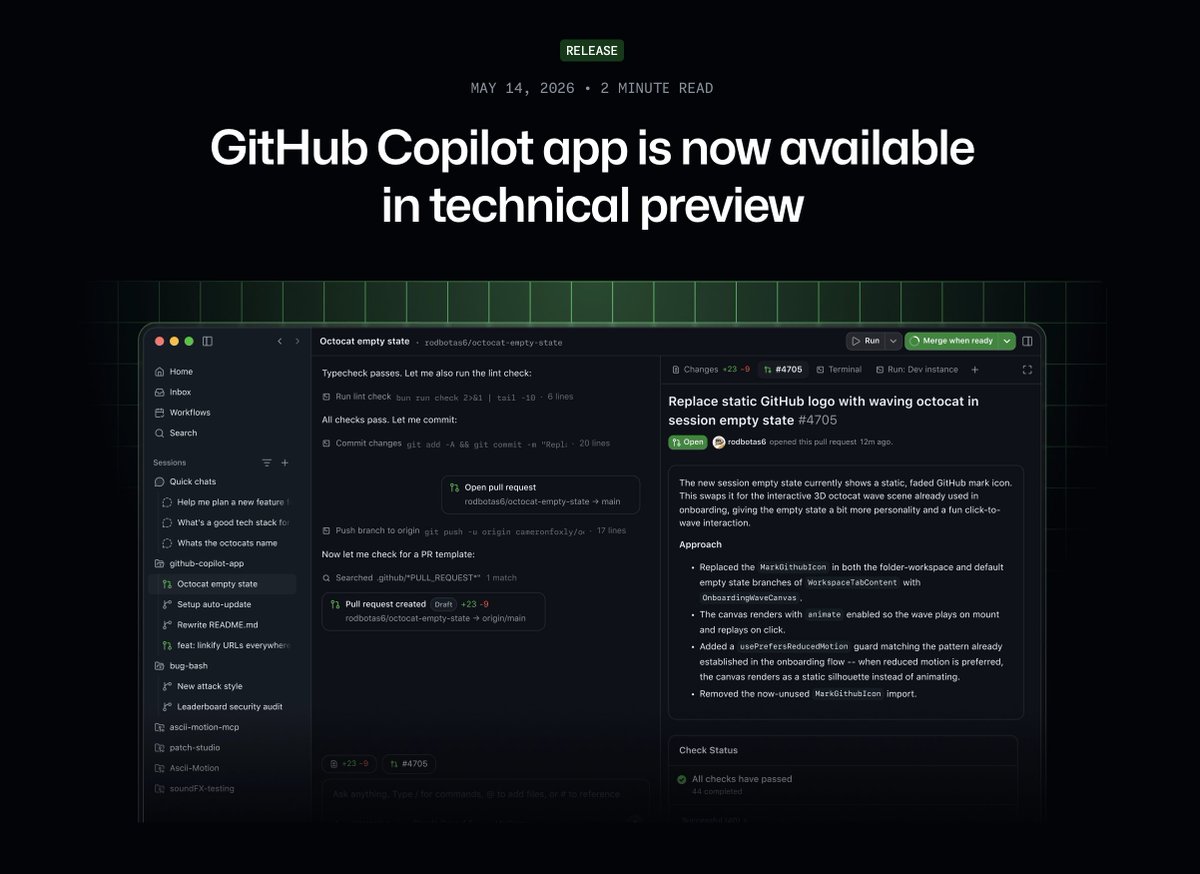
If you've been wondering what I've been up to, the team and I have been cooking up something new.
A new agent-native development environment deeply integrated with the GitHub graph. Not just for writing code, but all of the meta-work as well.
Big update for AI workflows in VS Code.
Bring your own language model/API key is now available in GitHub Copilot.
More flexibility. More control. More experimentation. 👇
https://t.co/k8BydNyG0t
Every agent will need its own computer. And with new Hosted agents in Foundry, every agent gets its own dedicated enterprise-grade sandbox, with durable state, built-in identity and governance, and support for any harness or framework.
Read more:
https://t.co/zL5eKrRr1j
Bring your own key in @code is now available to all Copilot plans, including Free, Pro, Pro+, Business, and Enterprise!
Use the best agent harness with local providers like @lmstudio or cloud providers like @OpenRouter :)
https://t.co/ujV6TayGXE
Two weeks without mobile internet improved mental health more than antidepressants and reversed roughly 10 years of attentional decline.
Screen time dropped 49% (314 to 161 min/day).
New course: Spec-Driven Development with Coding Agents, built in partnership with @jetbrains, and taught by @paulweveritt.
Vibe coding is fast, but often produces code that doesn't match what you asked for. This short course teaches you spec-driven development: write a detailed spec defining what to build, and work with your coding agent to implement it. Many of the best developers already build this way.
A spec lets you control large code changes with a few words, preserve context across agent sessions, and stay in control as your project grows in complexity.
Skills you'll gain:
- Write a detailed specification to define your mission, tech stack, and roadmap, giving your agent the context it needs from the start
- Plan, implement, and validate features in iterative loops using a spec as your agent's guide
- Apply the same repeatable workflow to both new and legacy codebases
- Package your workflow into a portable agent skill that works across agents and IDEs
Join and write specs that keep your coding agent on track!
https://t.co/hI4GwuvhtN
Se volete essere più sereni...
(e magari anche un filo più svegli)
Ascoltate un po' meno il frastuono dei TG e dei social - quel jukebox impazzito che passa sempre la Stessa canzone... solo con titoli diversi.
E aprite qualche libro in più.
Sì, lo so...
non vibra, non notifica, non urla "ULTIM'ORA!!!" ogni tre minuti.
Però - strano a dirsi -
fa pensare.
E ogni tanto...
fa pure capire.
È meno rumoroso, ma molto più pericoloso.
Leggere non vi renderà perfetti...
ma almeno un po' meno telecomandati.
E già quello, oggi, è rock.
#pensierodelgiorno #vascolive
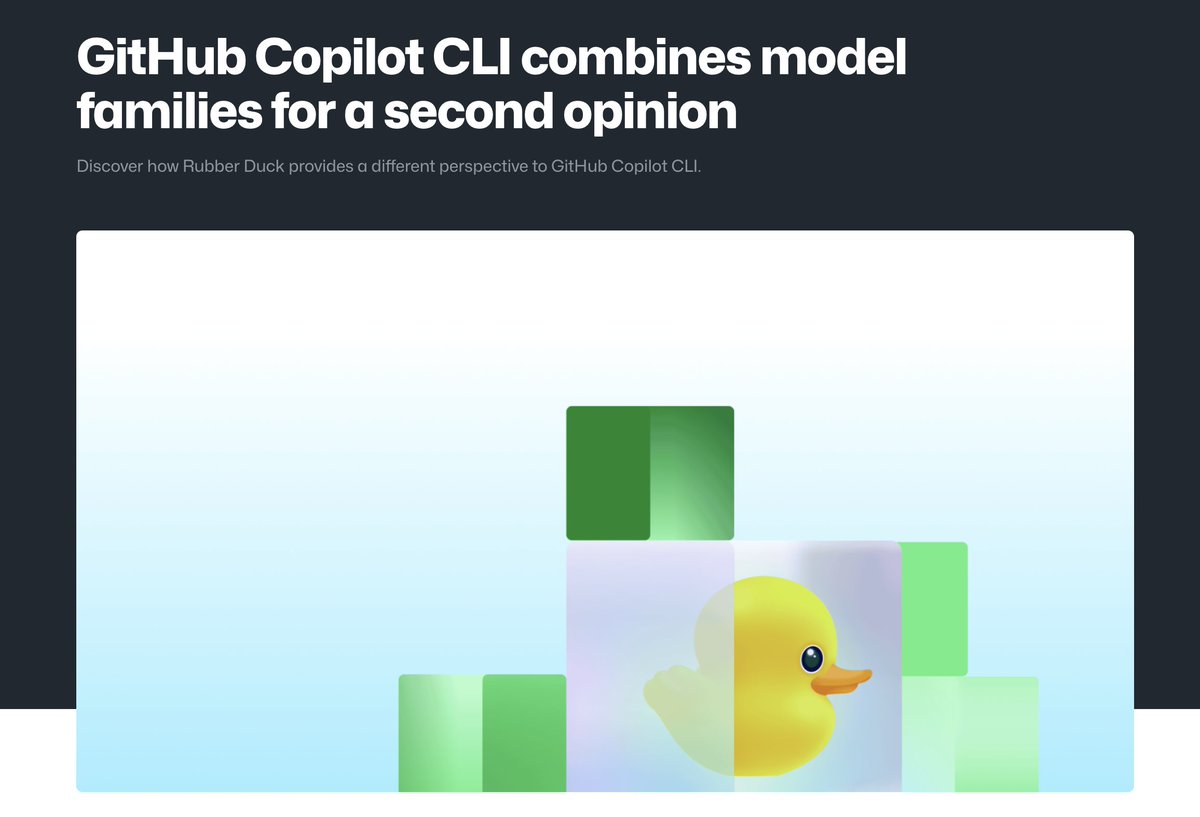
Introducing RubberDuck in Copilot CLI: a new builtin subagent for cross model family escalations. Sonnet will now proactively solicit input from GPT 5.4 and vice versa.
In our most difficult benchmark subsets, this results in a massive 5% improvement in resolution rates