What is it costing you—financially, emotionally, and physically—to postpone action?
Don’t only evaluate the potential downside of action. It is equally important to measure the atrocious cost of inaction.
If you don’t pursue those things that excite you, where will you be in one year, five years, and ten years?
How will you feel having allowed circumstance to impose itself upon you and having allowed ten more years of your finite life to pass doing what you know will not fulfill you? If you telescope out 10 years and know with 100% certainty that it is a path of disappointment and regret, and if we define risk as “the likelihood of an irreversible negative outcome,” inaction is the greatest risk of all.
1. Finding your true self is an act of love. Expressing it is an act of rebellion.
2. A sign of growth is having more tolerance for discomfort. But it’s also having less tolerance for bullshit.
3. Who you are is not your fault, but it is your responsibility.
A popular theory is that the size of a horse’s butt in Ancient Rome determined the size of NASA’s shuttle rocket boosters.
There are holes in the story but it's an interesting way to think about path dependence and technological lock-in.
Here’s why (and 5 other examples)🧵
1. Don't make decisions out of fear
Yes, you could fail.
Yes, people will talk about you.
Yes, it'll be hard.
But when my bro for instance got let go I told him it was the best gift he could ask for... the worst outcome is you die underutilized.
5-step process for coming up with startup ideas:
Explore to find a market that you’re interested in
Research to understand the landscape
Define an attack strategy
Test your strategy
Get early traction
Love like an 80 year old.
Relax like a 60 year old.
Work like a 40 year old.
Lift like a 30 year old.
Explore like a 20 year old.
Play like a 10 year old.
A reproducible testing process is more valuable than any one idea. Innovate here first.
All things equal, a team with more shots at bat will win against a team with an audacious vision.
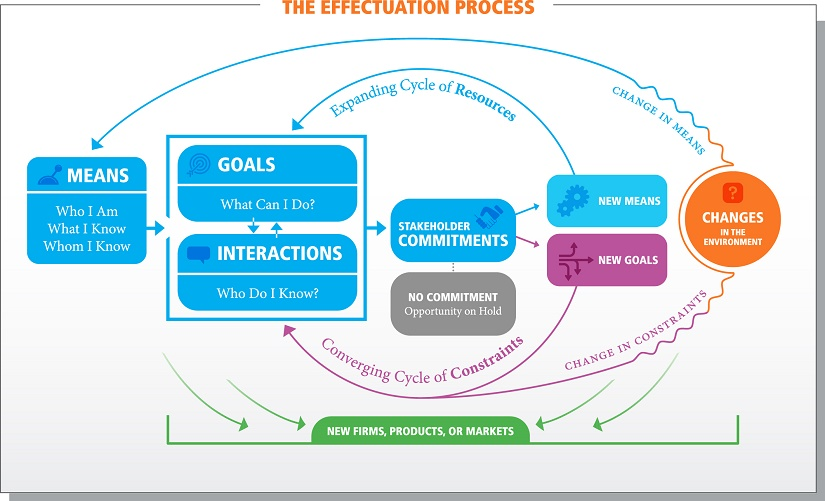
6. Effectual Cycle
These principles tie together in a cycle that’s BACKWARDS from what others do.
Capabilities -> initial actions and experiments.
Your experiments maximize learning -> conviction.
And goals (especially audacious ones) emerge!
All done in a low-risk way.
(I jest of course. what really matters is the urge to move vs the urge to endure. and to ask ourselves: if the world is full of enchantment, and we want to see that enchantment, where can our senses grow sharper?)
New agri-revo in the making? Scientists synthesize artificial starch from CO2, more food (8.5x efficiency vs maize) with less enviro damage (90% less water/land, no pesticide/fertilizers)
https://t.co/E3lJxw7vja
Love this. Spent last year learning completely tough topics (Spanish, Mandarin, piano, investing, ML, comp neurosci) and main lessons after some mini-burnouts: limit # of learning topics, clear milestones+deadline, accountability/community. Or as McK says: 3x3x3.
1. Read and write more.
2. Don't hesitate to admit when you're wrong.
3. Be comfortable changing your opinion.
4. Find a mentor.
5. Stay teachable.
6. Make mistakes and learn.
7. Don't get offended easily.
8. Ask questions.
9. Spend time with nature.
10. Stay humble.