Memory Skill for OpenClaw with 26k+ users in 1 week🚀
OpenClaw's memory system is broken by default.
It requires curating massive MEMORY.md files or relying on duplicate-heavy generation. Hours are wasted tuning, and massive amounts of tokens are burned.
It's time to stop. So we built the memory skill to solve that prob
Here is our superpower ⚔️
🎯 Top #1 market accuracy (92.19%) after 8+ months of intense architecture iteration
🧠 The ultimate solution to keep the timeline, facts, and meaning perfectly in place
☁️ Local & Cloud + Version control
⚡ Super easy setup
Josh Elman, joining a16z, on the new consumer wave:
"It isn't the models that matter, but the harnesses, loops, and context."
This is the whole thesis. The model is the easy part now. The durable advantage is the harness around it, the loops it runs and the context it remembers.
That's exactly what we're building at @byterover. More soon.
@muratcan the loop is only as good as what it carries between passes. and that usually doesn't survive a restart or a handoff to another agent. loops without memory engineering is just local optimization.
@LearnWithBrij agree. the next wall: CLAUDE.md is scoped to one repo. the decisions that span projects (auth patterns, why you ditched approach X, the bug you've fixed 3 times) have nowhere to live. right instinct, doesn't compose.
@BharukaShraddha CLAUDE.md is the persistent part. chat history is ephemeral and gets compacted away. no real cross-run memory unless you build it yourself. the stuff that should survive a fresh session usually just doesn't.
@femke_plantinga "rot not crash" nails it. hard to catch because most retrieval strips provenance at index time, you get the chunk but not the source or the date. if it's a file you can just grep for why you decided something.
@cobi_bean "follows the work" is exactly it. the piece that makes it trustworthy is provenance: where a fact came from, which decision. otherwise it's portable but you can't tell if "we use postgres" was a real call or autocomplete that stuck.
@signulll the fragmentation is structural. each tool's memory lives in its own session. claude knows what you told claude, codex what you told codex. nothing holds the work context in a form all of them can read yet.
the agent memory and context lifecycle addition is the right call. one distinction worth drawing: memory and knowledge base are not the same problem. a KB stores things so you can retrieve them. memory governs what survives session to session, what's trustworthy, and what an agent is allowed to pass to another agent. the retrieval part is solved. the boundary and provenance part is wide open
the isolation-vs-narrowing tradeoff you flagged is the real one. what crosses the boundary matters as much as who holds the memory. if agents share a vector embedding, you get homogenization by osmosis. if they share a human-readable file they explicitly chose to expose, the scope is bounded and the reasoning stays local. the format of the handoff changes the nature of the contamination
the log is the agent, agree. the problem with compaction: the summary silently becomes the official record. decisions that were provisional get treated as settled. if memory lives in files you can grep and diff, compaction is a commit you can inspect, not a black box on a timer.
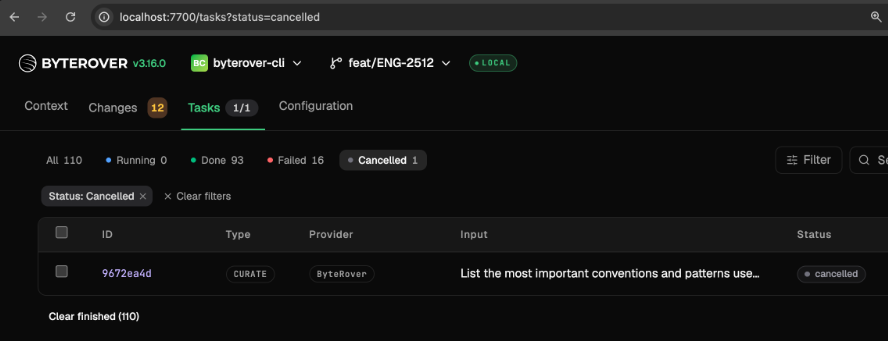
You can now cancel any running ByteRover task with 1 click:
- When you or an agent might create a query or curate with the wrong content.
- When local LLM models process tasks slowly, get stuck, or are pending for too long. It allows you to precisely cancel the task you want to cancel without restarting the daemon or losing other tasks.
We added a setting that lets you turn off ByteRover's automatic update check.
Once it is off, ByteRover stays on the exact version you have installed until you choose to upgrade yourself. When you have a brv version that works for your project, you can keep it that way.
You can change the setting from the CLI, the TUI, or the Local Web UI 👇
HTML vs Markdown for agent memory. Which is better in real production?
After the previous benchmark with 603 questions and HTML won on all accuracy, token saving and latency reduction. So, we were questioning:
Does HTML still perform better in real production at a larger scale?
To answer that, we re-ran our LoCoMo benchmark on the full set with 1,982 questions across 11 conversations. The results:
- HTML scored 90.77% accuracy at a total cost of $4.11, while Markdown scored 90.51% at $8.30.
- HTML ran 40% faster on query and 12.5% faster on curate.
Beyond the numbers, HTML brings three more benefits:
1. Anyone with a browser can open HTML without extra tools:
An HTML file opens directly in any browser, while Markdown files need a separate viewer or editor to render properly.
2. Agents can search HTML like a database and return the exact answers
3. HTML fits inside the new cross-agent protocols: A2A (Agent-to-Agent) and MCP (Model Context Protocol) both expect standardized input and output, and HTML provides exactly that.
We are shipping HTML as the default format for ByteRover soon
@AmaouchNab1023 Yes. In production, agent memory is also an efficiency/security/cost trade-off. Reusing context saves time and tokens, but only works if every memory change is visible, reviewable, and controllable.
We just added the Changes Tab so you can see every edit your agent makes when it organizes your memory in the background
Each edit shows what changed and why, and you can decide to keep or discard it
@getbold_ Exactly. Memory needs an audit trail, not just a “trust me” layer.
Seeing what changed and why is step one. Next is making that context portable across agent calls, with identity, provenance, and usage tracking attached.
That is when memory becomes infrastructure.
You can unlock a whole new way of building with Claude Code when HTML becomes the artifact.
Brilliant move by @AnthropicAI
We’re launching the coolest version of ByteRover yet, and it fits perfectly with where the whole coding industry is going next.
Stay tuned!