The question of "what is money" gets revisited periodically as fiat always replaces tangible. The gap between fiat and tangible widens as financialisation increases (humans being desirous of something for nothing). Then it crashes with a revaluation as the realisation that fiat is just that....fiat.
We are there...again.
Central banks are the main driver of the current gold bull market
When the US froze Russia's foreign reserves and cut it off from SWIFT, every central bank around the world learned the same lesson:
Your reserves aren't really yours if someone else controls them.
Gold is different.
- It isn't someone else's liability.
- It can't be frozen.
- It can't default.
- It can't be printed.
Since then central banks have been buying gold at one of the fastest paces in modern history while Western investors largely ignored the move.
Ironically, retail investors only started paying attention after gold had already rallied over $1,000.
Gold is becoming the new reserve asset
Wealth tax explained:
1. Laura loves to cook, she risks all her life savings and opens a small restaurant: Laura‘s Kitchen
2. Laura works really hard, evenings, weekends, no vacations
3. The local community loves Laura‘s Kitchen, it’s a success, the restaurant gets larger, Laura hires 30 people from the neighborhood
4. Laura makes 1,5 Million € in profit, she pays 40% in income tax: 600,000€
5. The left „tax the rich“ party wins the elections, and introduces a wealth tax
6. Laura‘s Kitchen gets valued by the tax authorities at 25 Million €. Laura must pay 5% wealth tax: 1,25 Million €
7. The income tax of 600,000€ plus 1,25 Million € in wealth tax is more than the 1,5 Million € Laura makes
8. Laura cannot afford to pay more taxes than she makes, she closes Laura’s Kitchen
9. Laura loses her life savings despite years of hard work, 30 people lose their jobs, the state receives zero taxes
10. The local community goes to McDonalds again
11. The local left “tax the rich“ party members blame „capitalism“ for that on social media
12. Everyone gets poorer due to higher unemployment and lower tax revenues
Why is this so difficult for the left to understand?
Note published today on our Substack...this might be @VD718's best paragraph ever when describing the investment activity coming out of D.C.:
"This hyper-transactional approach mirrors the fictional governing dynamics of Bruce Wayne’s hometown. In Gotham, public policy is rarely an ideological pursuit; rather, it is a series of monetization events negotiated in backrooms where the city’s elite leverage the law for personal or factional gain. The oligarchs of Gotham view (often self-created) civic volatility and instability not as a crisis to be solved, but as a spread to be traded."
https://t.co/squgvbeKeb
Correct. This is why I was never very impressed with private equity, which for the most part just plays this game at scale. Productivity would be higher, and society would be fairer without fiat currencies.
Lyn Alden: "The best product Coca-Cola ever sold was their bonds, not their Coke."
Coca-Cola borrows at 2-3% while the money supply grows at 7%. They then use that cheap debt to buy scarcer assets.
Governments do it. Corporations do it. Wealthy individuals do it. Everyone is shorting the currency...
Except the people at the bottom.
They can't access cheap debt and "are getting the full damage of the inflation" on their wages and savings.
FT @LynAldenContact@PeterMcCormack.
It’s interesting to consider the rise of Chinese EVs alongside China’s rise in consumer electronics and home appliances.
Over a similar time period, you have the rise of Chinese brands like Hisense, Haier, Roborock, Eufy / Anker, Midea, TCL, etc—all popular brands now in the US.
There was a previous wave of both consumer electronics and automotive brands from Japan with the rise of Sony, Panasonic, Toyota, Honda, etc.
And then the Korean wave of Samsung, LG alongside the rise of Hyundai, Kia.
Why is there this overlap? Yes, part of it is overlapping supply chains and complements. But there’s something deeper at work: the ability to scale and innovate quickly on electro-mechanical manufacturing. There’s some core competency here that, when mastered, seems to become a national capability that cuts across specific product segments.
It’s not just one firm or one industry but a g-factor for this larger cluster of technologies and skills.
Old enough to remember when many believed Putin was a master strategist and that Ukraine would quickly be defeated.
What actually unfolded was something few predicted. In trying to subjugate Ukraine, Putin inadvertently helped create one of the world’s most innovative weapons manufacturers and military technology ecosystems on his own doorstep.
It’s a reminder to be cautious when making confident geopolitical predictions. History is full of unintended consequences. China’s and Russia’s actions have also awakened much of the world in ways that were difficult to foresee.
None of us can predict with certainty what comes next. Unintended consequences have been a constant throughout civilisation, and they remain just as relevant today.
Those declaring an Iranian victory every 24 hours would do well to remember that history rarely unfolds the way the most confident commentators expect.
The mistake of our era is believing we can predict with certainty what today’s events will become tomorrow.
History suggests the biggest geopolitical shifts are often driven by unintended consequences that almost nobody saw coming.
This will not be decided in days or weeks. It will be a long, difficult contest, and anyone claiming certainty about how it ends is probably underestimating the complexity of history and over estimating their own insight .
4/5 Tada! Warsh has an excuse to lower rates, and hopefully the Treasury consolidates the spending (the real source of inflation).
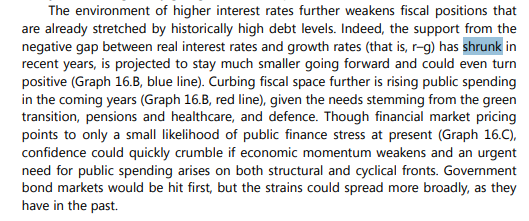
This way the US gets the benefit of a more negative r-g so much needed for sovereign debt relief.
3/5 BUT, if the market believes the charade and forgets for a while that more interest burden monetization means HIGHER inflation, they will pump the dollar until the fall 2026.
And then in USD, Oil is even lower and then?
2/5
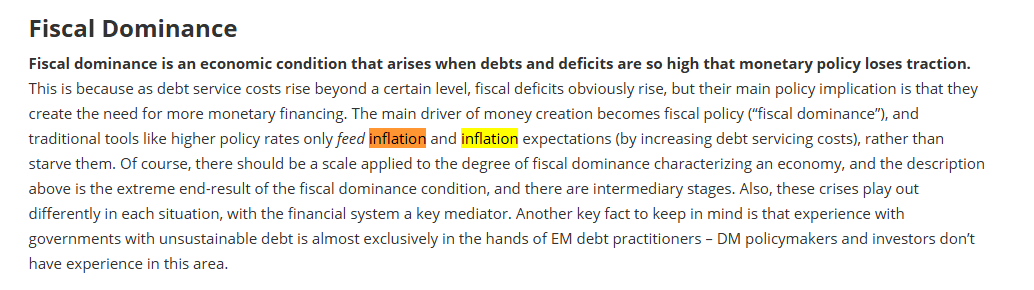
Don't be fooled. In fiscal dominance you produce higher inflation via an increased interest burden which needs to be further monetized.
Remember the "Reserves management of Dec 12 2025"? It's fiscal deficit monetization.
More interest burden?
more monetization=inflationary
1/5 So why is Warsh telling a charade to the market ? Making people believe he will raise rates while he can't in fiscal dominance (unless he wants more inflation )
Higher rates => higher inflation in fiscal dominance
... follow the logic, bear with me.
This indicates LNG exports through Hormuz are unlikely to ramp up quickly 👇 ⚠️
QatarEnergy extended its force majeure to some of its European and Asian LNG buyers into August-September
Edison said it received notice that its FM covers LNG scheduled into early September
It seems to me that most people are hooked on news items that last about a day or two and are then forgotten about, as other news items replace them, while failing to see how things are evolving and why. That’s not good for anyone.
There are big cycles unfolding almost exactly how they have repeatedly unfolded in the past, and they are being missed. If you’re interested in seeing these big cycles presented in an entertaining way, I am offering an overview of them here in my 5-minute animated video, Principles for Dealing with The Changing World Order. And if you'd like to see a more complete picture, you can watch the full 45-minute version here: https://t.co/1NjhMYQyaS
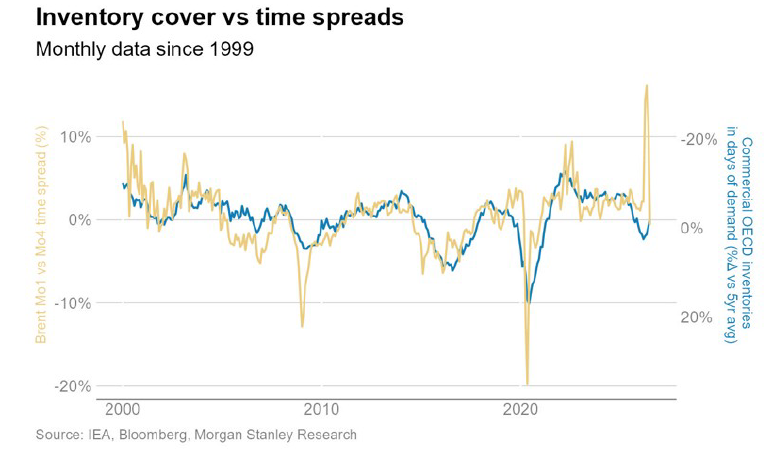
As I mentioned one week ago, even more important than the spot price is the term structure.
The Brent M1-M4 calendar spread has, precisely, reconnected with its historical relationship to commercial OECD inventory cover.
Let's explore how the conflict premium is gone with the help of Morgan Stanley. 🧵
(WCTW) Today's Oil Price Disconnect Is History In The Making
To give you an idea of how insane this market is, this is the highest 3-2-1 crack spread relative to Brent price in the history of the oil market.
https://t.co/QVHL0KrZLk