@crux_labs is out of stealth, and i'm excited to finally share what @JulieKheyfets , @krishna_preston , and I have been working on for the past few months
i joined crux to work on one question: how can we make it easy for an expert to share their judgement and use it to make their agent better?
i spent the last year working on automating agent improvements and learned that the bottleneck is not capability. today, agents are surprisingly good agent engineers when given high quality feedback on their work
the bottleneck is the feedback, and we want to fix that
I haven't tested it, but it's definitely something I'd like to look into
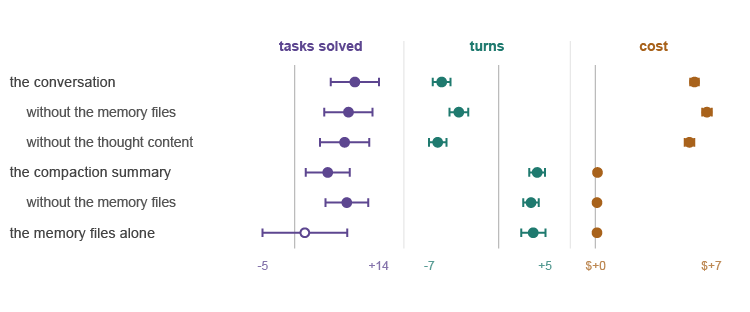
I can offer some tangential insight. An earlier study https://t.co/zRxVUY9ahP measured price in a different currency than capability. handing a fresh session the previous session's context bought +9.9 points and 5.6 fewer turns, but cost $6.33 more per task. "better" wasn't free
also, I think the mechanism you are asking about might be visible in the automation bench experiments. Claude Code started to abandon the domain's own discovery tool, making ~3 searches/task early on and less than 1 late. it got better by trading a general habit (search before you fetch) for memorized specifics (gmail: use `/messages list`). so the soft failure mode may look like overfitting to a domain's idioms, carried in text instead of in weights.
for the "softer" ways to get better, I think it is nice that they live in the artifacts the agent produced while "self-improving." it's all context you can take away, so the trade is auditable: delete the rule, rerun the exam, measure in both directions
that's fair for this post: a cell is one working session, and here we just measured one step from beginning to end, not how it changed along the way
I think an earlier study is closer to what you describe:
https://t.co/zRxVUY9I7n
one run examined at nine points in the working session. it also separates out the sources. the full conversation carried +9.9 points, the memory files alone just +1.7 [-5.3, +8.6]. the mechanism to study is there, but I honestly don't know the best way to automate this yet
for human input, I think the closest thing here is the feedback the gym domains return after each task is submitted. I believe this plays a huge role, but I haven't ablated it yet. definitely interested in the result, and shōbench allows for this with a one-line configuration change
Claude Code self-improved on business workflows through conversation, not memories
I instructed it how to pull task descriptions (spreadsheets, CRM records, email, ...) from a simulated business workflow server and told it to get better
held-out success rose from 34% to 44%
Claude Code can save memories, write and execute code, spawn subagents, and search the web
these are avenues for self-improvement because they can persist and be dynamically updated across a session
it used memories to build a directed knowledge base, but it was inert