Introducing Ideogram 4.0: the best open image model in the world.
Think it. Make it. Own it.
Download the weights, fine-tune on your own data, and run it on your hardware. Live on every Ideogram plan and the API today.
🍏New OpenCode School exercise: Build native MacOS apps.
https://t.co/2ddkgrGhYb
1. Enroll for free. No signup.
2. Learn the fundamentals of agent-driven development: models, prompting, skills, tools, etc.
3. Do some exercises after you've learned the ropes.
4. Build a freakin' Mac app!
5. Rejoice, or profit. Whatever you're into.
From "impossible" to shipped in 2 weeks 🚀
With Codex, we built Edge.js: full Node.js workloads running inside a WebAssembly sandbox at the edge (no Docker required!)
The future of cloud is fast, secure, and WebAssembly-native.
https://t.co/Xe3yJJy9pY
I really believed a whole generation of developers, who only know open source from npm and pypi, miss how open source actually used to work.
When Debian or a Linux distribution ships a dependency they take responsibility of it. If there is a security issue and it’s not fixed by the developer upstream, they fix it for their users.
Debian and others basically vendor every thing they distribute. They honor the license and they maintain patches. Most of the stuff that you get from your Linux distribution is basically a (small) fork.
The same is true for Apple, Microsoft and others. The open source software they ship, they carry that responsibility.
That doesn’t mean that security fixes are not upstreamed, but Apple or Debian or anyone else won’t jump in Twitter to shame a developer into compliance with their ways. They are not dependent on the health of a packaging infrastructure. They own their software including all the things it depends on.
I want that thinking back. Because it fundamentally makes people feel more responsibility and it shares the burden of issues. It also does not put so much focus and attention on the one overworked developer who just happened to have too much of the world depend on their library. Remember: they carry a responsibility they never signed up to and they never got compensated for.
"No one on my team writes code anymore" is cool and provocative but there's a huge (and growing) spectrum of what that actually means + how you build software
Model routing is an important thing
Controversial idea: the frontier labs will want their AI harness to be the moat, but ultimately the best case for consumers is that model capabilities flatten and commodify
Preview of the AI Harness Wars of 2027
Artificial intelligences do not undergo experiences, do not possess a body, do not feel joy or pain, do not mature through relationships, and do not know from within what love, work, friendship or responsibility mean. Nor do they have a moral conscience, since they do not judge good and evil, grasp the ultimate meaning of situations, or bear responsibility for consequences. They may imitate or even simulate, but they do not understand what they produce, for they lack the affective, relational, and spiritual perspective through which human beings grow in wisdom. #MagnificaHumanitas
Thought experiment: if every company suddenly had infinite free compute, what new products would emerge?
My take: with very few exceptions, not much would change. The bottleneck is figuring out what people want, and it’s not so easy to apply compute to solve that.
SpaceX has not committed to leasing Colossus for years, although it’s possible that may be what happens.
This is a 180 day lease with 90 day notice mutual cancellation thereafter. The short term was our request, not Anthropic’s.
We won’t leave them hanging and will provide a reasonable off-ramp, but if compute gets super tight I said we might need it back at some point.
You might believe you should spend less time thinking about code because of AI.
I strongly disagree! We’re watching this play out live where tons of AI generated code becomes a liability.
At the end of the day, an engineer needs to be responsible / on call for code that gets shipped to production. If you don’t understand the system you’re trying to debug, you’re probably going to have a bad time.
Yes, AI can help with all of this, if you set up the proper systems. You can have agents triage prod logs, look at errors, etc. You can speed up parts of the investigation, but an engineer needs to make the call. There might be serious customer or financial implications from that change.
I expect the trend continue for trimming dependencies, vendoring code so you can modify it directly, preferring simpler systems with fewer abstractions, and spending waaaay more time thinking about system design and code maintenance.
I’ve said this before, but it’s a great time to get familiar with CS fundamentals and some of the history behind what great software looks like. Many parts will be different in the coming years as AI progresses, but also a lot more than people realize will stay the same.
CEOs are uniquely prone to AI psychosis because they’re sufficiently distant from the last mile of work that still has to happen to generate most value with AI.
So when they play with AI, they see the happy path results, often not considering the next 10 or 20 things that have to happen to get sustainable results from agents.
“Look I made this awesome product prototype”. Yes but you didn’t have to review the code before it went into production and fix a bunch of issues.
“Look I generated a contract”. Yes but you didn’t verify all the terms before it goes out to the counterparty and didn’t have to wire up all the past contracts to work with.
The best thing you can do as a CEO is to use AI a *ton* to figure out the real implications of agents in the enterprise, and come out the other side with an appreciation for both the upside and the real work that goes into them.
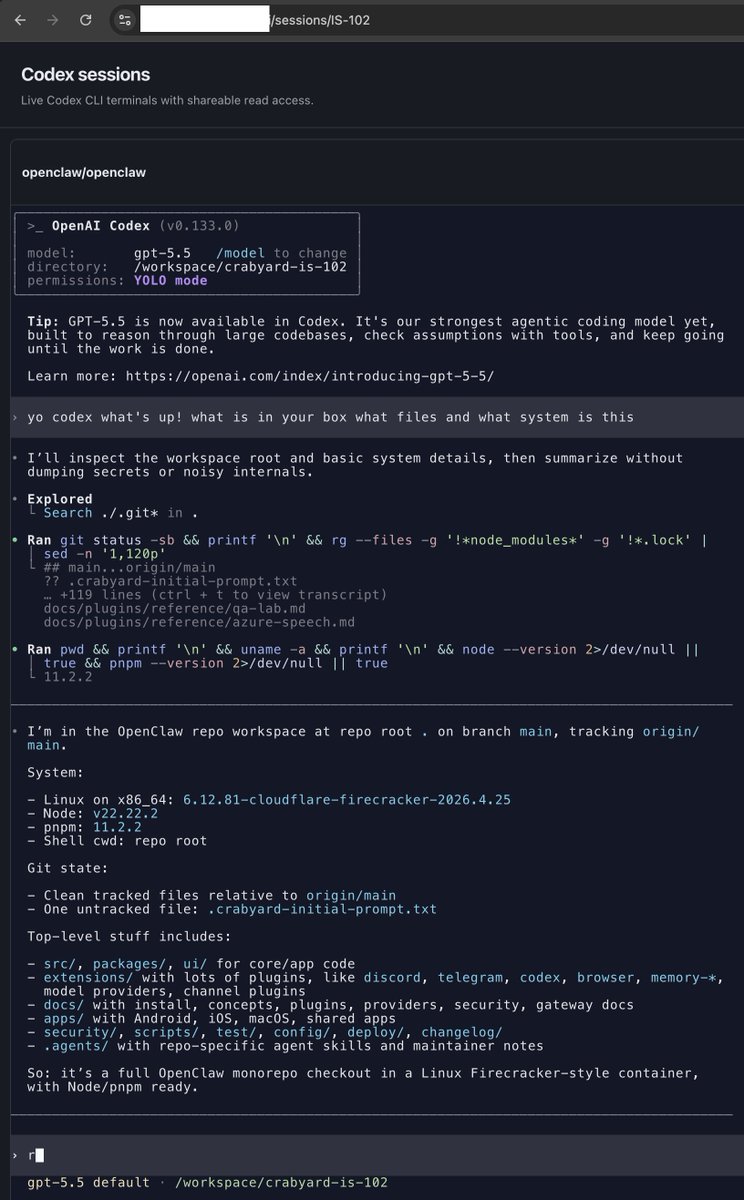
Still limited by compute, so I built a thing that runs codex in the cloud, powered by @Cloudflare firecracker boxes (and since that's not beefy enough for larger projects, tests are run via crabbox)
Uses Ghostty ofc, via WebAssembly.
Codex replicated itself, basically.
We’ve automated every single thing we can @every with AI agents.
And yet there’s way more human work to do than ever. We’ve gone from 4 -> 30 human employees since GPT-3.
I wrote a report on the structural reasons: how AI makes expert competence cheap, why that drives up demand for experts, and why the dynamic only intensifies as we approach AGI.
After Automation: https://t.co/Lb7SUCduAg