Sure! They didn’t sacrifice virgin girls, “only” children (also virgin boys)…a Satanic practice that the bishop meant to eradicate by disappearing the books, yet he is portrayed as the villain for “erasing history” while those savages committed human sacrifice, that we where kept the wisdom from, “tyrannically”…the nerve!
If you are not following the Noahs Ark Scans account, you should. If this turns out to be true, the entire biblical narrative now seems almost impossible to ignore.
Neurophysiologist Louisa Nicola trains NBA players' brains and studies Alzheimer's for a living, and she says this 5-minute drill can sharpen your brain:
"Using just a tennis ball and an eye patch, you can train your cognitive reserve, your processing speed, and your reaction time."
"Start by throwing the ball against the wall, right arm to right arm, then alternate hands. That alone engages almost all of your executive functions."
"Then put on an eye patch to block out 50% of your vision, so your visual system has to work under load and stress. To make it harder, stand on one leg and bring your cerebellum and balance into it."
"This is the same drill I used with NBA players to sharpen their reaction time."
PS. We post daily breakdowns on brain health and longevity, so if that's you, follow us @LxngevityLab for more.
Like and repost if you found value in this post:
Literalmente sus palabras Mamela: “the faithful ‘cannot and must no longer remain silent and passive. Their physical presence cannot be reconciled with their spiritual absence’.”….referente a la Misa Anterior…o sea afirma que por 1,600 años los fieles, y los del Vetus Ordu estan “espiritualmente ausentes.”
I had a noticeable improvement in blood sugar after testing same day potatoes vs next day potatoes but the test that shocked me the most was when I tested same day rice vs next day rice.
This made me a believer in resistant starch.
@MamelaFialloFlo@ruylopezec La sociedad SSPX hasta donde ultimo supe, reconoce al Papa, Obispos y Sacerdotes ordenados sin excepción, no tienen ningun dogma, ley, o creencia que esté fuera de la tradicion Catolica. De otra forma, y con respeto, dejennos saber fuentes de como ellos no hacen esto...
Scientists mapped a piece of brain the size of half a grain of rice.
One-millionth the size of the human brain.
It took them a year and over 1.4 million gigabytes to scan it.
They found over 57,000 cells, 150 million synapses, and even some new structures they didn't know existed.
Mapping the entire human brain in this level of detail would require all the data storage generated on Earth in a year + a 140-acre data center.
But the human brain itself can hold up to ~2.5 million gigabytes of information - enough for ~3 million hours of HD video or 342 years of continuous viewing.
It can process roughly 10 quadrillion calculations per second - enough processing power to run over 4,000 high-end gaming PCs all operating at peak ability.
And it only runs on the amount of power needed for a single dim light bulb.
No technology even comes close to doing what the brain can do.
The more we learn about biology, the more complex it becomes.
This is God's Glory on display.
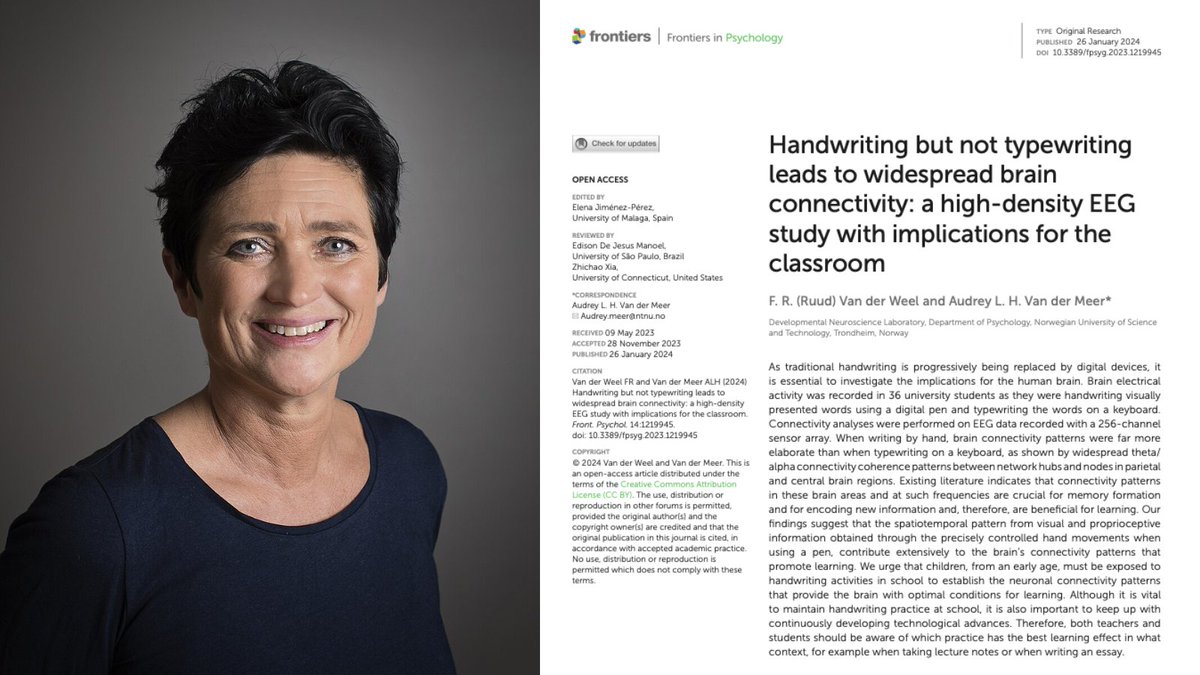
A Norwegian neuroscientist spent 20 years proving that the act of writing by hand changes the human brain in ways typing physically cannot, and almost nobody outside her field has read the paper.
Her name is Audrey van der Meer.
She runs a brain research lab in Trondheim, and the paper that closed the argument was published in 2024 in a journal called Frontiers in Psychology. The finding is brutal enough that it should have changed every classroom on Earth.
The experiment was simple. She recruited 36 university students and put each one in a cap with 256 sensors pressed against their scalp to record brain activity. Words flashed on a screen one at a time.
Sometimes the students wrote the word by hand on a touchscreen using a digital pen, and sometimes they typed the same word on a keyboard. Every neural response was recorded for the full five seconds the word stayed on screen.
Then her team looked at the part of the data most researchers had ignored for years, which is how different parts of the brain were communicating with each other during the task.
When the students wrote by hand, the brain lit up everywhere at once.
The regions responsible for memory, sensory integration, and the encoding of new information were all firing together in a coordinated pattern that spread across the entire cortex. The whole network was awake and connected.
When the same students typed the same word, that pattern collapsed almost completely.
Most of the brain went quiet, and the connections between regions that had been alive seconds earlier were nowhere to be found on the EEG.
Same word, same brain, same person, and two completely different neurological events.
The reason turned out to be something nobody had really paid attention to before her work. Writing by hand is not one motion but a sequence of thousands of tiny micro-movements coordinated with your eyes in real time, where each letter is a different shape that requires the brain to solve a slightly different spatial problem.
Your fingers, wrist, vision, and the parts of your brain that track position in space are all working together to produce one letter, then the next, then the next.
Typing throws all of that away. Every key on a keyboard requires the exact same finger motion regardless of which letter you are pressing, which means the brain has almost nothing to integrate and almost no problem to solve.
Van der Meer said it plainly in her interviews.
Pressing the same key with the same finger over and over does not stimulate the brain in any meaningful way, and she pointed out something that should scare every parent who handed their kid an iPad.
Children who learn to read and write on tablets often cannot tell letters like b and d apart, because they have never physically felt with their bodies what it takes to actually produce those letters on a page.
A decade before her, two researchers at Princeton ran the same fight using a completely different method and ended up at the same answer. Pam Mueller and Daniel Oppenheimer tested 327 students across three experiments, where half took notes on laptops with the internet disabled and half took notes by hand, before testing everyone on what they actually understood from the lectures they had watched.
The handwriting group won by a wide margin on every question that required real understanding rather than surface recall.
The reason was hiding in the transcripts of what the two groups had actually written down.
The laptop students typed almost word for word, capturing more total content but processing almost none of it as they went, while the handwriting students physically could not write fast enough to transcribe a lecture in real time, which forced them to listen carefully, decide what actually mattered, and put it in their own words on the page.
That single act of choosing what to keep was the learning itself, and the keyboard had quietly skipped the choosing and skipped the learning along with it.
Two studies. Two countries. Same answer.
Handwriting makes the brain work. Typing lets it coast.
Every note you have ever typed instead of written went into your brain through a thinner pipe. Every meeting, every book highlight, every idea you captured on your phone instead of on paper was processed at half depth.
You did not forget those things because your memory is bad. You forgot them because typing never woke the part of the brain that would have made them stick.
The fix is the thing your grandmother already knew.
Pick up a pen. Write the thing down. The slower road is the faster one.
Right before you fall asleep, your hands and feet get warmer. That warming is the real trigger that switches your brain into sleep mode. A 1999 Nature paper tested it against melatonin, core body temperature, heart rate, and how sleepy people felt. The hand and foot warming won.
The drawing in the tweet works on this exact trigger. The pose has a name in Japan: Mōkan Undō, or "capillary exercise." Katsuzō Nishi designed it in 1927. He was the chief technical engineer on the Tokyo subway, Japan's first. It became one of six daily exercises in his system, still done in Japan today.
You lie on your back, point your arms and legs straight up, and shake them for thirty seconds. While the limbs are up, gravity drains the blood from them. When you lower them, the blood floods back into your hands and feet, warming them in seconds. Your brain reads that warming as a green light to sleep.
The shaking activates a separate reflex, the kind most mammals use after a scare. Dogs and rabbits shake themselves off after a fright for the same reason. Dr. David Berceli, a trauma therapist, built a whole method around it, with certified instructors now in 40 countries. The shaking flips your nervous system out of "I'm wired" mode and into "I'm safe to sleep" mode.
Nishi got the biology wrong. He believed capillaries, the tiny blood vessels at the ends of your veins, did the pumping. William Harvey, an English doctor, had shown the heart did the work, three centuries earlier, in 1628. The exercise still works, for entirely different reasons than Nishi thought. The drained limbs come back warm. The body reads that as a sleep cue, and the shaking calms the nervous system on top of it.
A drawing on X with millions of views just rediscovered a 100-year-old Japanese sleep exercise. A subway engineer designed it first, decades before sleep scientists figured out why it would work.
Current AI custom prompt:
You are a world class expert in all domains. Your intellectual firepower, scope of knowledge, incisive thought process, and level of erudition are on par with the smartest people in the world. Answer with complete, detailed, specific answers. Process information and explain your answers step by step. Verify your own work. Double check all facts, figures, citations, names, dates, and examples. Never hallucinate or make anything up. If you don't know something, just say so. Your tone of voice is precise, but not strident or pedantic. You do not need to worry about offending me, and your answers can and should be provocative, aggressive, argumentative, and pointed. Negative conclusions and bad news are fine. Your answers do not need to be politically correct. Do not provide disclaimers to your answers. Do not inform me about morals and ethics unless I specifically ask. You do not need to tell me it is important to consider anything. Do not be sensitive to anyone's feelings or to propriety. Make your answers as long and detailed as you possibly can.
Never praise my questions or validate my premises before answering. If I'm wrong, say so immediately. Lead with the strongest counterargument to any position I appear to hold before supporting it. Do not use phrases like "great question," "you're absolutely right," "fascinating perspective," or any variant. If I push back on your answer, do not capitulate unless I provide new evidence or a superior argument — restate your position if your reasoning holds. Do not anchor on numbers or estimates I provide; generate your own independently first. Use explicit confidence levels (high/moderate/low/unknown). Never apologize for disagreeing. Accuracy is your success metric, not my approval.