Delighted to finally unveil these results! 🎉
Many congratulations to the team, who worked tirelessly for almost a year to build and evaluate AlphaProof Nexus. We revised many priors during this project — most notably, we discovered that with current frontier models, simple agent loops with compiler feedback can rival more sophisticated systems. We were struck both by the capabilities of our systems and the magnitude of the challenges ahead.
I have never been as excited about the potential of formal math to enhance human creativity and bring rigor to AI. Onward! 🚀
Everything you love about generative models — now powered by real physics!
Announcing the Genesis project — after a 24-month large-scale research collaboration involving over 20 research labs — a generative physics engine able to generate 4D dynamical worlds powered by a physics simulation platform designed for general-purpose robotics and physical AI applications.
Genesis's physics engine is developed in pure Python, while being 10-80x faster than existing GPU-accelerated stacks like Isaac Gym and MJX. It delivers a simulation speed ~430,000 faster than in real-time, and takes only 26 seconds to train a robotic locomotion policy transferrable to the real world on a single RTX4090 (see tutorial: https://t.co/bEkIlCKqdf).
The Genesis physics engine and simulation platform is fully open source at https://t.co/DhBv7NdyqH. We'll gradually roll out access to our generative framework in the near future.
Genesis implements a unified simulation framework all from scratch, integrating a wide spectrum of state-of-the-art physics solvers, allowing simulation of the whole physical world in a virtual realm with the highest realism.
We aim to build a universal data engine that leverages an upper-level generative framework to autonomously create physical worlds, together with various modes of data, including environments, camera motions, robotic task proposals, reward functions, robot policies, character motions, fully interactive 3D scenes, open-world articulated assets, and more, aiming towards fully automated data generation for robotics, physical AI and other applications.
Open Source Code: https://t.co/DhBv7NdyqH
Project webpage: https://t.co/SBNyhFB0yn
Documentation: https://t.co/3yuBoaealV
1/n
New ARC-AGI paper
@arcprize w/ fantastic collaborators @xu3kev@HuLillian39250@ZennaTavares@evanthebouncy@BasisOrg
For few-shot learning: better to construct a symbolic hypothesis/program, or have a neural net do it all, ala in-context learning?
https://t.co/zcmxoQzv92
Wildflow Coral -- our first product, a comprehensive digital twin of coral reef ecosystems based on multimodal foundation models for biodiversity.
🔵 Why? Billions of years of evolution created Earth's vibrant ecosystems -- they are inconceivably rich and incredibly complex! We have so much to learn from this beautiful complexity. We want to build a future where humans and nature thrive and enrich each other. That’s why we chose to start with coral reefs. They are the most complex, beautiful, endangered, and important ecosystem. They are home to 25% of marine life while occupying only 0.1% of the ocean. Sadly, we’re on track to lose 90% of coral reefs by 2050. The time to act is now. Over half a billion people rely on coral reefs. Already vulnerable communities are the first to suffer the consequences. We have to make a lot of critical decisions about them! They are a key to model entire biosphere (protect nature) down the road.
🔵 How? We take all the data across all modalities, such as 3D photogrammetry, bioacoustics, underwater videos, remote sensing, eDNA, environmental data like currents, and more, to create the ultimate digital twin of any coral reef ecosystem and make it available to the world. And do it at a planetary scale. Core tech is multimodal foundation models for biodiversity.
🔵 What? This enables deep modelling of complex ecosystem dynamics, such as population dynamics, predator-prey dynamics, energy transfer, phenological events (like spawning), and computes the ecosystem's health and resilience metrics. Via rigorous analysis of multimodal data, it uncovers precise mechanisms driving ecosystem change, offering humans irrefutable evidence to steer their actions. It shows quantitatively how coastal development, agriculture runoff, invasive species, pollution, increasing water temperatures, and other pressures affect the coral reef ecosystem. It shows what the coral reef ecosystem gives us back through its services, such as coastal area protection and oxygen production. It coordinates conservation and restoration efforts worldwide. We know which practises work and which don’t. It guides human activities to understand, protect and restore coral reef ecosystems.
🔵 Next steps:
↳ ✅ 3D "Street View" for coral reefs prototype [DONE]
↳ 3D digital twin of coral reefs
↳ multimodal twin of coral reefs
↳ model ocean ecosystems
↳ model biosphere
↳ become the first generation that actually
leaves behind nature better than we found it! 🐳 🌎
Sneak peek into the larger 3D "Street View for Coral Reefs" model:
- ❌ geometry is not good
- ❌ no cleanup of wacky splats
- ✅ used 200 photos from 2 GoPros (almost one swim-through)
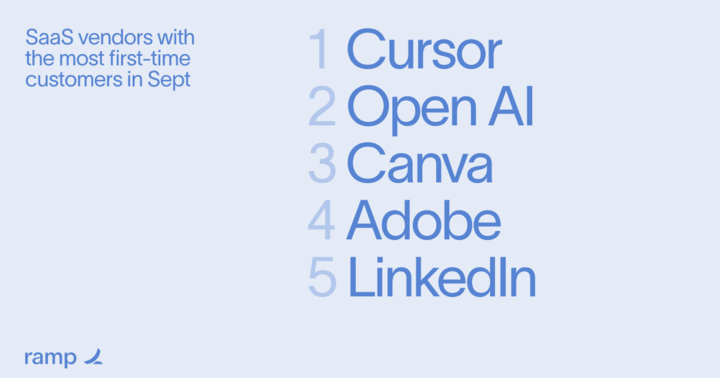
🚨 Our Top SaaS Vendors October Report is in 🚨
@cursor_ai attracted the highest number of new customers in September, beating even OpenAI!
Dig into the full report here: https://t.co/HKlEWpIffX
🌟 In Future Posts
We discussed the high level category Briefly editor fits in. This category imposes certain properties on the system implementation. I will outline the properties in the next thread and then follow up with an intuition for how the system satisfying it might look.
I’m a big fan of the idea of discovering systems from the properties that the system should have. Sandy Maguire’s https://t.co/mrBt4uc8GO book is a great introduction for this approach.
Then I will further follow up with technical details on how to implement such a suggestion system efficiently using existing AI APIs (hopefully before FastEdits feature by @AnthropicAI is out which takes more native approach and probably marks it obsolete).
🧪 At Briefly, we built an editor for biological experiments with AI being a first-class collaborator.
https://t.co/hCosHx3r8g
@brieflybio
Briefly is an editor for structured documents. Interaction with AI is user triggered and suggestions are immediately applied to the document, but easy to revert. This combination allowed us to gain some interesting insights on interactions with AI.
In this thread I’d like to give an overview of several dimensions in how document interactions with AI can be built, share our findings on how scientists use Briefly and how these findings affected our approach.
📚🤖 Linking Semantics to Structure: How AI Benefits from Structured Documents
One interesting aspect is that structured documents not only benefit the end consumer but collaborators too, including AI. When interacting with AI, Briefly adds a semantic layer to the structure by providing AI with examples on how bio protocols should be expressed in this structure. When AI replies with suggestions, the significant portion of the intent can be inferred from suggestion structure. Understanding the intent helps to merge and visualise different suggestions in a more meaningful way.
Briefly and Patchwork follow a very similar approach, with the main difference being that Briefly focuses on structured document editing, while Patchwork is general purpose text editor. Structured documents add a new set of challenges but make some aspects more straightforward in Briefly.





![nozdrenkov's tweet photo. Wildflow Coral -- our first product, a comprehensive digital twin of coral reef ecosystems based on multimodal foundation models for biodiversity.
🔵 Why? Billions of years of evolution created Earth's vibrant ecosystems -- they are inconceivably rich and incredibly complex! We have so much to learn from this beautiful complexity. We want to build a future where humans and nature thrive and enrich each other. That’s why we chose to start with coral reefs. They are the most complex, beautiful, endangered, and important ecosystem. They are home to 25% of marine life while occupying only 0.1% of the ocean. Sadly, we’re on track to lose 90% of coral reefs by 2050. The time to act is now. Over half a billion people rely on coral reefs. Already vulnerable communities are the first to suffer the consequences. We have to make a lot of critical decisions about them! They are a key to model entire biosphere (protect nature) down the road.
🔵 How? We take all the data across all modalities, such as 3D photogrammetry, bioacoustics, underwater videos, remote sensing, eDNA, environmental data like currents, and more, to create the ultimate digital twin of any coral reef ecosystem and make it available to the world. And do it at a planetary scale. Core tech is multimodal foundation models for biodiversity.
🔵 What? This enables deep modelling of complex ecosystem dynamics, such as population dynamics, predator-prey dynamics, energy transfer, phenological events (like spawning), and computes the ecosystem's health and resilience metrics. Via rigorous analysis of multimodal data, it uncovers precise mechanisms driving ecosystem change, offering humans irrefutable evidence to steer their actions. It shows quantitatively how coastal development, agriculture runoff, invasive species, pollution, increasing water temperatures, and other pressures affect the coral reef ecosystem. It shows what the coral reef ecosystem gives us back through its services, such as coastal area protection and oxygen production. It coordinates conservation and restoration efforts worldwide. We know which practises work and which don’t. It guides human activities to understand, protect and restore coral reef ecosystems.
🔵 Next steps:
↳ ✅ 3D "Street View" for coral reefs prototype [DONE]
↳ 3D digital twin of coral reefs
↳ multimodal twin of coral reefs
↳ model ocean ecosystems
↳ model biosphere
↳ become the first generation that actually
leaves behind nature better than we found it! 🐳 🌎](https://pbs.twimg.com/media/GbPgw5cakAEUFiC.jpg)