If doomscrolling X is part of your research workflow, we built something for you.
Introducing Paperscrolling 🚀
Get the most trending research with key ideas, figures, and audio explanations from alphaXiv Briefs
We are proud to announce that Ion Stoica (@istoica05) co-founder of @databricks, @anyscalecompute, and @arena, and UC Berkeley Professor of Computer Science, has joined Liquid AI as a strategic member of our Advisory Council.
Ion will guide us on our growth journey as we build the efficient AI infrastructure and platform for a hardware-aware, physical AI future.
Meet Liquid ShieldFlow.
An on-device privacy layer powered by a device-native Liquid Foundation Model, Liquid ShieldFlow redacts sensitive data before it ever leaves your machine. No GPU needed and light on memory. It runs on almost any PC, locally, in real time.
ShieldFlow was featured yesterday at @Microsoft Build for Foundry Local. It also ran live on @AMD laptops at @computex_taipei.
Request your early access here to ShieldFlow here: https://t.co/wU2ZPECvQx
Today, we release LFM2.5-350M. Agentic loops at 350M parameters.
A 350M model trained for reliable data extraction and tool use, where models at this scale typically struggle.
<500MB when quantized, built for environments where compute, memory, and latency are constrained.
🧵
> 385ms average tool selection.
> 67 tools across 13 MCP servers.
> 14.5GB memory footprint.
> Zero network calls.
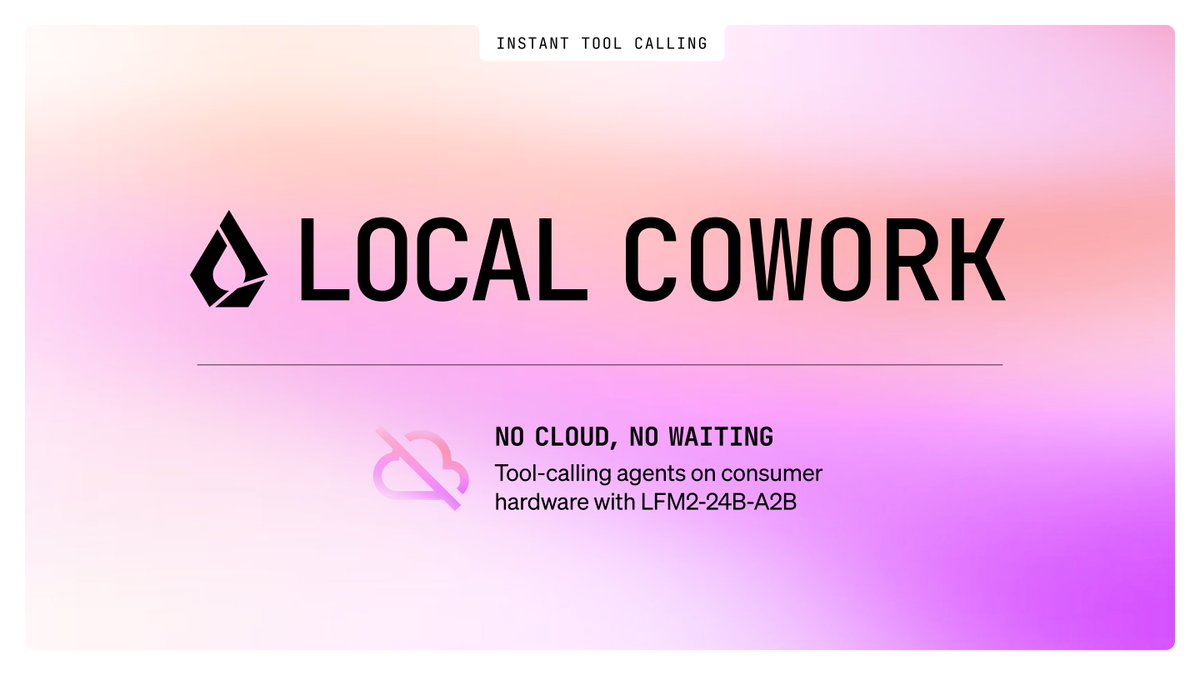
LocalCowork is an AI agent that runs on a MacBook. Open source.
🧵
Amazing work done in our team 🎉
The same set of codebooks works across channel configurations, so you can train your speech LM with a single codec vocabulary and still switch the output format at inference (mono - 5.1 stereo - multi-channel) without changing the codec
Florian Gr\"otschla, Arunasish Sen, Alessandro Lombardi, Guillermo C\'ambara, Andreas Schwarz, "VCNAC: A Variable-Channel Neural Audio Codec for Mono, Stereo, and Surround Sound," https://t.co/R0d8kMYLfh
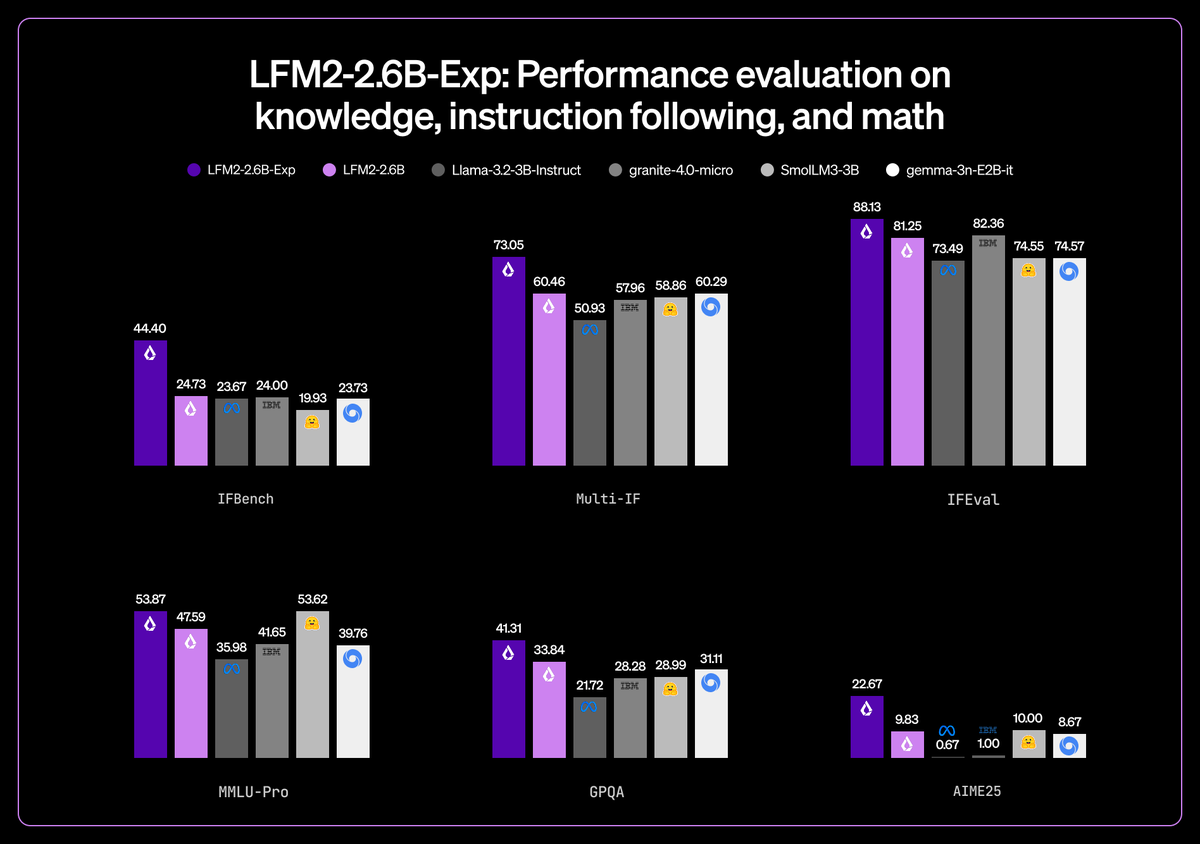
Meet the strongest 3B model on the market.
LFM2-2.6B-Exp is an experimental checkpoint built on LFM2-2.6B using pure reinforcement learning.
> Consistent improvements in instruction following, knowledge, and math benchmarks
> Outperforms other 3B models in these domains
> Its IFBench score surpasses DeepSeek R1-0528, a model 263x larger
Download and play 👉 https://t.co/uLvFHUSELW
Happy holidays,
The Liquid AI team🎄✨
Meta’s SAM Audio is basically Segment Anything, but for sound: you can type a prompt like “dog barking”, use a video mask, or provide a time span, and it generates a target stem plus a residual “everything else” track.
👭From a couple of quick tests: it didn’t reliably do fine-grained speaker separation for me, but it worked really well for foreground vs. background speech. So, in 2-channel call audio where faint cross-talk leaks into the other channel, you can often suppress that before ASR
🔊I’m also very curious to play with their DAC-VAE continuous latents (25 Hz) as a target for speech generation (LLM → latents → DAC-VAE decoder)
Other useful models mentioned in the paper:
PANNs-style AED (audio event detection) (used for an auxiliary alignment loss): 🔗https://t.co/2BvtSlWXAr
PEA-Frame (language-queried temporal localization; great for annotation): 🔗https://t.co/PTVRx3K2p9
SAM Audio Judge (SAJ) (reference-free separation quality scorer; authors report better correlation with human ratings than CLAP): 🔗https://t.co/xUsWdG5Inp
SAM Audio: https://t.co/twmh9IZVos
Current local text-to-speech models lack speed or sound too robotic.
Hence, I open-sourced MiraTTS: a text-to-speech model that can generate 100 seconds of realistic audio in just 1 second!
Code: https://t.co/RzyhgltzJl
Weights: https://t.co/dvABBdGHCe
@derangineer@giffmana Generalized Reward Preference Optimisation — I’ve seen it already in a couple of papers
thought that was a big typo, didn’t know that’s a known artifact of LLM writing
@Tu7uruu Thanks a lot for sharing! I am thinking whether it makes sense to pick a weak ASR model as a reward model (well, maybe weak is the wrong term here, but smth not robust)? In this case the model would likely fail on less intelligible generations? What is your take on this?
Doing the LM head in FP32 materially raises the ceiling by stabilizing importance‑sampling ratios (generator vs trainer use different kernels - tiny prob mismatches - unstable gradients without FP32)
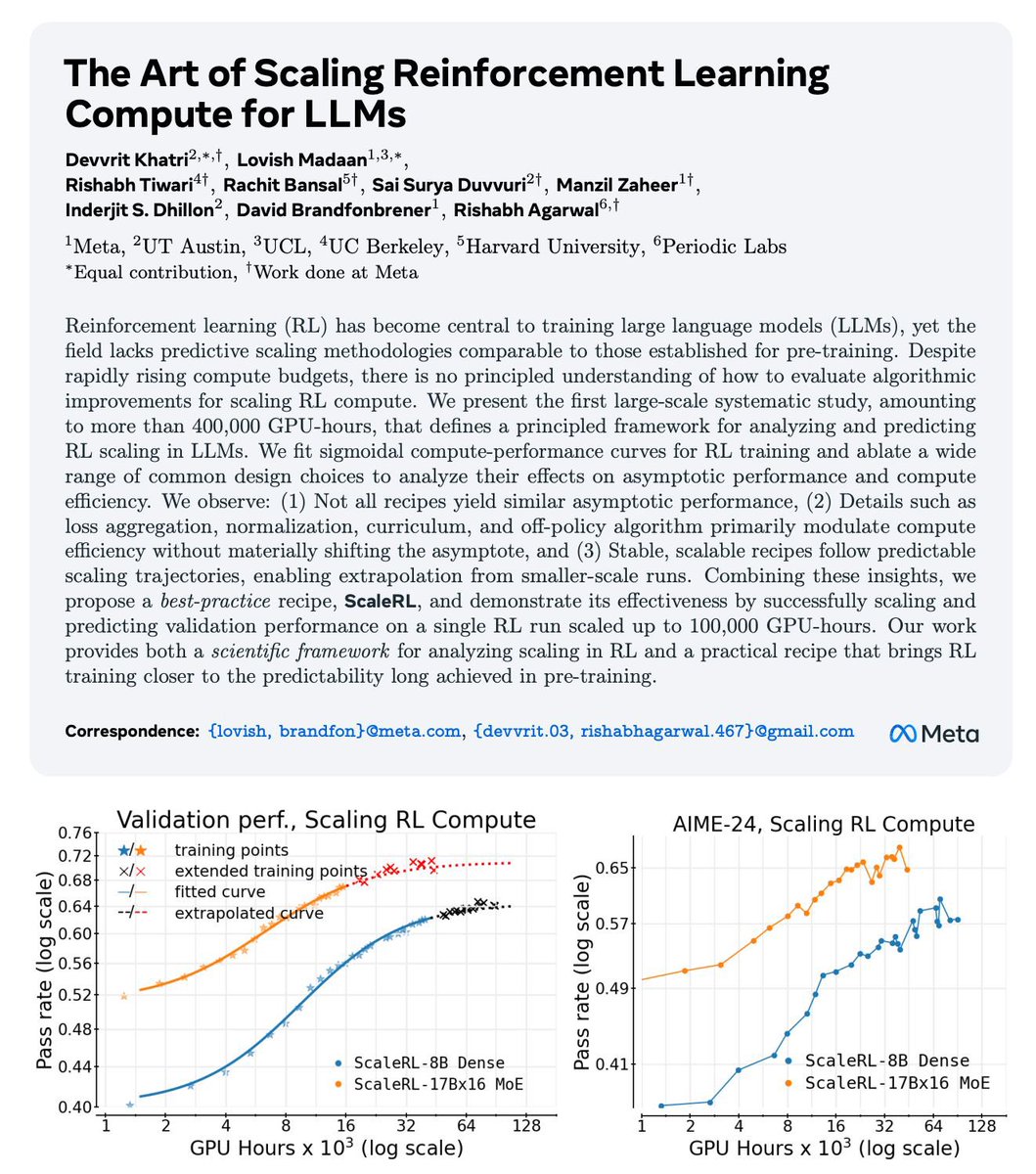
RL for LLMs got a scaling law 🎉
A Meta‑led team shows compute -> performance follows a sigmoid, not a power law, and introduces a stable RL recipe ScaleRL
Losses
On the same setup, CISPO & GSPO beat DAPO on asymptotic performance. CISPO is slightly better late in training and less sensitive to hyper‑params, so it’s their default
ARC-Encoder compresses your prompts by 4–8× without touching the decoder LLM, you just feed compressed embeddings into LLM (after embedding layer)
This is definitely great for RAG
And I believe it carries over to speech conversational models, where context runs much longer 🗣️ Looking forward 🎉
🚀New models: ARC-Encoders
We introduce a lightweight encoder that compresses context into continuous representations for LLMs, reducing inference cost while preserving performance.
Our Adaptable text Representations Compressor, named ARC-Encoder, achieves large efficiency gains through compressing contexts by more than 4 while keeping strong performance across multiple decoders and tasks. We release three pretrained encoders, a fine-tuning dataset as well as a code to pretrain, fine-tune and evaluate any ARC-Encoder!
📄 Paper: https://t.co/mIGpj40vyJ
💾Code: https://t.co/OicepdCRIS
🤗 Models: https://t.co/CJuMGCFnYB
1/2 We’re releasing an in-depth tutorial on neural audio codecs, the secret sauce that makes it possible for audio LLMs to not sound like a horror movie:
SpeechLLM-as-Judges is a neat idea, but human alignment is rather modest at the moment: AVG PCC 0.476.
I’d say it is good for ranking, not ground truth. Biggest win is CoT with 8 per-dimension scores before textual audio description. If you’re building a speech judge, invest in explicit, dimension-wise CoT
Dataset release + encoder/decoder ablations would be great to see too
@fawaz_sammani Totally! AR transformers update a latent too each time they emit a token. The distinction is rather in where recurrence conceptually lives
TRM/HRM recur over a global latent canvas and each step edits the whole hypothesis
The evolution of recurrence in neural architectures:
🟠 RNN: Recurrence over TOKENS (h_t → h_{t+1})
🔴 Universal Transformer: Recurrence over DEPTH (same layer, all positions)
🟣 Diffusion: Recurs only at INFERENCE (training = one step)
🔵 HRM/TRM: Recurrence in LATENT SPACE (iteratively refine answer z)
Why TRM?
Tiny Recursive Model (TRM) is a simple, effective approach built on the idea: do more with less.
It uses just 1 small 2-layer network that recursively improves its own answers.
With only 7M parameters, TRM sets new records, beating LLMs 10,000× larger:
- Sudoku-Extreme: 55% → 87%
- Maze-Hard: 75% → 85%
- ARC-AGI-1: 40% → 45%
- ARC-AGI-2: 5% → 8%
Here is how it works: