🇲🇽🇩🇰🇬🇧 | PhD student @MCB_sheffield researching Class I PI3K isoforms in D. discoideum | Interested in all things space medicine 👩🏻🚀⭐️ | #LatinainSTEM
Absolutely honoured for this to be the first time my name is on a paper. Merging all my interests together: space, molecular biology (PI3Ks!!!) and female reproductive health ❤️ Thank you for the opportunity @NASAGeneLab@jeancallejaagiu@AfshinBeheshti https://t.co/fdX8muh0ym
The amount that the UK space sector brings to the UK economy has grown by £1 billion over a 12-month period, according to new figures released today by @spacegovuk & @SpaceEconomics, in the 2022 #SizeAndHealth of the UK Space Industry Report. https://t.co/gzFvbCCf4F
🚀3...2...1...Lift off!
Our researchers (@JonesLabICR) are teaming up with Kayser Space and @spacegovuk to study the 3D spread of #Cancer cells in microgravity aboard the @Space_Station! (1/2) 🧵
https://t.co/LWLYpgqOhK
#FluorescenceFriday Actin waves on the bottom of a giant dictyostelium. Giant cell generated by electrofusing multiple cells together and actin marked by LifeAct. Image by Joe Tyler @jtyler91@jasonkinglab
I should also say if you want to join us we are currently advertising a PhD studentship to study what happens next - after macropinosomes and phagosomes begin to be processed. https://t.co/fxP2n6b1qB
Ever wondered how cells get a drink? Probably not, but we have a new preprint out from a fab collaboration with Rob Kay and Till Bretschneider @TBatUoW. We use lattice light sheet imaging to define a new model for macropinosome formation in Dictyostelium. https://t.co/1tyhtVJ3f8
🎉New pre-print alert 🎉 from @jasonkinglab: A PI(3,5)P2 probe reveals PIKfyve is required for Rab7 acquisition and the delivery and fusion of early macropinosomes to phagosomes! @hannes_maib https://t.co/1rszx2N4W4
Microgravity offers a unique opportunity for cancer research. By removing gravity, we can grow cancer cells closer to how they appear in the human body. @NASA joins President Joe Biden’s Cancer Moonshot team in the fight to accelerate cancer prevention and precision health.
Check out our latest paper driven by @compBiology utilizing a machine learning approach to identify antimicrobial resistant microbes growing on the surface of the International Space Station: https://t.co/SRUZav8RZ9
@mason_lab@VenkatJPL@Nitin_NJC
The misconception that there is no sound in space originates because most space is a ~vacuum, providing no way for sound waves to travel. A galaxy cluster has so much gas that we've picked up actual sound. Here it's amplified, and mixed with other data, to hear a black hole!
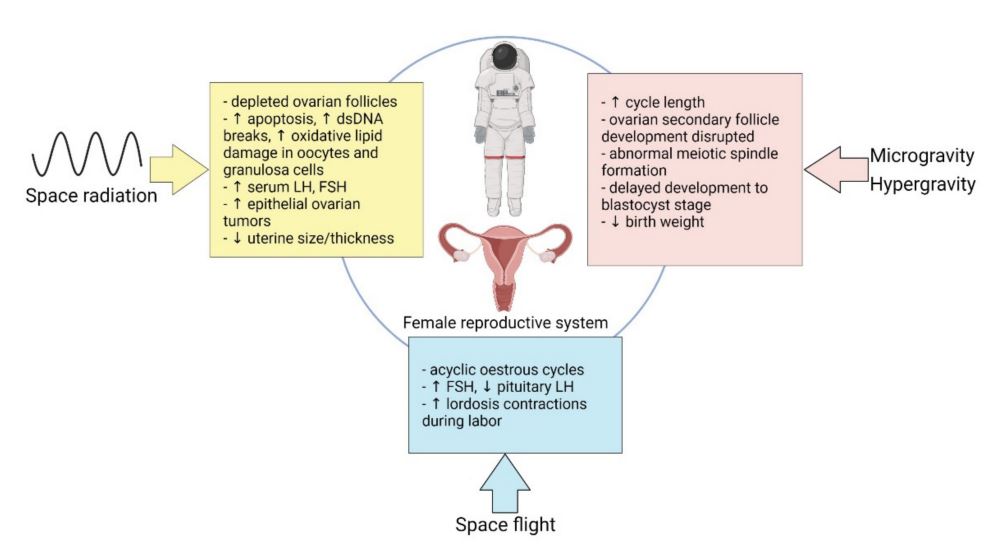
Can spaceflight increase the risk of developing gynecologic cancer in female astronauts? Find out in this latest review discussing the work done on extraterrestrial gynecology and further studies that are needed to pave the way for safer space travel.
🔗https://t.co/6BfY0elkBf
Med denne artikkelen om utenomjordisk gynekologi, med bidrag fra @subbannayya ved #CEMIR, ønsker vi ved @NTNUikom alle våre følgere god sommer: https://t.co/X6qAMJlP9l
How virulent are microbes that grow in the #ISS as compared to those that grow on Earth? Do any of these space microbes possess antimicrobial resistance? Find out with this whole genome sequencing dataset using Oxford Nanopore Technologies.
➡️GLDS-470: https://t.co/MyGKdTdSjr
An estimated 1.2 million people died in 2019 as a result of antibiotic-resistant bacterial infections, according to the most comprehensive study to date of the global impact of #AMR. Our members with expertise in AMR share their reactions to the study. https://t.co/EKU7ZHmnGa