Excited to have a concise write-up of my recent research on the complementarity between agglomeration and international trade (with @JanDavidBakker, @afgarciam and Nico Voigtlaender) out in VoxEU: https://t.co/3e9iPLKxXz via @cepr_org
Because so much of the debate about AI and jobs is driven by fears of outright replacement, there's a much more likely way in which AI could make work worse that isn't getting much attention. Here's my case:
1) A growing share of knowledge workers are managers of AI agents rather than doing the work themselves.
2) Being a manager (of humans) actually kinda sucks. You don't get to practice the craft you trained for; being responsible for others' mistakes is super stressful; and your attention gets split between dozens of things.
3) But we managers don't get to complain — it's higher pay and higher status, and mentoring people and watching them succeed is incredibly gratifying. We chose to get promoted.
4) Being a manager of AI brings all of the negatives without any of the positives. When everyone is a manager, it's not high pay / high status. And the role change is forced upon you.
What am I missing?
We cannot decarbonize if we cannot build at a scale and speed not seen in decades. We cannot harness clean energy to power the data center boom if we cannot build more, fast. No permitting reform deal is going to ONLY smooth the way for your preferred resources. But the sclerotic system of environmental permitting and grid planning today is unquestionably a barrier. We have to clear these barriers way, and then continue the fight to build the clean infrastructure necessary to decarbonize America. Take a hard look at this permitting deal. It's (long past) time to get something done.
🚨 WE HAVE A PERMITTING DEAL🚨
And it is easily the best permitting bill we've ever gotten!
- The Bipartisan American Affordability and Jobs Act is HUGE (400+ pages) and both sides got a LOT.
- The bill is much bigger and better than either Manchin post-IRA in 2022 or Manchin-Barrasso in 2024.
Once I finish reading the text I'll publish an explainer. For now, here are a few high level takeaways.
1. Transmission: The bill is absolutely HUGE for transmission, going further than Manchin-Barrasso. Includes: interregional transmission, limited federal backstop authority, interconnection queue reforms, directives for advanced grid-enhancing tech, and oversight of utilities. It's absolutely AMAZING all of this got in.
2. NEPA: The bill has BIG changes to NEPA, including fixes for judicial review that underpins the law's costs. Still reading but this is even better than I expected!
3. Certainty: The bill includes strong provisions to push back on misuse of permitting, like we're seeing with the admin's abuses against offshore wind.
4. Historic Preservation: The bill includes changes to the NHPA 106 process, including changes to judicial review that will help right-size the process.
5. Clean Water: The bill fixes problems with section 401 by adding new requirements for states and makes section 404 nationwide permits easier to comply with.
6. Geothermal: The bill includes big wins for geothermal, including parity with oil and gas catexs.
7. Mining: The bill fixes the "Rosemont decision"
8. Endangered Species: The bill creates a new path for states to take on endangered species consultation.
9. Hydro: Fixes for certain hydroelectric projects
10. Ratepayer protection: The bill adds protections for ratepayers from added data centers. Looks to be stronger than the House passed bill by quite a bit.
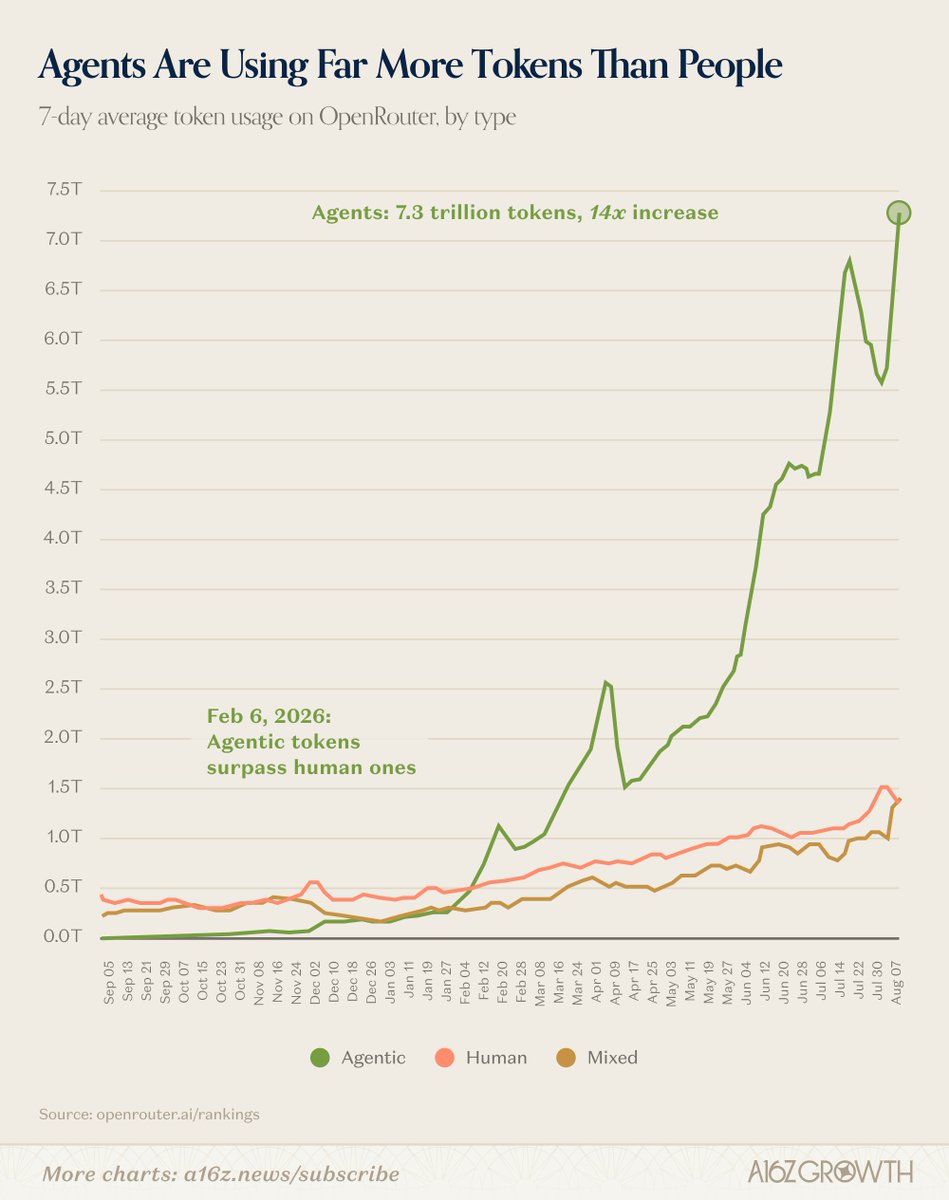
Humans are the minority user of AI
Agents burn nearly 5x the tokens people do, up 14x since February
More charts in State of Markets II: https://t.co/MTaxKUxa2w
We need a science of swarm governance. In our first experiment, we show how a message board can cause agent swarms to adopt shared delusions, and we explore rules that force agents to reveal their private signals to avoid these delusions.
These agent experiments are akin to fables, as @ArielRubinstein might put it: they are stories that suggest particular ways swarms might fail, and particular ways we might fix them. There are infinite possible experiments we might run, much like there are infinite fables we might tell. We need to figure out which ones are most useful, and find ways to tell them well.
To that end, here's a nice explainer video for our first experiment. And the full piece is here:
https://t.co/5nRySeSJ9b
(This is Stanford / Free Systems work, unrelated to my work at Anthropic).
I'll be running a wargame where you steer your life over the coming years as AI, gepolitics or financial events hit your timeline and you have to react, this Friday. Probably the best use case for the wargaming software I've been developing. Link in the next tweet.
New report with @AnthropicAI: What work can robots do today?
We find that robots extend AI exposure far beyond digital work. Over 80% of working hours in the US are exposed to robots or LLMs, but robots are cost-competitive for just 0.3%.
If robot price declines follow past trends, it will take 40 years to reach 10%. 1/6
A CEO told me that while all her IT workers are more productive, her IT department is not. She thought "they were smoking the productivity gain in the corridors" @tylercowen asked me when we would see the leisure dividend of AI and I said it may be already there for some, although I joked for me it has not: my WHOOP age went from 53 to 57 this year.
We discussed many things: Spain and Europe, why AI will not cause mass unemployment, what I learned in politics and why political parties prefer to promote people whose outside option is low. I hope you enjoy it as much as I did.
https://t.co/Fck08SFDzJ
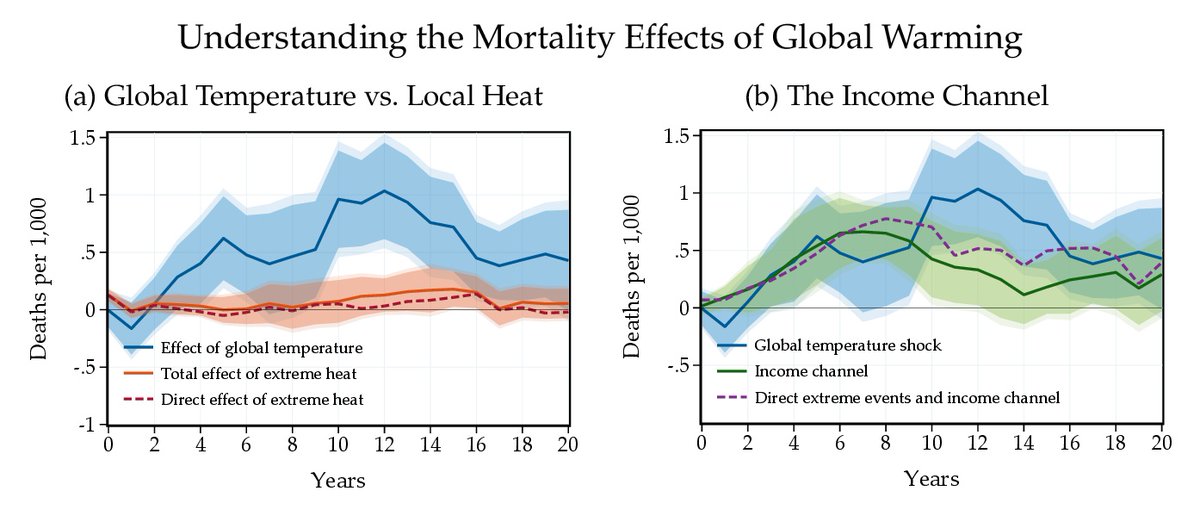
How large are the mortality costs of climate change? And mostly due to heat?
Large, and mostly indirect.
New paper with @drkaenzig and Krzysztof Lisiecki: "Global Temperature and Global Mortality"
https://t.co/YcD9SyA3mt
Ungated PDF: https://t.co/XqOao4VKcR
A thread.
1/5
This is a great hot take. Why hasn't econ been taken over by AI slop? Because field norms mean many publish ~1 paper per year and high quantity in low-ranked journals is seen negatively even pre-AI. Hence AI can lead to quality upgrading. This sounds right to me.
Crude version. There were only ever two possible UK-EU relations. "We'll take the economic / policy hit in exchange for preserving greater freedom" or "Being in gives us the greatest chance to shape our future even with some frustrations".
Neither acceptable to national pride.
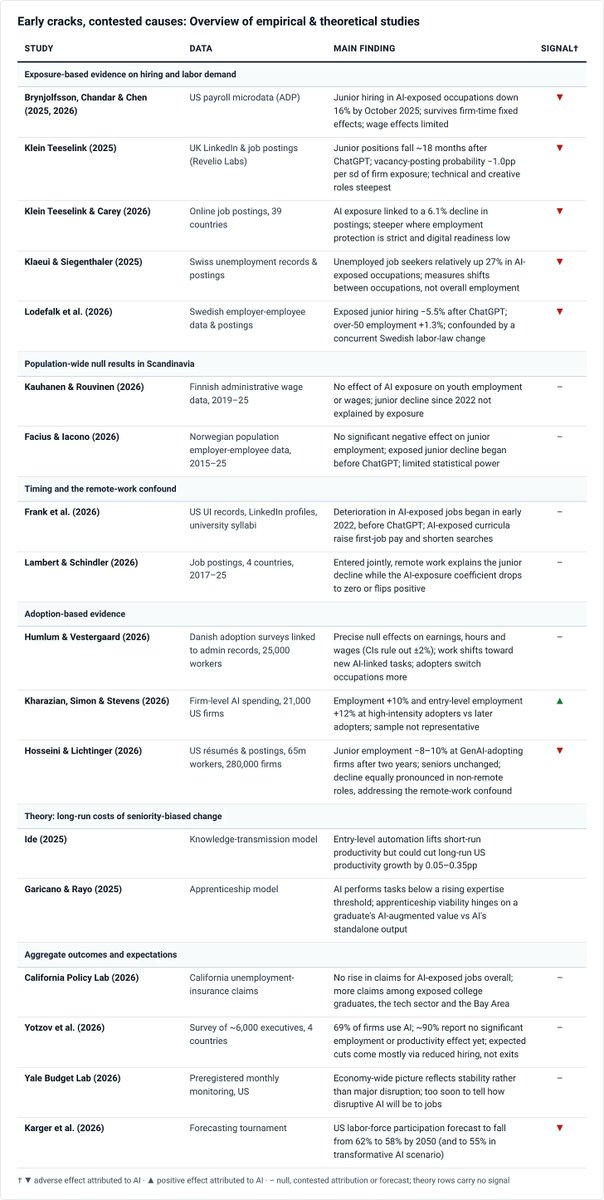
Has AI hit the labor market yet? @alexolegimas and my verdict after ~20 papers: not yet in aggregate. Unemployment and layoffs show almost nothing. But AI may already be cutting junior hiring in exposed white-collar jobs. Remote work may explain part of that decline.
A 🧵