Does anyone at @Discovery_SA Insure actually operate a vehicle on South African roads? :-)
Here is a free idea.
Constant warnings of "heavy breaking" should be overlaid with real-time traffic data for every Taxi, with insured drivers EARNING points for avoiding the 100-odd collisions we face daily.
In 1652, when Jan Van Riebeeck arrived in the Cape, the Bantu had built their own country right in the heart of what is now called Gauteng, before colonization happened.
They called it uBantuNova because "New Bantu" sounded too basic, and they were going for maximum vibes.
The capital city, eGoliPrime, floated 800 meters above the old Johannesburg skyline on a lattice of anti-gravity kraals powered by recycled braai smoke and pure ancestral spite. The buildings looked like someone fed traditional rondavels into a Zaha Hadid fever dream; smooth, curved obsidian towers topped with thatch-patterned solar arrays that shimmered like they were judging your life choices. Every structure was modular; if your neighbor's vibes were off, the whole block just detached and drifted to a better postcode.
Transportation? Forget boring hyperloops. Citizens commuted on hover-izinkomo (holographic cattle that double as personal taxis). They moo'd disapprovingly if you were late for a meeting and could stampede through traffic in emergency mode. Traffic fines were paid in cattle, virtual ones, of course, but the shame wss very real.
The national sport was Vibranium braai rugby; same rules as regular rugby, except the ball was a compressed lump of synthetic vibranium that randomly teleported 5 meters when someone shouted "Yebo!" too loudly. Matches routinely ended with players accidentally teleporting into the stands, which counted as a try if they landed in the braai zone.
The economy ran on UbuntuCoin, a cryptocurrency backed by the collective guilt of every colonizer who ever lived. Inflation was impossible because the blockchain literally refused to process transactions from people who weren't being nice. Try to scam someone and your wallet just sent them an apology note and a free goat emoji NFT.
Food was next-level; pap was 3D-printed in real time from heirloom sorghum strains grown in vertical hydroponic towers shaped like giant mealie cobs. The national dish was umngqusho à la fusion, samp and beans slow-cooked in a quantum oven that aged the flavor 400 years in 12 minutes. Side effects included sudden urges to call your ancestors at 3 am to say thanks.
Foreign policy was simple; they beamed free high-speed internet and free education to the entire continent via satellite dishes disguised as giant marula trees. In return, they asked only one thing; stop asking when they're "going to be like Wakanda." The official response was a polite holographic middle finger made of light particles that spelled out "We got here first, actually" in 11 official languages.
And the national anthem? It was just 4 minutes of perfectly synced amapiano beats with occasional isicathamiya harmonies, because why use words when the bassline already slapped harder than history?
uBantuNova; where the future was black, the vibes unbreakable, and if you complained about load-shedding, the grid personally ghosted you.
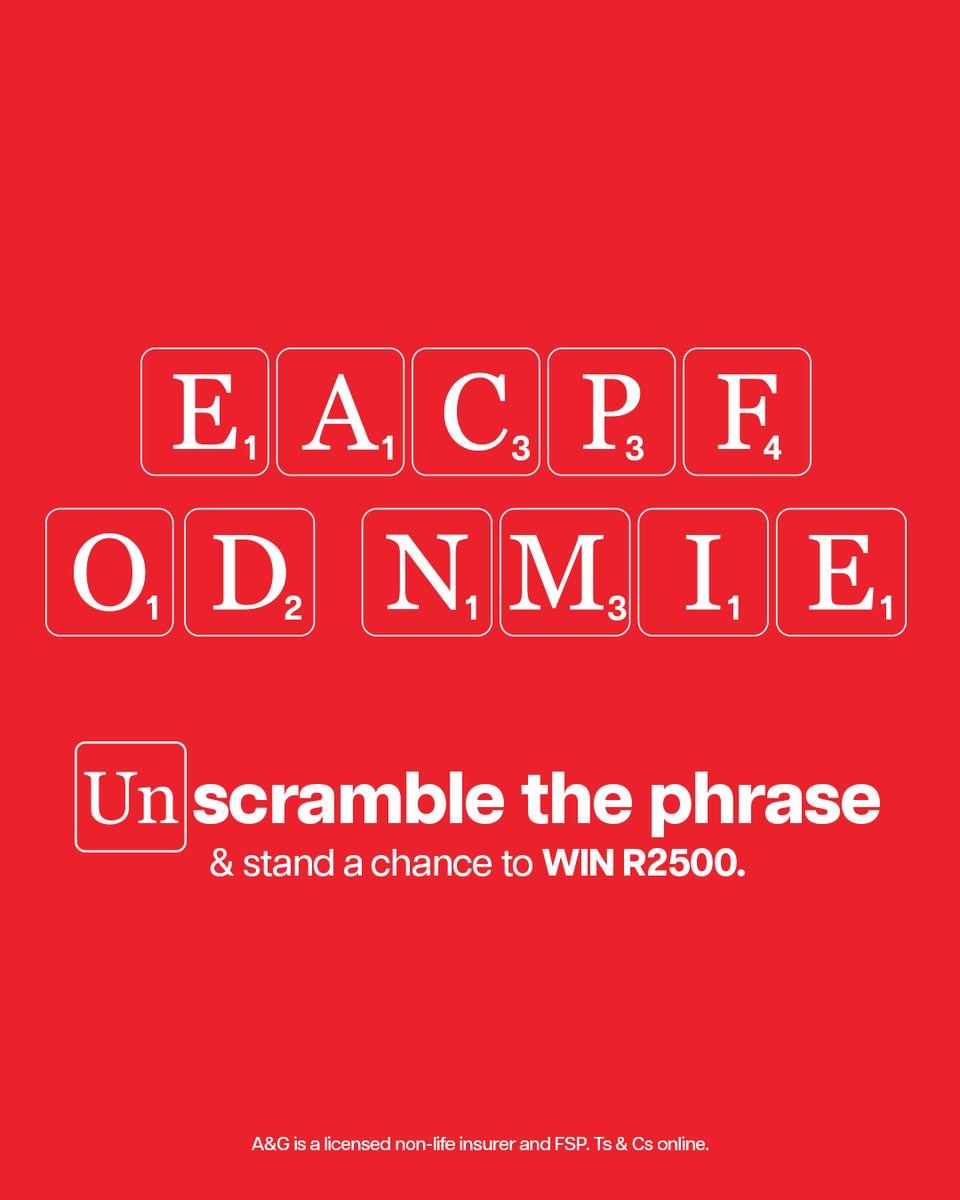
Stand to WIN R2500 🏅
Complete the sentence and unscramble these letters:
E-A-C-P-F-O-D-N-M-I-E
Hint: This is some feedback we’ve recently received from happy Auto&General customers. 🔐
Entry is easy, simply follow us & answer in the comments with #AGLove#NeverNotThere
Exposing misinformation:
I guess apartheid was really that bad and blacks were deprived of so much in South Africa.
In 1988, a German book published how benevolent the White giant of Africa actually was. Below are some of the facts referencing 1988.
In 1972, SA blacks owned 360,000 vehicles. (More than all the black African states together)
The monthly income of blacks per capita in 1988 was R352 per month in South Africa – Malawi and Mozambique was less than R20 per month.
In 1988 black people could undergo a complicated heart valve surgery for just more than $ 1 while black Americans had to pay $ 15,000. In a Pretoria hospital between 2,000 and 3,000 of these surgeries were done per year.
In 1970, black workers earned R1,751 million, or 25.5% of the total wage fees in SA and increased to R17,238 million in 1984 (1,000% growth) and 32.3% of total wages in SA.
In the 1986/1987 financial year, whites paid R9,000 million and blacks R171 million tax. Indians paid R257 million and coloreds paid R315 million on tax.
Between 1962 and 1972 the UN paid $ 298 million to underdeveloped countries compared to South Africa that spent $ 558 million on the development of its black areas.
The budget amount for black education increases every year from 1970 to almost 30% more than any other government department.
From 1955 to 1984 the number of black scholars increased from 35,000 to 1,096,000. In 1988 71% of the adult black population could read and write versus 47% in Kenya, 38% in Egypt and 34% in Nigeria. On average during the year 15 new classrooms per working day were built for black scholars.
In 1985 there were 42,000 black students enrolled at SA universities.
There were 5 black universities and 28 higher education institutions funded by the government.
Soweto with its population of 1.2 million had 5 modern stadiums versus Pretoria with its 600,000 whites who had three. Soweto had 365 schools versus Pretoria 229. In Soweto in 1978, there were 115 football fields, three rugby fields, 4 athletic tracks, 11 cricket fields, two golf courses, 47 tennis courts, 7 swimming pools, 5 bowling halls, 81 basketball fields, 39 children playgrounds and countless community halls, cinemas and clubhouses.
In Soweto in 1978, there were 300 churches, 365 schools, 2 technicons, 8 clinics, 63 kindergartens, 11 post offices and its own fruit and vegetable market.
The white government built a huge hospital Baragwanath 3,000 beds in Soweto. One of the largest and most modern hospitals in the world.
Its 23 operating theaters were equipped with the best equipment money can buy.
Here blacks were treated at a nominal cost of R2 for an unlimited period.
In 1982, no fewer than 898 heart surgeries were done here.
Next to the Baragwantha Hospital is the St. John-eye clinic, famous for the treatment of glaucoma, previous fix retinas, traumatic eye injuries and rare tropical diseases.
There were over 2,300 registered firms, 1,000 taxi operators and 50,000 car owners in Soweto.
Dr. Kenneth Walker, a Canadian physician, visited Soweto and made the following observations:
He saw several houses worth more than R100 000 with various BMW’s at the door.
Only 2% of homes are shacks with neat buildings with lawns. If he had to choose between the decaying apartments in New York, Detroit or Chicago than he would rather stay in Soweto.
He’d rather be very ill in Soweto as in some Canadian cities.
He says the city has more schools, churches, cars, taxis, and sports fields than any other independent African states.
In 1978 the South African government built a highly modern hospital MEDUNSA on the border of the independent state of Bophuthatswana at a cost of R70 million on 35 hectares. In this “city” there were living and sleeping facilities for male and female students.
Black doctors, dentists, veterinarians and para-medical staff were trained. It is the only specialized university of its kind in Africa and one of the few in the world financed by white taxpayers exclusively to benefit blacks. Almost all students who mainly came from the national homelands costs were taken care of by the government.
The practical training took place in the nearby Garankuwa Hospital farm where the whole range of human ailments is covered.
Garankuwa had the facilities for kidney transplants, isotopes units with specialized laboratories where 200 doctors were trained practically every year.
South Africa provided training for the airline personnel of Swaziland, Botswana, Zimbabwe, Zaire and the Comores.
In 1979, when the train traffic to the Malawian capital Lilongwe was interrupted by rebels, SA sent transport aircrafts with fuel drums to keep their economy going.
In 1986, 80,000 black businessmen from Africa visited Cape Town to finalize business deals.
South Africa provided the grain needs of its neighboring countries and wider. In 1980, Zambia received 250 000 tons of maize, Mozambique 150,000 tons maize and 50 000 tons of wheat, Kenya 128,000 tons maize and Zimbabwe 100 000 tons. Other countries that also received South African grain were Angola, Ivory Coast, Malawi, Mauritius, Tanzania and Zaire.
At least 12 countries of Africa, according to the “Argus African News Service” were so dependent on SA grain that a total ban on imports and exports would have destroyed them economically.
About half of Lesotho’s male population worked in South Africa, about 146,000 in 1983, and earned R280,6 million which was about half of Lesotho’s treasury.
In the 1982/83 financial year SA budgeted R434 million for assistance to the independent neighboring states.
SA produced more electrical energy than Italy, as much crude steel as France, more wheat than Canada, more wool than the US, more wine than Greece and more fish than Great Britain.
South African trains ran on more rail lines than in West Germany, carried more passengers than Switzerland, have better punctuality record than Austria and exported car parts to 100 countries.
SA mines bore down to the depth of 3,480 meters and holds the record for the deepest vertical shaft at 2,498m deep into the hardest rock in the world.
They were accused by the world that they were a police state:
In SA 1.4 officers for every 1,000 people while the world is as follows: UK 2.2, Israel 3.5, New York 4.3, and Moscow 10 per 1000. In South Africa there were 16,292 white policemen versus 19 177 non-white.
They were accused of killing their political offenders:
In 1979-1980 there were no deaths in SA prisons. In the previous 10 years 37 died versus 274 in the same period in Wales and England.
They were accused that they payed starvation wages:
In 1974, the average monthly income of black workers in South Africa were $ 127 versus the $ 140 in the US, the richest country in the world.
They were accused that they locked up thousands of political prisoners:
In 1983, 127 such prisoners are confined in SA and 11 whose movements were limited. A further 32 were under house arrest.
*Absolute verval by die Potch Dam*
Kyk gerus na hierdie video van *John Steenhuisen, DA-leier en Minister van Landbou,* tydens sy onlangse besoek aan ons gemeenskap.
Hy het belangrike plaaslike kwessies aangespreek en met inwoners oor uitdagings en geleenthede gepraat.
It’s Capitec Connect’s 3rd birthday & you already know the party’s not over yet! 🎉
Another iPhone 16 is up for grabs today. All you've gotta do to enter is tell us: What’s the first thing you’d do with free Connect data? Best comment wins.
T&Cs apply: https://t.co/o6ZnlnXDVF
So Malema was found guilty of hatespeech in the Cape High Court. Question: eill he get the same punishment as Penny Sparrow? Asking for myself and others.
🇿🇦 WHO MADE RAMAPHOSA RICH? THE CORPORATE TRAITORS BEHIND SOUTH AFRICA’S MANUFACTURED PRESIDENT🇿🇦
27 August 2025 By Paul Hattingh
Cyril Ramaphosa has been packaged as a “self-made billionaire.” It is a myth. He is not an entrepreneur. He is not a corporate genius. He is a manufactured president — a puppet carefully built by corporations who bought him influence, cloaked their betrayal in the language of Black Economic Empowerment (BEE), and entrenched him as both billionaire and political savior. In truth, they gave South Africa a soft dictator whose wealth was engineered in boardrooms and baptized in blood... This is not just about Ramaphosa. It is about the companies that made him. Their names are known. Their scandals are recorded. Their betrayal is undeniable.
🔴 THE VEHICLE: SHANDUKA GROUP
Founded in 2001, Shanduka was Ramaphosa’s empowerment holding company. It was never about genuine transformation. It was a political ATM. Corporations lined up to give Shanduka shares, board seats, and deals. Ramaphosa, the so-called executive chairman, was there to provide one thing only: political cover... By 2014, Shanduka was worth more than R20 billion. Ramaphosa’s family trust was the majority shareholder. This fortune, which made him a billionaire, came not from innovation, but from corporate collusion.
🔴 MTN – BRIBES ABROAD, EXPLOITATION AT HOME
MTN, Africa’s telecoms giant, appointed Ramaphosa as chairman for over a decade. It gave him prestige, shares & credibility. But MTN’s own record is stained:
▫️ In 2015, MTN was fined $5.2 billion in Nigeria for failing to disconnect unregistered SIM cards, amid allegations of bribery.
▫️ In Iran, MTN was accused of bribing officials to secure licenses.
▫️ At home, MTN has been condemned for some of the highest mobile and data prices in the world, crippling millions of South Africans.
Ramaphosa was no innovator here. He was the political face of a company that thrived on corruption abroad and exploitation at home.
🔴 COCA-COLA & McDONALD’S – FAST FOOD, FASTER PROFITS
In 2011, McDonald’s South Africa was handed to Shanduka as its developmental licensee, giving Ramaphosa control of every franchise in the country. Coca-Cola too gifted Shanduka lucrative empowerment shares. These were not earned business achievements. They were global corporations buying political favor, desperate to secure transformation points and maintain access to the South African market. Communities they claimed to “empower” remained poor, but Ramaphosa became rich.
🔴 STANDARD BANK & ALEXANDER FORBES – BANKING ON POLITICS
South Africa’s largest bank, Standard Bank, brought Ramaphosa into its web. Alexander Forbes, the financial services firm, did the same. Through BEE, both companies handed him stakes and seats, not for skill, but for access to ANC leadership. In return, they secured political protection and cemented their dominance. Meanwhile, ordinary South Africans were bled dry by rising bank charges and endless fees.
🔴 BIDVEST – THE TENDER GIANT
Bidvest, South Africa’s mega-conglomerate, installed Ramaphosa as chairman. This was the same Bidvest that gorged itself on government tenders, thriving in an environment where ANC-linked companies flourished. Ramaphosa’s presence gave Bidvest cover: they could point to transformation while securing more tenders. He gave them legitimacy; they gave him millions.
🔴 LIBERTY, MPACT, MACSTEEL - CORPORATE COMFORT
Liberty Life, Mpact (packaging), and Macsteel (steel trading) all brought Ramaphosa in. He did not invent their business models. He did not transform their industries. He sat in boardrooms, a political ornament. His mere presence gave them credibility with the ruling elite, and in return, he cashed out.
🔴 SEACOM & HELIOS TOWERS – INFRASTRUCTURE FOR THE FEW
Shanduka invested heavily in telecoms infrastructure through Seacom and Helios Towers. These were gateways to Africa’s digital economy. Yet the irony is stark: millions of South Africans remain unable to afford reliable internet. Ramaphosa grew richer from monopolistic structures while his people stayed disconnected.
🔴 RENTWORKS, GIGAJOULE, FEVER TREE, TBWA – THE IMAGE ECONOMY
From RentWorks (asset rentals) to Gigajoule (energy), from Fever Tree Consulting to TBWA (advertising), Shanduka’s tentacles reached everywhere.
▫️ RentWorks gave him access to state-aligned asset leasing.
▫️ Gigajoule put him into energy markets where political contacts meant everything.
▫️ Fever Tree and TBWA helped craft the narrative of “Ramaphosa the businessman.”
These were not random opportunities. They were carefully chosen placements to build both wealth and brand.
🔴 THE MINES – BLOOD MONEY AND MURDERED WORKERS
Mining made Ramaphosa’s fortune darker than any other sector. Through Shanduka Coal, Kangra, Scaw Metals, Mondi Shanduka, and Pan African Resources, he became deeply tied to an industry of exploitation.
But nothing compares to Lonmin.
As a Lonmin board member and shareholder, Ramaphosa directly intervened in the 2012 Marikana strike. His emails called for “concomitant action” against striking workers. Shortly after, police opened fire. Thirty-four miners were slaughtered.
Their deaths remain the bloodstain on his billions. This was not business leadership. This was betrayal of workers and complicity in massacre.
🔴 PHALA PHALA – THE ROT CONTINUES
Even after “disinvesting” from Shanduka in 2014 Ramaphosa’s scandals continued. In 2020, $580,000 in cash was found inside a couch at his Phala Phala farm... He called it a “business transaction.” Parliament blocked investigations. Acting public protector Kholeka Gcaleka cleared him. The same old formula: political power and corporate protection walking hand in hand.
🔴 CORPORATE STATE CAPTURE
What emerges is clear: South Africa was not only captured by the ANC. It was captured by corporations.
▫️ MTN bought him.
▫️ Coca-Cola and McDonald’s bought him.
▫️ Standard Bank bought him.
▫️ Bidvest bought him.
Lonmin bought him — and workers died.
These companies did not just play politics. They manufactured a president.
🔴 THE REAL TRAITORS
The betrayal is not only in Luthuli House. It is in the boardrooms of Sandton, London, and New York. These corporations — MTN, Standard Bank, Coca-Cola, McDonald’s, Bidvest, Liberty, Lonmin, and the rest — are not neutral brands. They are traitors. They chose profit over principle. They chose corruption over conscience. They chose betrayal over South Africa.
🔴 THE QUESTION SOUTH AFRICANS MUST FACE
Who made Ramaphosa rich? Corporations.
Why did they do it? To buy political cover.
What did South Africa get? A billionaire president, a captured state, and a betrayed nation.
Cyril Ramaphosa’s billions were not earned. They were engineered. His presidency is not a triumph of democracy. It is the victory of corporate collusion.
And until South Africans call these companies what they are - traitors - the cycle of betrayal will continue
DISCLAIMER
This publication constitutes commentary and opinion protected under the principles of free expression. The content is based on information already in the public domain, including news reports, company filings, and historical records. It is presented for purposes of public debate, academic interest, and investigative discussion.
Nothing in this article should be interpreted as a final statement of fact or a legal finding against any individual or company. References to corporations and political figures are strictly limited to their public roles and reported activities. Any allegations mentioned are derived from existing media or investigative reports and are not independently verified legal conclusions.
No defamatory intent exists, nor is this article designed to cause unjust harm to reputation. It does not accuse any party of unlawful conduct unless such conduct has already been established by credible judicial or regulatory findings.
The responsibility for determining the truth of specific matters lies with competent courts of law and official regulatory authorities. Readers are strongly advised to consult multiple independent sources and exercise their own judgment when forming conclusions.
It’s #FuelFriday and we’re busting myths again for a chance to WIN a R1,500 fuel voucher!
This week’s question: Does idling your car for a few minutes help it warm up and save on fuel?
All you have to do is comment TRUE or FALSE using FuelFriday to enter.
🎉 Big ups to everyone who guessed broccoli and a padel racket in our last zoom-ins. Next mystery: It's always under you, but never slows you down. Can you guess this fitness favourite? Tell us how it fits into your healthy lifestyle.