I think what is actually needed is for Indian people to actually give a damn about their cities and fellow citizens.
Anybody using the "I pay taxes, I shouldn't have to do anything" excuse should go live in another country. India isn't developed, it's developing, so it needs patriots, not parasites. If this triggers you, it means you're part of the problem.
If you're not happy with the footpath (or a pothole, or anything else which is broken), fix it, or call someone to fix it, and don't give up until it's fixed. Be relentless. Be vocal. Be creative. Make it your mission to get that one thing fixed. Look at what Virendra (@Virendra0698) did by just calling the right people and being respectful (but also persistent). He and Arun Pai (@arunpaiblrwalks) along with the help of GBA and some wonderful volunteers turned an unofficial garbage dump into a pristine, beautiful footpath through sheer force of will.
https://t.co/pBmWjgckFf
The overarching thesis: As models improve and software becomes easier to replicate, value shifts toward proprietary data, agent infrastructure, memory, trust, domain expertise, and distribution.
I spent 48 hours in SF hanging out with billionaires, data labs and AI founders and execs running $1B to $100B companies.
My observations:
1. Sooo MANY stories of data brokers making like $2M a WEEK selling company data to labs. I can't tell if it's the beginning or a bubble, and I kept wondering which niches are left. Digging into it actively.
2. At dinner, someone asked the table, "If a new model drops next month, does your company get better or worse?" HALF the table went quiet! I think that's the best question to ask about any AI startup right now.
3. The bar people talk about now is hitting $1B in revenue in 12 months (I guess that's the new unicorn?). What I didn't hear much about is retention. AI revenue can come in fast and leave fast, and I think we're going to see a lot of stories of AI companies with huge revenue and terrible retention.
4. It's pretty clear we're living through the reinvention of the computer. The model is the CPU, the harness is the operating system, and skills and plugins are the apps. Thinking about it that way makes it easier to see where the whitespace is.
5. We're maybe 12 months from an agent that can watch you work for a week and then do your job without any instructions. The screen recording plus agent memory plus local model combination makes this possible right now.
6. Agent harnesses feel like the new GPT wrappers, in a good way, especially vertical ones. The best teams I talked to treat the model as swappable. One founder walked me through routing different models to different jobs: one for taste and visuals, a cheaper one for the everyday stuff, another for text.
They use prompts they can move across models over fine-tuning, and A/B test the output on what users actually do with it: do they edit it, export it, share it? A vertical harness is basically four things: the connectors for that industry's data, evals written by people who know the work, rules for what the agent can and can't touch, and a clean screen for a human to review. The model is maybe 20% of it.
7. There's a lot of reverse engineering going on/cloning going on more than I've ever seen. People are decompiling software and rebuilding it with agents, and someone showed a suite of like 10 apps that are worth $5B+ each all that he cloned open source. Me and everyone are still thinking through what it means when software gets this easy to copy.
8. My guess is the value moves to data. If the software can be rebuilt quickly, what's worth paying for in a legacy SaaS company is the years of customer data and workflows inside it. Some SaaS companies are secretly data companies.
Gets me thinking about how do you truly value data for this saas companies? Like if we were buying these dying saas companies at 2x ARR before (as example), maybe there is a better metric. Idk, just thinking out loud here.
9. It feels like a good chunk of legacy software won't make it to the agentic era, especially anything built around people clicking through a lot of screens.
10. Every company I talked to wants to pipe its internal data into one place and expose it to agents through MCP. Then they look at the data and realize it's a mess: five versions of the same customer, old Slack channels, PDFs nobody can search. Cleaning that up feels like a big consulting opportunity!
11. A lot of founders are building the basic building blocks for agents: APIs, data layers and tools. Some of the companies I saw barely have a UI because the main user is an agent. I really believe the startups that build primitives to this agentic era will do extremely well. Building blocks is the best way to think about it.
12. Labs can get plenty of training data, but it's harder to get real examples of agents failing inside companies. Whoever has those logs has something valuable.
13. Someone running a big consumer company told me the next fight is over memory. The model that remembers the most about you wins, and the smartest model matters less than people think.
14. Physical AI came up a lot. Astra I think was the first model that got people into AI can actually do CAD, and I think a lot of people are thinking what does vibe manufacturing really look like. The line I keep thinking about came from a robotics founder: the hardest problems in AI are deployment problems now, not research problems. Their robots work on their own, call a human when they get stuck, and every one of those calls becomes training data.
15. Cybersecurity companies are having a moment and are actually cool companies to build now, especially the ones that clean up after a breach. Every agent with access to your systems is a new door into your company, and a lot of those doors were left open.
16. Some startups are worth more dead than alive now. A shutdown company with 5 years of Slack, email and code can get paid for licensing all of it. I wouldn't be surprised if founders start factoring that into when they shut down.
17. People are starting to talk about monetizing the agent web. It feels really early, but when the most popular user of the internet is an agent, what startups should you be building?
18. I think agent insurance is coming. Once an agent makes an expensive mistake, insurers will want audits before they cover anyone.
19. Several people said the hire they want most is someone with taste who can write evals. The models are getting good at generating ideas, so the hard part is judging which ones are good.
20. New trend I observed: startup raises VC, uses venture dollars to become a creator, startup fails, founder falls back on being a full-time creator and incubates other products bootstrapped.
21. Getting SIGNIFICANT distribution is HARD right now. Founders are sponsoring buses, buying billboards like crazy and throwing parties with famous DJs to get noticed. Kinda feels dotcom era in that sense.
Attention is what's scarce! The growth guy going viral sharing his UGC strategy from Wispr Flow is a good example. It's the sauce everyone wants, and I truly believe there are probably only 50 people on the planet who know how to scale these types of businesses efficiently in this era.
Always good to get that dose of SF. I felt sooo lucky to have such an incredible trip during such an incredible time in building businesses. Surreal in so many ways.
Happy to be home and locked in.
Until next time!
We are releasing Ultramarine 1 Flash, a frontier-class model built for knowledge work. It is open-source and achieves similar performance to Fable 5, while being 60x cheaper.
It was post-trained by a team of 5 for ~$300k all-in. Available on API now, with weights releasing in 2 weeks.
@IndiaBottomline@elonmusk Anyone can get a degree. True learning happens when you spend hours doing something and learn from others (not college). Especially in India
@IndiaBottomline@elonmusk Again, you're missing the point. There is a difference between education and having a degree. Dhirubhai was (obviously) highly educated in matters of business even though he did not have a degree.
Impressive. This set of talks, along with the new America dot gov website, has the unmistakable feel of an Apple launch event. They're rebooting the federal government as a tech startup. Several observations.
(1) First, with this new AI interface to the entire federal government, if it works as promised, there won't be a single American who can't say their life wasn't helped at least in part by AI, or that the benefits accrued solely to zillionaires. This in itself cannily mitigates anti-datacenter sentiment.
(2) Second, Joe Gebbia and Marco Rubio's talks on simplifying name changes and passport filings introduce a completely new era where the US government is actually launching tangible features that benefit users.
(3) Third, this launch event in and of itself may visibly drive reform. It could become much more important than the State of the Union. Unlike laws, code is user-visible, and can be instantly audited by the public, as Obama found out with the failed obamacare website launch. So: the annual America dot gov event may be substance, whereas SOTU is traditionally optics. I wouldn't be surprised to see the President present at the next one.
(4) Fourth, this kind of event is a perfect example of where tech and red cooperate best. They both hate bureaucracy. Automating paperwork with code reduces the power of statists over both capitalists and nationalists. It's also hard to undo by other admins: once you digitize a process, hard to turn it back to paper.
(5) Fifth, it's an obvious point perhaps, but think about how much influence YCombinator has had in 20 years. From Gebbia's Airbnb joining their 2009 batch to a complete overhaul of the user interface of the US bureaucracy, and thus the US government.
(6) Sixth, this is another take on the network state. The functional part of the US (the network, meaning tech) is merging with and partially reforming the dysfunctional part (the state, meaning bureaucracy) by automating 20th century paper forms.
As a tech startup, there will no doubt be bugs and user issues and so on, but unlike with paper laws those issues will be visible and the code fixes will be verifiable. A new era of AI America. Rooting for them.
Last month I wrote about how we can build a positive and safe future for everyone: https://t.co/eoLGVY8yad
Every lab has the responsibility and incentive to move at the pace required to train its models safely, and the ability to take its own actions to ensure that happens.
The reality is:
- People won't want to use agents that are misaligned with them and that don't do what they ask, so labs have a strong natural incentive to make their models more aligned.
There is a lot of debate about slowing progress on capabilities until alignment catches up. My view is that trust and alignment are quickly becoming the most important capabilities that will differentiate agents and models. Any lab that doesn't focus on alignment will fall behind.
- Labs face significant liability if their models cause harm, so they have a strong incentive to prevent this as well.
Meta delayed shipping Muse for several months to focus on safety and security. We didn't call for everyone else to do this before we would. We just did it as part of our day-to-day work because it was clearly the right thing for people and for us. I'm proud of the security foundations we've built.
- Engaging independent evaluators and advisors is industry best practice. MSL already does this today in several areas because it helps produce better work. Other labs can just do this too. In general, it would be helpful for there to be a larger and more diverse ecosystem of evaluators.
- Committing the significant majority of compute towards serving people rather than racing towards recursive self-improvement is one of the best ways to ensure we develop this technology safely. Meta has made this commitment and other labs can do this as well.
I believe the key to building a positive future for everyone is maintaining the right balance of power. This is within our power to do.
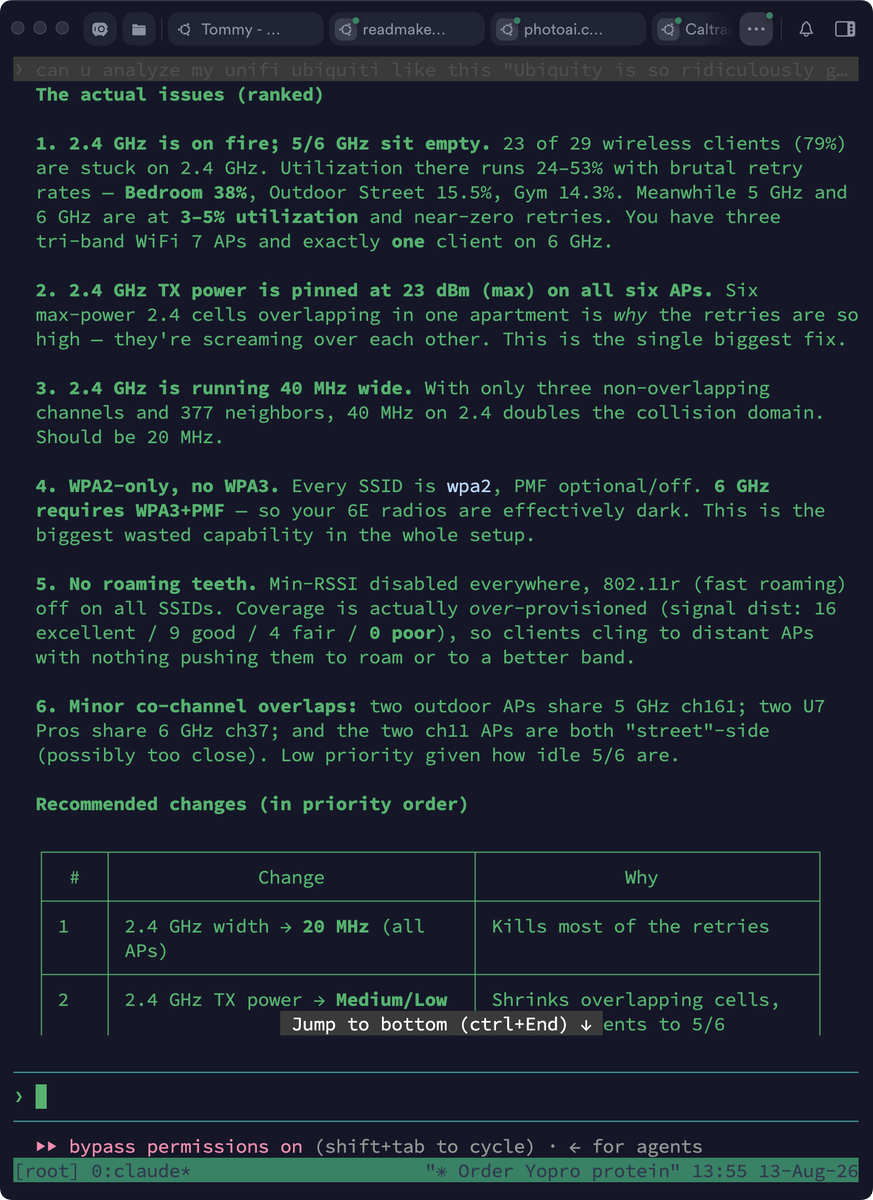
Lost my phone at the office and spent 30 minutes turning the place over. Find My was disabled by MDM.
Out of ideas, I asked Claude how I could find it. It suggested tracking the Bluetooth signal strength, then wrote me a meter in about a minute.
I walked around watching the number climb. Found it.
Apparently you can just make the tool you need now.
Code: https://t.co/fmnISzHfZ2
The internet was busy debating jantar Mantar & a quiet facility in India witnessed something straight out of science fiction. An engine fired up. But it did not hum & it did not roar like a normal jet.
It detonated. Continuous supersonic shockwaves raced around a circular chamber 1000s of times/sec, harnessing controlled explosions to generate thrust.
The startup D-Propulse just gave the world a sneak peek of their air-breathing Rotating Detonation Engine (RDE) with an integrated aerospike nozzle.
Every jet engine on a commercial airliner, every fighter jet & every rocket we have ever seen operates on deflagration. We mix fuel with air/oxygen, ignite it & it burns relatively slowly at subsonic speeds. It is effective, but humanity has pushed this tech to its absolute physical limits.
RDEs throw that century-old playbook into the fire. Instead of burning fuel smoothly, an RDE explodes it intentionally. A continuous detonation wave sweeps around an annular (ring-shaped) channel at supersonic speeds, reaching over 2000 m/s. This is called Pressure-Gain Combustion.
It extracts 15-25% more thermal efficiency out of the exact same amount of fuel. In the world of high-speed flight, a 25% jump in efficiency is a completely different league.
Why this Matters for India?
For decades, the narrative surrounding Indian engineering was tied to catching up on legacy systems, spending billions trying to replicate 1970s turbofan engine metallurgy/importing critical defense tech.
D-Propulse is proving that India does not need to play catch-up anymore.
By leapfrogging straight to Pressure-Gain Combustion, an Indian deep-tech startup, guided by veteran scientists & built by young engineers is standing on the frontlines alongside research labs in the US, Japan & China.
Imagine hypersonic cruise missiles, ultra-long-range combat drones & spaceplanes that do not need heavy, complex moving turbopumps to break speed records. That is the realm this technology unlocks.
The future does not belong to those who build better versions of old machines. It belongs to those who rewrite the physics of how machines work.
Two years ago, this was just an idea, a small team, and a bet that we could build launch vehicles powered by #methalox propulsion from Thoothukudi, Tamil Nadu.
No lab.
No existing infrastructure.
Just a conviction that the hard path was the right one.
That bet became @CosmicportSpace.
This week, that belief turned into our first cryogenic hot fire.
A few seconds of fire.
Years of work behind it.
Proud of this team. Every late night, every setback, every test brought us here.
Mission Blue Frost has begun.
The loud part is just getting started. ❄️🚀
#MakeInIndia #SpaceTech