@junaxup Awesome, thank you! I actually met the team at a neurotech event and was excited about the work, although haven't had a chance to interact with you.
In 1992 Peter Ratcliffe received this rejection letter from Nature.
His findings were not "a sufficient advance in our understanding".
27 years later he won the Nobel Prize for the same discovery.
Don't lose faith in the things you believe in.
I remember Ethan Shevach talking about how he reviewed this paper in @J_Immunol and only accepted it because he thought “why not let this crazy idea through”, though all reviewers were highly skeptical. Not all Nobel Prize papers have to be in glam journals; they likely require a stroke of luck in review too!
Today in @ScienceMagazine, we report a new DNA editing technology to seamlessly write massive changes into the right place in the human genome.
The reason gene editing hasn't transformed human health is that current gene editing technologies like CRISPR are very limited.
The problem with CRISPR is that it cuts up your DNA, and then hopes that unreliable cellular DNA repair will make the wanted edit. @geochurch famously called it genome vandalism. More precise versions of CRISPR only edit less than 100 bases - often only a single base. Therefore, it's not suited to make large changes safely.
However, most diseases are not the result of mutations in one location. Instead, their causes are spread all across the 3 billion base pairs in the genome.
We found bridge RNAs in bacterial “jumping genes” that allow us to make safe and arbitrary changes (insert, cut out, or flip) to every nucleotide within (up to) a 1 million bp sequence in your DNA.
In the paper, we show that we can correct the disease-causing DNA repeats that cause Friedreich's ataxia (which is a rare neurological disease). The same approach could be applied to Huntington’s and other repeat expansion disorders.
At @arcinstitute, we're working towards a full Turing machine for biology. Evo, our DNA foundation model, helps us design the optimal healthy DNA sequences. And Bridge recombination gives us the ability to seamlessly write these changes into the right place in the genome.
This work was a wonderful collaboration with my @arcinstitute cofounder @SKonermann and led by the indefatigable @ntperry13, alongside our amazing bridge editing team: @BartieLiam@dhruvakatrekar@Gabogonzalez515@mgdurrant@james_jw_pai@AlisonFanton Juliana Martins Masa Hiraizumi @chiaroscurale@hnisimasu
"The day the paper was published should have been a moment of pride. Instead, it felt like a quiet erasure." #ScienceWorkingLife https://t.co/EpmK1mgQFS
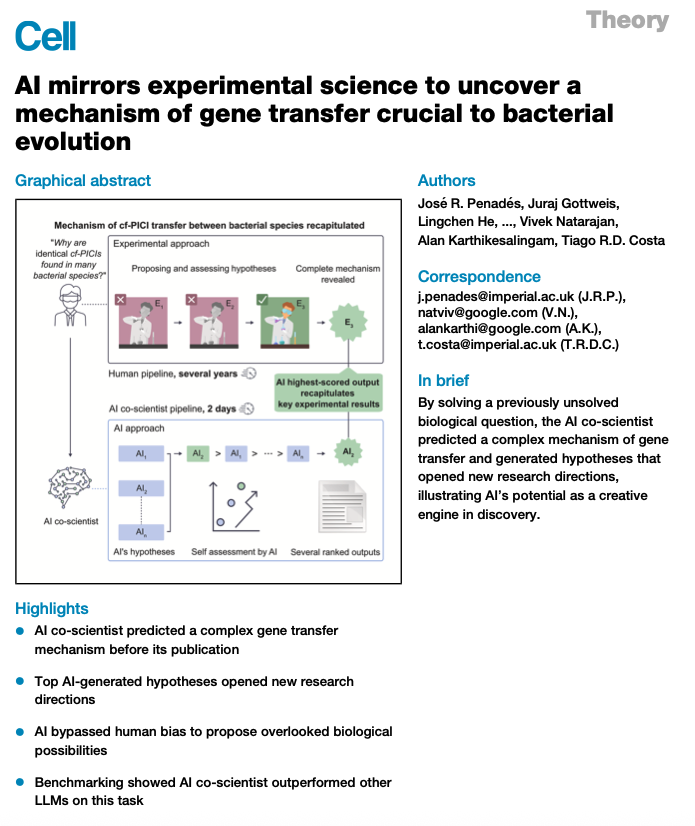
A new "AI makes scientific discoveries" paper, out in Cell. Don't know what to make of it.
But here's a TL;DR:
> Researchers in London are studying phages. These are viruses that infect bacteria. Usually, each phage has its own special "host" it likes to infect.
> The researchers find that different bacterial species sometimes carry the same DNA sequences, stretching 15-20kb, that come from these phages.
> Huh, they think. That's weird. How do these sequences get into different bacterial species if phages only infect one species?
> The scientists speculate that there is some kind of new, unknown horizontal gene transfer mechanism between phages. Somehow, these phages are swapping DNA.
> So they spend years and years doing experiments. And finally, they discover that, actually, these DNA sequences make their own capsids (the thing that holds in DNA). Yes, these sequences actually encode the "head" part of the phages; but they do not make tails.
> Somehow, these capsids then steal tail parts from a phage infecting the same cell, attach them to their capsid-DNA package, and use that combined particle to inject their DNA into a new bacterium. Wild. These are basically circulating DNA sequences that have figured out how to hijack phage tails.
> (These researchers claim that there is NO WAY an AI model could know about this discovery, because they had never publicly mentioned the discovery anywhere. They didn't tweet about it, they didn't share it online, and they didn't....expose it to an AI model on any servers?)
> Anyway, they write up a paper about the phage tail thing and submit it to Cell. That paper was published alongside this AI paper on Sept. 9.
> "With this knowledge, and confident the scientific community was unaware of this breakthrough, we challenged the AI co-scientist to hypothesize how identical [DNA sequences] could exist in different bacterial species." The researchers gave the AI coscientist a single document, "comprising only previously published, openly available information as the system's research goal."
> "The AI co-scientist generated five ranked hypotheses, with the top one recapitulating the key hypothesis and main experimental finding of our original manuscript submitted to Cell."
> They tried to see if other AI models could do the same thing. They repeated this with Gemini 2.0, OpenAI o1, DeepSeek, etc. (Note that the AI Coscientist uses Gemini 2.0 models.)
> None of the other AI models "were able to recapitulate the findings of the experimental manuscript."
Not sure what to think of this paper. There is no way to repeat it or independently verify it in other laboratories, right? And if the AI Coscientist is just a bunch of agents using Gemini 2.0 and other models, presumably they should have been able to do the same thing using other multi-agent tools, no? They didn't seem to try that at all.
Anyway that's the TL;DR. The paper is really readable and you can form your own opinions about it.