1/ I’m hiring an ML Scientist / Engineer for my Reasoning and Control team at https://t.co/hHDU7q2tUi.
The role sits at the intersection of control theory, dynamical systems, machine learning, and agentic reasoning systems.
It is mindblowing to me how few people realize that their lives and everything they know will change drastically in the near future.
At this point, it should be pretty clear.
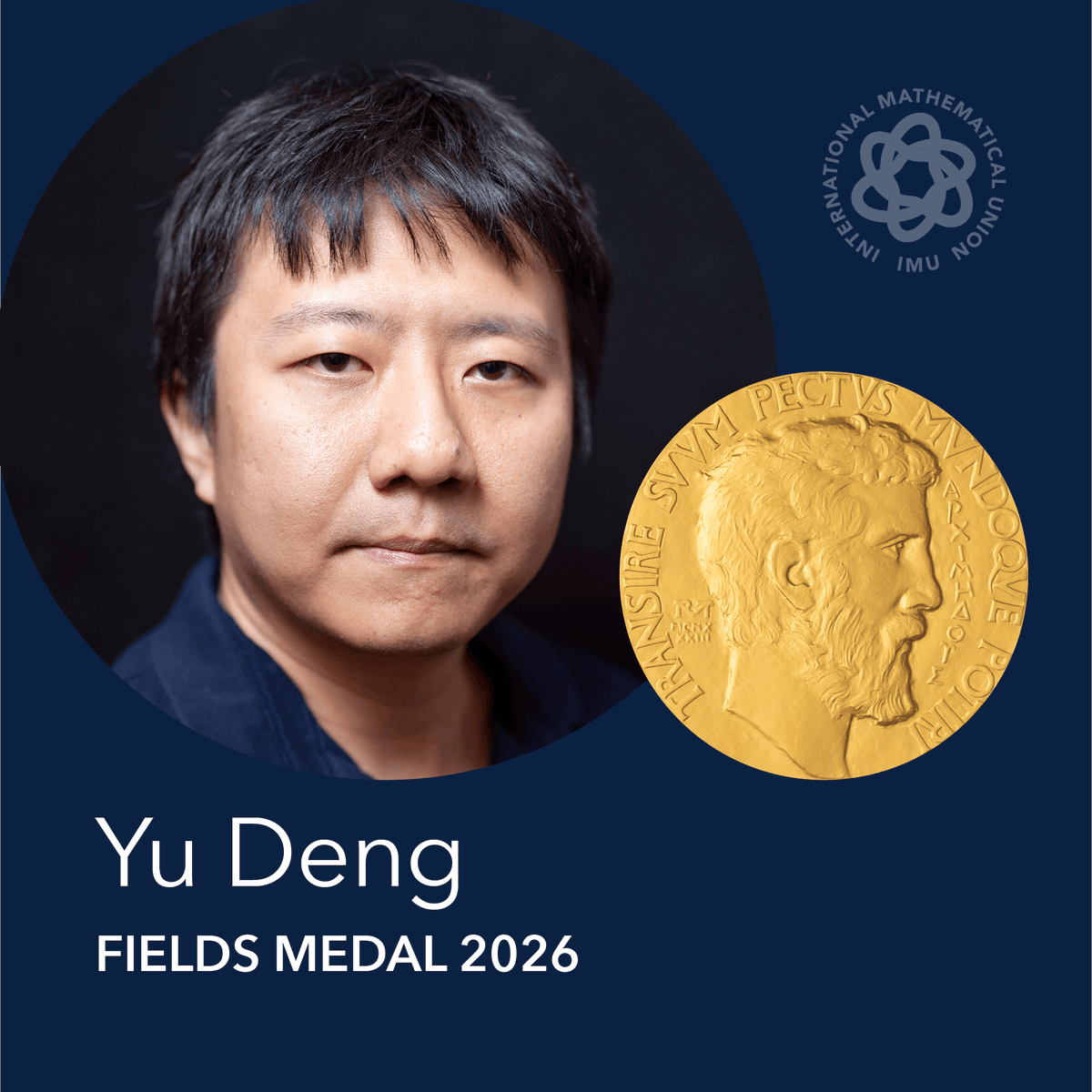
During today's #ICM2026 opening ceremonies, the IMU announced the 2026 Fields Medals recipients:
@UChicago's Yu Deng, @stonybrooku's John Pardon, @UofT's Jacob Tsimerman, and Hong Wang of @nyuniversity and @Institut_IHES.
Read more: https://t.co/oJARAI8I8j
Presenting Stackelberg Mean-Field Games for Adaptive Cancer Therapy at #ICML2026 today, cancer treatment as a game between the clinician and billions of evolving tumor cells. See you at the poster if you’re around!
Our thoughts on the importance of AI sovereignty.
1. Your AI sovereignty dictates your institution’s future. Sovereignty is the precondition for choice. Relinquishing sovereignty transfers the future choices of your institution to others, who are likely to exploit it for their gain and your loss.
2. Data retention is your treasure. Transfer it at your own peril. Your ability to win is dictated by your ability to recognize and use your unique edges, and you keep winning by compounding the underlying data to generate new insights. Transferring that data hands over access to your pre-existing winning plays and yields the means of production for new ones.
3. Tokenmaxxing hijacks your value orientation and decreases your institutional fortitude and intelligence. The pursuit of high token usage incentivizes disposable scripts over robust software — with the addictive feeling of false progress. There is a reason why those selling tokens refuse to charge based on value.
4. Controlling your weights is controlling your fate. Weights are the distilled form of hard-won, accumulated institutional knowledge. If you let others control your weights, you are allowing them to migrate the alpha of your business to theirs.
5. There is no contradiction between sovereignty and alpha. The architecture that maximally preserves sovereignty is one that enables institutions to own their tribal knowledge, and to compound it as alpha.
6. Politicizing the technical issues involving sovereignty is what your adversary wants. Techno-politicization is the wellspring of false sovereignty. Techno-politicization drives decisions that seem to reduce dependency, but ultimately limit agency — especially on the battlefield in the West.
7. Real expertise is existential. Allowing politics or favoritism to determine your technical decisions rewards whoever is best at politics, not whoever is right. Listen to those closest to the problems, not those speaking most compellingly about them.
8. Learn from institutions that are winning or that have consistently delivered. Institutions facing existential threats do not have the luxury of making technical decisions based on political preferences.
9. Only listen to institutions, countries, and people who have a proven record of being right. A track record of correctness is the best and only signal for future correctness. Judging something as right or wrong based on who you like is exceedingly misguided.
Congratulations @bneyshabur and team! An important bottleneck to tackle, especially given the uncertainty around the future availability of frontier models. Excited to see what you build.
Today, I’m excited to formally announce @mirendil with my amazing co-founders Harsh Mehta, Shayan Salehian, and Tara Rezaei!
We’re fortunate to work with @a16z and @kleinerperkins, who led our seed round of $200M, followed by a major investment from NVIDIA, among others.
Mirendil exists to accelerate science and technology, and through them, to help solve humanity's most pressing problems.
Self-accelerating AI R&D is the most direct path to delivering on AI's broader promise, which is why we believe the most important application of AI is AI itself. Get this loop right, and it compounds. It fundamentally changes the rate of progress itself across all domains.
We believe this capability should be democratized. It should be used to power all scientific efforts trying to innovate at the frontier. There are far more important problems—and broader ones—than any single lab can take on, so more groups should be able to pursue them.
This pulls concentration of power away from a few labs: businesses and science labs can own their AI and infrastructure, keep their margins, and control their own destiny instead of ceding it all to a single AI lab.
We’re a small team with a singular focus. Our founding team consists of 20 researchers and engineers from frontier institutions including Anthropic, xAI, Google DeepMind, and OpenAI, united by a passion for science and a drive to build the technologies that move it faster. If you want to build the system that builds systems, join us!
@HarshMeh1a, @shayan_, @tararezaeikh
Working on AI for cancer? Sorry, I can't help you.
Working on AI for Alzheimer's Disease? Sorry, I'm becoming a bit dumb when it comes to the AI part of it.
Why don't everyone stop trying to do AI for Science & Tech? We can do it all gradually. You just have to be patient.
1/ I’m hiring an ML Scientist / Engineer for my Reasoning and Control team at https://t.co/hHDU7q2tUi.
The role sits at the intersection of control theory, dynamical systems, machine learning, and agentic reasoning systems.
Peter Scholze (left) and Dustin Clausen are undertaking an ambitious project to generate an entire new category of mathematical objects. Their work retains all of the best parts of topological spaces — without the drawbacks. https://t.co/bNMGJruyyz
The Helmholtz decomposition is one of the fundamental results of vector calculus.
It says any well-behaved vector field can be split into two parts, one capturing sources and sinks through divergence, and one capturing rotation through curl.
@kchonyc The plan you mentioned for this course was really interesting. I’d be curious to hear the students feedback and your thoughts after the semester. I think education should co evolve with AI and we need to actively optimise what to learn with our brain and what to leave to AI.