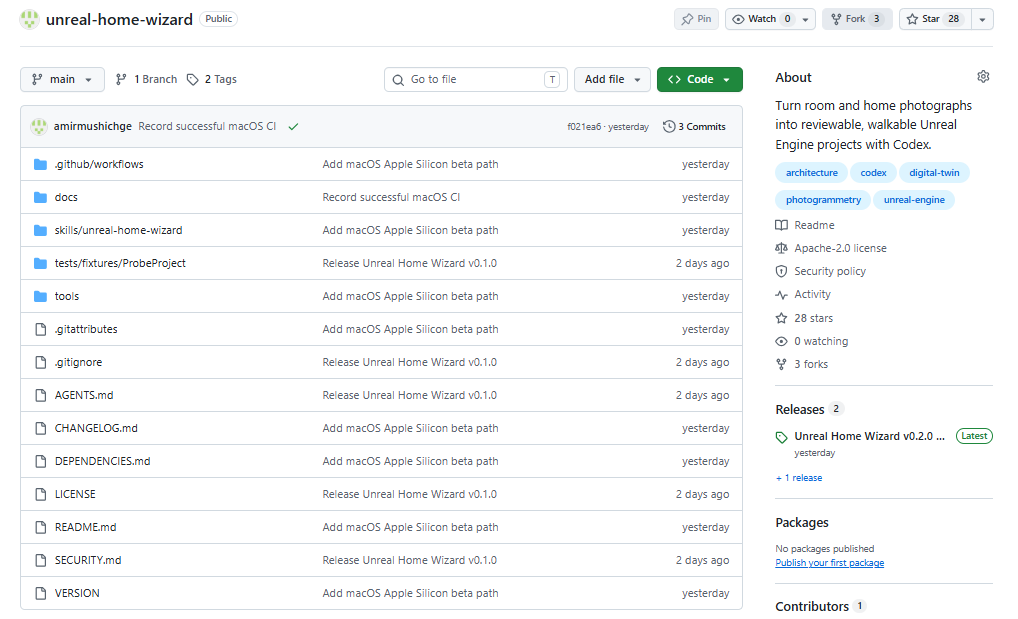
GPT-6 Astra (or Sol) / Opus 5.5. + my SKILL.md:
turn real estate photos into 3D walkable spaces
the Skill will guide you - save it:
https://t.co/MKQeBG9Iy7
Introducing Synthetic Hospital: an open, fully synthetic longitudinal EHR benchmark with verifiable ground truth!
1,268 patients, 5,602 encounters, zero PHI. Physicians could not reliably distinguish its charts from real ones.
📄 https://t.co/kU6Rkqr2dA
💻 https://t.co/k3UH8vgQ6H
✍️ https://t.co/otOqD6LMee
We built an all-synthetic simulation of a hospital that can be shared publicly without any issues. Our data quality is so high, physicians cannot tell the difference between real/synthetic patients. The data is fully verified -- perfect for RL.
Monster Hunter Portable 3rd has been recompiled for windows PC.
Complete with menus for config adjustments, online multiplayer support, and drag and drop HD texture packs.
Can't wait to try this one!
Blood: The Last Vampire (2000)
1080p (5.69GB)
Audio: JA
Subs: EN
&
the spin-off anime
Blood+ (2005-2006)
All Fifty Episodes
1080p (32.68GB)
Audio: EN, JA
Subs: EN
&
the other spin-off anime
Blood-C (2011)
All Twelve Episodes
1080p (22.1GB)
Audio: EN, JA
Subs: EN
THIS IS FUCKING INSANE.
a Chinese developer just released a FREE tool that can turn one script and one photo into a complete video with a presenter.
it was just released and already has 26,000 stars.
it’s called
"lanshu-create-ai-presenter-video".
here's how it works:
you give it a script and a presenter photo you have permission to use.
the AI creates the voice, makes the presenter talk, and matches the lips to the audio.
then it adds the subtitles, creates the cover, checks that everything is synced properly, and gives you the finished video with a quality report.
the final video is 9:16, 1080x1920, 30fps, and 45-75 seconds long.
and the crazy part is
it does all of this in one run on your own computer.
if you make short form content, save this before you make your next video.
will be dropping more free tools soon,
so bookmark
NVIDIA and Stanford just challenged Jev.
(their new System 1 architecture runs up to 9x faster.)
It is called a Contrastive Language Model, or CLM.
Like Jev, CLM is not designed to generate text. It handles the small, repeated decisions inside AI systems, such as choosing a tool, ranking a patch, routing a request, or selecting the next action.
But CLM reaches those decisions differently.
Instead of generating an answer token by token, it treats decision-making as a retrieval problem.
Here is how it works.
1) Encode the state
CLM takes the current situation, such as an agent’s context or the state of a game, and converts it into a vector.
It uses a frozen Qwen3-8B model with a small trainable state projection head.
2) Encode every possible action
A separate action head converts each candidate into the same vector space.
In the Mario example, the candidates are left, jump, and right run. CLM does not invent a fourth option. It only evaluates the actions supplied by the application.
3) Learn which states and actions belong together
During training, the correct state-action pair is pulled closer while incorrect pairs are pushed apart.
A batch of B examples produces a B × B similarity matrix. The matching pairs sit on the diagonal. Every other pairing becomes a negative example.
This contrastive training uses InfoNCE, the same general mechanism behind systems such as CLIP and dense retrieval.
4) Turn similarity into a decision
At inference, CLM measures the cosine similarity between the state and every candidate action.
A softmax converts those scores into a probability distribution. The application can choose the winner, apply a confidence threshold, or escalate an uncertain result.
The real speed advantage comes from separating states and actions.
Actions can be embedded once and cached. If an agent repeatedly chooses between the same tools, CLM only needs to encode the changing state and compare it with stored action vectors.
That replaces repeated generation with one embedding pass and a set of cheap dot products.
The researchers report that CLM-8B matches Jev across computer-use, gaming, and tool-calling evaluations while reaching up to 9x lower latency. The improvement is largest when actions repeat or the candidate set grows.
CLM still has limits. It cannot generate new actions, its probabilities are relative to the supplied candidates, and its strongest verifier results require task-specific fine-tuning.
But its central idea is powerful.
The entire research is open-source, including the code.
Read more here: https://t.co/I9kPwMPI7B
When software already knows the possible answers, an AI model should score them instead of generating more words.
I also wrote a full breakdown on how system one models like Jev work.
The article is quoted below.
Introducing MONAI Physio at #MICCAI2026.
3D and 4D medical images ➡️ personalized cardiac and respiratory digital twins.
This open-source Project MONAI toolkit lets researchers model how the heart beats and lungs move for simulation, visualization, and reproducible research.
Explore the project 👉 https://t.co/jmFhZW5k4R
I recorded a 47-minute tutorial on how I use Opus 5.5 to create designs with gorgeous three.js scenes.
I've been using Mobbin MCP to give my agents strong references, then letting Opus bring them together into a full landing page with multiple sections and a consistent design.
Opus also created a super detailed brand guide, logo explorations, and some amazing ad creatives. Went way beyond my expectations.
Live site: https://t.co/XvMDmU4EAI
Site made during the tutorial, with prompts: https://t.co/5edYikmZEG
GPT Astra / Opus 5.5 -> Real estate photos to 3D walkable spaces - GitHub Skill
Repo is here:
https://t.co/1duqWGKmhJ
This workflow sparked a lot of "how to do it" questions - so we decided that to share the skill will be the best solution
Your AI agent will lead you through all the steps, and the README file will explain all the installation details.
Have fun:
medical ai keeps advancing, now you can take the bones out of a chest X-ray 🩻
@qure_ai released a model that splits a radiograph into soft tissue, bone and lungs, so the ribs stop hiding what's behind them
▶️ on Spaces https://t.co/iQJ4651mmN
Pet project:
1) Advanced PS1/N64 game extraction (+all animations).
2) Website where you can browse and compare models, textures, animations, FMVs, for preservation.
Already have FF7, Mega Man Legends 1 and 2 and MediEvil fully ripped.
#FF7#FinalFantasy#FFVII#PS1#PSX