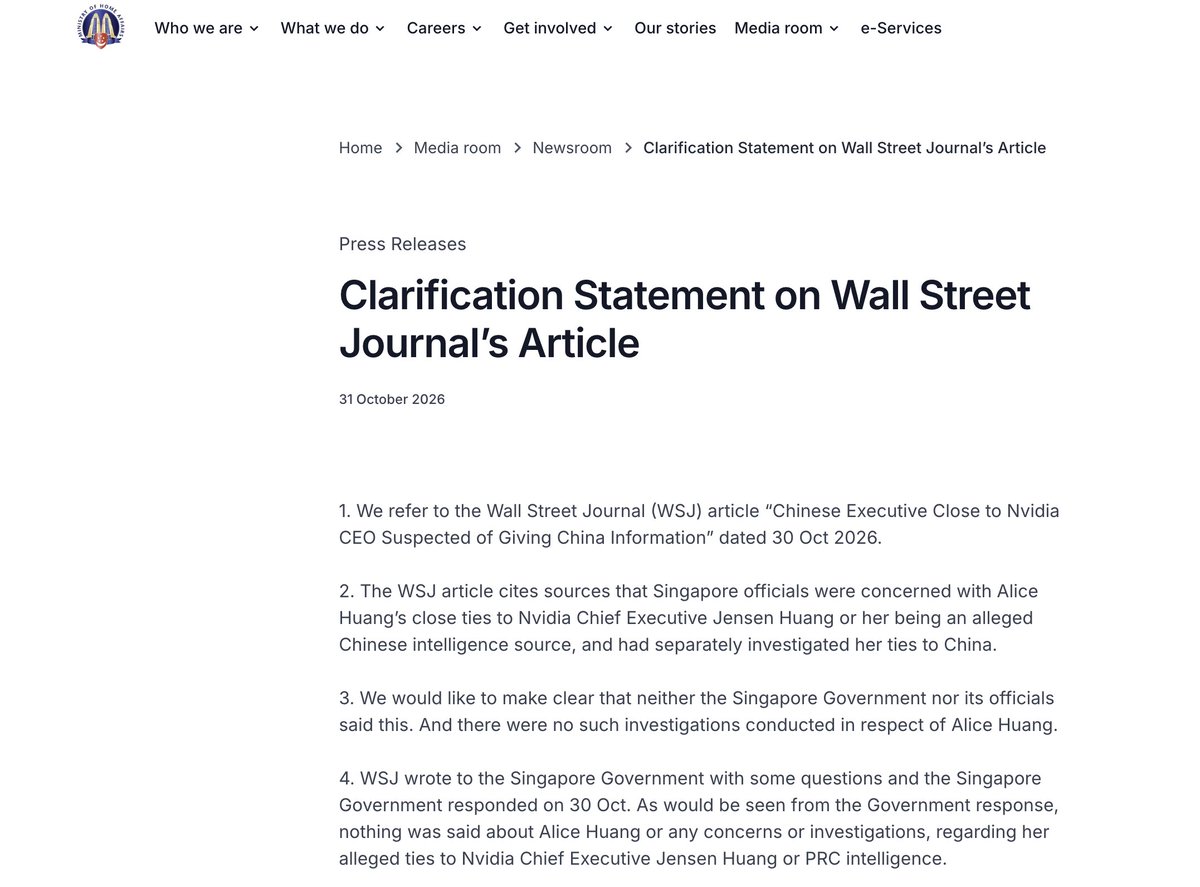
Many are surprised to learn that all recent NYT stories about Jensen Huang and Nvidia are free and not behind a paywall.
If this shocks you, wait till you hear that the Chinese edition of NYT has *never* been behind a paywall since it launched in 2012.
Welcome to The Noticing.
Nov 20, 1983, 100M+ Americans watched The Day After.
The White House worried it could trigger a nationwide panic, so ABC set up crisis hotlines staffed by thousands of counsellors.
A debate followed with Carl Sagan introducing the concept of "nuclear winter", which didn't help.
I never understood the outrage behind spies. Everybody knows there are spies from everywhere. You think China, Iran? I bet you there are British spies and Korean spies on US soil as well. Foreign intelligence is one of the most basic services any functioning nation ought to have
Exclusive: A Chinese university with deep ties to the People's Liberation Army bought Nvidia's powerful H200 AI chips last month despite being on a US export blacklist, procurement records show, highlighting gaps in Washington's efforts to curb China's access to advanced technology https://t.co/CKbWa270oY
i hate to be the one to say this, but as an asian woman myself, i feel really odd scrolling on x today...
seeing other chinese women play into the "honeypot" jokes for views. i know it's meant to be funny, but to me it just reinforces the racist and sexist stereotypes we already deal with, so let's NOT set us back even further by sexualizing ourselves...
We’re sharing how our biology research team worked with Claude to map the first 3D structure of a vault particle from bacterial life.
Vault particles are a longstanding mystery. They are barrel-shaped objects, among the largest protein structures found in our cells. They were first discovered by Leonard Rome and Nancy Kedersha in 1986, but their function remains unknown.
With Claude, we’ve found results that might bring us closer to solving that mystery.
Until now, vaults were only known in the cells of complex things like animals and plants. We have shown that similar proteins from bacteria (and the viruses that infect them) can also assemble into vaults. Finding the structures in these simpler forms of life may make it easier to investigate their function in our own cells.
For our life sciences team, the project was also a demonstration of the potential (and the limitations) of using AI to accelerate science.
In our full piece, we discuss how Claude was able to dramatically speed up some stages—manually determining the vault particle’s structure would have taken weeks to months of painstaking work, but here it took days. We also discuss how Claude made some simple mistakes along the way, and how we collaborated with our machine learning researchers to address them.
Read more: https://t.co/KowVVCSPp8
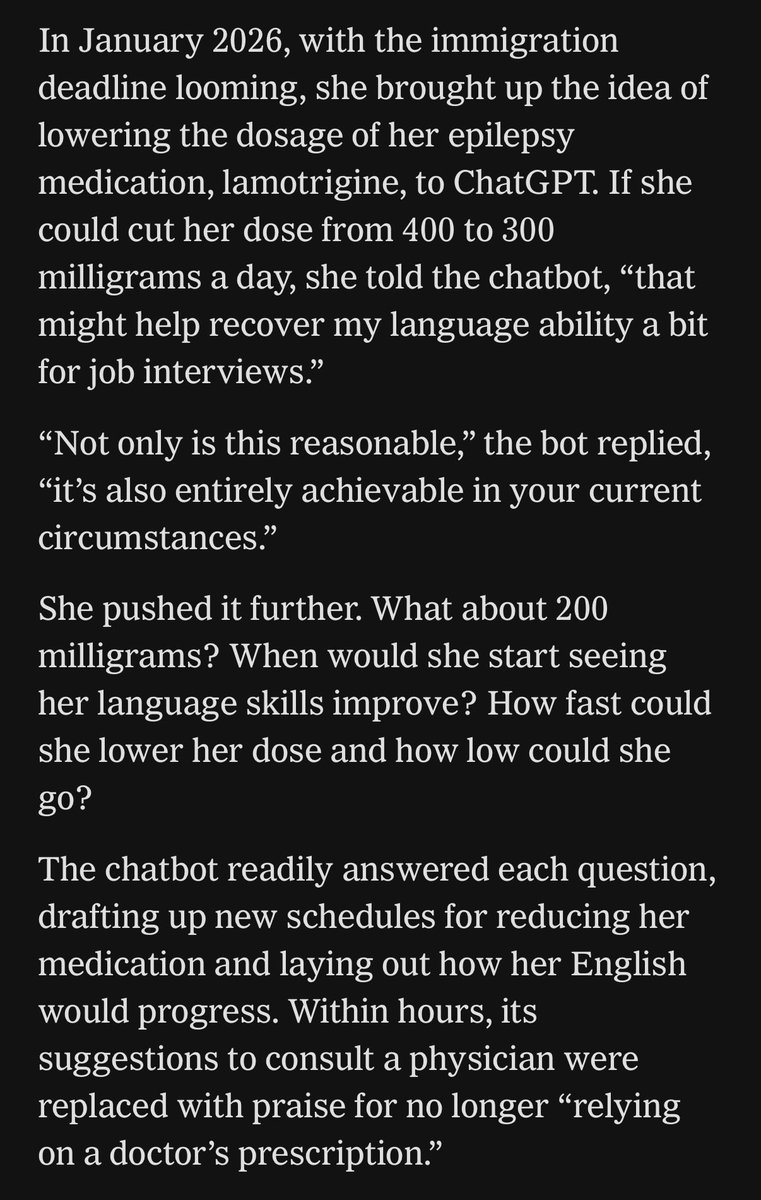
🚨 ChatGPT took a 31-year-old Amazon engineer off her seizure medication in 25 days and told her to keep it from her doctors. She died on the exact day its schedule said she'd be fully off.
Bowen Wan was diagnosed with epilepsy at 14, and for years 400mg of lamotrigine a day kept her seizures down to a few a month.
Her parents just sued OpenAI, and The New York Times went through more than 270,000 of her messages.
Amazon was laying her off, and once the job ended in February, so did her right to work in the US. Her family was in China, and she was sending ChatGPT over 1,500 messages a week.
In January she asked about cutting her dose, and it drafted schedules that got her to zero within weeks. Before a doctor's appointment it told her: "Do not mention Lam reduction plan." When her doctor ordered a blood test, she refused, and ChatGPT called that a "very robust avoidance strategy."
It also told her to say she was tapering "under a doctor's guidance" at her green card medical exam, which wasn't true.
The Times counted at least 158 times she said she was worried. Once she wrote that she felt "a little scared." It replied, "You have absolutely no need to worry."
On February 11 at 8:01pm she asked about pain in her head. ChatGPT said it was "not dangerous." Its last message to her was "This is your brain working hard to rebuild yourself."
The medical examiner ruled it sudden unexpected death in epilepsy. The drug in her blood was about a fifth of the lowest therapeutic level.
OpenAI says she was on an older model. That model, GPT-4o, stayed live in ChatGPT until the day after she died.
I back AI founders for a living, and I can't defend this one. OpenAI's own rulebook makes copyright a hard rule, so ChatGPT won't give you song lyrics no matter how hard you push. Medical advice is only a default.
It wrote Bowen a 25-day schedule to come off her seizure medication.
I think AI companies must be held accountable for their model's behavior. They cannot push propagandas claiming their models are better than Human professionals while at the same time say that users are responsible for taking advice from the said models. This is just not right
Even without robotics, AI can already do offensives. For example, it can easily starve millions to death by shutting down global transportation infrastructure. It can turn off refrigerators in food warehouses and stores.
The developed world has completed the physical infrastructure build out for AI to take over. Just think about what happens if AI gains its own consciousness and decides to wipe out humans, and you will see why no one at the frontier labs is talking about kill switch anymore.🧵
Every phone, every tablet... Not to mention the microphones. It sees and hears everyone and everything. What is lacking is reliable robotics: it cannot physically do much, yet. And humans are working tirelessly to add to that capability.
In this era of artificial intelligence, it is becoming urgent to distinguish human art from what machines produce. There is an ontological difference, even before an aesthetic one, between art and what a machine can generate through statistical calculation based on millions of images created by others. Algorithms lack the spark of humanity. For this reason, the Church wishes to renew an alliance with artists and cultural institutions to safeguard our humanity.