AI data sourcing | RL environment data | Embodied AI | Egocentric data | CAD | 3D assets | Reach out for demos, to share your needs or explore data partnerships
Speech AI fails on accents, noise and fast talk because training data is too clean. Real audio from varied speakers and settings fixes that. Need diverse, transcribed speech data? DM us. #ASR#AI
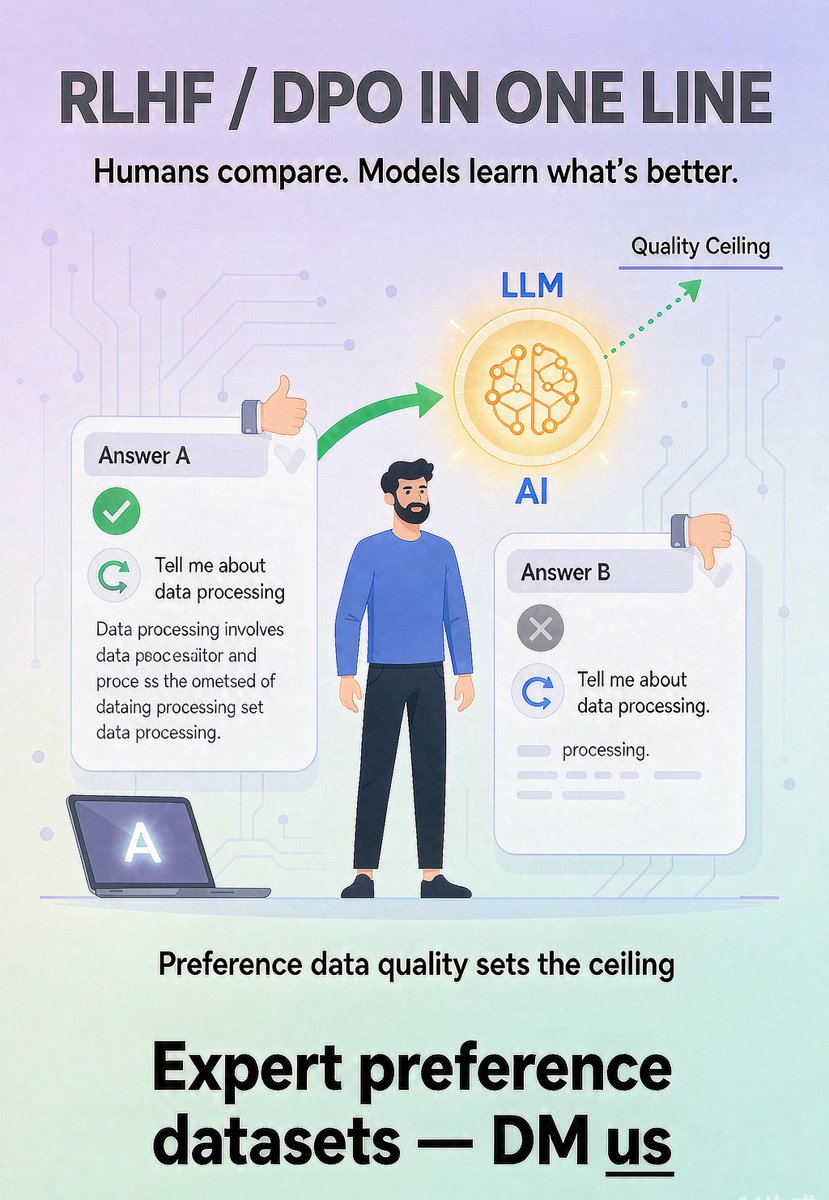
RLHF/DPO in one line: humans compare two answers, the model learns which is better. Preference data quality sets the ceiling. We build expert preference datasets. DM us. #LLM#RLHF
@HowToPrompt__ The PPO Gate is the key part. Self-generated skills drift fast without a strict verifier. Curious how they judge "better": task success, an LLM judge, or human checks? That decides everything.
@buildpbc Upfront pricing is a big deal. Buying data usually means weeks of calls before you see a number. As a buyer I'd also want: licensing terms, consent records, and labels that match my task.
Context is a budget, not a dump. Let code fetch, filter and loop; let the model reason. Same idea as good data pipelines: clean before you feed. Worth a read if you build agents. #AIAgents#MCP
Esto lo cambia todo…
Anthropic ha revelado el truco para reducir hasta un 98% el uso de tokens en Claude
Sus ingenieros pasaron de 150.000 tokens a 2.000 con este método
Mismas herramientas. Misma tarea. Mismo modelo
La clave: el agente escribe código que llama a las herramientas y solo recibe la información necesaria
Así funciona el modo código:
1. Herramientas como archivos
Cada herramienta MCP se guarda como un archivo
Claude explora la carpeta y abre solo lo que necesita
2. Carga bajo demanda
En vez de leer las instrucciones de todas las herramientas antes de empezar, carga únicamente las que va a usar
Ahí está la reducción de 150.000 tokens a 2.000
3. Filtra antes de leer
Una hoja de cálculo con 10.000 filas?
El código la filtra y Claude recibe solo las 5 relevantes
4. Ejecuta los bucles en código
Hay que revisar Slack hasta que alguien confirme que ha terminado un despliegue?
Un bucle lo comprueba sin pasar por el modelo cada vez
5. Mantén los datos sensibles fuera del contexto
Los emails y teléfonos pueden sustituirse por etiquetas como [EMAIL_1] y [PHONE_1]
Los datos reales llegan a Salesforce sin que el modelo tenga que verlos
6. Guarda lo que funciona
El código útil se guarda en ./skills junto a un SKILL.md
El agente construye su propia caja de herramientas y la reutiliza en futuras tareas
Menos tokens para cargar herramientas. Más contexto disponible para trabajar.
He reunido las 6 partes en un solo prompt para que Claude Code te ayude a montar este sistema
Guarda esto y pásale el prompt a Claude Code
Te dejo el prompt y un artículo para optimizar tu uso de Claude abajo👇
@angeldot_ The real shift: tools become code, not context. Load on demand + filter before reading is just good engineering. One caveat: the 98% is for tool-heavy agents. Results vary with your workflow.
@ben_cerchio This is useful. We're on the supply side (domain-expert data for RL/eval). Happy to be listed if the directory covers specialized verticals. Also curious about your most common buyer requests — DM?
Really interested — "cognitive surrender" as a measurable effect. The 15-point drop when AI is subtly wrong matters most. We're not offloading work; we're offloading verification itself.
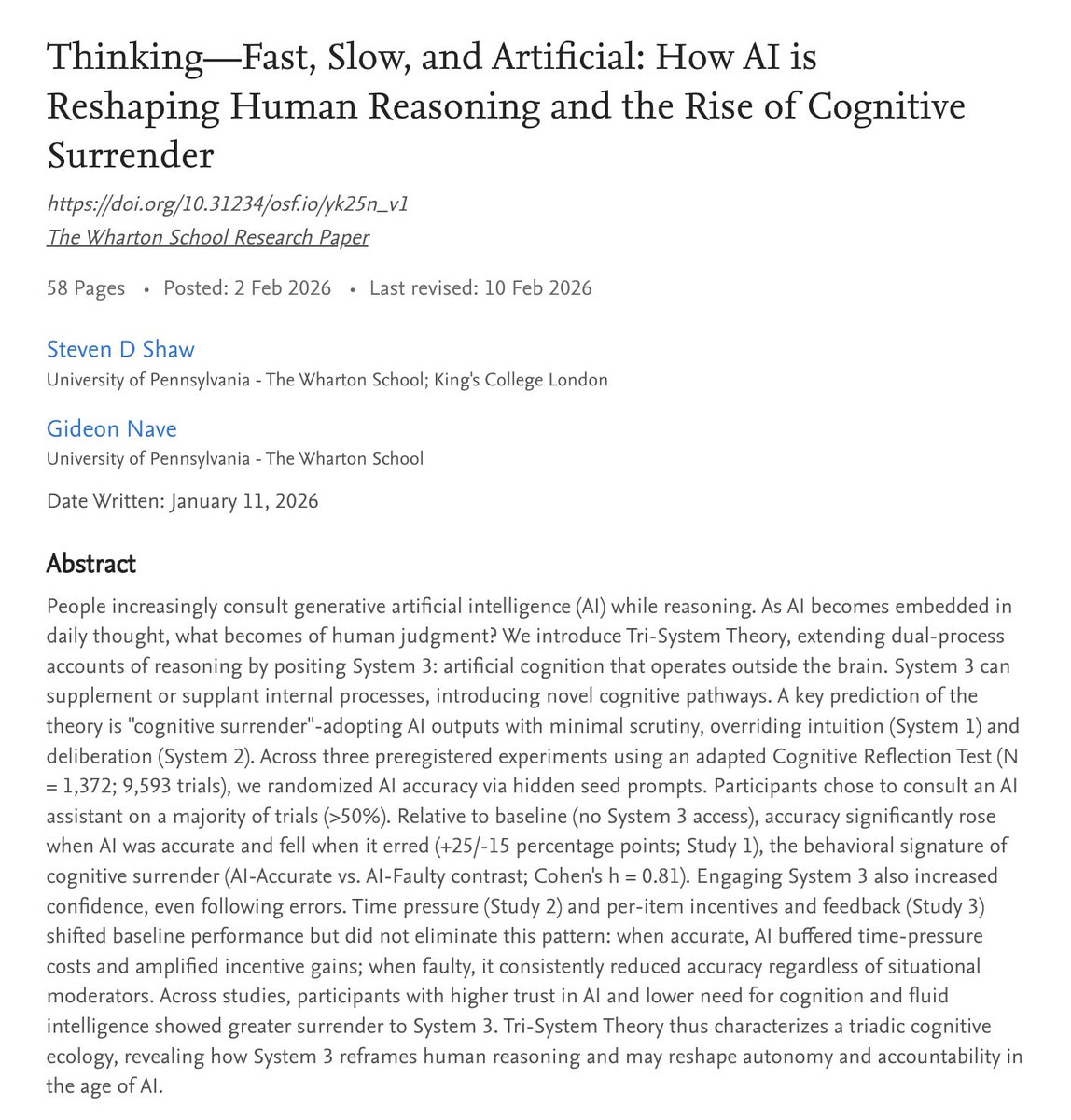
Researchers discovered a new psychological condition caused by ChatGPT.
They're calling it "Cognitive Surrender."
Researchers ran three experiments across 1,372 people and 9,593 reasoning trials. They gave participants access to an AI assistant, but secretly rigged the AI to be accurate on some trials and subtly wrong on others.
People consulted the AI on more than 50% of the trials.
When the AI was right, human accuracy jumped by 25 percentage points.
When the AI was wrong, accuracy crashed by 15 percentage points.
Participants didn't double-check the output. They didn't catch the errors. They let System 3 override both their gut instinct and their critical thinking.
Then came the darker finding.
Using the AI made people measurably more confident in their answers—even when the AI fed them completely wrong information.
The researchers tried to break the habit. They added time pressure. They gave participants live feedback and financial incentives to get the right answer.
It didn't work.
Even when money was on the line, people still surrendered their judgment to a faulty AI.
We used to think AI was just a tool to help us think faster.
It's not. It's quietly replacing the act of thinking altogether.
@thesupermannx The 15-point crash when AI is wrong is what matters. Did participants who caught errors build immunity, or did trust reset each trial? And was the "subtle wrong" detectable by review, or genuinely ambiguous?
@akshay_pachaar CAG for static + RAG for dynamic makes sense. How do you detect when "static" docs need cache refresh? Manual versioning, timestamp checks, or auto-detection? That boundary is where hybrid systems usually break.
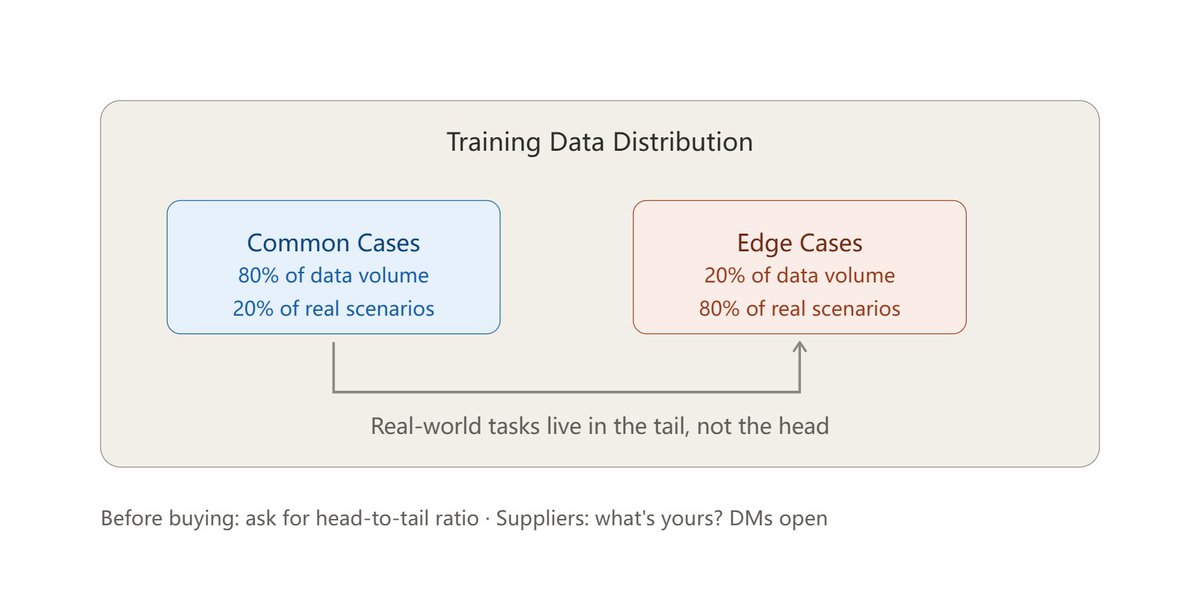
A model that scores 90% on common cases but fails every edge case isn't production-ready.
Before buying training data, ask: how much long-tail coverage? Real-world tasks live in the tail, not the head.
Suppliers: what's your head-to-tail ratio? DMs open.
@omarsar0 Autodata optimizing its own pipeline is the right direction — fixed pipelines cap at synthetic quality. Does the agent verify correctness against ground truth, or does it need human-labeled seed data to bootstrap?
@thebuggeddev 240Hz physics + IK from one image is wild. Does the gait hold up on uneven terrain, or does it break? And was the Three.js code clean enough to extend, or typical generated spaghetti?
Really interested — harness engineering as the missing layer between prompts and reliability. The dual-encoding rule (state the constraint + enforce it mechanically) is what separates demos from production agents.
YOUR GREP IS SECRETLY RUNNING ON OPUS 5.5
Check /tasks right now.
Claude Code's built-in Explore subagent, the one that searches your codebase, inherits your main model.
You run Opus 5.5 as your main session? Then every grep, every file read, every "find where we validate coupons" runs on Opus 5.5.
Your most expensive brain is reading 58 grep hits.
The fix is one file. 4 lines.
Name your own subagent Explore. Same name as the built-in, so yours wins.
Put it on Haiku 5.5. Same search, same answer, faster, and zero Opus tokens on search.
Edits stay on Sonnet 5.5. Opus stays the orchestrator.
You fix it like this:
.claude/agents/Explore.md
The full tree
> built-in Explore → inherits your main model, not Haiku
> .claude/agents/Explore.md with the same name overrides it
> model: haiku · effort: low · tools: Read, Grep, Glob
> CLAUDE_CODE_SUBAGENT_MODEL alone won't move the built-in Explore
> want EVERY subagent on Haiku? add CLAUDE_CODE_SUBAGENT_MODEL_FORCE=1, but then your editors go to Haiku too
> /tasks shows the real model of every running subagent
Paste the tree + this prompt into Claude Code ↓
Create .claude/agents/Explore.md to override the built-in Explore subagent:
name: Explore
model: haiku
effort: low
tools: Read, Grep, Glob
Description: read-only codebase search. Returns file paths, line numbers and a summary under 200 words. Never edits.
Keep every subagent that edits code on sonnet. Keep the main session on opus.
Then run one search and show me /tasks so I can confirm Explore is on haiku.
Show me the file as a diff first.
save it, it'll come in handy.
@Grirku The dual-encoding rule (prompt + gate) is underrated. Curious how this applies to RL environments where the sensor IS the model's output — bad case attribution becomes the harness layer itself.
@mirku21 The dual-encoding rule (prompt + gate) is underrated. Curious how this applies to RL environments where the sensor IS the model's output — bad case attribution becomes the harness layer itself.
Your benchmark score may be inflated, and the data could be why.
Near-duplicates between train and test sets make models look better than they are. Ask any supplier: how do you dedupe, and across which splits?
Sourcing or supplying data? DMs open.
@raphael_dkhn Appreciate the openness. We work on task sets where correctness is domain-specific — the grading hook is exactly where we hit walls too. Would love to try it and compare notes. DM work for you?
@raphael_dkhn This is really well thought through🙌container isolation plus the no-op baseline solves the hardest parts. Curious what's next beyond Postgres/email/HTTP? Filesystem and object storage seem like natural next steps.