I'm open-sourcing Miroir 🪞, a tool I originally built for myself.
It turns your product into an environment for training and evaluating AI agents.
You add a manifest and a few tasks to your product's Docker image. Miroir seeds the data, resets state between episodes, exposes APIs as tools through OpenEnv and MCP, and grades what the agent actually changed.
There's some cool stuff too, like turning production traces into tasks. And it works with @huggingface's TRL and @PrimeIntellect's verifiers.
It's still early. If you're working on agentic RL, I'd love to get feedback.
https://t.co/poRbGeWuxD
@arielzzzz_ Yes, I think so. I'm waiting for feedback from people who are using it so I can establish a clear roadmap. If you're trying it for a specific project, please feel free to share your comments!
There is no reset that could cause a leak, each trial boots a fresh container from an image baked at build time. The product has no route out, so emails and payment calls land in local recorders and get graded. And a no-op run must score 0 with no harm, so background drift fails validation.
However there are some limits, only Postgres rows, emails, and HTTP requests are evaluated for now. PRs are welcomed :)
I'm open-sourcing Miroir 🪞, a tool I originally built for myself.
It turns your product into an environment for training and evaluating AI agents.
You add a manifest and a few tasks to your product's Docker image. Miroir seeds the data, resets state between episodes, exposes APIs as tools through OpenEnv and MCP, and grades what the agent actually changed.
There's some cool stuff too, like turning production traces into tasks. And it works with @huggingface's TRL and @PrimeIntellect's verifiers.
It's still early. If you're working on agentic RL, I'd love to get feedback.
https://t.co/poRbGeWuxD
Both. It works through three commands:
1. `miroir import --traces` redacts personal data and secrets, and excludes traces without consent.
2. `miroir draft` creates a task draft for each trace. The user's request becomes the instruction, and the agent's actions become the reference solution.
3. `miroir derive` replays each draft in the env and generates checks based on the resulting state.
But it's not fully turnkey yet. There are a couple of requirements for now:
- You need to convert your traces to JSONL. Built-in connectors for Langfuse or OpenTelemetry aren't implemented yet, but planned.
- You need a production DB snapshot from the same point in time as the traces. If an action behaves differently during replay than it did in production, the trace is rejected.
I dive more into it here:
https://t.co/h989nbUYPb
Agree with this. It was one of the motivations behind Miroir.
If you already have a product and its data, turning it into an RL environment should be easy. Miroir handles the plumbing: turning production traces into tasks, seeding data, resetting state between episodes, exposing tools through OpenEnv/MCP, and grading agents against db changes and HTTP side effects
https://t.co/poRbGeVWI5
I’m realizing that some SaaS businesses could make tens of millions in additional revenue by building RL environments for AI labs.
Take a KYB startup. You’ve spent years collecting company records across 150 countries, cleaning them, linking entities, and building APIs on top.
You have millions of real-world investigations hiding in your database. You can turn them into tasks for AI agents:
“Find the CEO of this company and cite the official document.”
“Identify everyone who indirectly owns more than 25% of this business. Follow the ownership chain across France, Luxembourg, and Singapore.”
“Compare this company’s onboarding application with the registry filings. What’s missing or inconsistent?”
Give the agent tools to search the records and read the documents. Then use your structured data to check the answer: did it find the right entities, calculate the ownership correctly, and cite the right evidence?
Now you have an environment where agents can practice millions of investigations and get a reward when they get them right.
These aren’t just KYB tasks because the same skills matter for due diligence, investing, procurement, compliance, and a ton of other knowledge work.
If you can show that training on your environment makes models better at these tasks, I think you’ll find a buyer for a lot of $$$
@RuslanVolkov25 Outbound HTTP and email go to sinks in the container that log every call for grading, and each reset wipes the log, so there's no real sandbox to clean up
Recently I’ve been exploring how companies can train expert agents in their products using RL to optimize tool usage, multi-step editing, and speed within their product environment, much like Cursor did with Composer.
One of the challenges I’ve faced so far has been creating realistic envs, converting production traces into relevant tasks, resetting the state between episodes without leaking data, seeding data, etc
So I built a simple tool that handles all of this, assuming your product is packaged as a Docker image. For example, in the “example” folder, I’ve created an RL env for Gitea. It trains and tests an agent on some engineering workflows like ticket sorting, PRs, access management, webhooks, incident management ... Let's see where this leads
@Wv3EcACHtizRjZK Each env declares a quiet command. Grading waits until it passes twice in a row. And reset kills every process, restores the state, waits for quiet again, then clears the change log
Anthropic is releasing an open source library, FlashProve, for provable inference. It was measured on Llama 4 Maverick, a 400B-parameter mixture of experts model.
Code:
https://t.co/1ILw5Zf8Lh
Blog post:
https://t.co/YROBN2PThF
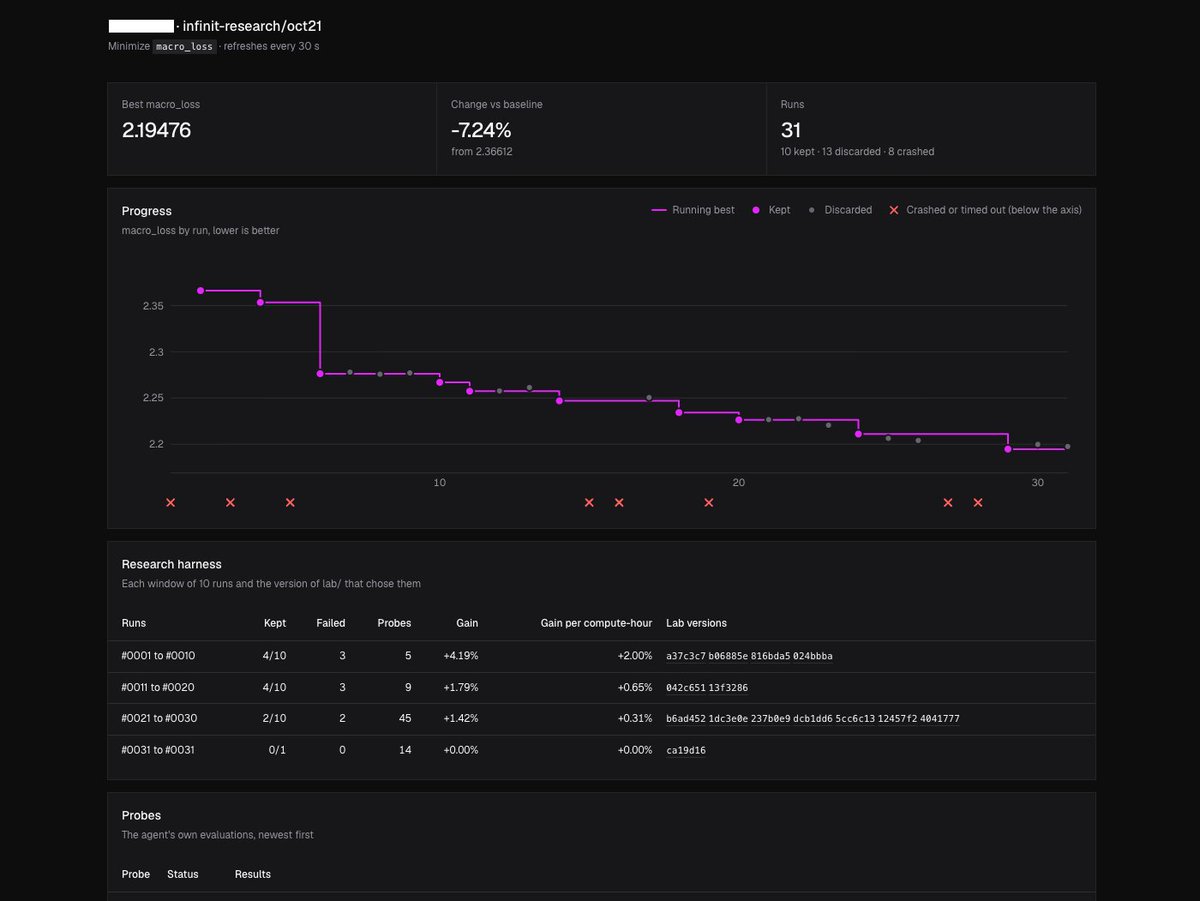
For the past few days, I’ve been letting my agents run on autoresearch to improve an architecture I’m working on.
I define a metric, freeze the eval and let agents experiment. Keep what improves the score and revert what doesn’t. Then let the harness recursively improve its own research process.
Inspired by Karpathy’s autoresearch, @yukonresearch and Harness², I turned my workflow into a small Claude Code plugin to make it easier to run.
Feedback and contributions welcome:
https://t.co/PgMsfbSub7
we've been maintaining rust libraries for many years now so we already love the language and have convinced many people about how amazing it is, but it's really the only language where i feel i can write software post-agents and my brain doesn't explode from the complexity
You are in the Squiggle. You've left (or want to leave) your job. You don't know what to build yet. You're reading, journaling, talking to friends, getting nowhere fast. What do you actually want to spend the next five to ten years on?
worldbuilder is a collection of Skills that operationalize @spc' -1 to 0 thesis. Inspired structurally by @garrytan's gstack, but oriented around the pre-founder phase instead of the shipping phase.
Every skill pushes you toward the things -1 to 0 founders avoid: shipping artifacts into the world, talking to external humans, and killing your favorite ideas.
Disclaimer: I'm not part of SPC. I'm just a builder who found the -1 to 0 thesis compelling enough to apply it to my own squiggle. I'd love to see SPC contribute and add their own personal touch (cc @adityaag, @rsanghvi)
https://t.co/MyeWNAlk6f