The U.S. has 2,441 proposed data-center projects scheduled to break ground between 2026 and 2028, representing as much as $2.48 trillion in planned investment. That pipeline is roughly 5 times the cost of building the original Interstate Highway System (inflation-adjusted) —except this infrastructure doesn’t move cars; it moves intelligence.
This is bs, sorry
Gf didn't ask me anything and made an entire app in Claude Cowork locally
Then she asked how do I make it a real app on the internet
Then I helped her install Claude Code, and told her to ask it that
Claude Code deployed it on Netlify with Supabase without her knowing anything about that and I didn't help her
All she did was give Claude Code her Netlify API key!
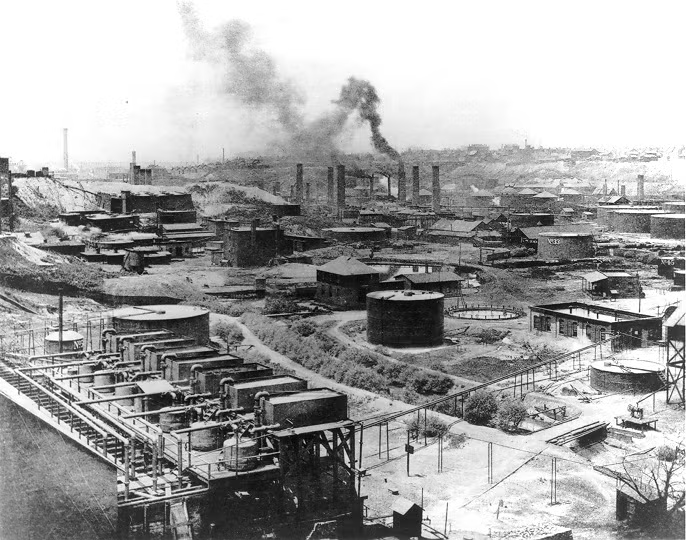
By 1880, John D. Rockefeller controlled 90% of American oil.
The biggest lever he'd used to get there had almost nothing to do with oil.
It was a deal with the railroads that his rivals didn't know existed until it was too late.
Rockefeller was 31 when he founded Standard Oil in Cleveland in 1870. At the time, his company controlled roughly 4% of the American oil refining market. It was a good business but nothing dominant. The oil rush had started in Pennsylvania a decade earlier and hundreds of small refineries had sprung up along the rail lines. Most of them lost money. Refining lived and died on 3 numbers: the price of the crude oil going in, the cost of the labor and equipment running through it, and the freight moving the finished product to buyers.
Everyone in the industry fought over crude prices and refining technology. They negotiated with drillers. They argued about equipment. They built bigger and cleverer stills.
Nobody negotiated the freight.
Freight was treated as a cost of doing business, something the railroads set and everyone paid. It was also, quietly, 40% to 60% of the delivered cost of oil.
Rockefeller looked at that number and asked why nobody was fighting it.
His answer was that no single refiner shipped enough oil to have leverage over the railroads. If he consolidated the shippers on his side, he could go to the railroads and offer them something they couldn't get anywhere else. Predictable, high-volume, dedicated freight. A single customer they could plan around.
In 1871, he made the offer. Standard Oil promised to give the Pennsylvania Railroad, the New York Central, and the Erie a guaranteed 60 car-loads of oil a day. Over 4,000 barrels. Every day, on a schedule. The railroads could build dedicated oil trains, cut turnaround times from 30 days to 10, and shed most of the empty-return costs that made oil freight unprofitable.
In exchange, the railroads gave Rockefeller 2 things.
The first was a rebate. Standard Oil paid the same list rate as everyone else on paper, but got a large percentage back from the railroad in cash. The published rate went up to $2.56 a barrel. Standard's effective rate stayed around $1.50.
The second was a drawback. For every barrel that a competing refiner shipped on those railroads, part of that competitor's freight payment was also sent back to Standard Oil. The competitor paid full freight. Rockefeller collected a check on top of his own discount.
The math on the ground was brutal. A rival refiner in Cleveland shipping oil to New York was paying $2.56 per barrel while Standard was paying $1.50, and part of the rival's $2.56 was being kicked back to Standard. Rockefeller's cost structure was lower and his rival was subsidizing it. There was no refinery clever enough to make up the difference.
When independent refiners in Pennsylvania figured out what was happening in 1872, the outrage was enormous. The Pennsylvania legislature revoked the charter of the arrangement. Rockefeller signed slightly quieter versions of the same deal instead and kept going.
By 1879, Standard Oil refined 90% of American oil. The price of kerosene, the main product, had dropped from 26 cents a gallon to 9 cents.
This story usually gets framed 3 ways. As cheating. As efficiency. As political influence. All 3 are incomplete.
Rockefeller's advantage wasn't that he refined oil better than his competitors. He probably did, but so did a dozen other operators. His advantage was that he'd identified the single largest cost in the industry, the one everyone else treated as a fixed feature of the landscape, and turned it into a variable he could move.
Every other oil man in America was optimizing the parts of the business they enjoyed. Rockefeller optimized the part they refused to touch.
That is almost always where the leverage is. It sits in the part of the business everyone considers beneath them, waiting until 1 person picks it up and uses it to end the industry.
One of my close friends started taking zinc in the morning, magnesium at night, and vitamin D+K2 with breakfast after his doctor told him to.
He did it literally for 30 days straight.
Then... no joke his personality did a complete 180
Er lijkt geen einde te komen aan de politieke corruptieschandalen in Spanje.
Vandaag heeft rechter Santiago Pedraz, Belén Gualda, de bestuursvoorzitter van de Spaanse staatsinvesteringsmaatschappij SEPI, als verdachte aangemerkt.
SEPI beheert namens de Spaanse staat miljarden euro’s aan deelnemingen in strategische ondernemingen en speelde een sleutelrol bij de redding van bedrijven tijdens de coronacrisis. De beste Nederlandse vergelijking is NLFI, de organisatie die de staatsbelangen in onder meer ABN AMRO beheert, al is de invloed van SEPI aanzienlijk groter.
Dat juist de hoogste bestuurder van zo’n machtige staatsinstelling nu onderwerp is van een strafrechtelijk onderzoek, maakt deze ontwikkeling politiek bijzonder zwaar.
Toch staat deze zaak niet op zichzelf.
De afgelopen weken volgden de affaires elkaar in hoog tempo op. Eerst de Koldo-affaire. Daarna voormalig minister José Luis Ábalos. Vervolgens voormalig PSOE-partijsecretaris Santos Cerdán. Ondertussen lopen ook onderzoeken naar Begoña Gómez, de echtgenote van premier Pedro Sánchez, en naar diens broer David Sánchez. En vele meer.
Steeds opnieuw duiken namen op van mensen uit de directe politieke omgeving van de regering. Iedere afzonderlijke zaak kent haar eigen feiten en zal uiteindelijk door de rechter worden beoordeeld. Maar politiek draait niet alleen om de uitkomst van strafzaken. Zij draait ook om vertrouwen.
En juist dat vertrouwen is in Spanje steeds verder afgebrokkeld. Nauwelijks is het ene dossier uit de kranten verdwenen of het volgende dient zich alweer aan. Ministers, partijbestuurders, adviseurs, ondernemers en nu zelfs de bestuursvoorzitter van een van de belangrijkste staatsinstellingen van het land worden in verband gebracht met strafrechtelijke onderzoeken.
Voor veel Spanjaarden voelt het alsof de regering voortdurend achter de feiten aanloopt en steeds opnieuw moet reageren op een nieuwe affaire.
Welke zaken uiteindelijk tot veroordelingen leiden, zal de rechter bepalen.
Maar de politieke conclusie is nu al duidelijk. Een regering die vrijwel onafgebroken wordt geconfronteerd met nieuwe corruptieonderzoeken, verliest onvermijdelijk haar geloofwaardigheid.
De vraag is in Spanje allang niet meer óf er volgende week een nieuw dossier opduikt.
De vraag is alleen nog welke naam er dan boven staat.
🚨 Anthropic just showed a 27-minute workshop on how to actually do prompts for Claude.
Taught by the people who built it.
Free. No registration. No paywall.
I've seen $300 courses that don't cover what they teach in the first 8 minutes.
Watch it and bookmark it now.
the Anthropic engineer who built Claude Cowork, Boris Cherny, just dropped a masterclass on how to actually use it properly.
Automate your workflow and stay ahead.
Bookmark this and watch it now.
How to set up Claude Cowork so it actually works like an AI chief of staff (not just another chatbot):
1. Most people open Cowork, type a message, and get generic output. It's not a Claude problem. It's a setup problem. Cowork needs context before it can help you. Who you are. How you work. What you're building. Your team. Your priorities. Give it that, and every session feels like picking up a conversation with an executive assistant.
2. The setup has three layers:
a) Global instructions (who you are, how you work, what Claude should never do).
b) Connectors (Slack, Gmail, Google Calendar, Notion)
c) And a folder structure on your computer that acts as Claude's long-term memory. That combination is what takes it from generic to personalized.
3. Skills are the real leverage. A skill is a markdown file that tells Claude exactly how to do one thing well. Write my newsletter. Coach me on a decision. Review a case study. Each skill lives in its own folder with context, examples, and a definition of what success looks like.
4. We built a CEO coach skill in the video below. Gave it business context, leadership style, company goals. Then tested it with a real decision: should we increase our newsletter from once to twice a week? It came back with trade-offs, second-order consequences, and risk assessment.
5. Then we built a multi-agent advisory board. Five subagents, each with a defined persona:
a) the operator
b) the skeptic
c) the customer advocate
d) the finance partner
e) the legal/risk advisor.
You feed it a decision. Each agent evaluates independently. The main agent synthesizes the feedback. It's like having a board meeting on demand.
6. Third skill: a thought leadership content pipeline. Topic scoring, idea capture, distribution cadence, tone calibration. All built from your actual expertise and audience. Designed so an executive can go from idea to published post without starting from scratch every time.
7. The workspace map is what ties it all together. It's a top-level file that shows Claude how to navigate your entire setup. Which folders exist, what skills live where, how to invoke them. Without it, Claude has to search for everything. With it, Claude goes straight to what it needs.
8. Everything you build is portable. The folder structure works in Cowork, Claude Code, and Codex. Push it to a private GitHub repo and you can access it from your phone through Claude Code, or use Claude Dispatch.
9. The pattern is repeatable. Pick a task you do often. Create a folder. Build a skill. Add examples of what success looks like, and what a bad output looks like. Test it. Workshop it. Move on to the next one. Each skill is like onboarding a new employee who never forgets and never needs to be re-trained.
The people who invest in this setup now are the ones who will have a 10x advantage when these tools get even better. And they're getting better fast.
I sat down with @alexlieberman on Human In The Loop and we built all three of these live from scratch. Full breakdown in the video below..
I tried to explain this as clear as possible for my non-developer crowd.
Send it to someone who should be using Cowork but isn't yet. Or bookmark it to level up when you're ready.
Watch 👇🏼
VR founder Jaron Lanier says a future where people are paid for the data they give AI is better than one where everyone depends on billionaires to survive
"artificial intelligence is a marketing term, even a religion"
The software behind drug discovery and chatbots is very different, but we call it all "AI" because it serves politics, ideology
🚨 Anthropic's own team just showed how to actually prompt Claude.
24 minutes. free. from the people who built it.
watch the workshop. bookmark it.
worth more than every $300 course you almost bought.
you've been using Claude without knowing 40 of its prompts.
Then read the guide below.
🚨 INSTEAD OF WATCHING NETFLIX TONIGHT.
Spend 3 hours with this.
Claude Code FULL COURSE that teaches you how to BUILD apps, teams, and anything.
The people who watch this tonight will wake up tomorrow with a new skill.
Watch it and Bookmark it now.
This 50 minute lecture from Jeff Bezos in 2005, before AWS, before Kindle, before Prime took over, will teach you more about building revolutionary products than a $150,000 MBA.
Bookmark this & give it 50 minutes today. It’s the most productive thing you can give your morning.
I am not sure the American military establishment has fully grasped what Trump has actually done here. So let me spell it out in language even a Pentagon procurement officer can understand.
Europe has been buying American weapons at a staggering rate. In 2024 alone, US foreign military sales notifications to European countries hit $76 billion. Four times the European average since 2008.  F-35s, missile systems, air defence, ammunition. All of it American. All of it coming with decades of service contracts, maintenance agreements, spare parts, software updates and training programmes worth hundreds of billions more over their operational lifetimes.
Between 2020 and 2024, the United States supplied 64 percent of all European weapons imports. 
That is now over.
Europe has an $860 billion defence plan, and American contractors are being frozen out. The goal is 80 percent of all military purchases from European factories by 2030.  Airbus. Rheinmetall. KNDS. Saab. Leonardo. BAE Systems. They are about to receive the largest order book in the history of European defence industry. Because Trump made it politically impossible for any European government to keep writing cheques to Washington.
Some European governments have discussed worries that the Pentagon could remotely disable American F-35 fighters or impose restrictions on how US weapons can be used.  When your supplier is also threatening to annex your allies, that is not paranoia. That is basic procurement logic.
Trump set out to make America great again. He has succeeded magnificently. For Rheinmetall.
Gandalv / @Microinteracti1
Enige manier om Europese welvaart kan redden, is door een dikke Milei-bezem door die enorme EU-bureaucratie heen te halen. Weg met overheidsbemoeienis en gestapelde belasting en regelgeving. Mensen en bedrijven zoveel mogelijk vrij worden laten om hun eigen zaken te regelen.
10 years ago I went to a birthday dinner,had a couple of red wines I was feeling a bit sick,chatting to AJ. Little did I know I was having my 1st heart attack & the wine had thinned my blood enough to ease the symptoms. The big one was to happen the next day. @arjan1971
@VuelingVA booked a flight with my partner in 1 booking. At checkin desk got separate seats assigned. Why can't you block 2 seat next to each other when flying with an onboard with animal. Not good for dog and next seat passenger. Why??? VY6247 zrh/bcn #dog#vueling#seating