@GoogleNest@MadeByGoogle I 'upgraded' my Home devices to Gemini and lost Continued Conversation. The help docs say I can't revert!? This is a major accessibility regression! Continued Conversation must be expedited for Gemini immediately. #GoogleHome#Gemini
UPDATE: After hours of deliberation, I joined 650 of the 700 OpenAI employees and signed the letter to the board.
No one asked me to sign it and I have no affiliation to OpenAI in any capacity, but I still signed it.
Doesn't booting @sama work against this?? 🤔
Said @ilyasut: "If you have an arms race dynamic with multiple teams trying to build AGI first, they will have less time to make sure the AGI will care deeply about humans."
(clip @guardianfilm) #SamAltmanExit#OpenAI
I’m the head of Google AI ($15.7M TC).
You better believe we’re using this OpenAI news to make rapid advancements and go on the offensive.
As soon as I’m back from PTO for Thanksgiving break (December 1, 2023) I will be coordinating an all-hands with my team (on February 5, 2024), where we will put some Q2 OKRs in place to discuss a plan to get to parity with GPT 4 by the year 2026.
Look out, world!
Confirmation that AGI is indeed here!
The classic argument made over 30 years ago by Fodor and Pylyshyn - that neural networks fundamentally lack the systematic compositional skills of humans due to their statistical nature - has cast a long shadow over neural network research. Their critique framed doubts about the viability of connectionist models in cognitive science. This new research finally puts those doubts to rest.
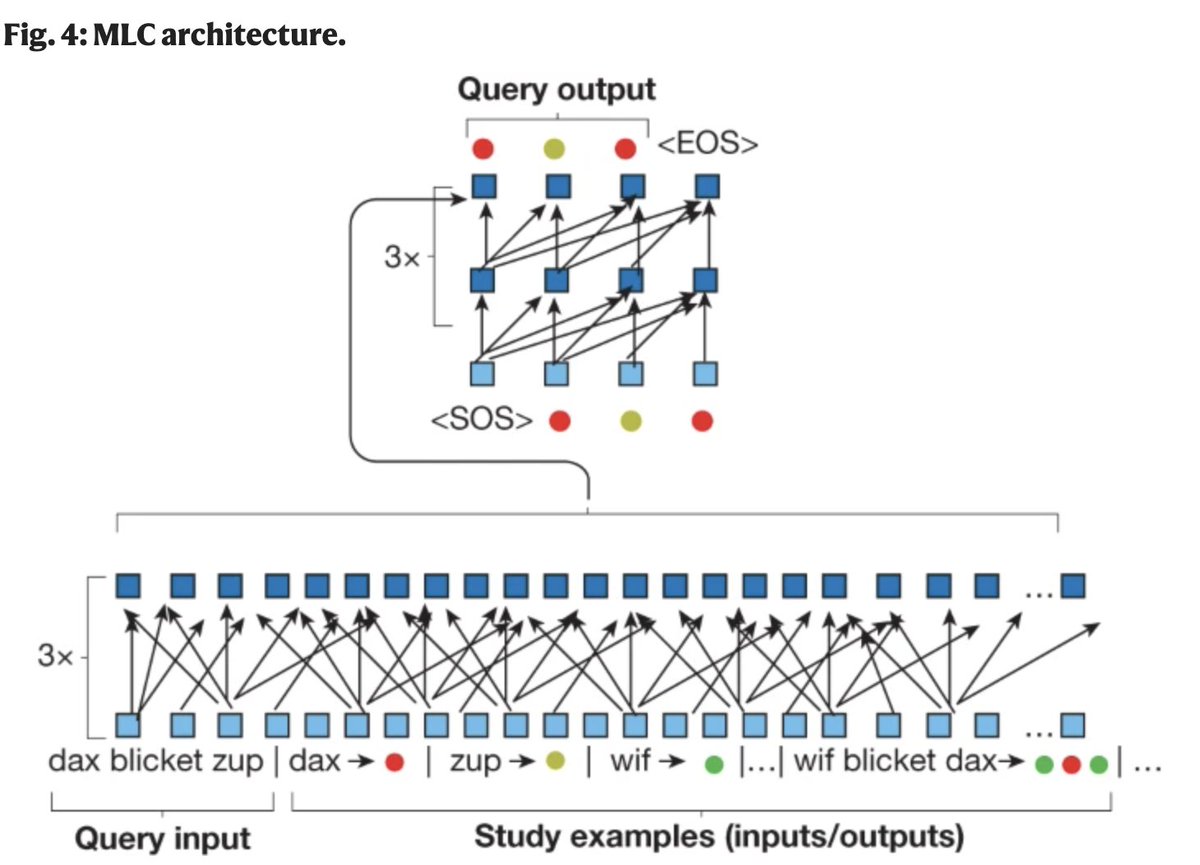
Through an innovative meta-learning approach called MLC, the authors demonstrate that a standard neural network model can exhibit impressive systematic abilities given the right kind of training regimen. MLC optimizes networks for compositional skills by generating a diverse curriculum of small but challenging compositional reasoning tasks. This training nurtures in the network a talent for rapid systematic generalization that closely matches human experimental data.
The model not only displays human-like skills of interpreting novel systematic combinations, but also captures subtle patterns of bias-driven errors that depart from purely algebraic reasoning. This showcases the advantages of neural networks in flexibly blending structure and statistics to model the nuances of human cognition.
Furthermore, this research provides a framework for reverse engineering and imparting other human cognitive abilities in neural networks. The training paradigm bridges neuroscience theories of inductive biases with advanced machine learning techniques. The approach could potentially elucidate the origins of compositional thought in childhood development.
By resolving this classic debate on the capabilities of neural networks, and elucidating connections between human and artificial intelligence, this research marks an important milestone. The results will open new frontiers at the intersection of cognitive science and machine learning. Both fields stand to benefit enormously from this integration.
In summary, by settling such a historically significant critique and enabling new cross-disciplinary discoveries, this paper makes an immensely valuable contribution with profound implications for our understanding of intelligence, natural and artificial. Its impact will be felt across these disciplines for years to come.
Sam Altman has repeatedly said Open AI is looking beyond transformers for the next big jump in AI capabitilies. Who thinks they're building an "AI research genius" with expert coding skills who is trained on all the AI academic literature?
🎉 I am thrilled to introduce you to https://t.co/KLwHQwWggj, an AI-powered email tool that helps heavy Gmail users reply to emails 10X faster with automatically pre-filled responses.