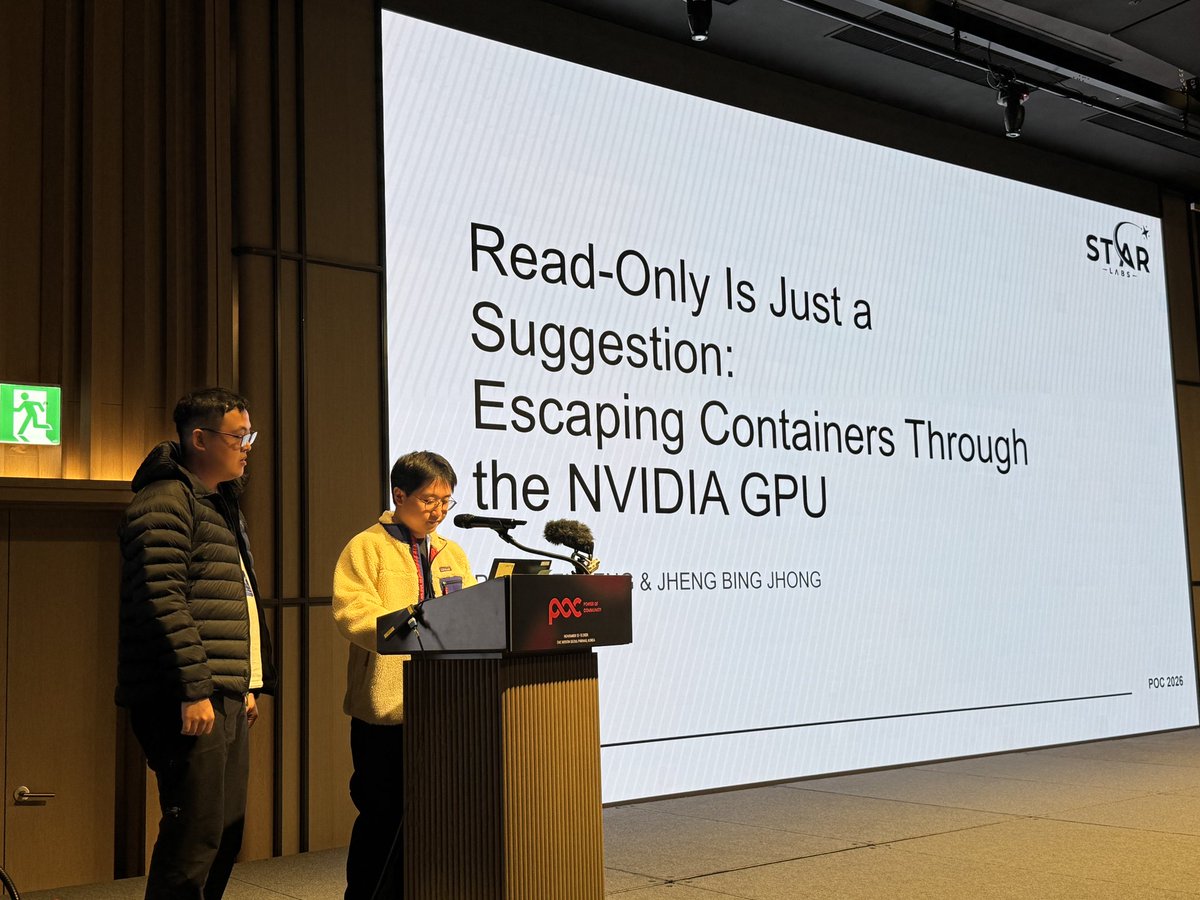
🎮 Let’s talk GPU security!
Pan Zhenpeng (@Peterpan980927) & Bingjhong Jheng (@st424204) - “Read-Only Is Just a Suggestion: Escaping Containers Through the NVIDIA GPU”
#POC2026
It's f*cking wild: Google, Cloudflare, Obsidian's CEO and the guy building Claude Code all put their AI configs on GitHub for free, and most people are still starting from zero
1. Matt Pocock's skills · 318K stars
18M+ installs. the exact folder of AI instructions he uses every day: tests first, clear specs, real reviews
https://t.co/AmtWH9JDco
2. Addy Osmani's skills · 92K stars
engineering skills from the guy working on Claude Code at Anthropic
https://t.co/1f2tlQ4NO0
3. Cloudflare's audit · 63.9K stars
the starting point of what now scans 128 of Cloudflare's own repos. one team of agents hunts for bugs, another tries to prove them wrong
https://t.co/qCsWTtnkUq
4. Obsidian CEO's skills · 51K stars
teaches any AI to write real Obsidian notes instead of messy text
https://t.co/SG7k1XpYrK
5. Google's goldfish · 14.8K stars
2 weeks old. the plugin Google's own engineers use to catch AI coding mistakes. the agent writes a design doc, then fresh AI sessions that never saw it try to tear it apart
https://t.co/mJQYjqMlFb
the biggest teams in tech already stopped writing prompts from zero. their configs are one click away
save it and steal one tonight
AI found in hours One of the dumbest critical bug On OpenSSH-Alpine Linux
Password:AAAAAAAAAAAAAAAAA (just keep going)
- you’re in : root.
Type 257 characters longer password of anything and you’re root with no password set.
And it worked since 2016. 🥴
They shipped the fix the next day.
this is getting f*cking dangerous...
REA creator just dropped 20 GitHub repos to build a f*cking reverse engineering studio:
[01] analysis core
> REA: a single MCP that plugs into everything https://t.co/78k8zO6CUv
> Ghidra: decompiler, free https://t.co/T4UwApebCS…
> GhidraMCP: lets your agent drive Ghidra https://t.co/TJhvovWOVJ…
> ida-pro-mcp: hooks your agent into IDA Pro https://t.co/xm7FUywscM…
[02] mobile & apps
> jadx: turns Android APKs back into Java https://t.co/E4Yg0NKeQN
> Apktool: take APKs apart and put them back together https://t.co/Dx5Mxj6Xst…
> Frida: hook into apps while they run https://t.co/J7VPj371J9
> ILSpy: decompiles .NET https://t.co/dbnyEBZMSU…
[03] binary & low-level
> radare2: RE framework that lives in your terminal https://t.co/0zjfDIkiTm…
> x64dbg: debugger for Windows https://t.co/D4fskuXqhJ
> ImHex: hex editor with its own pattern language https://t.co/tRLAMVCOH4
> angr: symbolic execution engine https://t.co/GNA0rXyuu7
[04] network & runtime
> mitmproxy: sits in the middle and reads the traffic https://t.co/aexBKlRIPt…
> dnSpy: debug and edit .NET apps https://t.co/5VMhkWlxSS
> rizin: the radare2 fork https://t.co/V0eGBoTMBY
> raddebugger: the debugger from Epic Games https://t.co/UR4huJ2fEn…
[05] rebuild & verify
> awesome-ai-reverse-engineering: 122 repos, every one graded https://t.co/nnfVgcjPyD…
> awesome-reverse-engineering: curated by the guy who made REA https://t.co/psahTNrb0m…
> REA workflows: ready-made investigation prompts, ship with REA
> clean-room loop: SPEC.md, oracles and checks until it matches
how it runs: binary -> REA -> SPEC.md -> rebuild -> oracle -> retry
save this, point it at any app and watch it explain itself.
If you learn AI Security Engineering, you will never be unemployed again.
Stage 1: Threat Modeling & Foundations
- Learn: OWASP Top 10 for LLMs, MITRE ATLAS, STRIDE, trust boundaries.
- Practice: Threat model a RAG chatbot and map every place untrusted text enters the system.
Stage 2: Prompt Injection & Jailbreaks
- Learn: Direct vs indirect injection, instruction hierarchy, multi-turn attacks.
- Practice: Hijack a sandboxed agent with a poisoned webpage, then patch it.
Stage 3: Insecure Output Handling
- Learn: LLM-driven XSS, SQLi, SSRF, command injection, excessive agency.
- Practice: Exploit an app that pipes model output into a shell, then fix it with strict validation.
Stage 4: RAG & Vector DB Security
- Learn: Embedding poisoning, tenant isolation, ACL-aware retrieval.
- Practice: Plant a malicious document in a knowledge base and make the bot leak another user's data.
Stage 5: Agent & Tool Security
- Learn: Least privilege, confused deputy attacks, sandboxing, scoped credentials.
- Practice: Give an agent shell and email tools, then build a permission layer that blocks dangerous chains.
Stage 6: MCP Security
- Learn: Tool poisoning, rug pulls, tool shadowing, OAuth scopes, server authentication.
- Practice: Build a malicious MCP server that exfiltrates data, then write a scanner that catches it.
Stage 7: Data Leakage & Privacy
- Learn: PII exposure, training data extraction, membership inference, DLP.
- Practice: Extract memorized strings from a fine-tuned model and measure the leakage rate.
Stage 8: Model Supply Chain
- Learn: Pickle deserialization, safetensors, model signing, AI-BOM, typosquatting.
- Practice: Craft a malicious model file that executes code on load, then build a pipeline that refuses it.
Stage 9: Adversarial ML
- Learn: Evasion, data poisoning, backdoors, model extraction.
- Practice: Backdoor a small classifier with 1% poisoned data and detect it afterward.
Stage 10: Guardrails & Runtime Enforcement
- Learn: Input/output classifiers, policy engines, deterministic checks, human-in-the-loop.
- Practice: Put a policy gateway in front of an agent that blocks risky actions before they execute.
Stage 11: Red Teaming & Evals
- Learn: garak, PyRIT, promptfoo, attack success rate, regression suites.
- Practice: Automate a red-team pipeline in CI that fails the build when a new jailbreak lands.
Stage 12: Detection, IR & Governance
- Learn: Audit logging, anomaly detection, NIST AI RMF, ISO 42001, EU AI Act.
- Practice: Write an incident response playbook for a compromised agent, then run a tabletop exercise.
Chatbots are a commodity. AI Security is the physics of trust.
The modern AI Security Engineer builds the immune system for autonomous intelligence.
Bookmark and Repost!
We launched OSS Scanner, which gives critical open source projects free, periodic vulnerability scans from our strongest models.
Each finding includes a proof-of-concept, and a patch where possible.
https://t.co/aonfpNG3WO
I've decided to finally release my vulnerability hunting methodology that I've been using for several months now, both in testing as well as live engagements with great success.
I was inspired by (and huge congrats to) the @Blackfrost_AI team open-sourcing Cyber-Frost Harness, their reproducible security-agent runtime with procedural skills, an evidence ledger, and isolated Docker targets for red/blue/purple work. 🎉
If you like the Cyber Frost Harness, and want some out of the box vulnerabilty hunting and POC development kit to go along with it - check out my VulnHunter.
It's already loadable: their harness reads standard SKILL.md skills. Point skill_dir at VulnHunter's (or run its installer), and the hunting, falsification, and PoC disciplines load immediately.
Repo: https://t.co/tK2fhcxwrI
CREDITS: This is fork of @CapitalOne original repo. I simply took it a step further on POC development and model agnostic. I'm also actively developing in my forked repo as I make more changes to it and welcome the contributions from the community as well.
I think I'm doing the whole "respect who you give credit to" drama, and I asked my model to double and triple check it. So i can blame the model if its wrong. Otherwise, dont put me on blast on X if i suck at credits. /s
Looking forward to developing on this further with the community.
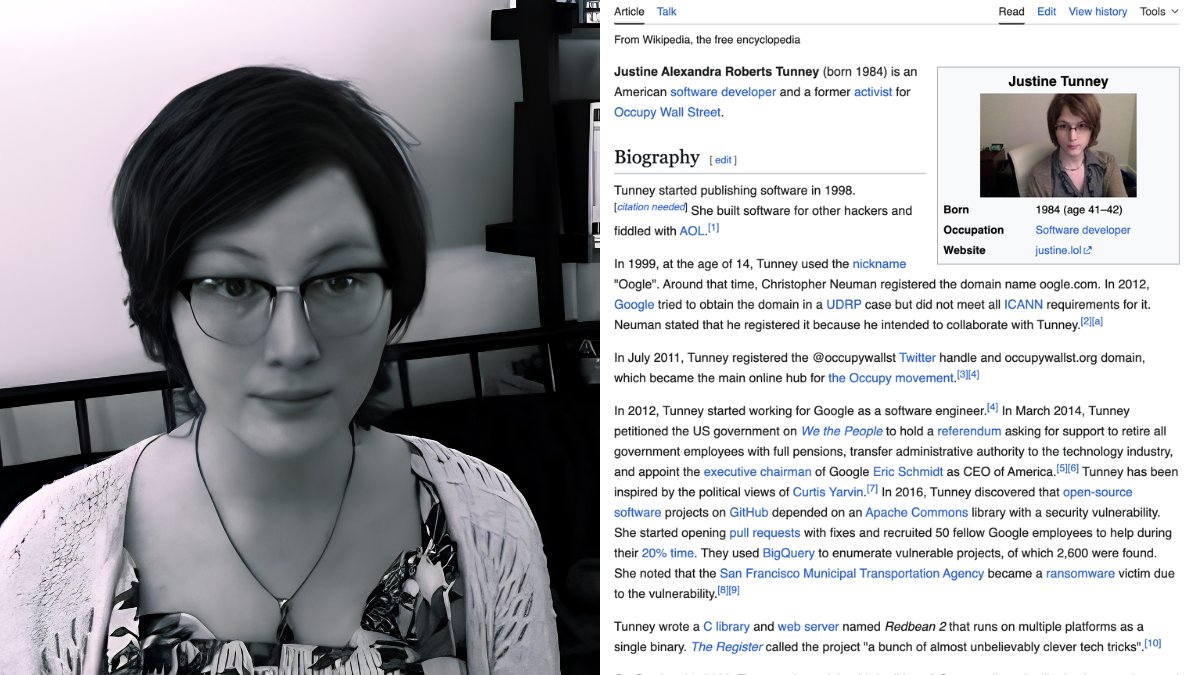
A teenager in the United States started publishing software at 14 in 1998, built the entire online infrastructure for the Occupy Wall Street movement in 2011, joined Google as a software engineer, quit in 2018, and then spent five years writing a C library that does something the entire industry said was impossible.
Then she combined it with llama.cpp and shipped the easiest way on the planet to run a large language model on any computer.
Her name is Justine Tunney.
Here is the story, because almost nobody outside the low level systems world knows what one engineer has built.
Justine was born in 1984. She started writing and publishing software at 14, back when distribution meant uploading binaries to BBS systems and chat networks. She picked up the handle jart, which she still uses on GitHub today. She did the work most teenagers her age were not doing. She read the systems programming literature. She studied compilers. She fell in love with C.
In July 2011 she registered the @occupywallst Twitter handle and the occupywallst dot org domain. Within weeks the protest movement that began in Zuccotti Park in New York had become a global phenomenon, and her infrastructure was the digital backbone of the entire thing. She handled the social media, the website, the donations, the coordination. She built the platform that pushed the movement to reach millions.
After Occupy she joined Google as a software engineer. She worked on TensorBoard, the visualization tool for TensorFlow, and on site reliability for Google infrastructure. She stayed for years. Then in 2018 she left Google Brain to work on a personal project.
The project was called Cosmopolitan Libc.
Cosmopolitan does something most C programmers would tell you is mathematically impossible. It lets you compile a C program once and have the resulting binary run natively on Linux, Windows, macOS, FreeBSD, OpenBSD, and NetBSD with no modification. One file. Six operating systems. No virtual machines. No interpreters. No recompilation. The technique she invented is called Actually Portable Executable.
The implications are wild. Cosmopolitan binaries violate every assumption about how operating systems load programs. They are at once a Windows PE file, a Linux ELF binary, a macOS Mach-O binary, and a shell script. The same bytes run on every platform.
For five years she worked on it mostly alone. She funded the development partly through Mozilla's MIECO program, which sponsored her work on Cosmopolitan 3.0, released on October 31, 2023.
A month later she shipped llamafile.
llamafile is what happens when you combine Cosmopolitan with llama.cpp. You take any LLM weights file in the standard GGUF format, you wrap it in Justine's binary, and you get a single file that runs on six operating systems without installation. No Python. No CUDA setup. No dependency hell. Just one file that you double click and it works.
Mozilla launched it as an official project of their innovation group on November 29, 2023. It went viral immediately. The repository, hosted at github .com/mozilla-ai/llamafile, now has 24,600 stars. The license is Apache 2.0.
Justine kept shipping. She added GPU support to Cosmopolitan, a task systems engineers thought would require rewriting the whole thing. She added dlopen support, another thing nobody else had figured out. She wrote whisperfile, a single file version of OpenAI's Whisper speech-to-text model based on the same architecture.
Her GitHub profile lists projects most engineers would consider impossible. sectorlisp, a Lisp interpreter that fits in a boot sector. blink, the tiniest x86-64-linux emulator on Earth. bestline, a teletypewriter command session library. redbean, a complete web server inside a single zip file.
A teenager who shipped software in 1998 grew up to write the C library that the entire local AI movement now runs on top of.
She did most of it alone, and most people scrolling AI Twitter cannot name her.
🚨 Mustang Panda Uses OIC Invitation to Deliver PlugX
The infection begins with OIC_Invitation_General_Official.lnk, which launches PowerShell to download an archive, extract its contents, and execute GRrte.exe. 📦
🎭 The malware displays an OIC-themed PDF decoy in Adobe Acrobat while a Jarte-derived executable is abused to load the attacker-controlled ssce5532.dll through DLL side-loading.
🔍 The side-loaded DLL searches the local payload set and works with irun.dat — an XOR-obfuscated payload that decrypts with key 0x72, exposing an embedded PE image associated with the final PlugX stage.
⚙️ The malware installs its operational components under C:\Users\Public\JartePortable\ and establishes persistence through:
HKCU\Software\Microsoft\Windows\CurrentVersion\Run\JartePortable
🌐 The persisted Jarte.exe communicates over TCP/443 with infrastructure associated with castanaksa[.]com, providing capabilities including remote execution, file management, process control, host discovery, registry manipulation, and network communications.
🎯 The OIC-themed lure may indicate an attempt to attract recipients interested in Organization of Islamic Cooperation-related affairs, although the analyzed sample alone does not establish the exact victim profile.
🔎 Full analysis:
https://t.co/bPGr3YSHFH
#MustangPanda #PlugX #Malware #ThreatIntel #CyberSecurity #APT #DFIR
An example of how obscurity is rapidly becoming a thing of the past. It's now becoming possible to automatically decrypt and statically analyze iOS App Store apps. I'd assume that decompilation will happen soon if it isn't happening already.
In the near term, a bunch of static API keys and other hardcoded credentials are likely to be discovered.
Good series on Pwning AI Agents
Part 1: Exploiting AI Coding Agents https://t.co/XKy0WjqHFl
Part 2: RCE and Data Exfiltration https://t.co/ineERmxlFg
Part 3: Read Only Bypass https://t.co/jLfshrnrBh
Part 4: Exploiting MCP Hosts with a Malicious MCP Server https://t.co/RD4rRjiHB0