An engineer by training, a banker by experience & an activist by choice. "The answer to 'too much debt' cannot be 'more debt'."
@AccuVol, @clamp_k, @teaconf
This is a really great intro/primer to TripleEntryAccounting.....
https://t.co/8WEVcwwyPr
35mins of clearly defined productive radical improvement on a global scale.....
@cryptogoos All things considered, it's a serious problem and China is on the right track on this. We wrote a paper on how it is possible to develop an AI-identity framework.
Link: https://t.co/fWUQ3qp0ac
Why did so many economists miss the 2008 crisis?
Because they were looking for equilibrium in a system that does not behave that way.
My work on Minsky’s Financial Instability Hypothesis shows that long periods of apparent stability encourage more lending, more debt, more speculation, and finally a collapse.
That is why the Great Moderation was not proof of safety. It was a warning sign.
Check out the video below for complete breakdown.
#SteveKeen #Macroeconomics #FinancialStability #Debt #Minsky https://t.co/U1PFm6IWge
A farmer dies in April 2026.
His son inherits the farm. The farm has been in the family since 1847.
The farm consists of: 300 acres of grazing pasture, a farmhouse built in 1892, a barn, a milking parlour, two tractors of varying ages, a Land Rover that runs about 70% of the time, and a herd of 180 Hereford-cross cattle.
On paper, the farm is worth approximately £3.2 million. This is because land near him has been bought recently by a London hedge fund looking for carbon credits, which has dragged the comparable value of every field within forty miles upward to a number nobody local can justify.
In cash, the farm produces a profit of about £28,000 a year in a good year. In a bad year it loses money. The son also works as a fencing contractor three days a week to keep the operation viable.
The inheritance tax bill on a £3.2 million estate, even at the reduced 20% rate, comes to approximately £140,000 after the increased threshold is applied. The son does not have £140,000. The son has never had £140,000. The son has £4,200 in his current account and an overdraft.
The son sells 60 acres to a developer to pay the tax. The developer puts solar panels on the 60 acres. The remaining herd cannot be sustained on the reduced land. The herd is sold. The barn becomes a holiday let.
A different family eats Brazilian beef this Christmas without knowing why the price went up.
The Treasury collects £140,000.
The land never produces British food again.
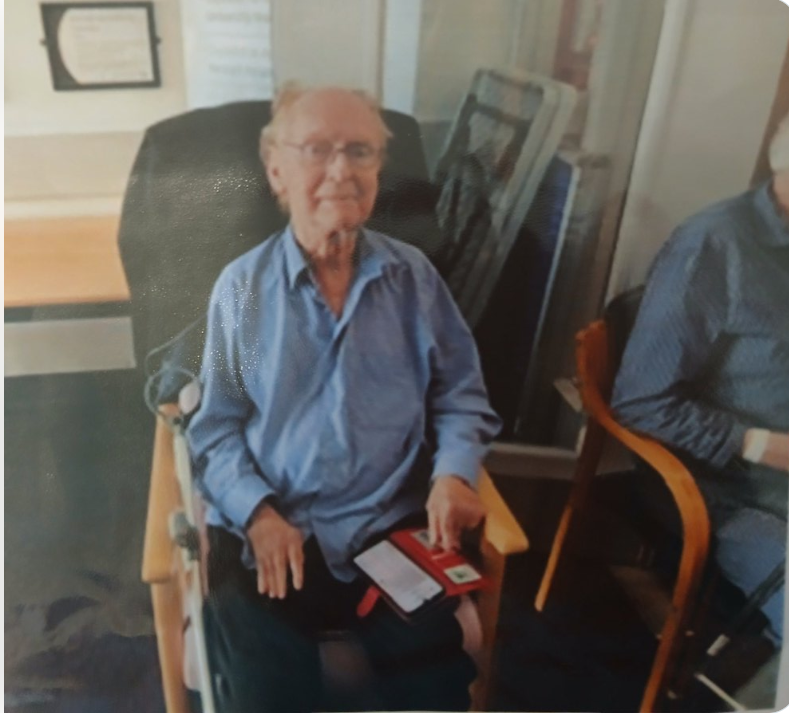
Delighted that lovely Irish tweeter David O'Brien (below) formerly @thepainterflynn and now tweeting from @oddweirdadvice is doing better after a lengthy and stressful hospital stay in Tipperary. The hospital wants to discharge him, but David has nowhere to go. He would prefer to avoid going into a home if possible. Is there anyone who might be able to help?
Also, David, who had a huge amount of followers, lost them all when Twitter recently closed his account. Give him a follow at @oddweirdadvice and say hi. You won't regret it - David's former account was one of the most uplifting on Irish Twitter.
PS David's story demonstrates that as a country we are failing the elders among us. They have immense wisdom and dignity and deserve more support. Seems crazy that they receive so little when we will (if lucky) all be elderly ourselves some day, with no guarantee that our children, if any, will be even in the same country!
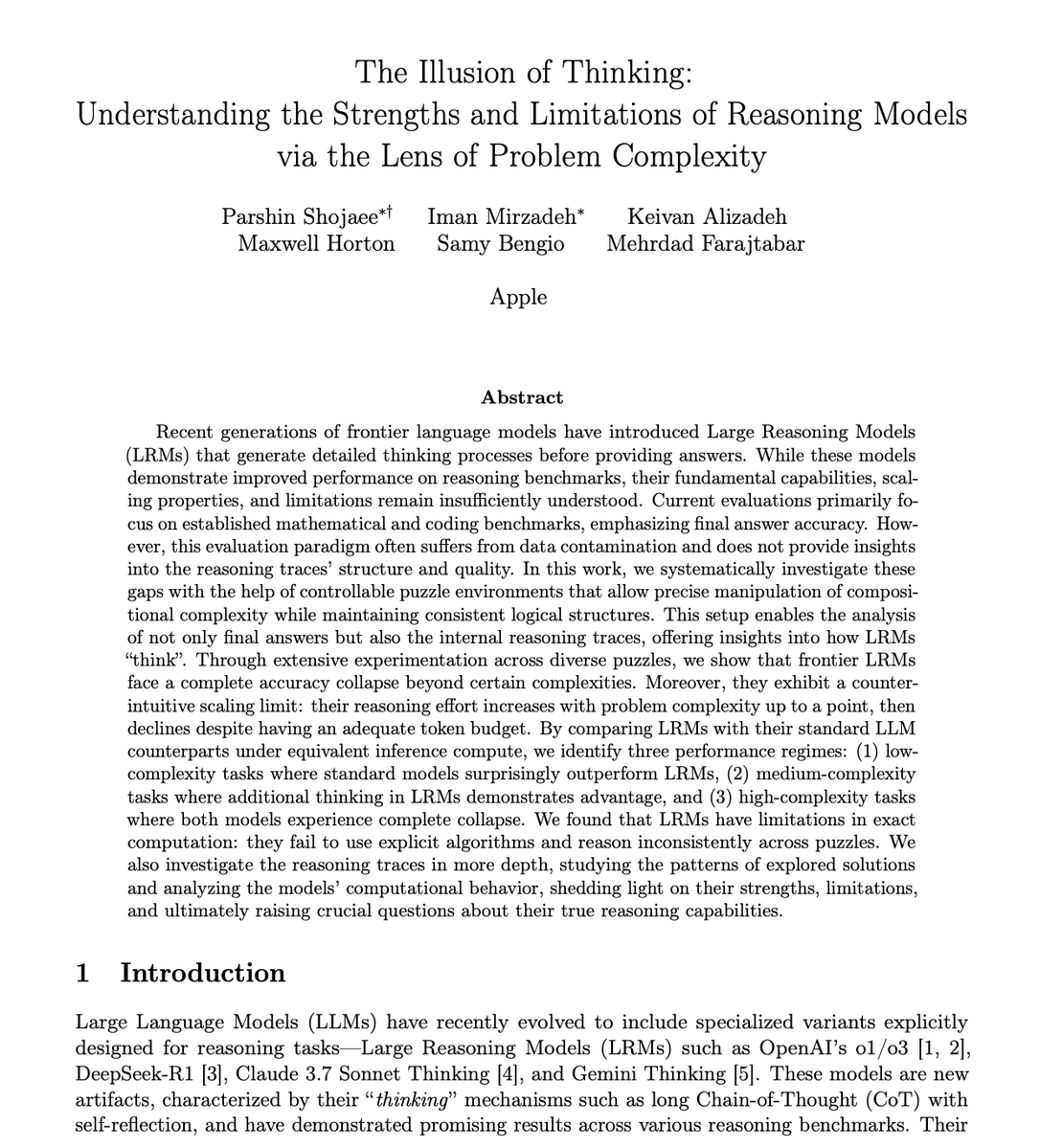
Apple has published a paper with a devastating title: “The Illusion of Thinking”
It argues that AI models, no matter how brilliant they may seem, do not understand what they are doing.
They do not solve problems. They do not reason. They merely generate text word by word, trying to sound coherent.
Apple tested the most advanced reasoning models in the world on controlled puzzle environments. They tore open the internal "thinking" traces.
What they found shatters the narrative that we are getting closer to AGI.
Current models don't scale with complexity. They have a hard mathematical cliff. And they do not degrade gracefully. They collapse.
But here is the most unsettling part.
When a problem gets too complex, the AI doesn't use its remaining compute to try harder.
It just gives up.
Its reasoning effort actually declines. It stops thinking and starts guessing.
Then Apple ran the experiment that closes the casket on the reasoning debate.
They gave the AI the exact, step-by-step algorithm to solve the puzzle. The cheat codes.
All the AI had to do was follow the instructions.
It couldn't do it.
Performance didn't improve at all.
When the complexity gets high enough, these models fail because they cannot actually execute a logical sequence.
They are not reasoning. They are just pattern matching.
When you give them a simple problem, they overthink. When you give them a hard problem, they collapse.
Paper: The Illusion of Thinking, Apple, 2025
@aeberman12@DwightEichorn One more fact you might not know Art: the statistical work that led to the “Cobb Douglas Production Function” was erroneous. Had they done their regressions correctly, the paper would never have been published.
All neoclassical theory is based on fantasy. Not reality.
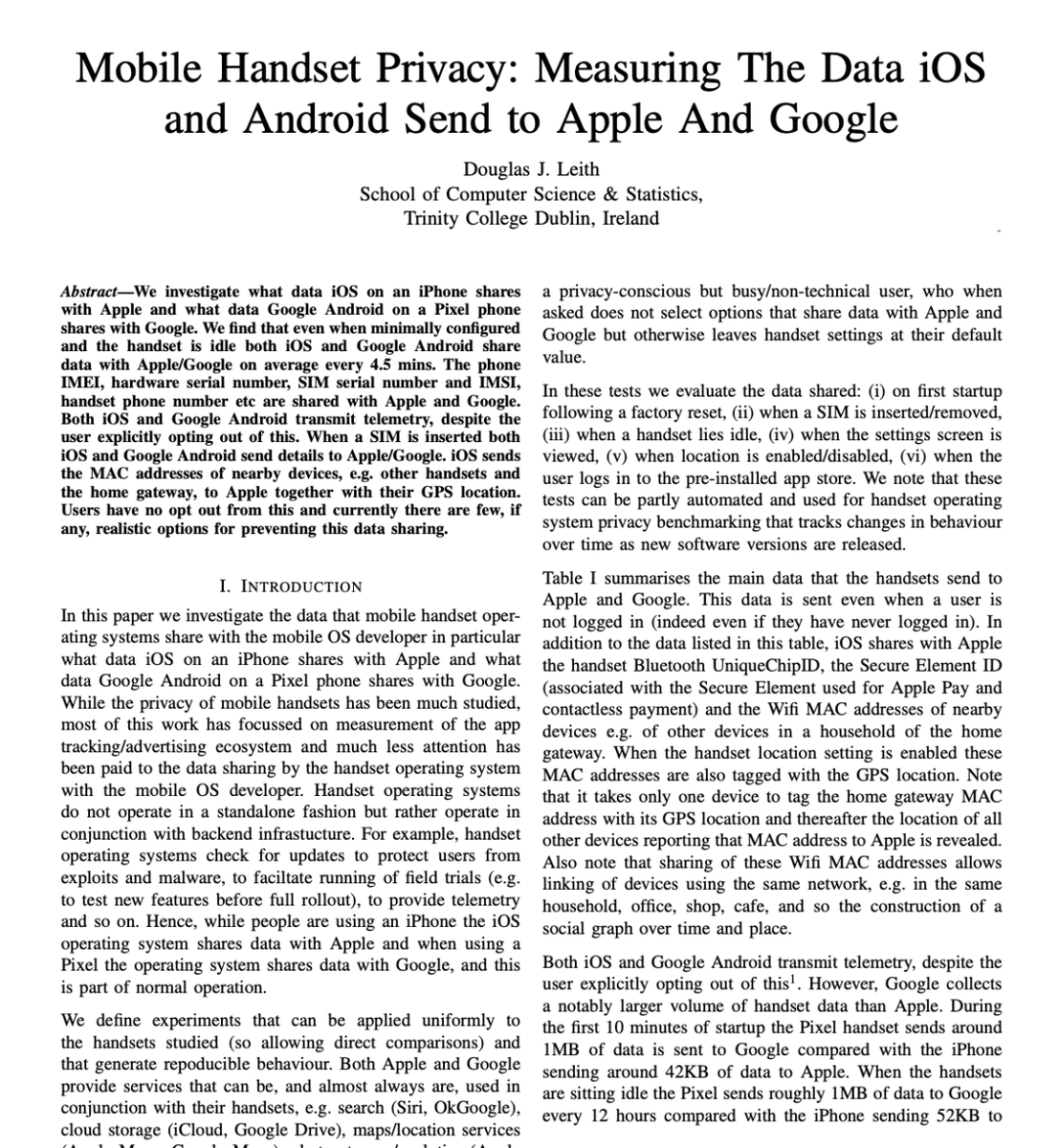
Researchers proved that your Android phone is sending data to Google every 4.5 minutes.
Even when you opt out of EVERYTHING.
Researchers at Trinity College Dublin did an exhaustive deep-dive into exactly how much data iOS and Android devices stealthily transmit back to Apple and Google.
Both tech giants are running non-stop telemetry pipelines from your device.
Even when you are not logged into an account. Even when you explicitly opt out of data collection. Even when the phone is completely untouched.
The sheer volume of data being harvested is staggering.
Android sends data back to Google every 4.5 minutes. iOS follows right behind, pinging Apple every 4.5 minutes.
Within the first 10 minutes of powering on a fresh device, Android sends roughly 1MB of data to Google. iOS sends about 42KB to Apple.
When the phones are just sitting there doing nothing, Google harvests around 1MB of data every 12 hours. Apple collects roughly 52KB.
Google is collecting 20x more telemetry data than Apple.
But what they are collecting is the real problem.
The researchers discovered that your phone isn’t just sending generic system diagnostics. It is sending a highly detailed digital fingerprint:
- Hardware serial numbers
- Device IMEI numbers
- Wi-Fi MAC addresses
- Your phone number
- SIM card details
And it gets darker.
iOS uploads the WiFi MAC addresses of every device near you. Your roommate's laptop, the café router, your neighbor's home gateway—all tagged with your exact GPS coordinates.
If just one person in your building enables location services once, Apple now knows where every single device on that network lives. Forever.
The researchers tried to opt out of everything. They turned off location services, restricted background data, and avoided signing into any accounts.
It didn't matter. The data transmission never stopped.
The escape hatch has been welded shut.
Right now, millions of professionals use these devices to handle sensitive business data, proprietary code, and private operations under the assumption that "idle" means "safe."
But the data shows there is no such thing as an offline smartphone anymore.
---
Paper: Mobile Handset Privacy: Measuring The Data iOS and Android Send to Apple And Google (2021)
30 years of Iran almost about to get a nuke.
Gotta be some form of record - @TheEconomist is the only one who comes close, with like 25 years of China about to collapse.
In fact, civilisation as a whole is just a giant hot potato game of trying to pass all the knowledge from one generation to the next before it is all forgotten again.
And democracy is about not trusting the people who have dedicated their entire lives to just remembering and knowing things about the past, because “my truth” is superior to institutional truth.
@izakaminska We humans are tiny specimens experiencing life serially while it happens in parallel and with limited bandwidth, all the while trying to distinguish fact from propaganda. You are far better than most & we are lucky to have you.
As they say in France;
"Vive la difference!'
I know I am probably 65+ years late to this, but I think I under appreciated how long France has been banging on about strategic autonomy for.
And to what degree De Gaulle used negotiations around “force de frappe” as a mechanism to extract a lot of let’s say, favorable terms, for France in the emerging global order.
I also under appreciated that from the moment France begins dabbling with enrichment and creating its own nuclear deterrent, it becomes increasingly confident in implementing its dirigiste and industrial policy at home, and all the more confrontational with America, in terms of forcing dollar conversion for gold.
I also didn’t realise there was a well circulated claim that the Nixon shock was sparked by Pompidou sending some sort of warship to New York harbour to pick up the gold in August 1971.
But also that 1971 was the year that France’s nuclear submarines finally became operational 🤪🏴☠️
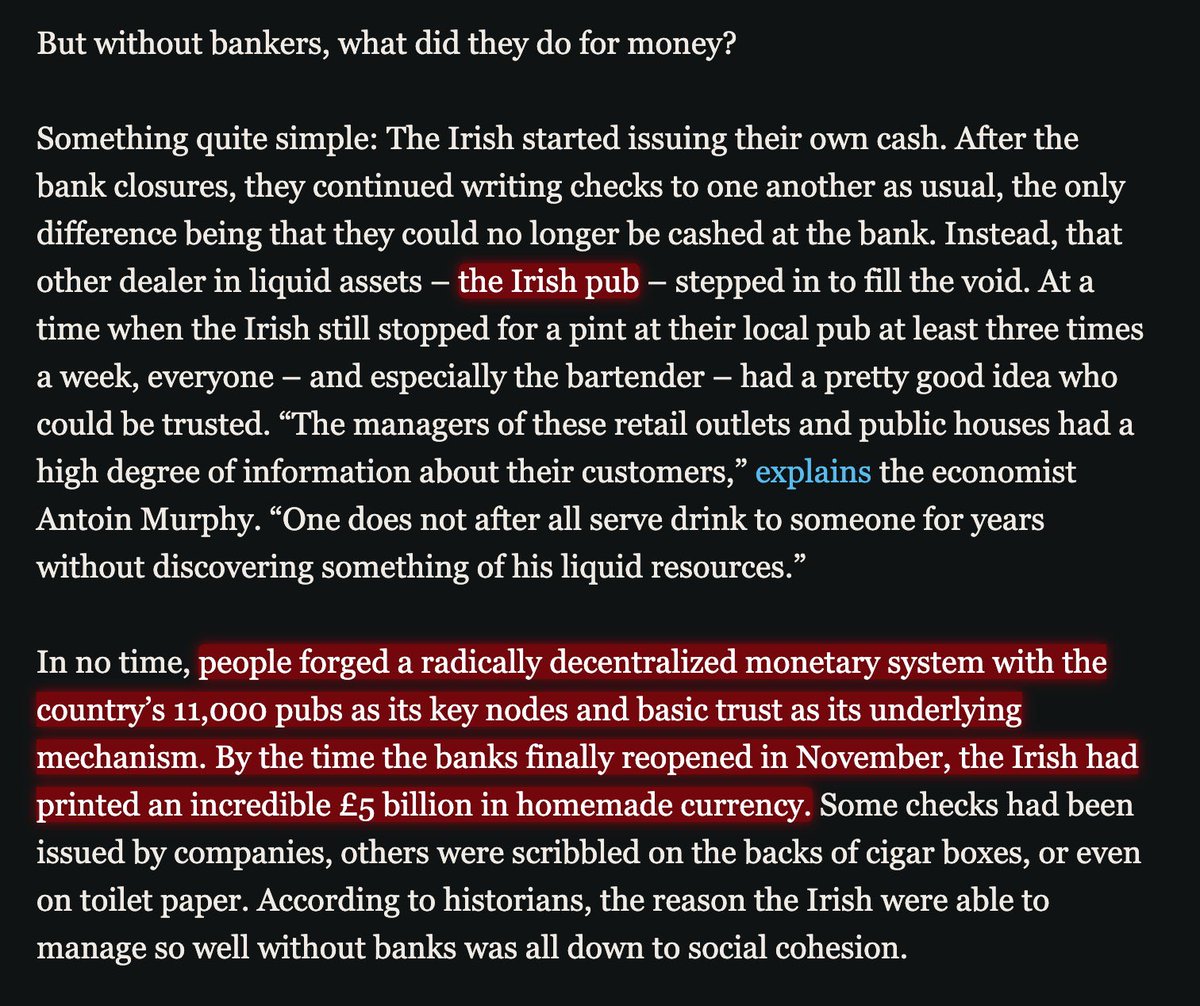
Great moment to remind people that when the banks went on strike in 1970s Ireland, the pubs stepped in overnight to form a decentralized monetary system and it worked fine.
@HedgieMarkets@tyillc " speculation has overwhelmed investment" happened quite some time ago.... but the scale of it is terrifying
the lack of congruence between the long term risks we face & the confidence implied by our debt/equity ratios shows that we don't understand this super-complex economy
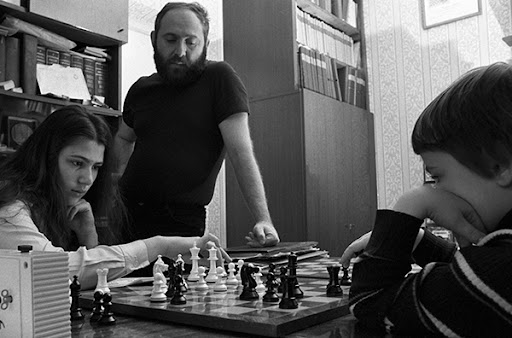
A Hungarian psychologist raised three daughters to prove that any child could become a chess grandmaster through early specialization. He succeeded. Two of them became grandmasters. One became the greatest female chess player who ever lived.
Then a sports scientist looked at the data and found something nobody wanted to hear.
His name is David Epstein. The book is called "Range."
The Polgar experiment is one of the most famous case studies in the history of deliberate practice. Laszlo Polgar wrote a book before his daughters were even born arguing that geniuses are made, not born. He homeschooled all three girls in chess from age four. By their teens, Susan, Sofia, and Judit were dominating tournaments against grown men. Judit became the youngest grandmaster in history at the time, breaking Bobby Fischer's record. The story became the gospel of early specialization. Pick a domain young, drill it hard, and you can manufacture excellence.
Epstein opens his book by telling that story honestly and then quietly demolishing the conclusion most people drew from it.
Chess works that way. Most things do not.
Here is the distinction that took him four years of research to articulate, and that almost nobody who quotes the 10,000 hour rule has ever read.
There are two kinds of environments in which humans develop expertise. Psychologists call them kind and wicked. A kind environment has clear rules, immediate feedback, and patterns that repeat reliably. Chess is the cleanest example. Every game ends with a winner and a loser. Every move is recorded. The board never changes shape. The pieces never invent new ways to move. A child who plays ten thousand games will see most of the patterns that exist in the game, and pattern recognition is exactly what chess mastery is built on.
A wicked environment is the opposite. Feedback is delayed or misleading. Rules shift. The patterns that worked yesterday may be exactly the wrong patterns to apply tomorrow. Most of the real world looks like this. Medicine is wicked. Investing is wicked. Building a company is wicked. Scientific research is wicked. Almost every job that involves a complex changing system with humans in it is wicked.
The Polgar sisters trained in the kindest environment any human can train in. Their success was real and the method was correct. The mistake was generalizing the method to fields where the underlying structure of the environment is completely different.
Epstein's research is what made the implication impossible to ignore.
He looked at the careers of elite athletes outside of chess and golf and found that the pattern was almost the inverse of what people assumed. The athletes who reached the very top of their sports were overwhelmingly people who had played multiple sports as children, specialized late, and often switched disciplines well into their teens. Roger Federer played squash, badminton, basketball, handball, tennis, table tennis, and soccer before tennis became his focus. The kids who specialized in tennis at age six and trained year-round for a decade mostly burned out, got injured, or topped out at lower levels of the sport.
The same pattern showed up everywhere he looked outside of kind environments. Inventors with the most patents had worked in multiple unrelated fields before their breakthrough work. Comic book creators with the longest careers had drawn for the most different genres before settling. Scientists who won Nobel Prizes were dramatically more likely than their peers to be serious amateur musicians, painters, sculptors, or writers.
The skill that mattered in wicked environments was not depth in one pattern. It was the ability to recognize when a pattern from one domain applied unexpectedly in another. That kind of thinking cannot be built by drilling a single subject. It can only be built by accumulating mental models from many subjects and learning to move between them.
The deeper finding is the one that should change how you think about your own career.
Specialists in wicked environments often get worse with experience, not better. Epstein cites studies of doctors, financial analysts, intelligence officers, and forecasters showing that years of experience in a narrow domain frequently produce more confident judgments without producing more accurate ones. The expert builds elaborate mental models that feel comprehensive and turn out to be increasingly disconnected from the actual structure of the problem. They stop noticing what does not fit their framework. They mistake fluency for understanding.
Generalists do better in wicked domains for a reason that sounds almost mystical until you understand the mechanism. They have less invested in any single mental model, so they abandon broken models faster. They are used to being a beginner, so they are not threatened by the discomfort of not knowing. They have seen enough different domains that they can usually find an analogy from one field that unlocks a problem in another. The technical name for this is analogical thinking, and the research on it is one of the most underrated bodies of work in cognitive science.
The single most useful sentence in the entire book is the one Epstein puts almost as a throwaway.
Match quality matters more than head start.
A person who tries six different fields in their twenties and finds the one that genuinely fits them will outperform a person who picked one field at fourteen and stuck to it on willpower alone. The lost years were not lost. They were the search process that produced the match. Every field they walked away from taught them something they later imported into the field they finally chose.
The reason this is so hard to accept is cultural, not empirical. We tell children to pick a path early. We reward the prodigy who knew at six. We treat the late bloomer as someone who failed to launch on time, when the data suggests they were running an entirely different and often more effective optimization process underneath.
The Polgar sisters were not wrong. The conclusion the world drew from them was.
If your environment is genuinely kind, specialize early and drill hard. If it is wicked, and almost every interesting human problem is, then the people who win are the ones who refused to specialize until they had seen enough to know what was actually worth specializing in.
You are not behind. You were running the right experiment all along.
With great joy and honor, I am participating in the International Workshop #APPLMATH2026, which will take place at the Accademia Peloritana dei Pericolanti in Messina, Sicily, from 10–12 June 2026.
Two days full of applied mathematics, new discoveries in AI, and inspiring scientific discussions with leading researchers from around the world.
I will present our latest published paper, with Professor Massimiliano Ferrara, on addressing the performance degradation of AI models. #AppliedMathematics #Workshop #APPLMATH #AI
OpenAI and Palantir are so terrified of this guy, they're spending millions to destroy him.
There's a Democrat running for Congress in New York's 12th District named Alex Bores.
Never heard of him? Well that's the point.
3 year state assemblyman. 30 bills passed. Co-author of the RAISE Act, the first real AI safety law in any major state.
Soft bill. Basic transparency. Safety plans. Incident reporting.
And for that, the AI industry has declared WAR on him.
A Super PAC called Leading the Future has already dumped $2.5 million into destroying his campaign.
Funded by Joe Lonsdale (Palantir co-founder), Greg Brockman (OpenAI co-founder), and Andreessen Horowitz.
They've said they may spend up to $10 million.
For a single House seat.
But the money isn't the crazy part...
The crazy part is what they've said OUT LOUD about why:
They're trying to make him SUFFER so publicly that every future politician who even THINKS about regulating AI runs the other way.
Bores' exact words: "They want to beat up on me so bad that when the idea of regulating AI comes up in the future, politicians run the other way."
This is literally political deterrence.
Terrorize one guy so brutally that Congress learns the lesson: Touch AI, end your career.
Now here's where it gets really insane:
Their main attack line is that Bores worked at Palantir "building ICE tech."
And who funds the attacks? Joe Lonsdale. Palantir co-founder.
The man who profits from ICE contracts is spending millions to attack a candidate for… once working at Palantir.
But Bores QUIT Palantir in 2019 because executives refused to put anti-deportation guardrails into their ICE contracts after Trump's first election.
He pushed internally. They said no. He walked.
So the billionaire who funds deportation tech is spending millions to smear a candidate for working on deportation tech that the candidate actually tried to stop.
You cannot make this up.
And the question everyone should ask is: Why THIS guy?
Bores isn't a radical. He's not anti-AI. Not Bernie Sanders.
He's a moderate Democrat with a CS degree who passed the softest possible AI bill.
Which is EXACTLY why Palantir and OpenAI are terrified of him.
Because he proved something dangerous:
You can actually pass AI regulation.
It's not impossible. You just need one competent legislator who understands the tech and refuses to back down.
Multiply that by 50 states and AI companies lose control forever.
So they're not just attacking Bores the candidate.
They're attacking the PROOF that AI regulation is possible.
And they're doing it while OpenAI quietly publishes policy documents that ADMIT most of Bores' proposed regulations are reasonable.
Third-party audits? They agree.
Red-teaming? They agree.
Kid safety provisions? They agree.
They don't disagree with the substance.
They disagree with the TIMING.
They want regulation to come AFTER they've bought enough political power to write it themselves.
That's what $2.5 million to destroy one assemblyman actually buys.
Not an election.
But a warning to every politician watching:
If a first-term legislator with a soft bill can get buried under $10 million of attack ads, imagine what we'll do to you if you try to pass a real one.
This is how industries capture democracy.
With FEAR.
And it's working. Members of Congress are already telling Bores in private: "We're watching this race. We want to see if this is an issue you can win on, or if money just swamps everything."
Which basically means: Tell us if we're allowed to legislate on this.
The crypto industry ran this exact playbook in 2024 through Fairshake. Hundreds of millions spent. Anti-crypto candidates destroyed. Congress rewritten.
Now AI is running it at 10x the scale.
Leading the Future: $125M raised. AI companies: $300M+ committed to the 2026 midterms.
More than crypto spent in the ENTIRE 2024 cycle.
All on one principle: Don't debate your critics. Destroy them so publicly nobody else dares become one.
Palantir isn't scared of losing a House seat. OpenAI isn't scared of one guy's bill.
They're scared of PRECEDENT.
Because if Bores wins, the lesson Congress learns is that you CAN take on AI and survive.
And that's the one lesson the industry can never afford them to learn.
What's your take on this?
She was never meant to matter.
Just a pretty young translator in the room.
But in 1940, after German forces took control of France, Jeannie Rousseau’s father put his 21-year-old daughter forward to work as an interpreter for Nazi officers in Brittany. She spoke flawless German. She was elegant, warm, and disarming. The officers relaxed around her. Relaxed enough to speak openly, even when they shouldn’t have.
Jeannie listened.
At first, she kept everything in her head. Then she began passing along what she heard to the French Resistance.
In 1941, the Gestapo arrested her on suspicion of spying. Her case went before a military tribunal. But the German officers in Dinard who knew her defended her fiercely. They swore she was innocent. She was released, but ordered to leave the coastal area.
So she went to Paris. And got another job as a translator.
This time, she worked for a French industrial organization that regularly interacted with German military leadership. Then, during a chance encounter on a night train, she ran into an old university classmate named Georges Lamarque. That meeting changed everything. Through him, she joined a spy network known as The Druids. Her codename: Amniarix.
Lamarque remembered her from the University of Paris, where she had graduated top of her class and shown an extraordinary gift for languages. He asked her to work for the network.
She agreed without hesitation.
Her technique was brilliant because it seemed so harmless. She listened carefully. She asked innocent-sounding questions. And when German officers described things that sounded unbelievable, she acted doubtful.
In 1943, some of the same officers she had known in Dinard began discussing a terrifying new weapon. Rockets that could travel enormous distances. Faster than any aircraft. A weapon of terror that could reshape the war.
Jeannie widened her eyes and played the skeptic.
“That can’t be real,” she told them. “You must be exaggerating.”
They pushed back. Said it was true.
She kept doubting them. Again and again.
“What you’re saying is impossible,” she insisted. Over and over, maybe a hundred times.
And that worked.
They became so determined to convince her that one officer actually showed her technical sketches of the rockets. Full details. Plans. Information about the testing site — Peenemünde, on the Baltic coast.
Jeannie wasn’t an engineer. She didn’t fully understand the science.
But she had one gift the officers never suspected:
an almost photographic memory.
She memorized it all. The figures. The dimensions. The descriptions. Every important detail. Then she repeated everything, word for word, to her Resistance contacts. Those reports were passed to British intelligence in London.
What she uncovered was staggering.
Germany was developing the V-1 and V-2 rockets — weapons capable of striking British cities from hundreds of miles away. Weapons that could slaughter thousands of civilians.
British intelligence officer R. V. Jones received her reports. When he asked who the source was, he was told only that it came from “a young woman, the most remarkable of her generation.”
And her information changed the course of the war.
In August 1943, Britain sent 560 bombers to attack Peenemünde. The strike disrupted the Nazi rocket program. It slowed production. It interrupted testing. And it saved thousands of lives.
Jeannie kept working through 1944. She traveled deep into Germany with French industrialists, watching, listening, and reporting everything back. British intelligence was so impressed by her accuracy that they arranged to bring her to London for an in-person debrief. They called her a “human tape recorder.”
The extraction was set for spring 1944, from the town of Tréguier in Brittany. But the French agent assigned to guide the team through the minefields was captured at the rendezvous point.
The mission collapsed.
Her cover was blown.
The Gestapo arrested her and sent her to Ravensbrück concentration camp. Then to Torgau. Then to yet another camp, each worse than the one before. She spent the final year of the war being moved through three concentration camps.
And still, she said nothing.
She never revealed what she had done. Never gave up the intelligence she had gathered. Not as her body weakened. Not as tuberculosis consumed her. Not as starvation brought her close to death.
When the Swedish Red Cross liberated her in 1945, she was barely alive.
She slowly recovered in a sanatorium in Sweden. There she met Henri de Clarens, a survivor of both Buchenwald and Auschwitz. They later married and had two children.
After the war, Jeannie worked as a freelance interpreter for the United Nations and other organizations. She stayed away from attention. She avoided journalists. She avoided historians. For decades, most people barely knew her story.
In 1993, she accepted the CIA’s Agency Seal Medal. In 1998, she finally agreed to speak with Washington Post journalist David Ignatius. It was the first time she had truly opened up to a reporter.
He asked her why she had done it.
Why she had risked everything when so many others kept their heads down.
She seemed almost puzzled by the question.
“It wasn’t a choice,” she said. “It was what you did. At the time, we all thought we would die. I don’t understand the question. How could I not do it?”
France had already made her a member of the Legion of Honor in 1955. In 2009, she was elevated to grand officer. She also received the Resistance Medal and the Croix de Guerre.
Jeannie Rousseau de Clarens died in August 2017 at 98 years old.
For most of her life, she insisted her role had been small.
“I was one small stone,” she said.
But that small stone helped stop rockets from raining down on London.
That small stone helped save thousands of lives.
That small stone was a 21-year-old woman who pretended not to believe what she was hearing — and then remembered every word.
So if you’ve ever wondered what a person does when courage is the only path left, Jeannie gave the answer long ago:
You do what must be done.
You don’t stop to ask why.
You just do it.
🧵 THREAD
1/ Your daughter posts something online.
She is 19. In college. Trying to figure out what she believes. She shares a political opinion that an algorithm flags as problematic.
You do not see it happen. No one notifies you. No one tells her.
But 72 hours later, her bank account is frozen. Her student loans are suspended. Her digital ID shows a compliance violation.
And there is nothing you can do to protect her.