Thank you for being here today. Your support means a lot to the whole team. We will get back to flight, and we will get to the Moon. Gradatim Ferociter.
Auxos (@UseAuxos) lets marketing, product, and research teams simulate every decision at scale before it reaches a real customer. Test hypotheses on messaging, ads, pricing, and brand positioning in minutes.
Congrats on the launch, @TheAshtonDaniel, @kerry_lu_, and @jwoobers!
https://t.co/iGq91eXOFq
@ycombinator@UseAuxos@TheAshtonDaniel@kerry_lu_@jwoobers This is the future. Amazing launch from YC: Auxos: A platform to simulate decisions for product, pricing, and user experience before they reach real users—a direction that feels critical as systems need speed of execution and grow more complex.
OMG.
🇰🇪 Sabastian Sawe becomes the first man ever to break 2 hours in a marathon (legal conditions) in 1:59:30 at the London Marathon!
Yomif Kejelcha 🇪🇹 runs 1:59:41 in his DEBUT.
Jacob Kiplimo 🇺🇬 takes third in 2:00:28
All under the previous WR.
THIS IS THE BEST OF HUMANITY
At the 2026 Boston Marathon, runners Aaron Beggs (from Northern Ireland/Britain) and Robson De Oliveira (from Brazil) stop to help fellow competitor Ajay Haridasse cross the finish line after he collapsed near the 26-mile mark
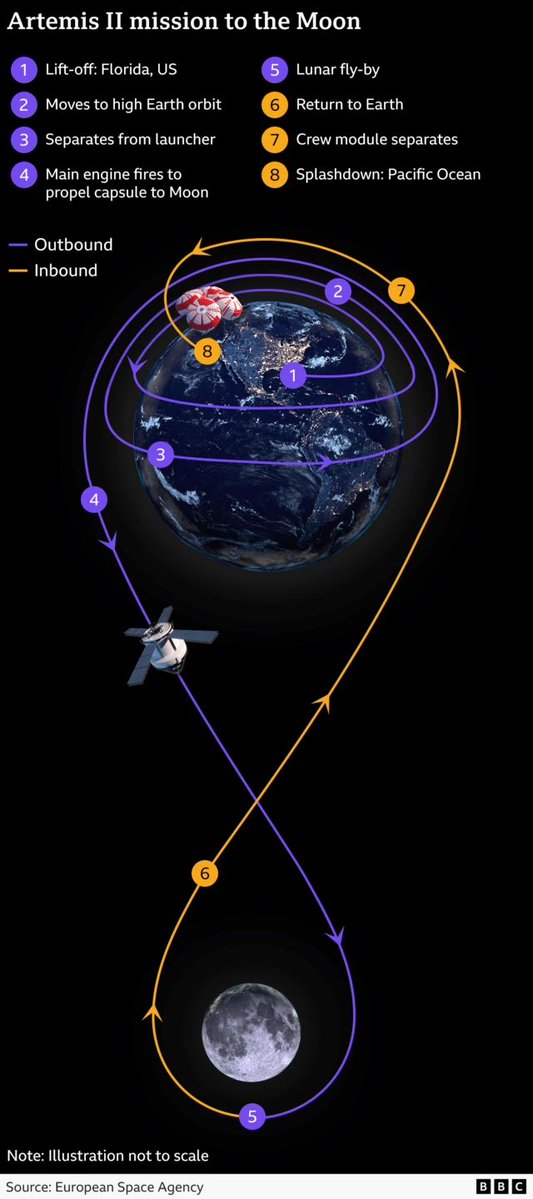
🚨SHOCKING: Artemis II mission isn’t “going to the Moon.”
It’s aiming for a precise point in space where the Moon will be.
252,706 miles away .
The human brain cannot process what this actually means.
Every space mission you’ve ever seen depicted gets this fundamentally wrong. Movies show rockets flying toward a destination like an airplane flying toward an airport. Point at target, fire engines, arrive.
Reality operates under completely different physics.
When NASA launched Artemis II on April 1, 2026 , the Moon was somewhere entirely different than where the spacecraft will intercept it on April 6 . The rocket launched toward empty space, betting everything on a mathematical prediction of where a target traveling 67,000 miles per hour would position itself five days  in the future.
Space travel is not transportation. It’s temporal ballistics.
The Moon orbits Earth every 27.3 days, covering roughly 1.5 million miles of distance. During the ten day journey of Artemis II  , the Moon moves approximately 370,000 miles along its orbital path. The spacecraft launched in a direction that looks completely wrong to every human instinct, following a free-return trajectory that intercepts the Moon’s future position  , not its current one.
This requires predicting exactly where an object the size of a continent will be located, down to mile precision, five days before the meeting happens. Any error in orbital calculation, any miscalculation in the Moon’s gravitational influences from Earth and Sun, any slight deviation in spacecraft velocity, and the crew of Reid Wiseman, Victor Glover, Christina Koch, and Jeremy Hansen  sails past their target into the infinite void of space.
NASA engineers call this a “free return trajectory,”   but the name obscures the cognitive breakthrough required to make it work. You cannot think about space travel the way you think about any form of transportation that exists on Earth.
Destinations don’t exist in space. Only intercepts exist. You’re never going somewhere. You’re always going somewhen.
The mathematics behind orbital rendezvous calculations treats time and space as completely integrated variables. The spacecraft’s translunar injection burn on April 2  lasted exactly six minutes. Miss that window by even minutes, and the geometric relationship between Earth’s rotation, the Moon’s orbital position, and the spacecraft’s trajectory becomes unsolvable. The destination literally disappears from the realm of possibility until celestial mechanics realign.
The Artemis II crew spent five days flying through vacuum toward coordinates   that would contain nothing but empty space if they had launched 24 hours earlier or later.
They bet their lives on humanity’s ability to predict the future position of celestial objects with mathematical precision that exceeds anything we do on Earth.
Today, April 6, they’ll pass within 4,070 miles of the lunar surface , reaching their maximum distance from Earth. But they launched toward empty space and intercepted a moving target with pinpoint accuracy across a quarter million mile void.
Space doesn’t contain destinations. It contains equations.
Instead of watching an hour of Netflix, watch this 2-hour Stanford lecture on AI careers. It will teach you more about winning in the AI race than all the AI content you’ve scrolled past this year.
Our biggest update to @GoogleMaps in over a decade begins rolling out today. Ask complex, real-world questions in conversational language and get answers with Ask Maps, and take the guesswork out of driving with intuitive guidance and 3D visuals from Immersive Navigation so you can stay focused on the road.
I ACCIDENTALLY UNLOCKED "GOD MODE" IN CHATGPT,
AND IT STARTED TEACHING ME THINGS I DIDN'T KNEW EXISTED.
HERE ARE THOSE 7 CHATGPT PROMPTS THAT WILL CHANGE EVERYTHING FOR YOU:
Today @GoogleMaps is getting its biggest upgrade in over a decade. By combining our Gemini models with a deep understanding of the world, Maps now unlocks entirely new possibilities for how you navigate and explore. Here’s what you need to know 🧵
Columbia CS Prof explains why LLMs can’t generate new scientific ideas.
Bcz LLMs learn a structured “map”, Bayesian manifold, of known data and work well within it, but fail outside it.
But true discovery means creating new maps, which LLMs cannot do.
In 2014, Peter Thiel gave a 1-hour masterclass on how to build a monopoly from scratch.
He broke down how:
• Google became untouchable
• PayPal beat the odds
• Facebook crushed competition
Here are 11 timeless lessons from his masterclass:
1. Create value, then capture it
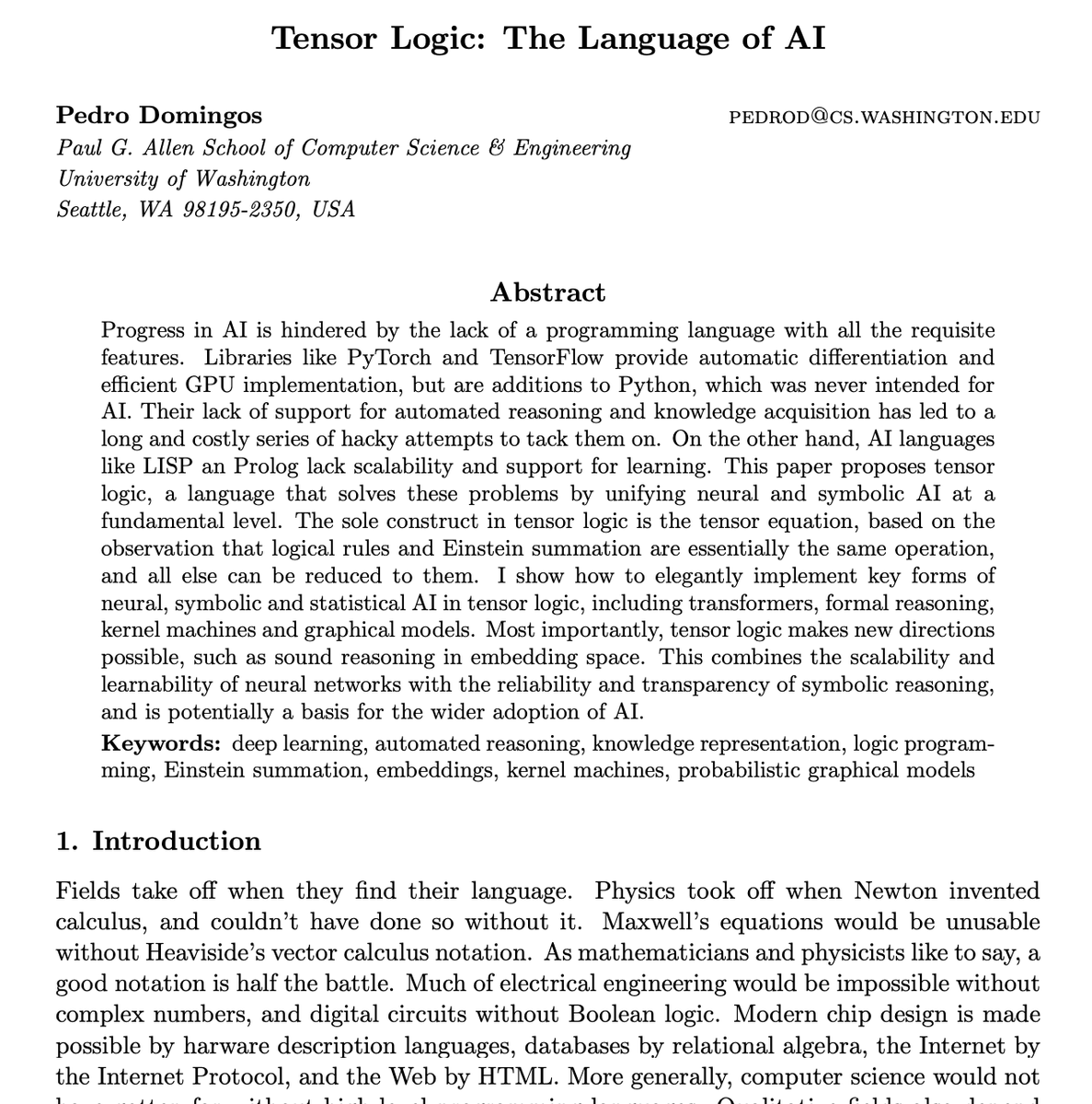
🚨 This MIT paper just broke everything we thought we knew about AI reasoning.
These researchers built something called Tensor Logic that turns logical reasoning into pure mathematics. Not symbolic manipulation. Not heuristic search. Just tensor algebra.
Here's how it works:
Logical propositions become vectors. Inference rules become tensor operations. Truth values propagate through continuous transformations.
Translation? Deduction and neural computation finally speak the same language.
This isn't symbolic AI bolted onto deep learning. It's not deep learning pretending to do logic. It's a unified framework where both happen simultaneously.
Every major AI model today hits a wall with consistency because logic is discrete and gradients are continuous. You can't backpropagate through "true or false."
Tensor Logic erases that boundary completely.
The system embeds Boolean reasoning, probabilistic inference, and predicate logic inside a single differentiable framework. That means you can train it end-to-end like a neural network while maintaining logical guarantees.
In experiments, the system performs logical inference as matrix operations. Neural nets can now reason with symbolic precision. Symbolic systems can learn from data like neural nets.
The numbers are wild. The system handles complex logical queries with the same computational efficiency as matrix multiplication. No expensive search. No combinatorial explosion.
But here's the part that should terrify the incumbents: this scales.
Traditional symbolic AI chokes on ambiguity. Neural networks hallucinate logical structures. Tensor Logic gets both right simultaneously.
If this approach spreads, we might finally get models that don't just predict truths they can prove them. Systems that reason with mathematical certainty while learning from messy real-world data.
The implications go way beyond academic AI. Every system that needs both learning and guarantees autonomous vehicles, medical diagnosis, financial systems, legal reasoning just got a new foundation.
Current AI is either good at learning or good at logic. Never both.
That dichotomy just ended.
The fusion of logic and learning isn't coming. It's already here.
A big step forward in the fight against Alzheimer’s: The FDA approved the first blood test to help diagnose the disease. Breakthroughs like this will make earlier, easier diagnosis possible—bringing us closer to better treatments and, someday, a cure. https://t.co/Mf5T0EDHf0