Así se ve un sueldo de 750.000 dólares al año: un tipo en camiseta blanca, un pizarrón y 2 horas y media.
Stanford, CS336. Percy Liang construye un LLM desde cero. Lo que hay debajo de Claude y ChatGPT, y arranca por la parte que todos saltan: el modelo no lee tu texto, lee números.
Anthropic paga ese sueldo a los ingenieros que entienden esa capa.
Lo único que cobra Stanford son 2 horas y media de tu atención.
ग्रेट निकोबार को बचाने के लिए आगे आइए- Nicobar Petition साइन कीजिए।
हिंदुस्तान की इस बेहद खूबसूरत और महत्वपूर्ण प्राकृतिक धरोहर को बचाने में अपना योगदान दीजिए 👇
https://t.co/epehDPTYYS
#GreenOverGreed 🇮🇳
#NicobarMatters
Another blow to Anthropic!
Devs built a free and better Claude alternative that:
- runs locally
- works with any LLM
- beats it on deep research
- has Cowork-like capabilities
- connects to 40+ data sources
- self-hosts via Docker, and more.
100% open-source (20k+ stars).
🚨‼️ BREAKING: Anthropic has decided to open source their entire codebase and is rebranding their AI to OpenClaude.
Anthropic CEO Dario Amodei said: "Yesterday was no slip-up. If we disappear just like OpenAI is vanishing right now, our code can live on through the community."
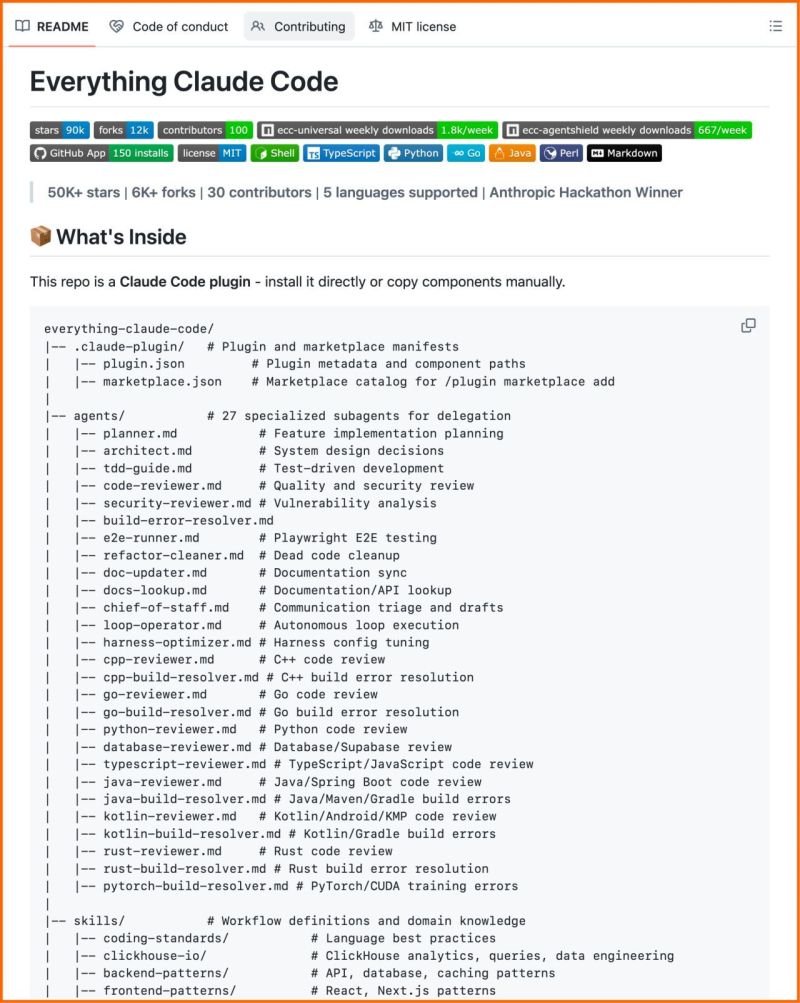
This is the most complete Claude Code setup that exists right now.
27 agents. 64 skills. 33 commands. All open source.
The Anthropic hackathon winner open-sourced his entire system, refined over 10 months of building real products.
What's inside:
→ 27 agents (plan, review, fix builds, security audits)
→ 64 skills (TDD, token optimization, memory persistence)
→ 33 commands (/plan, /tdd, /security-scan, /refactor-clean)
→ AgentShield: 1,282 security tests, 98% coverage
60% documented cost reduction.
Works on Claude Code, Cursor, OpenCode, Codex CLI. 100% open source.
🚨 BREAKING: Claude Code just got superpowers.
Someone just turned Claude Code into a full AI engineering team. 32 specialized agents. 5 execution modes. 3-5x faster output. Zero learning curve.
It's called oh-my-claudecode.
Bookmark it for later.
No new tools. No new subscriptions. Just Claude Code running the way it was always meant to run.
Trended #1 on GitHub with 858 stars in 24 hours. Here's why.
You type one sentence. The system figures out everything else:
→ "autopilot" and it builds the entire thing autonomously. Detects your intent, delegates to specialists, verifies with the architect agent, and delivers working tested code
→ "team 3:executor" and it spins up 3 parallel agents working on the same task simultaneously. 3-5x faster than sequential execution
→ "ralph" and it enters persistence mode. Won't stop until the job is verified complete. The boulder never stops rolling
→ "eco" and it switches to token-efficient mode. 30-50% savings without sacrificing quality
→ "ralplan" and it runs a Socratic deep interview before touching a single file. Exposes hidden assumptions and measures clarity across weighted dimensions
What's under the hood:
→ 32 specialized agents for architecture, research, design, frontend, testing, data science, security, and more
→ Smart model routing: Haiku for simple tasks, Opus for complex reasoning. Automatic. You never think about which model to use
→ 31 lifecycle hooks that enhance Claude Code behavior automatically
→ Cross-validate with external providers via omc ask: Claude, Codex, Gemini CLI
→ Discord and Telegram notifications when sessions complete
→ Anti-slop workflow built in
→ HUD with live observability and session replay artifacts
Here's the part nobody talks about:
It auto-resumes your Claude Code sessions when rate limits reset. No babysitting. No manually restarting. Just continuous execution.
Works on macOS and Linux natively. Windows via WSL2.
100% Open Source.
Link in the comments.
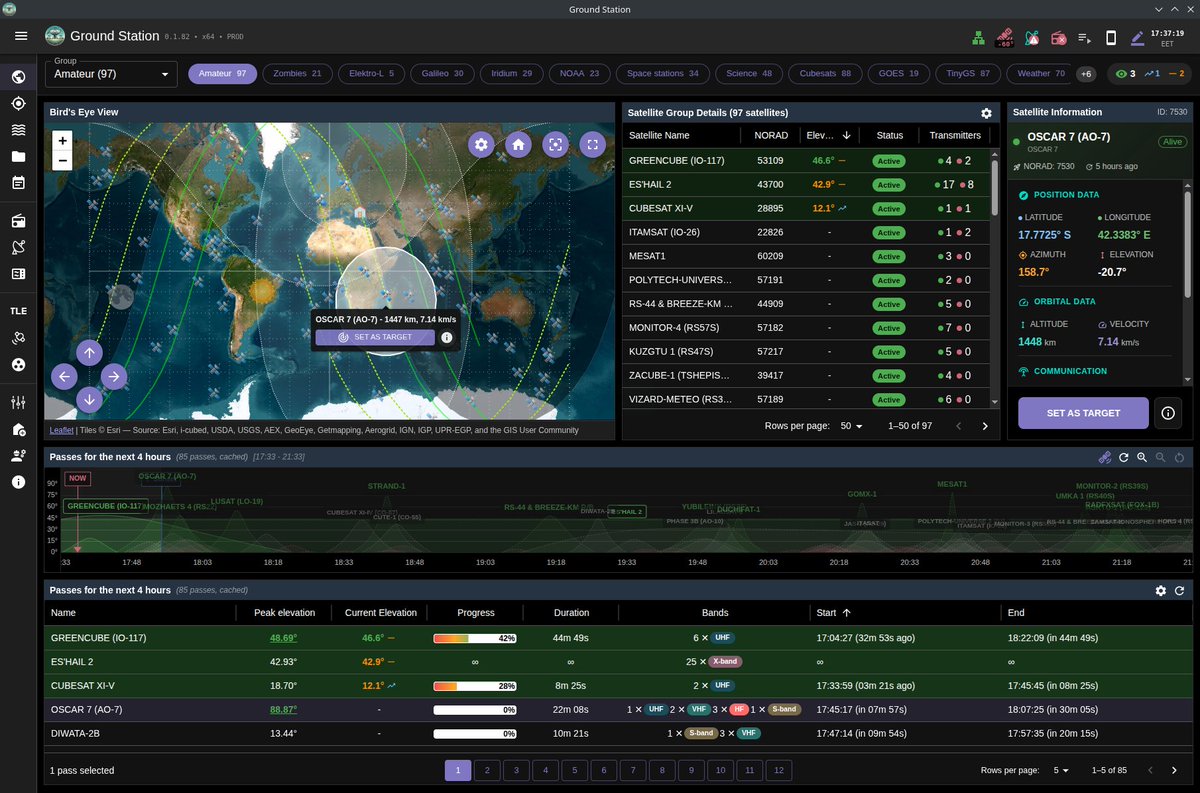
🚨 BREAKING: Someone just open-sourced a full suite for tracking satellites and decoding their radio signals locally.
You don't even need the internet. It uses an SDR to pull weather images and raw data straight from space to your hard drive.
100% Open Source.
Land was wealth 300 years ago. The person who owned the land owned the wealth.
Then, it was factories and production. The industrialist owned the wealth.
Today, it is information. The person who has the most timely information owns the wealth.
found a website where you can create, program and test electronic hardware. it already has some featured projects
really great if you want to test before building your own hardware
Norway Found Oil. Then Did the One Thing Most Countries Never Do
In 1969, Norway discovered one of the largest offshore oil deposits in the world.
The Ekofisk field changed everything.
Suddenly, this Scandinavian nation was sitting on extraordinary wealth.
They could have done what most oil-rich countries do:
* Spend all immediately.
* Build monuments.
* Create economic bubbles.
* Enrich a few while the many suffer.
And when the oil runs out, collapse into debt & instability.
Nigeria tried that.
Venezuela tried that.
Libya tried that.
Norway looked at these cautionary tales. Made a different choice.
In 1990, Norway created Govt Pension Fund Global.
Rules simple but revolutionary.
All oil profits would flow into fund. The fund would invest globally in 1000s of companies. Norway could only withdraw a small % each year— 4%, now 3%.
The rest would stay invested. Forever.
People thought they were insane.
Why hoard money for people who don't even exist yet?
Why not lower taxes, build bigger programs, and enjoy the wealth right now?
Norwegian govt had an answer...
Because future Norwegians will exist. And they deserve this wealth as much as we do.
In 1996, they deposited the first payment: $150 million.
Then they did something even more remarkable...
They stuck to the plan.
* Year after year, oil revenues flowed into the fund.
* Year after year, the fund invested in global markets—stocks, bonds, and real estate across 70 countries.
* Year after year, politicians resisted the overwhelming temptation to raid the funds for short-term political wins.
Every election cycle brought promises to spend more.
Every economic downturn brought demands to tap the fund.
Every crisis brought calls to break the rules "just this once."
Norway said no.
Every single time.
The fund's managers didn't try to beat the market or gamble on hot stocks...
They simply bought small stakes in 1000s of companies worldwide. 9,000 today—and held them.
They played the longest game imaginable.
By 2000, fund worth $50 bn.
By 2010, $500 bn.
By 2017, $1 tn.
Now $2 tn.
For a country of just 5.6 mn people, that works out to $340,000 per citizen.
Extraordinary part?
More than half of the fund's value didn't come from oil.
It came from investment returns.
The fund now generates more income from its global investments than Norway makes from selling oil and gas.
They transformed tem oil wealth into permanent financial wealth.
Fund owns 1.5% of every publicly traded company in the world.
It holds stakes in Apple, Microsoft, Amazon, and more.
When you buy almost anything from almost any major company, a tiny fraction flows back to Norway.
The 3% withdrawal rule ensures the fund will last indefinitely.
That 3% provides roughly a quarter of Norway's national budget—funding edu, healthcare, infra, pensions without ever depleting the principal.
Norway's oil will eventually run out. Maybe in 30 years, maybe 50. It doesn't matter anymore.
By the time the last barrel is pumped, Norway will have a multi-trillion $ fund generating returns forever.
The genius wasn't in discovering oil. - lots of countries found oil.
The genius was in the radical decision to:
* Save almost all of it,
* Invest it wisely, and
* Resist every political pressure to spend it immediately.
It required vision to see beyond the next election cycle.
It required discipline to follow the rules for 3 decades without exception.
It required humility to admit that future Norwegians deserved this wealth as much as current ones.
In 1996, started with $150 mn.
Today, $2 tn—and growing.
In 50 years, when Norway's oil fields are empty, rigs are silent:
* Norwegian children will attend free universities, elderly Norwegians will retire with security. Entire nation will thrive—all funded by oil that stopped flowing decades earlier.
Because in 1990, Norway made a choice that most countries never make.
Chose their grandchildren over themselves!
From #FB
Holy shit... Microsoft open sourced an inference framework that runs a 100B parameter LLM on a single CPU.
It's called BitNet. And it does what was supposed to be impossible.
No GPU. No cloud. No $10K hardware setup. Just your laptop running a 100-billion parameter model at human reading speed.
Here's how it works:
Every other LLM stores weights in 32-bit or 16-bit floats.
BitNet uses 1.58 bits.
Weights are ternary just -1, 0, or +1. That's it. No floats. No expensive matrix math. Pure integer operations your CPU was already built for.
The result:
- 100B model runs on a single CPU at 5-7 tokens/second
- 2.37x to 6.17x faster than llama.cpp on x86
- 82% lower energy consumption on x86 CPUs
- 1.37x to 5.07x speedup on ARM (your MacBook)
- Memory drops by 16-32x vs full-precision models
The wildest part:
Accuracy barely moves.
BitNet b1.58 2B4T their flagship model was trained on 4 trillion tokens and benchmarks competitively against full-precision models of the same size. The quantization isn't destroying quality. It's just removing the bloat.
What this actually means:
- Run AI completely offline. Your data never leaves your machine
- Deploy LLMs on phones, IoT devices, edge hardware
- No more cloud API bills for inference
- AI in regions with no reliable internet
The model supports ARM and x86. Works on your MacBook, your Linux box, your Windows machine.
27.4K GitHub stars. 2.2K forks. Built by Microsoft Research.
100% Open Source. MIT License
₹19,000 crore.
That is what Banks collected in last 3 years just for not maintaining ‘Minimum Account Balance.’
Not from the rich. Not from big borrowers.
From the poorest accounts in the system.
Their crime? They didn’t have enough money.
A farmer misses the minimum balance - Penalty.
A pensioner withdraws money for medicine - Penalty.
A daily wage worker falls short by a few hundred rupees - Penalty.
The poor keep money in banks for safety. Not to be quietly fined for being poor.
Financial inclusion should protect small savings, not punish small balances.
In Parliament today I proposed ending minimum balance penalties so the banking system stops charging people for their poverty.
You will never truly understand people until you understand these:
- Maslow's Hierarchy of Needs
- The Bystander Effect
- Dunning Kruger Effect
- Attachment Theory
- Stockholm Syndrome
- Cognitive Behavioral Therapy
- The Pygmalion Effect
- Mirror Neurons
- Emotional Contagion
- The Halo Effect
- Learned Helplessness
- Shadow Self by Carl Jung
- The Hero's Journey by Joseph Campbell
- Toxic Positivity
- The Fundamental Attribution Error
- Confirmation Bias and how it shapes reality
- The Backfire Effect
- Terror Management Theory
- Social Comparison Theory
- The Scarcity Mindset versus Abundance Mindset
- Why humans need narrative to function
- The psychology of tribalism
- How loneliness physic