It is not a matchbox for that widow who found her space to grieve and continue.
It is not a matchbox for that divorcee who has decided to move on and be happy.
It is not a matchbox for that girl who is trying to delay her marriage to build her career.
It is not a matchbox for the boy who couldn’t deliver what society asked of him.
A home is a safe space. It is measured in warmth, not in square feet.
Your mansions are worthless if they confine you.
Today is 2 July 2025!
>Exactly 9,131 days ago, the year 2000 began.
>Exactly 9,131 days from now, the year 2050 will arrive.
It means that this is the EXACT Halfway Point.
And after today, we will be closer to 2050 than 2000.
How shocking! Not a single person chanted the name of the only non-biological being on Earth.
Maybe that's why they're all safe now. But @IndiaToday won’t tell you this story.
Good morning 🙏
Go to the stopwatch on your smart phone.
Press start.
Wait for 32 seconds.
Press stop.
Now ask yourself:
What could you do in that time?
Brush your teeth?
Have a shower?
Wear your clothes?
Have a cup of coffee?
None of the above?
Then ask yourself:
Would you be able to make a life or death decision in that time?
Would you WANT to make a life or death decision in that time?
Well, that is apparently the amount of time that the pilots on the Air India Boeing 787-8 Dreamliner, Flight AI 171, from Ahmedabad to Gatwick, had.
From take-off to crash.
32 seconds.
If one has ever peeked into the cockpit of a modern aircraft, then I guess one would comprehend the difficulty even more.
Because people have been talking about and analyzing the videos of that horrible crash.
Expert airmen and air women.
Flyers with thousands of hours of experience.
And they are still unable to definitively state what might have gone wrong.
After more than 30 hours.
They can’t figure it out.
Bird strike?
Dual engine failure?
Incorrect take-off configuration?
Flaps not correctly deployed?
Landing gear not retracted in time?
Hydraulics?
Nah, they just can’t say.
Not yet, not with certainty.
Not without the flight data recorder and the voice recorder, they can’t.
And yet, those poor pilots in that fated cockpit didn’t have 30 hours.
They had the luxury of a full 32 seconds.
To decide.
With certainty.
What in their modern, highly complex airplane, with millions of little knobs and gizmos and gadgets and dials, had actually gone wrong.
What should they do?
Not what should they speculate, but what should they actually do?
Because once they had figured out what had gone wrong, they still had to fix it.
All in a grand total of 32 seconds.
And not 32 seconds of peaceful thinking.
But 32 seconds of horrible frantic thinking, scrambling for ideas, running through mental checklists in the blur of seconds, racking through their brains for everything they had learnt in flight school and thousands of hours of flying, checking, scanning, altimeter, airspeed, stick shaker, what’s going on, why, why, why, with sirens and warnings likely blaring in the background, knowing that what they decide could impact their lives as well as the lives of another 240 souls on board, shit, 240 souls, why, what, how, will I see my baby.
I pick up my own smart phone.
Flick on the stopwatch.
Start.
Let it run to 32 seconds.
What must it be like, then, to know, with utmost certainty, possibly around the 15 second mark, that this was it?
That these would be the last few precious seconds of my life?
To know that things were hopeless, beyond fixing, to press that button on the radio and say those last words:
Mayday, Mayday, Mayday.
Hopefully some day we will know.
Some of the answers at least, I hope.
Of what went on in that cockpit.
What went wrong with that aircraft.
Why did it fall slowly out of the sky?
And hopefully once we know, airlines around the world will scramble to fix things.
To fix airframes, or equipment, or crew, or ground staff or whatever went wrong.
So that these 32 seconds never happen again.
Tonight, before your head touches that soft comfortable pillow, close your eyes.
And say a little prayer.
For 32 seconds.
Better still, pick up that smartphone, yes, the one with the smartwatch, and call someone.
Someone you love.
And let them know.
You love them.
Because life is fragile.
And who knows.
One day, we may only have…
32 seconds.
-Written by a Pilot !
Imagine someone in the private earning ₹2 lakhs a month. Sounds like a good salary, right? That’s ₹24 lpa.
He pays around ₹4 lakhs in ITR, plus indirect taxes on everything he buys. Add EMIs, rent, bills, and daily expenses, how much can he realistically save? Maybe ₹3–6 lakhs a year. To save ₹2 crores, he’d need to work for 20–30 years.
Now consider this: ₹2 crores, that’s the bribe an IRS officer demanded from a business to settle just one case. One case. What could be a person’s lifetime savings is another man’s bribe from just one case! Imagine what he’ll accumulate over a lifetime if not caught. Multiply that by lakhs of govt employees, bureaucrats, politicians, judges. Not saying all are corrupt, but even if 20% are, the scale of money hoarded is unimaginable.
And yet, somehow, India continues to move forward. How we’re progressing despite this deeply institutionalised corruption is nothing short of a miracle.
🔸CM Devendra Fadnavis visited and inspected the Indira Gandhi Government Medical College and Hospital in Nagpur, today.
🔸मुख्यमंत्री देवेंद्र फडणवीस यांनी आज नागपूर येथील इंदिरा गांधी शासकीय वैद्यकीय महाविद्यालय व रुग्णालयाला भेट देऊन पाहणी केली.
🔸मुख्यमंत्री देवेंद्र फडणवीस इन्होंने आज नागपुर में इंदिरा गांधी सरकारी मेडिकल कॉलेज एवं अस्पताल में भेंट देकर निरीक्षण किया।
🕚 11am | 11-1-2025📍Nagpur | स. ११ वा. | ११-१-२०२५📍नागपूर.
@Dev_Fadnavis
#Maharashtra #DevendraFadnavis #Nagpur
Who is ManMohan Singh? Read this.
This man - who was introduced at the ASEAN Business Forum meeting as “the world’s most qualified Head of Government” - will be remembered by the History as one of the greatest son of India and perhaps the architect of Modern India.
WHENEVER he was asked for the secret of his professional success Manmohan Singh would say only one thing, “I am what I am because of my education.”
He has often thanked his family for ensuring that he went right up to college and then had opportunities to win many scholarships that finally helped him get a PhD from Oxford University.
Manmohan Singh was born into a family of modest means in the village of Gah in Pakistan. For the first 12 years of his life he lived there, a village which had no electricity, no school, no hospital, no piped drinking water.
He walked for miles every day to school and studied at night in the dim light of a kerosene lamp. When asked once why he had poor eyesight he confessed that it was because he had spent hours reading books in that dim light.
It was his hard work that enabled him to finish his schooling and attend college in Amritsar, where he lived after the Partition. He then won a scholarship to go to Cambridge University in England to do his Master’s in Economics. Another scholarship helped him complete his PhD.
He won the coveted Adam Smith Prize in Economics for his outstanding academic record. He always stood first and was a brilliant student.
For all his brilliance, he was a very shy boy. He once told Mark Tully, the famous BBC correspondent in India, that throughout his stay in Cambridge he used to bathe with cold water because the moment hot water was available in the hostel all the other students would come in to bathe and he felt shy to show them his long hair.
As the only Sikh student in the hostel he felt inhibited to remove his turban in front of others. It is this shy boy who became the darling of his teachers because he was such a good student.
He returned to India to teach at his college in Amritsar. One day, his neighbour, renowned writer Mulk Raj Anand, took him to meet Prime Minister Jawaharlal Nehru and Panditji asked him to join the government. But he had a commitment to teach at the college and so he could not accept that offer.
Later, when he was working at the United Nations under the famous economist Raul Prebisch, he got an offer to join Delhi School of Economics as a lecturer. He immediately accepted that invitation and decided to return to India. Dr. Prebisch was shocked. So many brilliant economists would be delighted to get a UN job and this young man was giving it up to teach in India? “You are being foolish,” Prebisch told Manmohan Singh, adding, “But, sometimes in life it is wise to be foolish!”
Manmohan Singh returned home first to teach and then to work in the Government.
He has held every important job in the field of economic policy making in India: Chief Economic Advisor to Government of India, Finance Secretary, Governor, Reserve Bank of India, Deputy Chairman, Planning Commission, Union Finance Minister and now Prime Minister!
In 1991, as India faced a severe economic crisis, newly elected Prime Minister P. V. Narasimha Rao surprisingly inducted the apolitical Singh into his cabinet as Finance Minister.
Over the next few years, despite strong opposition, he as a Finance Minister carried out several structural reforms that liberalised India's economy. These measures proved successful in averting the crisis, and enhanced Singh's reputation globally as a leading reform-minded economist.
In 1991, India's fiscal deficit was close to 8.5 per cent of the gross domestic product, the balance of payments deficit was huge and the current account deficit was close to 3.5 percent of India's GDP.[10] India's foreign reserves barely amounted to US$1 billion, enough to pay for a few weeks of imports, in comparison to US$283 billion today.
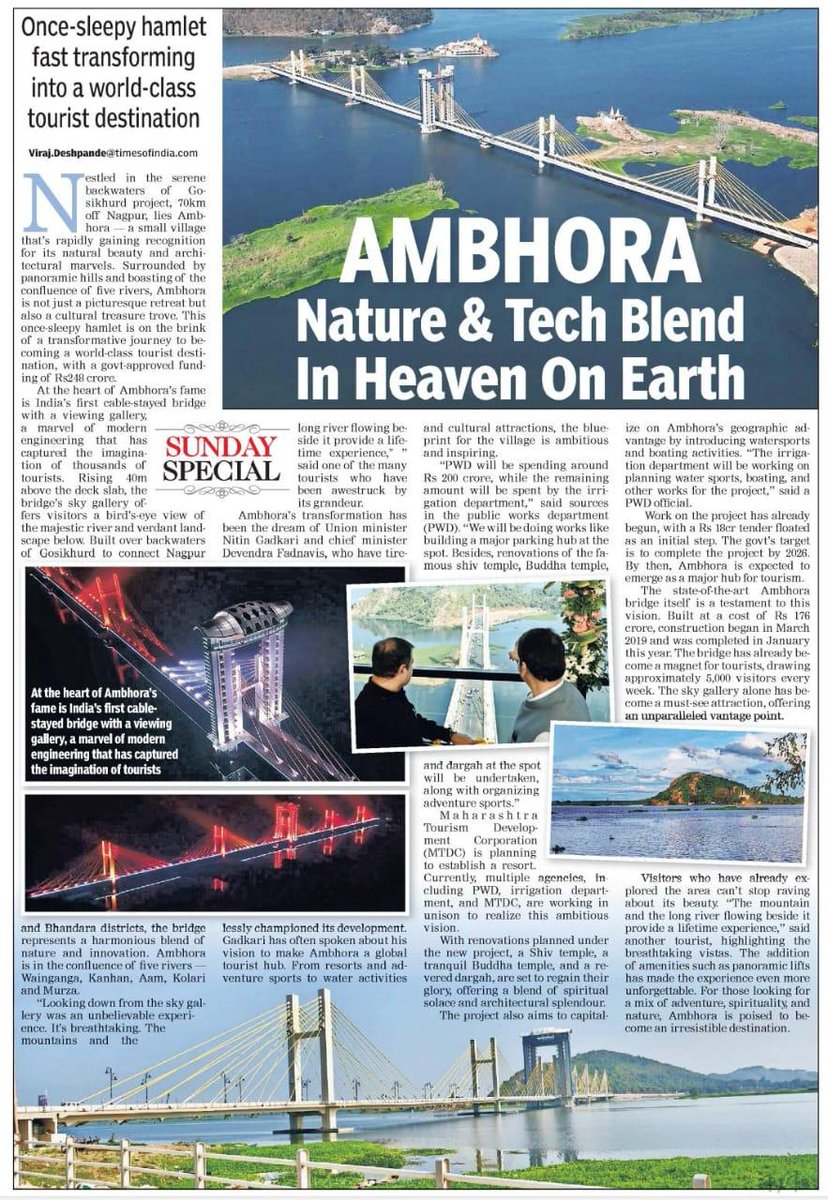
Experience heaven on Earth at Ambhora! 🌅
Ambhora : Where nature meets innovation in Maharashtra's backwaters.
Now all set to emerge as India's next big tourism marvel.
📍 Located: 70km from Nagpur
#IncredibleIndia
CROWN JEWEL
India's first cable-stayed bridge with a viewing gallery!
• Cost: Rs 178 crore
• Completed: January 2024
• Sky gallery: 40m above water
• Breathtaking panoramic views
• 5,000+ visitors weekly
NATURAL PARADISE
Nestled at the confluence of 5 rivers:
• Wainganga
• Kanhan
• Aam
• Kolari
• Marga
Surrounded by panoramic hills & serene backwaters of Gosikhurd project.
UPCOMING DEVELOPMENTS
Rs 200 crore sanctioned for:
• Marine parking hub
• Adventure sports facilities
• Water sports complex
• Boating activities
• Cultural preservation
SPIRITUAL & CULTURAL HERITAGE
Ongoing restoration projects:
• Ancient Shiv temple
• Famous Buddhist temple
• Historic dargah
Blending spirituality with modern tourism.
THE FUTURE
Vision 2025: Ambhora is set to become a complete tourism package offering:
• Adventure sports
• Spiritual tourism
• Cultural experiences
• Water activities
• Nature retreats









![drunkJournalist's tweet photo. Who is ManMohan Singh? Read this.
This man - who was introduced at the ASEAN Business Forum meeting as “the world’s most qualified Head of Government” - will be remembered by the History as one of the greatest son of India and perhaps the architect of Modern India.
WHENEVER he was asked for the secret of his professional success Manmohan Singh would say only one thing, “I am what I am because of my education.”
He has often thanked his family for ensuring that he went right up to college and then had opportunities to win many scholarships that finally helped him get a PhD from Oxford University.
Manmohan Singh was born into a family of modest means in the village of Gah in Pakistan. For the first 12 years of his life he lived there, a village which had no electricity, no school, no hospital, no piped drinking water.
He walked for miles every day to school and studied at night in the dim light of a kerosene lamp. When asked once why he had poor eyesight he confessed that it was because he had spent hours reading books in that dim light.
It was his hard work that enabled him to finish his schooling and attend college in Amritsar, where he lived after the Partition. He then won a scholarship to go to Cambridge University in England to do his Master’s in Economics. Another scholarship helped him complete his PhD.
He won the coveted Adam Smith Prize in Economics for his outstanding academic record. He always stood first and was a brilliant student.
For all his brilliance, he was a very shy boy. He once told Mark Tully, the famous BBC correspondent in India, that throughout his stay in Cambridge he used to bathe with cold water because the moment hot water was available in the hostel all the other students would come in to bathe and he felt shy to show them his long hair.
As the only Sikh student in the hostel he felt inhibited to remove his turban in front of others. It is this shy boy who became the darling of his teachers because he was such a good student.
He returned to India to teach at his college in Amritsar. One day, his neighbour, renowned writer Mulk Raj Anand, took him to meet Prime Minister Jawaharlal Nehru and Panditji asked him to join the government. But he had a commitment to teach at the college and so he could not accept that offer.
Later, when he was working at the United Nations under the famous economist Raul Prebisch, he got an offer to join Delhi School of Economics as a lecturer. He immediately accepted that invitation and decided to return to India. Dr. Prebisch was shocked. So many brilliant economists would be delighted to get a UN job and this young man was giving it up to teach in India? “You are being foolish,” Prebisch told Manmohan Singh, adding, “But, sometimes in life it is wise to be foolish!”
Manmohan Singh returned home first to teach and then to work in the Government.
He has held every important job in the field of economic policy making in India: Chief Economic Advisor to Government of India, Finance Secretary, Governor, Reserve Bank of India, Deputy Chairman, Planning Commission, Union Finance Minister and now Prime Minister!
In 1991, as India faced a severe economic crisis, newly elected Prime Minister P. V. Narasimha Rao surprisingly inducted the apolitical Singh into his cabinet as Finance Minister.
Over the next few years, despite strong opposition, he as a Finance Minister carried out several structural reforms that liberalised India's economy. These measures proved successful in averting the crisis, and enhanced Singh's reputation globally as a leading reform-minded economist.
In 1991, India's fiscal deficit was close to 8.5 per cent of the gross domestic product, the balance of payments deficit was huge and the current account deficit was close to 3.5 percent of India's GDP.[10] India's foreign reserves barely amounted to US$1 billion, enough to pay for a few weeks of imports, in comparison to US$283 billion today.](https://pbs.twimg.com/media/Gfvh20YbsAAPOGl.jpg)