Zaki and Martin were pushing llm product ideas in the davinci days, ridiculous foresight and technical vision. Way ahead of everyone else.
And Tilman’s truly a LS goat, and just delightful.
Very bullish, and happy they have got an investor of equal calibre!
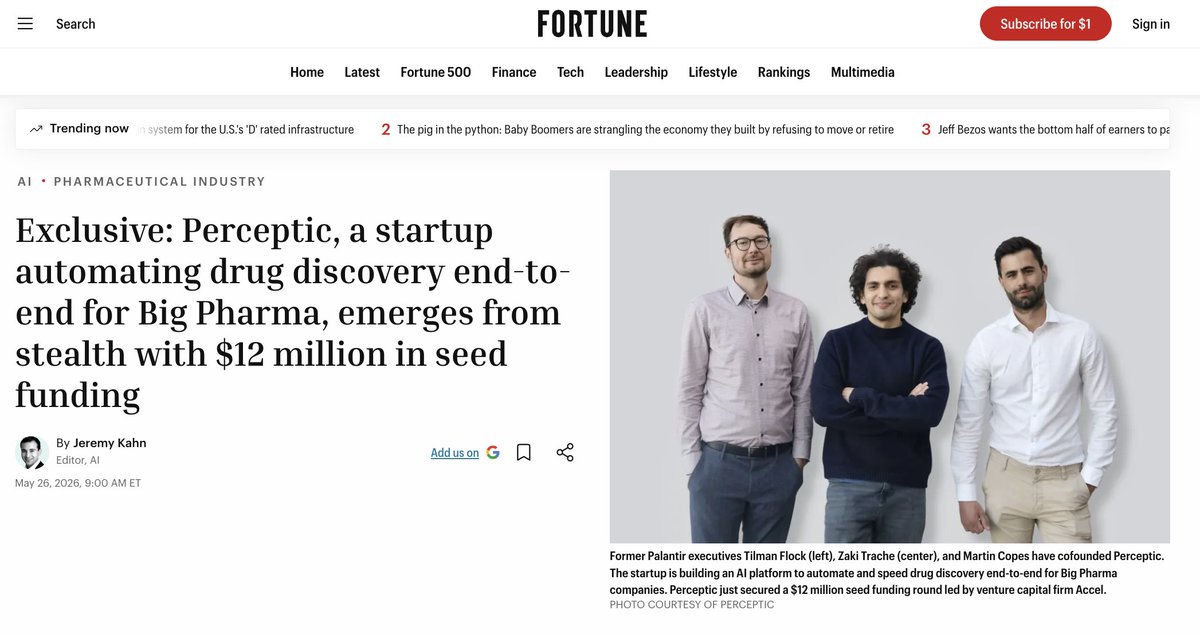
i'm excited to unveil a $12m round for @perceptictech, operationalizing frontier ai systems to transform biopharma from @airstreet@accel elder gull and angels from ai labs
@ashedwardst of fern labs (now @poolsideai) intro'd me to tilman (ceo) who was spinning up a newco in ai for science after his 7 year stint at palantir
since then, a) biopharma has materially revved up its appetite to transform itself from within with frontier ai systems and b) ai labs are pointing their attention to science too
now is the time to build a new ai-first software company to power the biopharma industry writ large
working with martin copes and zaki trache - of palantir aip lore - with whom i have way too many mutual pal friends, was the right crew to do this with
we're already live in top-20 pharma accounts speeding up a number of critical workflows with much more to come
more from me via @airstreetpress below
join us!
shimmer also runs entirely on your phone. An instant-on VM, with Poolside Agent in split screen and a full dev environment - pinch me
https://t.co/ds6LMCx653
Today we’re releasing Laguna XS.2, Poolside’s first open-weight model.
It’s a 33B total / 3B active MoE model built for agentic coding and long-horizon tasks.
Trained fully in-house on our own stack. Runs on a single GPU. Released under Apache 2.0.
Links 👇
Weights: https://t.co/HSo8L2gM64
API: https://t.co/DMJtNFrace
Blog: https://t.co/BXEjQxtQoV
Excited to share that @lmnrai has raised $3M to build open-source observability for long-running AI agents.
Laminar is how companies like @browser_use, @OpenHandsDev, and Rye see what their agents are doing, understand why they fail, and spot patterns across millions of runs.
Does it not allow people/funds who win to have more shots on goal
I.e win -> fail, presumably since it’s carried over you end up not paying/paying less cgt
So rewards investors who have a positive track record
Esp if you are large/make many bets that mostly fail, seems pretty good
A few random notes from claude coding quite a bit last few weeks.
Coding workflow. Given the latest lift in LLM coding capability, like many others I rapidly went from about 80% manual+autocomplete coding and 20% agents in November to 80% agent coding and 20% edits+touchups in December. i.e. I really am mostly programming in English now, a bit sheepishly telling the LLM what code to write... in words. It hurts the ego a bit but the power to operate over software in large "code actions" is just too net useful, especially once you adapt to it, configure it, learn to use it, and wrap your head around what it can and cannot do. This is easily the biggest change to my basic coding workflow in ~2 decades of programming and it happened over the course of a few weeks. I'd expect something similar to be happening to well into double digit percent of engineers out there, while the awareness of it in the general population feels well into low single digit percent.
IDEs/agent swarms/fallability. Both the "no need for IDE anymore" hype and the "agent swarm" hype is imo too much for right now. The models definitely still make mistakes and if you have any code you actually care about I would watch them like a hawk, in a nice large IDE on the side. The mistakes have changed a lot - they are not simple syntax errors anymore, they are subtle conceptual errors that a slightly sloppy, hasty junior dev might do. The most common category is that the models make wrong assumptions on your behalf and just run along with them without checking. They also don't manage their confusion, they don't seek clarifications, they don't surface inconsistencies, they don't present tradeoffs, they don't push back when they should, and they are still a little too sycophantic. Things get better in plan mode, but there is some need for a lightweight inline plan mode. They also really like to overcomplicate code and APIs, they bloat abstractions, they don't clean up dead code after themselves, etc. They will implement an inefficient, bloated, brittle construction over 1000 lines of code and it's up to you to be like "umm couldn't you just do this instead?" and they will be like "of course!" and immediately cut it down to 100 lines. They still sometimes change/remove comments and code they don't like or don't sufficiently understand as side effects, even if it is orthogonal to the task at hand. All of this happens despite a few simple attempts to fix it via instructions in CLAUDE . md. Despite all these issues, it is still a net huge improvement and it's very difficult to imagine going back to manual coding. TLDR everyone has their developing flow, my current is a small few CC sessions on the left in ghostty windows/tabs and an IDE on the right for viewing the code + manual edits.
Tenacity. It's so interesting to watch an agent relentlessly work at something. They never get tired, they never get demoralized, they just keep going and trying things where a person would have given up long ago to fight another day. It's a "feel the AGI" moment to watch it struggle with something for a long time just to come out victorious 30 minutes later. You realize that stamina is a core bottleneck to work and that with LLMs in hand it has been dramatically increased.
Speedups. It's not clear how to measure the "speedup" of LLM assistance. Certainly I feel net way faster at what I was going to do, but the main effect is that I do a lot more than I was going to do because 1) I can code up all kinds of things that just wouldn't have been worth coding before and 2) I can approach code that I couldn't work on before because of knowledge/skill issue. So certainly it's speedup, but it's possibly a lot more an expansion.
Leverage. LLMs are exceptionally good at looping until they meet specific goals and this is where most of the "feel the AGI" magic is to be found. Don't tell it what to do, give it success criteria and watch it go. Get it to write tests first and then pass them. Put it in the loop with a browser MCP. Write the naive algorithm that is very likely correct first, then ask it to optimize it while preserving correctness. Change your approach from imperative to declarative to get the agents looping longer and gain leverage.
Fun. I didn't anticipate that with agents programming feels *more* fun because a lot of the fill in the blanks drudgery is removed and what remains is the creative part. I also feel less blocked/stuck (which is not fun) and I experience a lot more courage because there's almost always a way to work hand in hand with it to make some positive progress. I have seen the opposite sentiment from other people too; LLM coding will split up engineers based on those who primarily liked coding and those who primarily liked building.
Atrophy. I've already noticed that I am slowly starting to atrophy my ability to write code manually. Generation (writing code) and discrimination (reading code) are different capabilities in the brain. Largely due to all the little mostly syntactic details involved in programming, you can review code just fine even if you struggle to write it.
Slopacolypse. I am bracing for 2026 as the year of the slopacolypse across all of github, substack, arxiv, X/instagram, and generally all digital media. We're also going to see a lot more AI hype productivity theater (is that even possible?), on the side of actual, real improvements.
Questions. A few of the questions on my mind:
- What happens to the "10X engineer" - the ratio of productivity between the mean and the max engineer? It's quite possible that this grows *a lot*.
- Armed with LLMs, do generalists increasingly outperform specialists? LLMs are a lot better at fill in the blanks (the micro) than grand strategy (the macro).
- What does LLM coding feel like in the future? Is it like playing StarCraft? Playing Factorio? Playing music?
- How much of society is bottlenecked by digital knowledge work?
TLDR Where does this leave us? LLM agent capabilities (Claude & Codex especially) have crossed some kind of threshold of coherence around December 2025 and caused a phase shift in software engineering and closely related. The intelligence part suddenly feels quite a bit ahead of all the rest of it - integrations (tools, knowledge), the necessity for new organizational workflows, processes, diffusion more generally. 2026 is going to be a high energy year as the industry metabolizes the new capability.
I find it outputs pretty poor svgs, but formats decks nicely. So use wispr flow to dictate to Claude chat for a few mins just live dumping what you want, that will give you the rougher structure, then I download and use Claude code for iterating on styling and stuff and add final logo tweaks and things manually
@inflammateomnia It literally outputs a pptx! Just ask it to make you a PowerPoint. Was also impressed. It behind the scenes writes html and then converts to pptx
@inflammateomnia Haha no like Claude chat (you can add pics of styles you want etc), sorry poorly communicated - yes Claude browser extension would be slow
The most-bought Tesco meal deal snack going from McCoys crisps the last two years to the boiled egg pot in 2024 couldn’t be a clearer sign that Britain is in the most rapid period of decline ever
TL;DR
Goalposts shifted
New surprise, core details of Pickle 1 revealed after pushback (I suspect these aren’t real)
No comment on Pickle’s company history and team’s lack of experience
—
I have a follow up article in the works with more information on Pickle’s history. Some of these things surprised me!
I suspect the “technical” details of Daniel’s response (particularly the power draw breakdowns) are preposterous, so I’ll be bringing in hardware engineers for deeper analysis.
Daniel also misconstrued my argument around FOV.
30+ degree FOV is possible as I said, just not on Pickle 1 (if it somehow exists).
Stay tuned!
very pleased to announce fern labs has been acquired by poolside!
now onto building the most ambitious large-scale multi-agent systems for some of the hardest problems out there.
thanks for backing fern from day zero @nathanbenaich, has been an absolute pleasure! 🫡
news! @poolsideai has acquired @fern_labs, in which @airstreet was the first and sole investor - and a first investor into poolside as well.
i met @ashedwardst in late 2024 before fern had a name or team. his technical depth, product taste and ambitious were 🔥
fern pushed long-horizon agents far beyond what public evals thought possible 👀
and by combining with poolside, we have a full-stack frontier ai company with the capabilities to delivery long-running, frontier multi-agent systems for complex enterprise and government workflows
thanks to @eisokant and @jasoncwarner for your continued partnership and for seeing what i saw in @ashedwardst@alexgoddijn and taylor at @fern_labs
more on the story below!
🪩The one and only @stateofai 2025 is live! 🪩
It’s been a monumental 12 months for AI. Our 8th annual report is the most comprehensive it's ever been, covering what you *need* to know about research, industry, politics, safety and our new usage data.
My highlight reel: