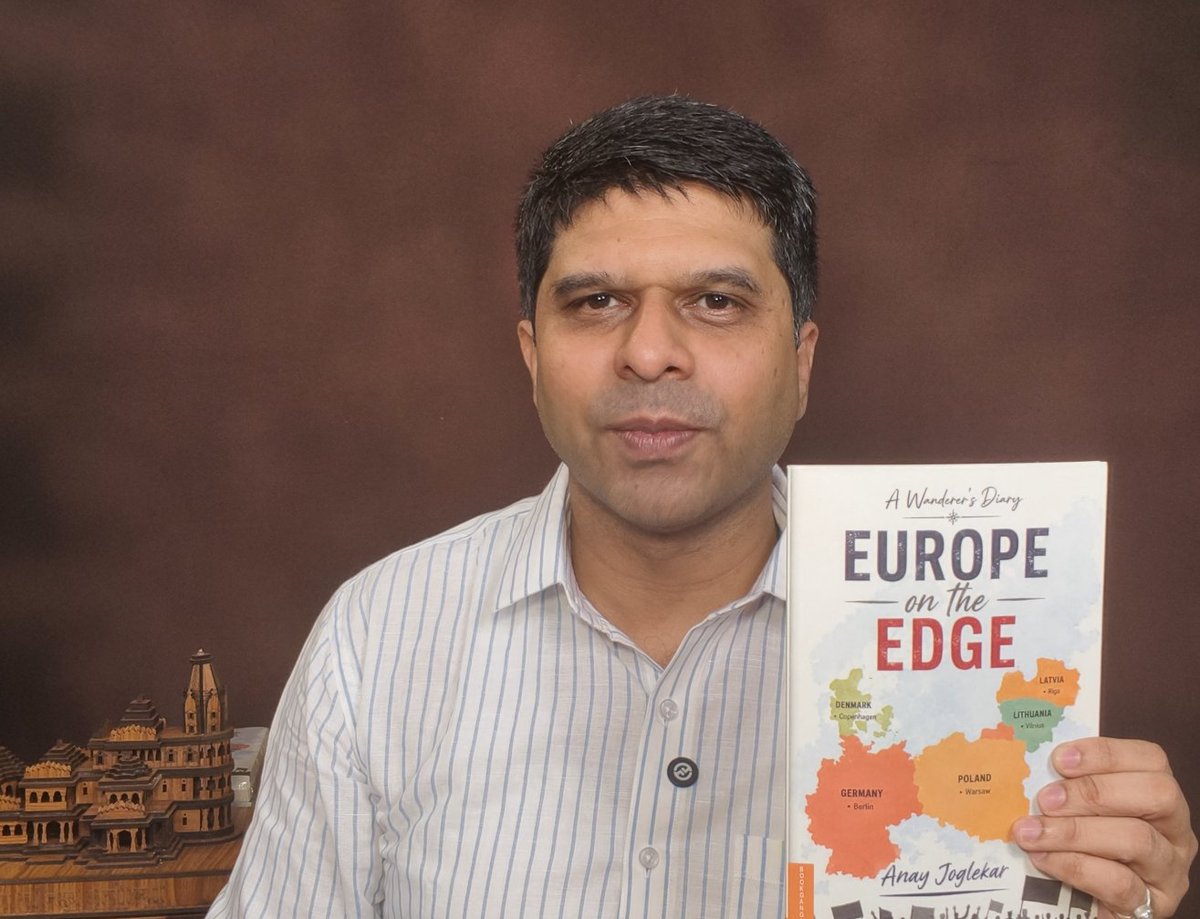
I am glad to announce that my book "EUROPE ON THE EDGE" is released. Exactly one year ago on 28th May, 2025 I started my two weeks journey to five European capitals... Warsaw, Berlin, Copenhagen, Riga and Vilnius.
You can buy this book at BookGanga Seva and Amazon on links below.
https://t.co/ikyo3dbNEA
https://t.co/Qy8aa7VZs1
Quite interesting thread on capabilities of real biological neurons (spoiler: they're way more capable than classical artificial neurons in a perceptron) . Nice work @IdoAizenbud and collaborators!
Speech translation has been one of the longest-running ML efforts at Google, and we’ve come a long way. Gemini 3.5 Live Translate is our latest speech-to-speech model, supporting 70+ languages. It enables more natural conversations across languages in everyday products and apps.
Here’s an example of how partners at @InsideGrab are helping connect travelers with drivers. 🚗
Rolling out in Google Translate and via the Live API in @GoogleAIStudio.
This is great to see. The scientific community & the general public should be in the habit of celebrating amazing scientific achievements with standing ovations 🎉
One of the new, buzzy jobs in Silicon Valley is the AI Forward Deployed Engineer (FDE), an engineer who is embedded within a client organization to help customize solutions, such as building and tuning agentic workflows that suit the client’s particular needs. I’ve heard from people who are wondering anew about the FDE career path since OpenAI and Anthropic started building new teams to place FDEs within client organizations.
The rise of FDEs for AI workloads is one way AI is creating new jobs (and why the jobpolcalypse narrative of upcoming job market collapse is false -- there will be many AI and non-AI jobs). However, I believe there will be far more AI Engineer jobs than FDEs, as I explain below.
The FDE role was pioneered about two decades ago by Palantir, which sent engineers to government locations to work on secure, air-gapped networks. In addition to having good technical skills, FDEs need communication skills and sometimes business skills. For example, they may need to speak with clients to understand their needs, formulate a strategy to prioritize projects, explain complex technology, and respectfully push back if a client asks for something unrealistic. They’re enjoying a resurgence because of the amount of work involved in taking an off-the-shelf LLM and building it into a custom agentic workflow that fits particular business needs.
However, I believe the number of AI Engineer jobs will be far larger. A company might accept a few FDEs to be embedded within its organization. But most companies will want far more of their own employees working on their projects. While my organizations do hire FDEs, we hire far more AI Engineers! Also, a common client concern is that it is hard to find vendor-neutral FDEs — they are, after all, there to deeply integrate a particular vendor’s product into a company. In this moment when it’s hard to predict which AI service will be the best one in a year’s time, optionality (the ability to pick whatever vendor turns out to fit best in the future) is very valuable. In contrast, letting FDEs tightly bind a company’s processes significantly reduces optionality.
Right now, I see surging demand for AI Engineers who can build software applications using AI software components (like LLM prompting, agentic frameworks, evals, etc.) and effectively use AI coding agents (like Claude Code, Codex, Antigravity CLI, and OpenCode). As the AI Engineer role matures, I expect it to fragment into more specialized roles, like the generic Software Engineer role from decades ago fragmented into frontend, backend, mobile, data engineering, devops, and so on.
What will be the future, specialized AI engineering roles? I don’t know. Perhaps there will be AI FDEs, LLMOps Engineers, Evals Engineers, AI Data Engineers, Harness Engineers, and other roles we don’t have names for yet. But for now, I see a lot of AI engineers who are generalists create a lot of value. Skilled AI Engineers are in very high demand! As our field continues to mature over the coming decade, I look forward to new specializations within AI Engineering that create even more job opportunities.
[Original text: The Batch newsletter]
It was a matter of pride to present #Civit, India's first AI powered digital approval twin for building permissions developed by @mybmc for trust based governance.
Mrs Ashwini Bhide, BMC Commissioner making presentation on AI-Powered Bu... https://t.co/q3D387qBuJ via @YouTube
My MLSys keynote on AI writing systems code got more interest than I expected. The recording will take a while, so in the finest tradition of AI labs sharing blog posts, we’re starting the Core Automation Blog with this one https://t.co/h4uSOyrglf
#Monsoon2026 has advanced further today 15th May, to cover entire #AndamanNicobar islands including #SriVijayaPuram (a full week ahead of schedule!), remaining #AndamanSea, most of southeast BoB and some parts of SW BoB.
Conditions becoming favourable for further advance of SW Monsoon over more parts of SW Bay and parts of #Comorin sea and south #SriLanka in next 48 hrs.
AI to accelerate science? Hot topic today, but when did machine learning first discover results worth publishing in a scientific journal? Hear from the person who did it - Stanford’s Bruce Buchanan in the 1970’s. Today’s new podcast episode. https://t.co/TSrk1Z1KiP
Michael I. Jordan on the new MLST.
Four things:
> AGI is a PR term. It confuses young people.
> Discourse is bipolar, either alarmist or exuberant, this is in his words "so demoralizing" for 20- and 25-year-old researchers.
> ML's methods came from statistics and operations research, NOT the AI tradition.
> Data markets are Stackelberg games, not optimisation problems. A lot of ML researchers have never computed an equilibrium.
Michael I. Jordan is a no-nonsense original gangster of the field and was described by Science magazine, back in 2016 as the most influential living computer scientist.
Beautiful day at #GoogleIO packed full of Gemini announcements, with my Gemini team colleagues @OriolVinyalsML and @borgeaud_s!
Take a sip of water every time you hear "Gemini"!
Your path to an IIT Madras degree no longer depends on age, location, or a JEE score.
Applications are now open for the IIT Madras BS Degree Programmes for the 2026 academic cycle.
Open to anyone who has completed Class 12, the programmes are designed to make high-quality IIT education accessible to learners from all backgrounds.
Programmes offered:
* BS in Data Science and Applications
* BS in Electronic Systems
* BS in Management and Data Science
* BS in Aeronautics and Space Technology
🗓️ Deadline: 31st May 2026
🔗 Apply at: https://t.co/FPPEL8m1ed
Built for flexibility, the programmes can be pursued as a standalone degree or alongside a regular college programme. Learners can study at their own pace, attend in-person exams across India, and choose pathways ranging from Certification and Diploma to a full Degree.
With thousands of learners already enrolled nationwide, the IIT Madras BS Degree Programmes continue to expand access to industry-relevant, future-ready education, with fee support of up to 75% for eligible students.
@iitmadras@iitm_bs
#IITMadras #BSDegree #FutureReadySkills #OnlineLearning
Dear @NandanNilekani You initiated a huge technology based revolution in India by starting with a strong "foundation" (aadhar), why not with AI? Once again, I respectfully, but strongly, disagree. India should be aiming to do both. Otherwise, it won't be a true leader.
The video of my conversation with Amin Vahdat, @gilbert, and @djrosent at Cloud Next last week is now up.
https://t.co/81ZpUuUDQE
Thanks for a great conversation!
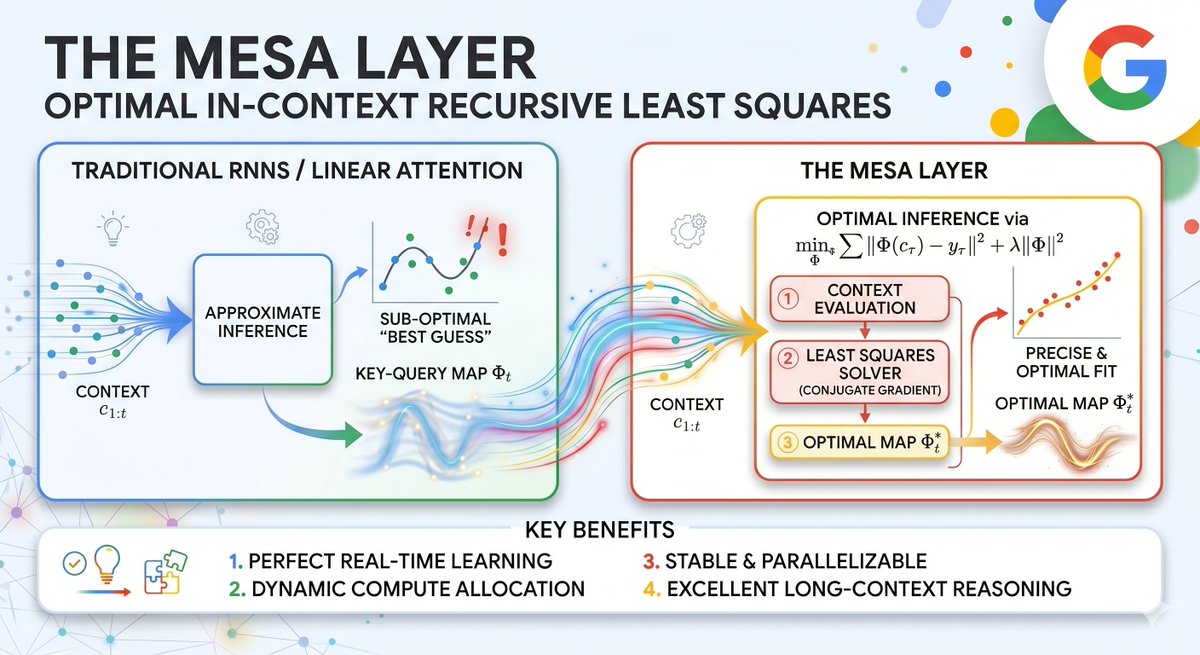
Google presents a new Transformer alternative at #ICLR2026! Join Nino Scherrer & Yanick Schimpf at the Google booth (#411) at 10AM to learn about MesaNet, proposing a new linear sequence layer that optimally learns in-context given a fixed memory budget.




![AndrewYNg's tweet photo. One of the new, buzzy jobs in Silicon Valley is the AI Forward Deployed Engineer (FDE), an engineer who is embedded within a client organization to help customize solutions, such as building and tuning agentic workflows that suit the client’s particular needs. I’ve heard from people who are wondering anew about the FDE career path since OpenAI and Anthropic started building new teams to place FDEs within client organizations.
The rise of FDEs for AI workloads is one way AI is creating new jobs (and why the jobpolcalypse narrative of upcoming job market collapse is false -- there will be many AI and non-AI jobs). However, I believe there will be far more AI Engineer jobs than FDEs, as I explain below.
The FDE role was pioneered about two decades ago by Palantir, which sent engineers to government locations to work on secure, air-gapped networks. In addition to having good technical skills, FDEs need communication skills and sometimes business skills. For example, they may need to speak with clients to understand their needs, formulate a strategy to prioritize projects, explain complex technology, and respectfully push back if a client asks for something unrealistic. They’re enjoying a resurgence because of the amount of work involved in taking an off-the-shelf LLM and building it into a custom agentic workflow that fits particular business needs.
However, I believe the number of AI Engineer jobs will be far larger. A company might accept a few FDEs to be embedded within its organization. But most companies will want far more of their own employees working on their projects. While my organizations do hire FDEs, we hire far more AI Engineers! Also, a common client concern is that it is hard to find vendor-neutral FDEs — they are, after all, there to deeply integrate a particular vendor’s product into a company. In this moment when it’s hard to predict which AI service will be the best one in a year’s time, optionality (the ability to pick whatever vendor turns out to fit best in the future) is very valuable. In contrast, letting FDEs tightly bind a company’s processes significantly reduces optionality.
Right now, I see surging demand for AI Engineers who can build software applications using AI software components (like LLM prompting, agentic frameworks, evals, etc.) and effectively use AI coding agents (like Claude Code, Codex, Antigravity CLI, and OpenCode). As the AI Engineer role matures, I expect it to fragment into more specialized roles, like the generic Software Engineer role from decades ago fragmented into frontend, backend, mobile, data engineering, devops, and so on.
What will be the future, specialized AI engineering roles? I don’t know. Perhaps there will be AI FDEs, LLMOps Engineers, Evals Engineers, AI Data Engineers, Harness Engineers, and other roles we don’t have names for yet. But for now, I see a lot of AI engineers who are generalists create a lot of value. Skilled AI Engineers are in very high demand! As our field continues to mature over the coming decade, I look forward to new specializations within AI Engineering that create even more job opportunities.
[Original text: The Batch newsletter]](https://pbs.twimg.com/media/HJvWmCHagAAnTxQ.jpg)