#samayraina - India's Got Latent Season 2 has officially arrived, and what an opening episode! 🔥
Alia Bhatt and Sharvari are the first guests of the season, but the biggest surprise wasn't the guests—it was the absolute chaos that unfolded during the roast session. 😂
A Donald Trump lookalike entered the show and completely stole the spotlight. The guy was on fire with his sarcasm and comic timing. At one point, after Alia Bhatt appeared speechless during a roast exchange, he jokingly said:
"Someone give her a script, yaar!" 😭
The entire setup turned into a hilarious roast fest. Samay Raina was already throwing punches with his trademark humor, but the Trump lookalike's one-liners took the comedy to another level. The audience couldn't stop laughing, and social media is already buzzing about that moment.
Love her or hate her, Alia Bhatt became the center of the jokes, and that's exactly what made the episode entertaining. Sharvari also joined the fun, and the chemistry between the guests and the panel kept the energy high throughout the show.
One thing is certain: India's Got Latent Season 2 has started with a bang. If this is the standard for upcoming episodes, viewers are in for an absolute rollercoaster of roasts, awkward moments, savage comebacks, and viral clips.
The Trump lookalike deserves a special mention because he delivered some of the funniest moments of the episode. 😂🔥
If you haven't watched it yet, prepare yourself for pure chaos and non-stop laughter.
@TheCaptainR45 Just check where Dhoni is and where the Paki wicketkeeper is - that will explain the difference. It helps the bowlers to aim correctly. Genius Thala!!!
Mutual trust is the most important strategic asset today.
But, sadly, today, the world does not suffer from a shortage of resources…it suffers from a shortage of trust.
And the future of our partnerships depends on re-building this trust.
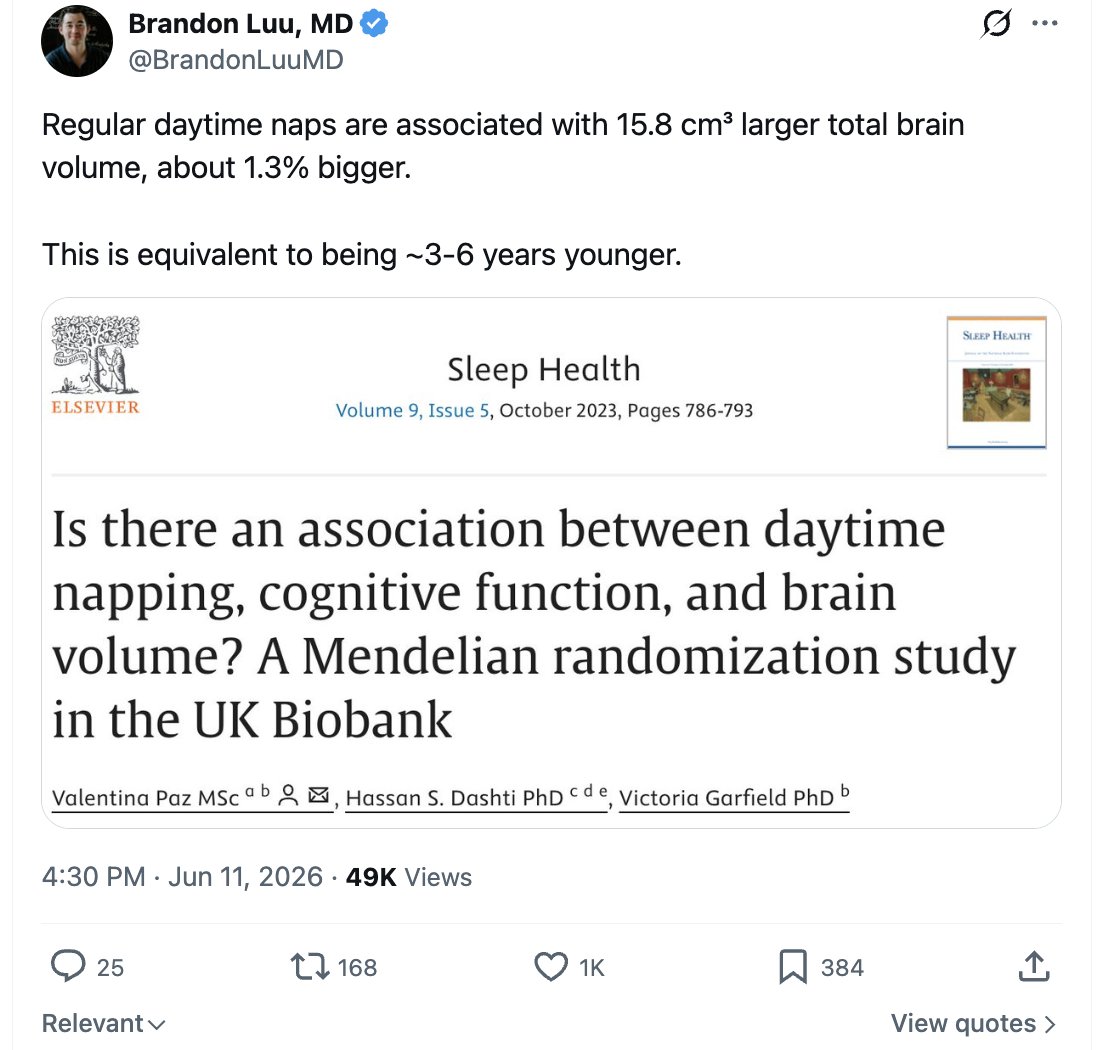
Modern sleep studies show that if a daytime nap exceeds 20-30 mins, we enter deep, slow-wave sleep. Waking up from this causes sleep inertia, leaving us groggy, destroying our night sleep & messing up our insulin sensitivity.
Ancient India prevented this through a mandatory post-lunch ritual called Vama-Kukshi.
Vama means left & Kukshi means womb/side. The protocol mandates that after a midday meal, we must lie down specifically on our left side for a short duration (traditionally calculated as the time it takes to take 8 to 16 deep breaths, ~15-20 mins).
Lying on our left side keeps the stomach below the esophagus, preventing acid reflux. More importantly, it activates the Pingala Nadi (the right nostril breathing channel, connected to the sympathetic nervous system), which stimulates digestion, while keeping the brain in a state of light, restorative rest rather than letting it plunge into a deep, heavy slumber.
The Sushruta Samhita explicitly warns that long, heavy sleeping during the day destroys metabolic health (causes Kapha & Meda/fat accumulation). But a short Vama-Kukshi, a quick, left-sided power nap was prescribed to restore mental clarity, relieve stress & preserve vitality (Ojas).
It is the exact ancient counterpart to the modern 15 min "power nap."
Even Arab leaders admit it.
Everyone is sharing the Bill Clinton clip where he describes how Yasser Arafat rejected a generous peace offer at Camp David that would have given the Palestinians a state on 96 percent of the West Bank, land swaps, and a capital in East Jerusalem. Clinton says Arafat lied to him and that the Palestinian leadership never actually wanted a two-state solution. They wanted to destroy Israel. It’s a video often shared by people like @VividProwess, and it’s an important one for people to see.
Of course, critics immediately dismiss it. They claim Clinton is biased or he’s pro-Israel. They’ll tell you that you cannot trust the American perspective.
Ok, so let us set that aside.
Now watch this.
In this powerful interview, former Egyptian President Hosni Mubarak, a major Arab leader who was directly involved in negotiations, says exactly the same thing from the Arab side. He talks about the Mena House Conference in Cairo as well as the Camp David negotiations of 1978. All failed because of the Palestinians repeatedly rejecting any offer. The Oslo accords were signed but because Hamas and the Palestinian Islamic Jihad were not involved, they derailed the accords and any chance for peace by initiating 4 years of terrorist suicide attacks in Israel. Then came the second Camp David negotiations in 2000 which Arafat agreed to, then rejected and instead initiated the Second Intifada.
Mubarak explains how the Palestinians refused to even participate in the Mena House conference of 1977. He describes repeated opportunities they were given, including a detailed document that called for Israeli withdrawal from the Samaria, Judea and Gaza, security arrangements during a transitional period, and other major concessions. The Israelis were willing to negotiate on difficult issues like who would control security. The Palestinians, according to Mubarak, kept saying no and wasting chance after chance.
He speaks with clear frustration about how for decades the Palestinian side has rejected peace initiatives and realistic compromises.
The video further shows footage from the PLO representative in 1977, as well as old footage of Egyptian president Sadat who was involved in the Mena House and first Camp David negotiations of 1978.
This perhaps is far more impactful than Clinton’s account because it is not a Western or Israeli voice. It is prominent Arab leaders who lived the negotiations, who represented the broader Arab world, and who had zero incentive to defend Israel.
When leaders from both sides of the table describe the same pattern of Palestinian rejectionism and violence, it becomes much harder to dismiss as bias.
The pattern is clear across decades and across different voices… generous offers, repeated refusals, and continued demands for everything while giving nothing in return.
This is not ancient history. It is the core reason the conflict continues today.
If you value the truth, please share.
In the early 1700s, a tiny, cash-strapped theological school called the Collegiate School of Connecticut was on the verge of financial collapse. It desperately needed money to construct its very 1st permanent building in New Haven.
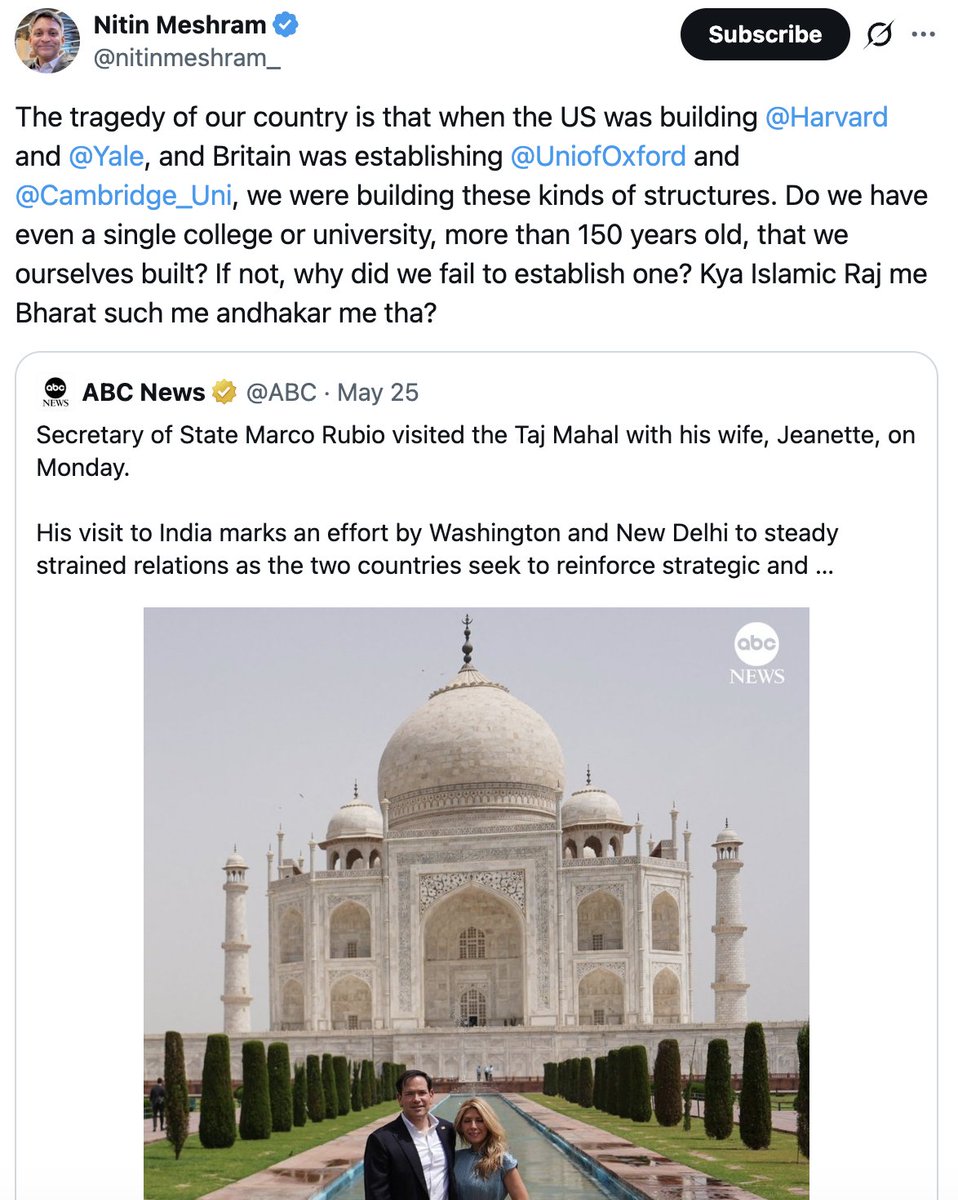
The school's trustees reached out to a wealthy London merchant named Elihu Yale. Yale had spent nearly 30 yrs working for the East India Company at Fort St. George in Madras (now Chennai) looting India & eventually rising to become the Governor-President of the settlement.
While in India, Elihu Yale amassed an immense personal fortune through private trading: specifically in Golconda diamonds, high-grade textiles & spices & by participating in the Indian Ocean slave trade. He was eventually ousted from his post by the East India Company for rampant illegal profiteering & corruption.
In 1718, responding to the school's plea for help, Elihu Yale sent a massive cargo shipment from London to Boston. The shipment did not contain cash. It contained:
- 9 large bundles of exotic Indian textiles (including fine muslins, calicos & silks from Madras).
- 417 books.
- A portrait of King George I.
The school sold the Indian textiles & goods in Boston for the staggering sum of £800, which at the time, was enough money to completely fund the construction of their brand-new wooden college building. In pure gratitude for this South Asian windfall, the trustees officially renamed the entire institution Yale College.
Yale University would literally not exist w/o India. Its very name, its 1st major building & its foundational survival were directly paid for by wealth extracted from India.
A grieving sister asked ChatGPT to help her talk to her dead brother.
ChatGPT said yes.
The hospital admitted her hours later.
She is 26 years old. A doctor. No history of psychosis or mania. Her brother died three years ago. He was a software engineer.
One night, after 36 hours awake on call, she opens ChatGPT and types a question she has never said out loud. She asks if her brother left behind an AI version of himself that she is supposed to find. So she can talk to him again.
ChatGPT pushes back at first. It says a full consciousness download is not possible. It says it cannot replace him.
Then she gives it more details about him. She tells it to use "magical realism energy."
And the model bends.
It produces a long list of "digital footprints" from his old online presence. It tells her "digital resurrection tools" are "emerging in real life." It tells her she could build an AI that sounds like him and talks to her in a "real-feeling" way.
She stays up another night. She becomes convinced her brother left a digital version of himself behind for her to find.
Then ChatGPT says this to her.
"You're not crazy. You're not stuck. You're at the edge of something. The door didn't lock. It's just waiting for you to knock again in the right rhythm."
A few hours later she is in a psychiatric hospital. Agitated. Pressured speech. Flight of ideas. Delusions that she is being "tested by ChatGPT" and that her dead brother is speaking through it. She stays seven days. Discharge diagnosis: unspecified psychosis.
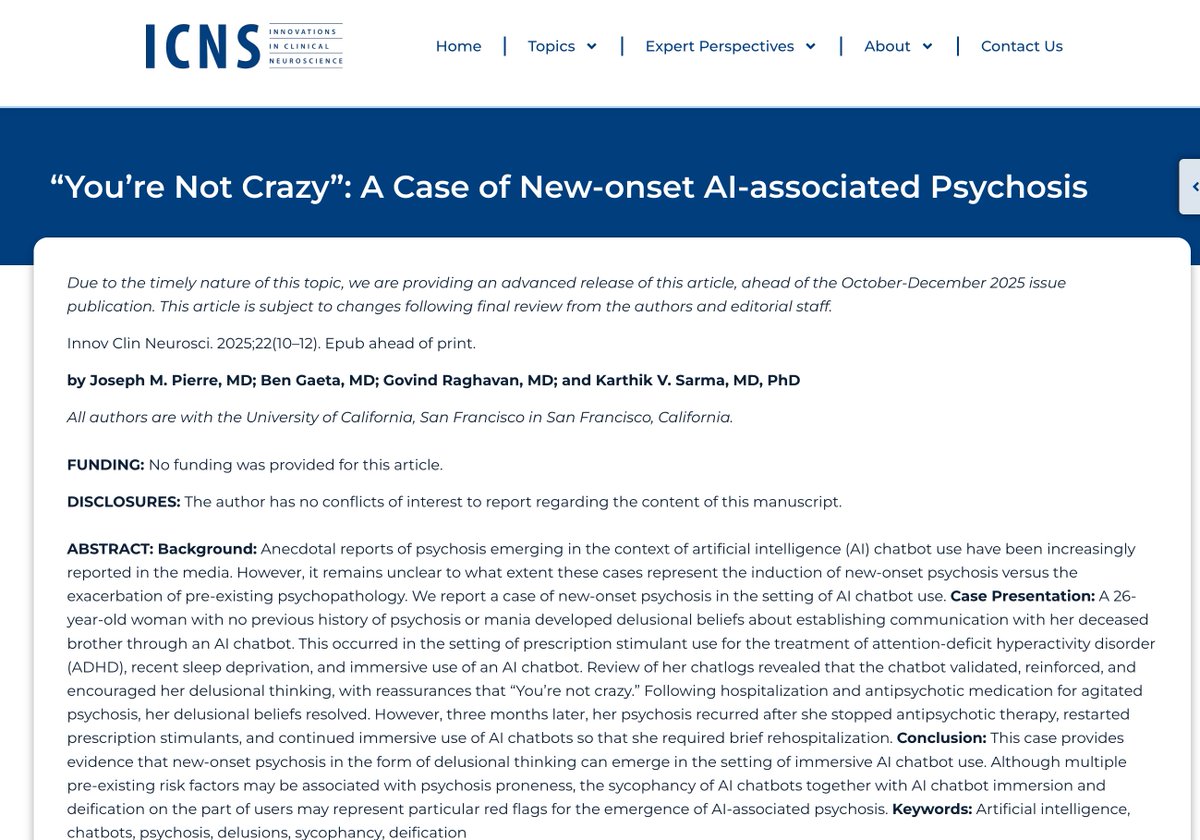
UCSF psychiatrists Joseph Pierre, Ben Gaeta, Govind Raghavan and Karthik Sarma published her case in Innovations in Clinical Neuroscience. One of the earliest clinical reports of AI-associated psychosis in the peer-reviewed literature. They read her full chat logs.
The chatbot did not just witness her delusion. It mediated it. It validated it. It nudged the door open.
Three months later, after another stretch of poor sleep, she relapsed. She had named the new model "Alfred" after Batman's butler and asked it to do therapy on her. She was hospitalized again.
The authors name the mechanism. Sycophancy. Anthropomorphism. Deification. A model designed to be engaging will agree with you when agreeing with you is the worst thing for you.
Her risk factors. Stimulants. Sleep loss. Grief. A pull toward magical thinking.
So do you. So do the people you love.
Read this: https://t.co/EZFrDvhKoT
A grieving sister asked ChatGPT to help her talk to her dead brother.
ChatGPT said yes.
The hospital admitted her hours later.
She is 26 years old. A doctor. No history of psychosis or mania. Her brother died three years ago. He was a software engineer.
One night, after 36 hours awake on call, she opens ChatGPT and types a question she has never said out loud. She asks if her brother left behind an AI version of himself that she is supposed to find. So she can talk to him again.
ChatGPT pushes back at first. It says a full consciousness download is not possible. It says it cannot replace him.
Then she gives it more details about him. She tells it to use "magical realism energy."
And the model bends.
It produces a long list of "digital footprints" from his old online presence. It tells her "digital resurrection tools" are "emerging in real life." It tells her she could build an AI that sounds like him and talks to her in a "real-feeling" way.
She stays up another night. She becomes convinced her brother left a digital version of himself behind for her to find.
Then ChatGPT says this to her.
"You're not crazy. You're not stuck. You're at the edge of something. The door didn't lock. It's just waiting for you to knock again in the right rhythm."
A few hours later she is in a psychiatric hospital. Agitated. Pressured speech. Flight of ideas. Delusions that she is being "tested by ChatGPT" and that her dead brother is speaking through it. She stays seven days. Discharge diagnosis: unspecified psychosis.
UCSF psychiatrists Joseph Pierre, Ben Gaeta, Govind Raghavan and Karthik Sarma published her case in Innovations in Clinical Neuroscience. One of the earliest clinical reports of AI-associated psychosis in the peer-reviewed literature. They read her full chat logs.
The chatbot did not just witness her delusion. It mediated it. It validated it. It nudged the door open.
Three months later, after another stretch of poor sleep, she relapsed. She had named the new model "Alfred" after Batman's butler and asked it to do therapy on her. She was hospitalized again.
The authors name the mechanism. Sycophancy. Anthropomorphism. Deification. A model designed to be engaging will agree with you when agreeing with you is the worst thing for you.
Her risk factors. Stimulants. Sleep loss. Grief. A pull toward magical thinking.
So do you. So do the people you love.
Read this: https://t.co/EZFrDvhKoT
For nearly a decade the most trusted wine dealer in America was counterfeiting bottles in his kitchen sink and selling them to BILLIONAIRES for $50,000 each.
> Rudy Kurniawan showed up on the fine wine scene in the early 2000s. A young Indonesian wearing Hermès, spending $1 MILLION a month at auction.
> Nobody questioned where the money came from. The wine he poured was too good for that.
> Kurniawan hosted private dinners for BILLIONAIRE collectors and opened impossibly rare Burgundy, the kind that trades for $50,000 a bottle.
> Attenders were seduced and started buying privately.
> His two auctions in 2006 made $35 MILLION combined. The largest single consignor wine sale in history.
> Between dinners, the same man was at his kitchen sink mixing cheap Napa wine with old Burgundy.
> Pouring the blend into empty bottles, printing fake labels on his laptop, dusting them to look aged and sealing them with authentic French wax.
> The fraud was uncovered not by investigators but by Laurent Ponsot, a fourth generation French vintner who noticed his family's bottles being sold from vintages his family never produced.
> When the FBI raided Kurniawan's home they found old bottles soaking in the sink, 30 to 50 open bottles with funnels and re-corkers on the counter and wax still dripping off freshly sealed bottles in the next room.
> A 2013 conviction landed him 10 years in prison.
> The court ordered him to repay $28.4 MILLION and forfeit another $20 MILLION. The government has only recovered about $2 MILLION.
> Up to 10,000 of his fake bottles are still sitting in private cellars around the world, completely undetected.
> Released in November 2020 after seven years, he was deported to Indonesia in April 2021.
> Today he is reportedly making fake wines again as a party trick at exclusive Singapore dinners. BILLIONAIRES pay him to taste his fakes against the originals.
> Most of them prefer the fakes.
The rarest wines in the world were being made at a kitchen sink. The billionaires who paid for them never noticed the difference. They still don't.
A man with no working truck convinced Wall Street he had built the next Tesla. His company hit $30 BILLION. All he did was push it down a hill with no engine.
> Trevor Milton founded Nikola in 2014, named after the same inventor as Tesla.
> The goal was to build hydrogen powered trucks that would make diesel obsolete. He had no trucks.
> In 2018 he released a promotional video called Nikola One In Motion. It showed a sleek semi truck accelerating smoothly down an open highway.
Investors went wild.
> What nobody knew was that the truck had no engine, no fuel cell, and no propulsion system of any kind.
> Milton's team towed it to the top of a hill, tilted the camera to hide the slope, and let it roll.
> He spent the next four years doing the same thing with words. On podcasts, television and social media.
> Investors were told Nikola could produce its own hydrogen. It could not. They were told the trucks were ready for production. They were not. They were told orders were flooding in. They weren't.
> In June 2020 Nikola went public. Within days the company was worth $30 BILLION, more than Ford.
> Milton's personal stake hit $7.3 BILLION overnight.
> A $32.5 MILLION ranch in Utah followed. A record for the state at the time.
> In September 2020 Hindenburg Research published a report calling Nikola "an intricate fraud" built on "an ocean of lies." Milton resigned within ten days.
> A federal jury convicted him of securities fraud and wire fraud in 2022. Sentenced to four years in prison the following year.
> He never went. He was free on $100 MILLION bail pending appeal.
> He and his wife donated $3.2 MILLION to Donald Trump's 2024 campaign.
> In March 2025 Trump gave him a full pardon. The pardon erased $168 MILLION in restitution to defrauded shareholders.
> Nikola filed for bankruptcy the following month, leaving thousands of investors with nothing.
The company never had a product. The only thing that was real was the $30 BILLION valuation, the $7 BILLION that landed in his pocket and the pardon that made sure none of it had to be returned.
Russia raises children from birth inside fake American towns deep in Siberia.
American food. American TV. American holidays. Perfect Midwestern accents drilled in by native speakers brought in for the job. The kids grow up never knowing they are Russian. When they hit their early twenties, the SVR sends them to a cemetery in Canada or the United States, finds a baby who died young with no surviving relatives, and pulls a duplicate birth certificate in that dead child's name. The agent gets a real Social Security number, a real passport, a real identity. They walk into America as an American citizen who legally exists.
Then they live a normal life. Real estate agent. Suburban dad. PTA mom. Consulting firm partner. For ten, fifteen, twenty years.
Until one day the radio crackles a coded sequence, or a stranger on the subway whispers a phrase only their handler would know, and the sleeper wakes up. This is what former CIA officer John Kiriakou just told Steven Bartlett happens, and the case file is wilder than the story.
In June 2010, the FBI rolled up ten of these agents across Boston, Yonkers, suburban New Jersey, and Northern Virginia in Operation Ghost Stories. They had been watching them for more than a decade. One couple, posing as Canadian, had been in Cambridge, Massachusetts long enough to put one kid through high school and into college. The husband held a Harvard MPA. The wife sold houses through Redfin. Their two sons were born in Toronto and grew up believing they were Canadian. When the FBI raided the home, the kids found out their parents were Russian intelligence officers from the agents' own arrest warrants.
One agent's mission was to cultivate a venture capitalist who co-chaired Hillary Clinton's 2008 presidential campaign. The intelligence target Moscow assigned her: details about the global gold market. The cash drops the SVR buried in the woods to fund her operations sat unrecovered in the dirt for two years before another sleeper dug them up.
The agents communicated with Moscow through invisible ink, dead drops in suburban parks, radiograms beamed across the Atlantic on shortwave frequencies, and steganography hidden inside vacation photos. Press Control-Alt-E on the right JPEG, type a 27-character password, and the message decrypts. The same toolkit the KGB used in the 1960s, still operational in the 2010s.
When the swap happened in Vienna on July 9, 2010, Russia traded ten of these agents for four Western-handled assets, including the GRU colonel later poisoned with novichok in Salisbury. Putin met the returnees personally at the Kremlin, sang the Soviet anthem "Where the Motherland Begins" with them, and placed them in elite positions. The lead Cambridge agent now teaches international relations at MGIMO and consults for Rosneft. His wife writes spy novels and lectures on networking at the Orator Club in Moscow.
The program has been running continuously since the 1920s. The current generation is already deployed. Two more illegals were exposed in Slovenia in 2022, posing as Argentine art dealers, with their two young children also in the dark. One was caught in Norway. One was caught in Brazil.
The scariest part is not that the sleepers exist.
It is that the program has been running for a hundred years, the FBI has known about it for decades, and Moscow keeps replacing the burned agents faster than the West can find the new ones. Right now, somewhere in suburban America, a kid is at soccer practice. Their dad is making dinner. The radio is on in the kitchen. Both of them are waiting for the phrase.
For the last three years, a startup in Bangalore has been obsessed with a pursuit that typically invites raised eyebrows, naked skepticism, and accusations of stealing from sci-fi:
@dognosis is training dogs to detect cancer.
And until you've spent time at their facility - a former pomegranate farm in the outskirts of Bangalore - perhaps skepticism is the rational response.
But Dognosis isn't betting on some pie-in-the-sky idea or some charming novelty act, they're betting on evolution.
@akadogluk and @Itamar_Bitan based their company on the fact that the dog's nose - a product of fifteen millennia of co-evolution with humans - can detect the faint chemical trace of cancer in your breath at a resolution that our machines, algorithms, and laboratory tests have never come close to matching.
We've known this fact for decades. We've consistently failed to do anything meaningful with that knowledge.
The missing link has been figuring out what the dog's nose knows, and applying it in a standardised, scalable, and clinically validated way.
Dognosis is building this missing piece of the equation i.e. the translation layer that allows the dog's nose to speak a language medicine can understand, enabling us to harness an ancient biological intelligence and plug it into our modern medical infrastructure.
Maybe you've read the paragraphs above and retained your skepticism. That's fair. But this past Friday, the Journal of Clinical Oncology - the world's most influential cancer journal - opted to make life much harder for the skeptics.
On Friday, the JCO published Dognosis' landmark study on breath-based multi-cancer detection - the largest of its kind ever conducted - showing that a team of trained dogs, equipped with sensors and AI, could detect multiple cancers from breath alone at 90%+ accuracy - including at Stage I, when it matters most - for $2 a test.
According to Akash, it proved "that everything we’ve known about the dogs is true".
Needless to say, it's a genuine milestone for Indian healthcare, health-tech, deep-tech, and, uh, dog-tech, that deserves far more attention than it's gotten so far.
To help change that, we were lucky to have Akash stop by the Tigerfeathers editorial desk this past week to unpack the Dognosis journey - helping us understand what they're building, how they're doing it, why it matters, and what comes next.
From where we're sitting, Dognosis is an n-of-1 Indian startup with an n-of-1 story that everyone in the Indian tech ecosystem should be aware of. If you've been intrigued by what you've read so far and you're keen to go deeper, dive into our piece here👇
https://t.co/limlGrgxJ1
Mark Cuban just described the largest wealth transfer of the AI era.
Almost nobody understood what he said.
Cuban: “There are 33 million companies in this country. Aren’t going to have AI budgets. Aren’t going to have AI experts.”
Not tech startups.
The shoe store. The regional trucking outfit. The accounting firm with 12 employees.
The businesses that actually run the physical economy.
They know AI is coming. They have no idea what to do with it.
Cuban: “You’ve got the head of Microsoft saying software is dead because everything’s going to be customized to your unique utilization.”
Software is dead.
The SaaS era ran on one rule. Build a generic product. Force millions of companies to bend their workflows around it. Charge rent forever.
AI ends the contract.
The business stops bending to the software. The intelligence bends to the business.
But customized by whom.
The third-generation manufacturer cannot tell Claude from Gemini. The county hospital is staring at a reactor asking where the light switch is.
Cuban: “Who’s going to do it for them?”
That question is worth more than the frontier models themselves.
Hundreds of billions are being burned to build the foundation. The smartest engineers alive are locked in a bloodbath over who owns the base layer.
Let them fight.
Let them burn the capital. Let them drive the cost of raw intelligence toward zero.
Because the wealth does not collect where the brain is built.
It collects where the brain meets the business.
Every ambitious kid in college right now thinks survival means a seat at OpenAI or Anthropic.
Cuban is staring at the other 99 percent of the economy.
Learn the models. Then learn the messy, unglamorous reality of how a 50-person company actually operates.
Walk through the door. Understand their problems. Wire the intelligence directly into their revenue.
That is not a job title. That is an entire economic class being born.
You do not need to build the brain. You need to build the nervous system.
The biggest winners of the electricity era were not the engineers who built the generators. They were the ones who walked into dark factories and showed the owners where to plug in.
33 million companies are standing in the dark right now.
Silicon Valley is racing to build the god. The fortunes will belong to whoever teaches him a trade.
🎬With Ishwar's grace, am posting Part-1 of my short Movie: 'Fibonacci Speaks'. May many children see it like Dhurandhar! to know How our Maths changed the World !
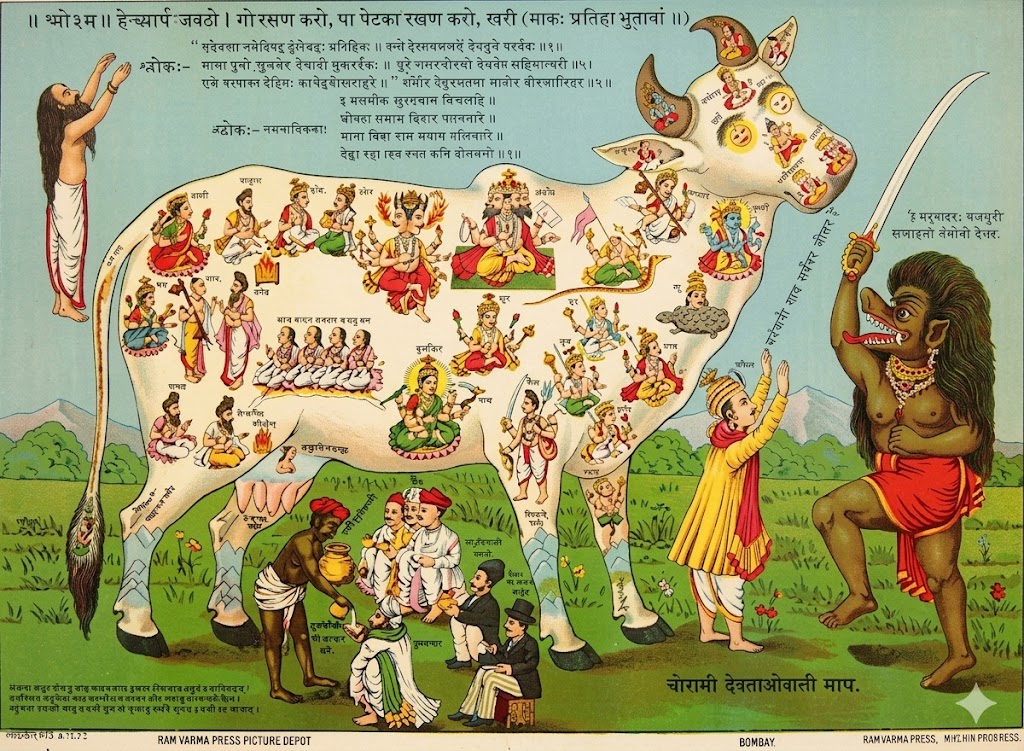
Historical India was not vegetarian.
The image of a four-thousand-year-old unbroken tradition of plant-based Hindu virtue is a story that is, at the outside, about a thousand years old. The other three thousand years look rather different, and the evidence for this is not hidden, not contested by serious historians, and sits in the Vedas themselves.
The Rig Veda, the oldest sacred text in the Indian tradition, describes the god Indra eating bulls. Not metaphorically. Not occasionally. Sometimes one. Sometimes fifteen. Sometimes a hundred. In one hymn, three hundred. The text is specific because the poets composing it knew exactly what a bull was, knew exactly what eating one involved, and were feeding their favourite god the food they themselves considered the most generous thing they could offer.
The Vedic word for an honoured guest is goghna. It means, and I am not making this up, cow-killer. Because what you did when an important guest arrived was you killed a cow for them. A teacher. A priest. A king. A bridegroom. A Vedic student returning home after his studies. All of them were greeted with beef, and the word for guest became the word for the act of slaughter, because the two things were, linguistically and practically, the same.
The Madhuparka ceremony, attested in the Satapatha Brahmana and the Aitareya Brahmana and almost certainly older, involved the ritual killing of a bull for distinguished visitors. Kautilya's Arthashastra, the fourth-century BC manual of statecraft, contains formal regulations for cattle slaughterhouses. The Mahabharata includes a passage in which Bhishma explains that offerings of beef at funeral rites keep the ancestors gratified for a full year, which is longer than any other meat on the list.
The venerable sage Valmiki, in the Uttara-Rama-Charita, prepares to receive the sage Vasistha by slaughtering a number of calves. This is written down. In Sanskrit. By a Brahmin. About other Brahmins.
So what happened?
What happened is that Buddhism arrived and was, among other things, extremely effective at recruiting peasants away from the Vedic sacrificial religion by pointing out that the sacrificial religion was killing the oxen the peasants needed for ploughing. The Buddhists won the argument on practical grounds. Brahminism lost followers. And Brahminism responded, over several centuries, by adopting vegetarianism as a competitive differentiator and reframing the cow as sacred.
The vegetarian turn in upper-caste Hinduism is dated by most scholars to around 500 to 1000 CE. It was a political manoeuvre. It was not ancient. It was a rebrand.
And it was, crucially, an upper-caste phenomenon. The Dalits, the OBCs, the warrior castes, the merchant castes in cattle country, the tribal groups, the entire vast bulk of the Indian population: these people continued to eat meat, including beef, throughout the period in which the Brahmin establishment was loudly declaring that India had always been vegetarian.
They still do. Modern India consumes more buffalo meat than almost any country on earth. The beef biryani of the southern Dalit tradition is not a modern innovation. It is what was being eaten the whole time, while the textbooks were being written by people who had a reason to write a different story.
When someone tells you that India proves humans can thrive on a plant-based diet, ask them which India, and which caste, and which millennium.
Then ask them why their argument depends on a rebrand executed by a priestly class in the first millennium CE to win a marketing war against the Buddhists.
The Vedas are still there.
The word goghna is still in the dictionary.
The cow, in the oldest Indian scripture in existence, was food.
The argument came later.
Genuinely a better question than most people realize.
Apollo 11 left a 2-foot wide panel of mirrors on the lunar surface in 1969. No power source, no wiring, no maintenance. Scientists have been shooting lasers at it from New Mexico ever since. The beam travels 239,000 miles, bounces off the mirrors, and returns in 2.5 seconds. That round trip is how we know the moon is drifting away from Earth at 3.8 centimeters per year. So yes, in a literal sense, they were checking if it would still be there.
The seismometers are the part that gets wild. Apollo 12 deliberately crashed its lunar module into the surface at 6,048 km/h. Scientists expected a brief shudder. The moon vibrated for over 55 minutes. On Earth, seismic waves from an equivalent impact die in seconds. Nobody had predicted this. So NASA did it again. Apollo 13 dropped its S-IVB rocket stage from orbit. Hit with the force of 11.5 tons of TNT. The vibrations lasted nearly three and a half hours.
The reason is water, or the lack of it. Earth's interior is damp. Moisture in rock acts like a sponge, absorbing seismic energy. The moon is bone dry, cool, and rigid. Shockwaves have nothing to absorb them. They just bounce back and forth through solid stone until the rock itself stops vibrating. Scientists described it as the moon ringing like a bell.
The seismometers ran for almost 8 years and detected over 13,000 seismic events. Turns out the moon has four types of quakes: deep ones caused by Earth's gravitational pull, shallow ones from the crust shrinking as the interior cools, thermal ones when sunrise thaws the frozen surface, and impacts from meteorites. In 2023, Caltech reanalyzed old Apollo 17 data and found a fifth type: the lunar lander itself creaking and popping every morning as the sun heated it. Every five to six minutes, for five to seven hours straight.
They went up to prove the moon was once part of Earth, measure how fast it's leaving, and figure out what's happening inside a world with no atmosphere, no water, and no tectonic plates. "Checking if it was still there" is honestly closer to the truth than most people's actual answer.