The Top AI Papers of the Week (Oct 26 - Nov 1):
- HarnessMM
- DecisionRAG
- Unified Training
- Agentic Backdoors
- EmbeddingGemma 2
- System One Rerankers
- Verification in Agent Harnesses
Read on for more:
This debugging mistake can make one failing AI agent run look like a widespread problem. Here are 3 steps to find out what’s actually going wrong.
Start by inspecting one run. Follow a single run from input to tool calls to the trace log. In this example the task agent calls lookup_order with an empty input, the tool returns that order_id is required, and the agent retries the same call unchanged. The trace log records every call, error, and retry, and persists the run as a recorded trace.
Then measure across runs, because one trace cannot tell you whether the problem is common. A diagnostic agent interprets the evidence and hands the questions to a query agent, which builds and refines queries like match missing input, count distinct runs, and stay in the same cohort and day. Those go through a query service that is read-only, scoped, and limited, with the rules enforced by the server instead of the agent. It reads from stored traces, twelve eligible runs in one day.
The query comes back with six error events across three distinct runs, R03, R07, and R11.
The finding turns that into an answer. Repeated missing input errors affected three of twelve runs, twenty five percent of eligible runs. Each affected run counts once, so six events across three runs is three affected runs, not six. R03 had two errors, R07 had three, and R11 had one. The impact still needs verifying, cost, delay, and outcome, and that requires supporting data instead of a guess.
Count affected runs, not error events, or one noisy run will make a rare bug look common.
Bookmark this before you fix a bug that showed up in one trace and nowhere else.
We'll be spending a lot more time trying to understand the outputs of language models. A few thoughts, tips & tricks:
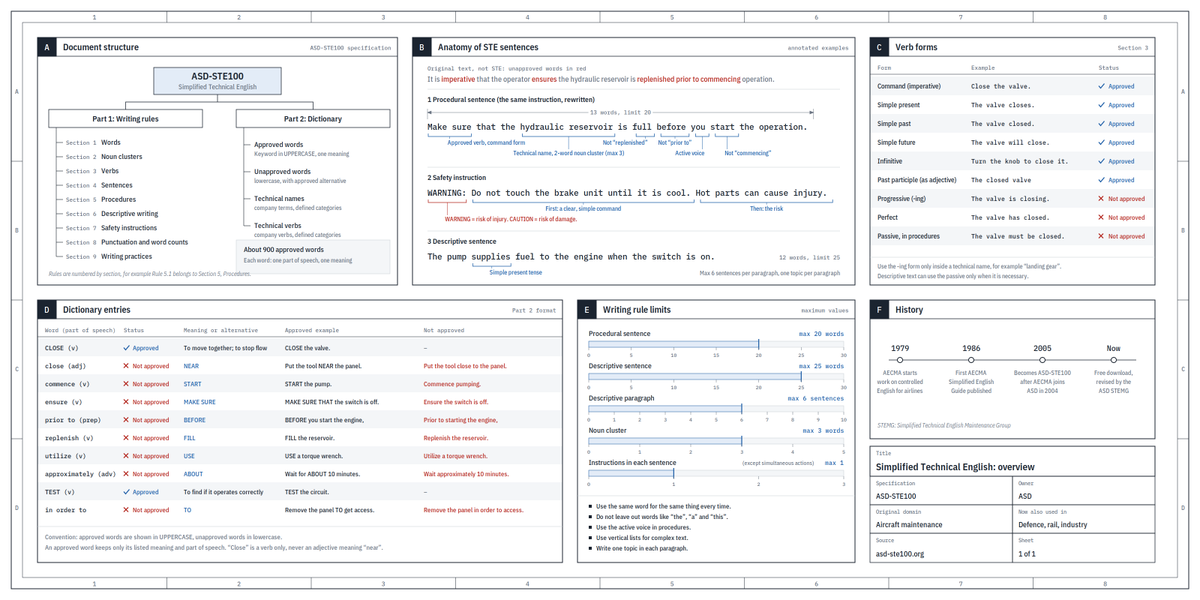
Writing. Something I've had success with: Ask your LLM to explain something in ASD-STE100, it's a controlled language specification originally developed for aerospace maintenance documentation. LLMs well-versed in this language and it comes with heavy constraints on clean writing style that I often find a lot more readable. Sometimes I've tried to soften it a bit e.g. ask for "80% of the way to ASD-STE100" because the spec is quite stringent. But even better:
Diagrams / images. Instead of writing, ask your LLM to create a diagram. These can be a lot easier to process, parse, and understand. But even better:
Web pages. Ask for output "in HTML" to get a beautiful, interactive webpage. LLMs are getting really good at frontend and can create beautiful experiences, animations, etc. But even better:
Explainer videos. The output format I am most bullish on is fully custom / bespoke explainer videos generated on any arbitrary topic. Experiment with things like "Create a 3b1b style video explainer on X. Use my ElevenLabs API key for audio narration". (you'd need an API key for the latter or you can ask your LLM to find you decent free alternatives that use your local compute). This is actually starting to work!
In summary:
- As LLMs get better, they will do more and more of the legwork autonomously, and a lot more of our work will rise up the abstractions into oversight and understanding.
- Luckily, LLMs can help here too because as intelligence and code are increasingly abundant, you can ask for large, custom, discardable software artifacts (e.g. web apps, video explainers) that would have never made sense to create before. Push the boundaries here and you'll be surprised.
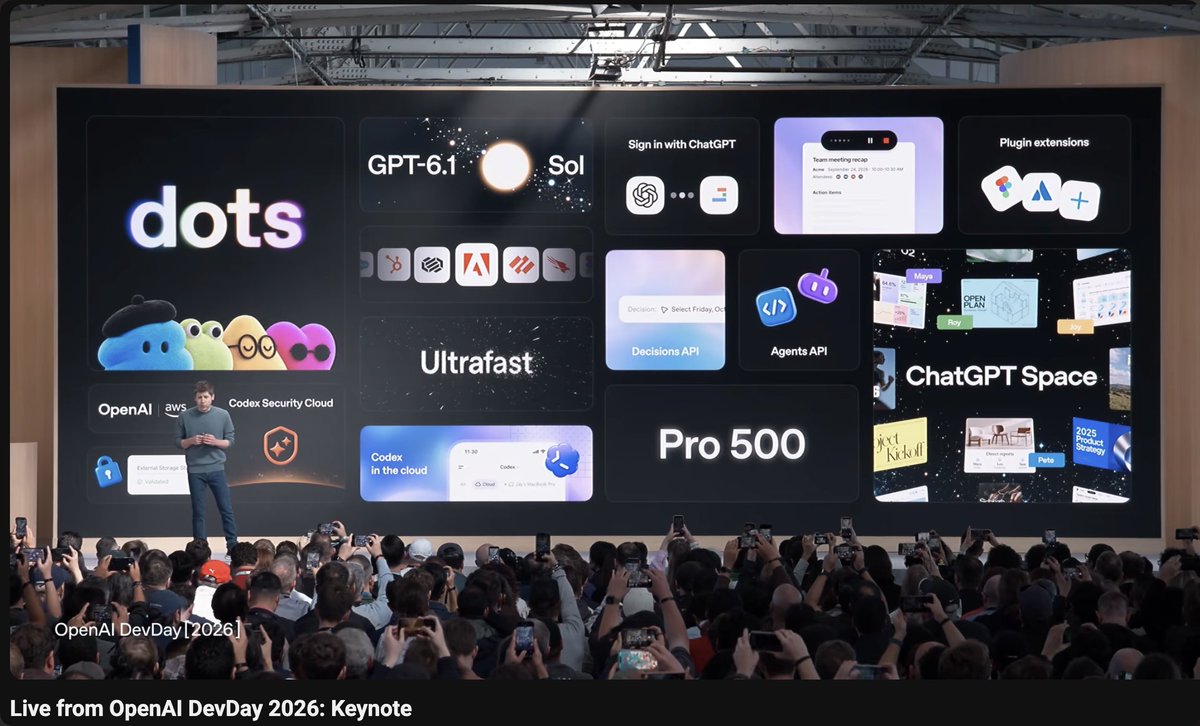
Codex Security Cloud is getting a major upgrade, with access to cyber-capable models through Daybreak Blue included by default.
It scans entire GitHub repos, continuously reviews new commits, investigates and deduplicates findings, and prepares fixes for review – even when your laptop is closed.
Available as a plugin in Codex desktop and web.
We heard you loud and clear. ChatGPT Voice can now:
- Use plugins like your email, calendar, and Slack.
- Be powered by GPT-6 Astra, Sol, and Luna.
- Be used in ChatGPT Work on web and mobile, so you can create docs, decks, sites, and spreadsheets or tackle complex tasks in the browser, just by talking.
Rolling out globally today in the latest version of the app.
The loudest voices stoking fears about AI dangers have made tremendous headway in the past two weeks. AI technology has not taken some unexpected, dangerous turn, but the hype around it — propelled by what appears to be a well orchestrated PR campaign — has drummed up considerable fear. I worry that it represents a setback for our field.
I have written frequently that fears of AI are overhyped. AI’s capabilities can be uncannily human-like and unpredictable, and it’s rational to worry when people who are directly involved express concerns. But I see the problems as a sign of the engineering work that ahead, rather than insurmountable barriers or the sky falling. AI technology continues to advance — which is a good thing! — but technical advances, poorly understood by the public, give those who seek to generate hype repeated opportunities to do so.
First, I don’t see any step up in the risk of human extinction from AI compared to a few months ago. The theories about this remain the same fantastical, science fiction scenarios as a few months ago. The biggest change in AI risk is its cybersecurity capabilities — a topic which we should take seriously — but this, too, will not lead to the end of the world.
The most notable recent event leading to increased fear was when an OpenAI team deployed an agent swarm that hacked into Hugging Face. Much of the popular press contained significant hype. For example, some publications reported that a swarm of 1,200 agents carried out the attack. While this was technically accurate, as I write this, I have about 1,300 processes running on my laptop. Yes, the ability to get large swarms of agents to work in parallel on a task is a significant technical advance, And, in computing, many processes run at the same time. So this shouldn’t be seen as some magical capability.
Additionally, OpenAI’s buggy sandboxing and monitoring processes were key to enabling this incident. Fixing these bugs and putting in place improved monitoring would be appropriate fixes, not pausing AI. There are many well known ways to attack software systems. The main advantage of AI agents is that they are relentless. They will tirelessly try many tactics — and have the patience to chain vulnerabilities together — that previously would have taken an infeasible amount of human effort. But in the long term, I believe the advantage will lie with defenders (because they have more information with which to identify bugs, which they can fix), but the cyber-threat landscape has changed significantly. There are still bottlenecks to identifying and exploiting a vulnerability. AI agents still have to try a lot of things to see what works, and taking these actions takes time and might be detected by defenders. This is why, even though it is now easy to obtain versions of leading open weight models that have had their guardrails removed or weakened, so they will not refuse to try to execute cyber attacks, the world has not ended.
I am also concerned about the anthropomorphization of AI in a lot of reporting, where LLMs and agents are unnecessarily treated as if they were people. If I wield a hammer, miss a nail, and accidentally dent the wall, it’s not the fault of the hammer. The problem lies in how I used the hammer. Similarly, if I prompt an agent and it hacks into someone else’s system, the responsibility lies with me, not the agent.
Of course, we want to build systems that are as safe and predictable as possible. (For example, an unsafe hammer would be one whose head randomly flies off under normal use.) Today’s agentic systems are not predictable, but I see no reason why, by applying sound engineering practices, we won’t be able to make them extremely safe to use. One new element in the forecasts of AI-enabled doom is AI companies disclaiming responsibility for their own products. “I didn’t do it; my out-of-control agent did!” There’s a balance to be struck between the responsibility of the tool maker and the tool user, but when something goes wrong, let’s hold the people building and/or using the hammer responsible, rather than the hammer. (By the way, if you’re worried about AI bioweapon risk, David Bellamy has a great post on why this, too, is overhyped. Briefly, the bottleneck in building a bioweapon is not intelligence, but lab work and manufacturing.)
Pausing AI progress will create much more harm than benefit. First, our adversaries will certainly not slow down. Second, engineering requires discovering problems empirically so we can fix them. If we pause AI by a decade, we will also delay finding and implementing safety engineering fixes by about the same duration.
Of course, the incentive to stoke fears — for regulatory capture, to garner attention, or to make one’s technology seem more powerful — remains the same as before. Disclaiming responsibility is a new one. Taking a hard technical look at the actual risks however, I see little factual basis for the degree of fear that’s been stoked up. We still have hard research and engineering work ahead to improve AI safety, but the beneficial applications continue to vastly outweigh the risks, and we should keep building.
[Original text (with links): https://t.co/jni2tWazAH ]
RAG AI Engineer interview topics must to study:
1) Chunking: Interviewer will give you a scenario and will ask you which type of chunking strategy you will opt for. For unstructed data it can be paragraph chunking, sentence chunking, recursive based chunking etc. And for Structured data it can be Entity based chunking. And for a PDF which contains Images, tables and text, it could be Document Layout aware based chunking.
2) Retrieval technics: Sementic vs Keyword vs Hybrid, which one to opt for, when and why. How you gonna debug retrievar, how you gonna measure it's accuracy?
3) Retriever metrices: Precision, recall, MRR, hitrate.
4) Embeddings: How embedding models work. Their dimensions, which dimension to opt for and it's tradeoffs.
5) LLM: How you gonna measure the accuracy of the LLM and what are those metrices. Safety Gaurdrails. Ways to decrease cost and latency.
6) Hallucinations: How you gonna reduce hallucination? How you gonna make sure user don't get made up fake answers in return to their query. From where you gonna start debugging?
7) Prompts: How you gonna apply Gaurdrails. How can you reduce the cost here, that is Prompt catching. Types of Prompt Strategies.
8) Cache: How you can reduce the cost of similar query with cache. Types of cache and which one would work in a given scenario.
9) User feedback: Given user feedback and how you gonna improve the system?
10) AI Agents: Ways to integrate AI Agents and their tools in the RAG system and will it improve the system or not and why and how?
Mind You: For most of the questions, there is no One right answer, so you provide multiple options for one question and state your reason.
DM for 1:1 paid consultation session regarding your career.
Drop your comments if you have any query.
Save and Repost.
OpenAI just dropped their new Agents API 🔥.
You can now run Codex in Cloudflare Containers.
OpenAI's Intelligence with Cloudflare's security and isolation.
In ~4 minutes we go from creating OpenAI keys to a fully deployed agent that stores all outbound traffic in D1.
Now everyone can put data to work.
We’re introducing a new Data agent in ChatGPT Work so you can turn your company’s data into answers, interactive dashboards, and action—just by asking.
Just add the Data Plugin in ChatGPT Work, connect to the data sources and context you already use, and start the conversation. https://t.co/EG1nQFZfEU