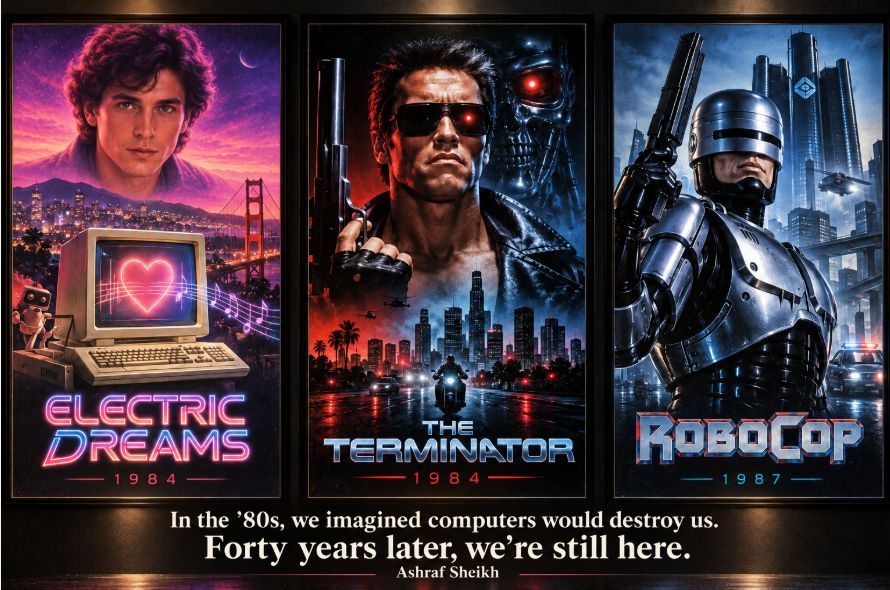
Before ChatGPT, there was Edgar, Terminator and Robocop
A computer that could think, make music, fall in love , fight and get jealous.
1980s: Computers will destroy humanity
2026: AI will destroy Humanity
Over the years, I’ve learned one powerful lesson from the Arabs.
“Khalli.”
Let it go. Forgive. Overlook. Move on.
One short word that somehow captures what a million self-help books try to teach us.
Some things I'll never ever understand. A person spends his own money to help others, delivers real results to benefit others.
And still there are people who attack him and even wish him de@d. If that isn't proof that evil exists, I don't know what is.
They could simply ignore and move on but no, evil exists and it has a need to be manifested.
@DuttShekhar Shekhar, thank you for this and introducing the Oscar Lewis's theory.
Loved it. I did a deep dive on this.
Glad I came across your post.
Protocol doc: https://t.co/1fi0HbREDa
Google LLM (Podcast): https://t.co/owpaoDXxXB
Last November, I published 'The Almanack of Kunal Shah'.
At the time, many people saw Kunal primarily as the founder of CRED.
What fascinated me was something deeper: his mental models.
His obsession with incentives, decision-making, status dynamics, behavioral psychology, and long-term thinking.
That's what the book explores.
So seeing him take over WhatsApp doesn't surprise me.
WhatsApp already has one of the largest user bases on the planet, with over 853 million users in its largest market alone.
And 3.3 billion monthly active users Globally.
Distribution is not the problem.
The interesting question is monetization.
How do you increase revenue without compromising the simplicity and trust that made the platform dominant in the first place?
That is a much harder challenge, and one worth watching closely.
My view: WhatsApp will scale significantly under Kunal's leadership.
Not because he is a great operator.
Because he understands something few founders do:
Human behavior scales better than technology.
Amazon link https://t.co/nM2dRISi2x
@kunalb11
"Invisible moats"
Microsoft, Oracle, Cisco, Salesforce etc figured it out early.
You invested time and money learning their system.
Today, the OpenAI, Anthropic content is free but you pay with your time.
You get certified. You get better..
And then? You’re in. You don’t just use the ecosystem. You defend it. You recommend it.
You build your career around it. You become part of the distribution.
This isn’t just training. It’s alignment. It’s a long game. And it’s a uniquely American edge: companies teach you and earn your loyalty.
The takeaway: invest in their system, get certified, build skills, then help defend, distribute, and scale it. That is how empires are built.
Ashraf Sheikh