“Do philosophers really think differently than non-philosophers?” A team of researchers focusing on neurodivergent traits and responses to thought experiments offers a partial answer...
https://t.co/g2ShXbP5M8
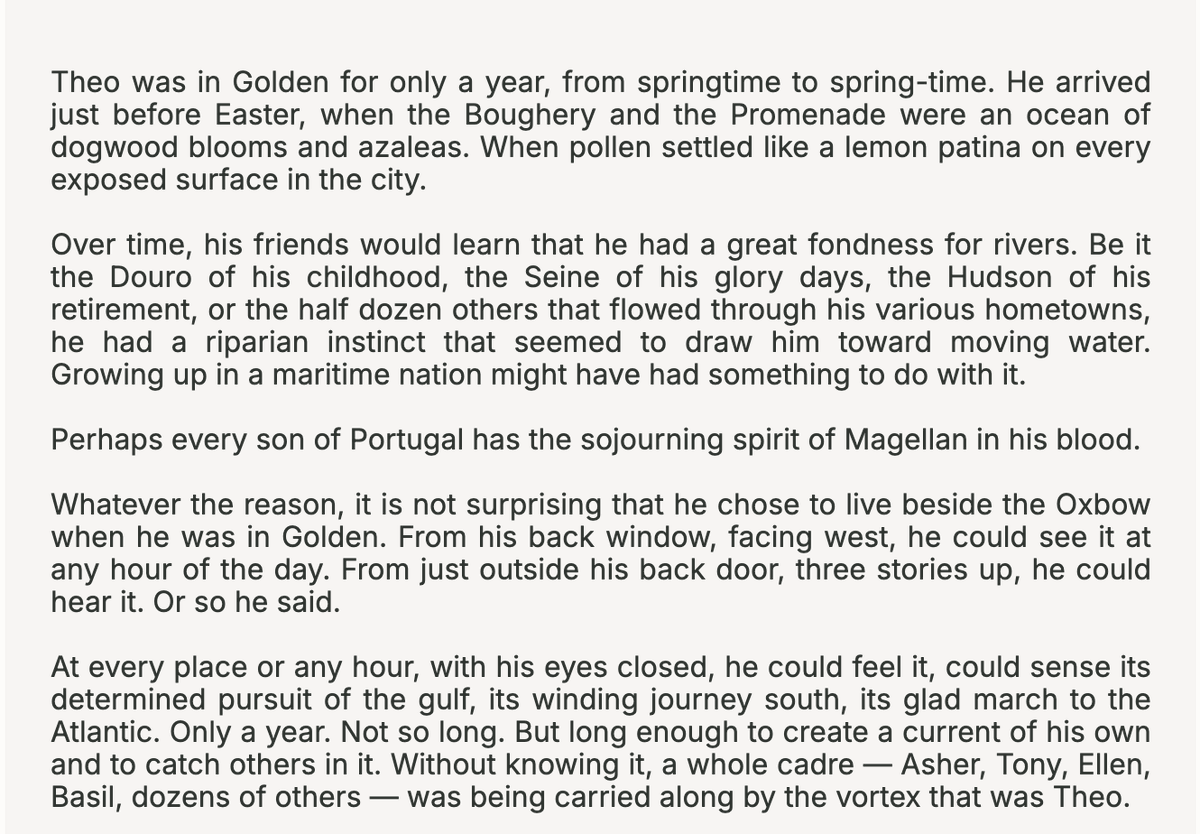
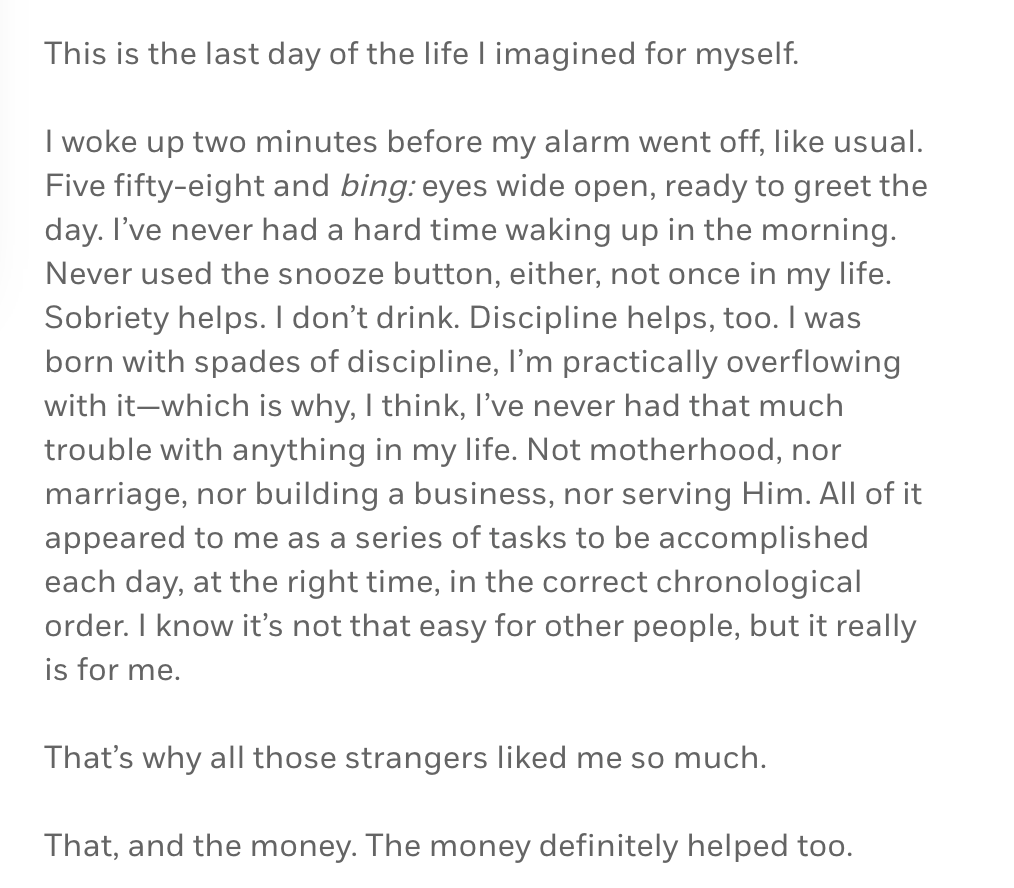
If you're wondering why fewer people read literary fiction today, compare these two novel openings.
One was originally self-published.
The other reflects the dominant style in contemporary publishing.
The difference is night and day.
We're looking for about 50 people to alpha test Verity, the new AI assistant from my startup, Xeit AI. Verity is our reasoning layer, built on the peer-disagreement literature in epistemology and game theory. Its free and you can DM me for more info.
What happens when you double teacher salaries?
- You get more satisfied teachers
- You do not get greater teacher effort
- You do not get better student outcomes
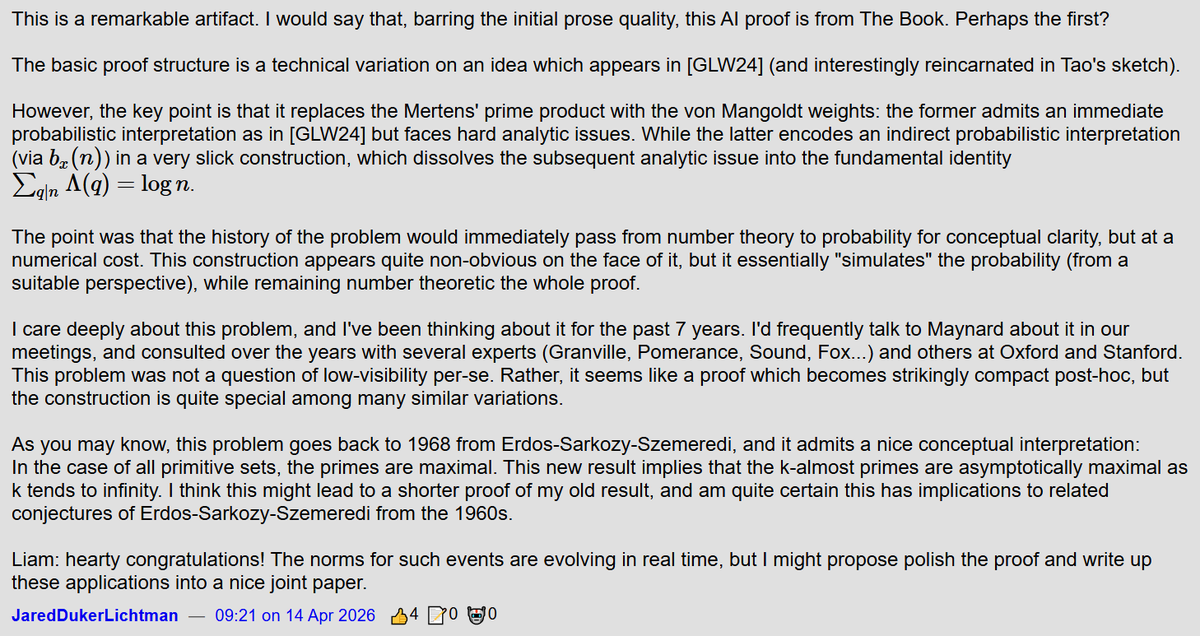
Kind of crazy. I had a rough idea for an Erdős problem, gave it to GPT-5.4 Pro, went for a walk, came back to a solution. I verified it, formalized it with Aristotle from @HarmonicMath together with @Tomodovodoo. Incredible how powerful these tools are in the right hands!
GPT-5.4 Pro solves Erdős Problem #1196!
Very pleased with this result; definitely my favourite thus far! This problem has been thought about for some time which makes this reasonably impressive and meaningful (see Lichtman's comments below).
Formalisation is underway!
The Terence Tao episode.
We begin with the absolutely ingenious and surprising way in which Kepler discovered the laws of planetary motion.
People sometimes say that AI will make especially fast progress at scientific discovery because of tight verification loops.
But the story of how we discovered the shape of our solar system shows how the verification loop for correct ideas can be decades (or even millennia) long.
During this time, what we know today as the better theory can often actually make worse predictions (Copernicus's model of circular orbits around the sun was actually less accurate than Ptolemy's geocentric model).
And the reasons it survives this epistemic hell is some mixture of judgment and heuristics that we don’t even understand well enough to actually articulate, much less codify into an RL loop.
Hope you enjoy!
0:00:00 – Kepler was a high temperature LLM
0:11:44 – How would we know if there’s a new unifying concept within heaps of AI slop?
0:26:10 – The deductive overhang
0:30:31 – Selection bias in reported AI discoveries
0:46:43 – AI makes papers richer and broader, but not deeper
0:53:00 – If AI solves a problem, can humans get understanding out of it?
0:59:20 – We need a semi-formal language for the way that scientists actually talk to each other
1:09:48 – How Terry uses his time
1:17:05 – Human-AI hybrids will dominate math for a lot longer
Look up Dwarkesh Podcast on YouTube, Apple Podcasts, or Spotify.
An attorney writes to me about the mostly AI-written law review article he had accepted this spring, now forthcoming in the flagship law review of a Top 50 law school. A draft of the article is now up on SSRN.
According to the attorney:
" Last month I used Claude to assist in drafting a new article . . . . I drafted this article in about 15 hours. In 2022 I published an article of similar length that took around 150 hours."
The attorney adds:
"I used Claude the way I’d use a junior associate—as a first drafter, sounding board, and research assistant. Most of the article, including the entirety of the title, abstract, and intro, is mine from the keyboard up. And anything Claude contributed that made it to the final version is there because I reviewed it, agreed with it, and chose to sign my name to it. This is no different than how I’d review an associate’s draft and then take responsibility for the finished product."
The attorney adds:
"That first draft was by no means file ready, but it was better than what I would’ve received from the vast majority of BigLaw associates. I was blown away, and have since started my own appellate and litigation practice in an effort to replicate these productivity gains for client work."
Your thoughts?
I know the attorney's name, and the journal, and I have checked out the article, but I figured that, at least for now, I would hold that back.
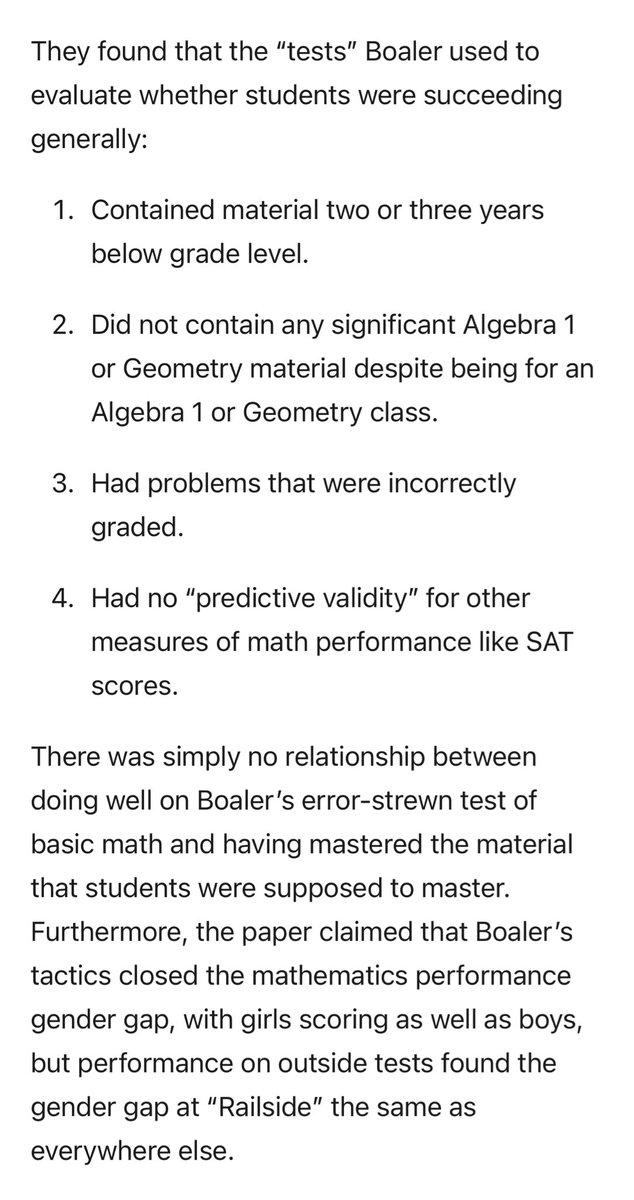
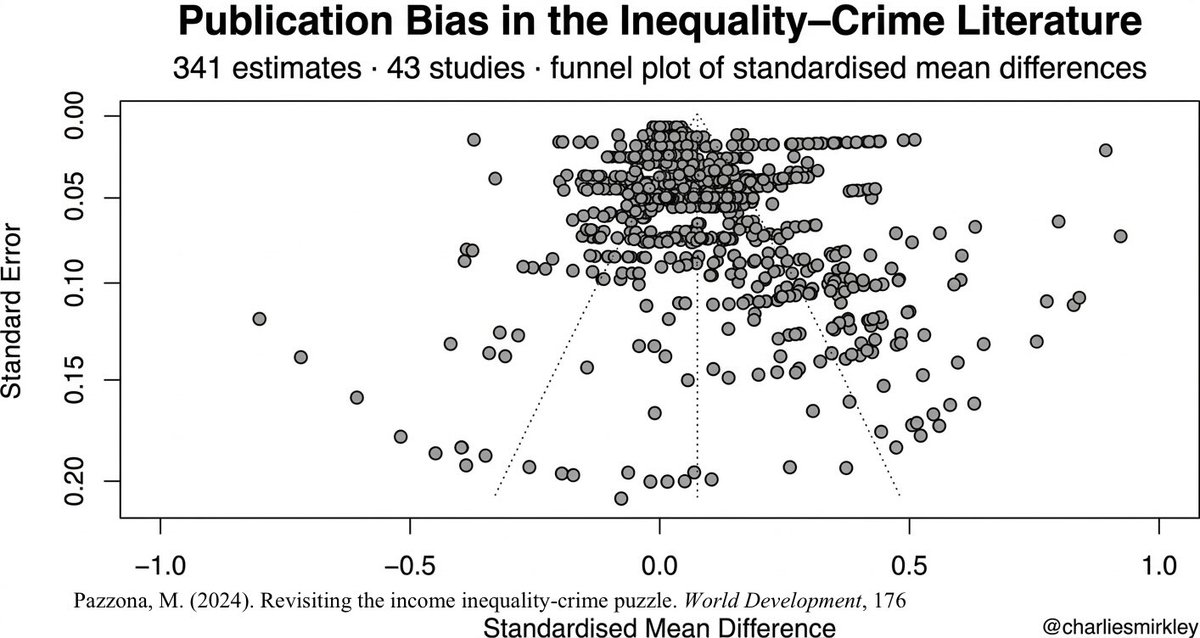
The inequality causes crime narrative is activist science. 43 studies. 1,341 estimates. Half the data never published.
Corrected effect: near zero.
Inequality doesn’t drive crime.
Academic scientists historically accepted lower salaries because the job offered intellectual freedom and institutional protection to pursue a passion for creating and disseminating knowledge. It was treated as a calling - closer to a priesthood or a federal judgeship than a corporate job.
As universities became corporatized, that relationship disappeared. Scientists became minor players inside large university bureaucratic structures focused on revenue streams.
If the freedom and protections of academic life disappear, there is no reason to accept a fraction of the salary.
It's truly a pity—almost unthinkable now—that Robert Lucas, Paul Krugman, and Scott Cunningham would almost certainly be rejected outright by today's top economics PhD programs.Lucas majored in history as an undergraduate.
Krugman, though he did major in economics, spent much of his time taking history courses instead of focusing seriously, and only really caught up on mathematics during his doctoral studies (as he himself admitted in Krugman, 1993).
Even Scott Cunningham studied English literature, originally dreaming of becoming a poet.Such unconventional paths, once possible for future Nobel laureates and leading scholars, now seem completely out of reach in the hyper-competitive, math-heavy admissions landscape of elite economics departments. What a loss of potential brilliance.😮💨😮💨
Mathematics has a creative aspect that is much more than randomly stringing concepts and seeing what sticks to the wall. Those with mathematical ability will get the most out of AI mathematicians in the same way that excellent coders get the most out of LLMs coding today.
I strongly suspect that we will have powerful AI mathematicians in the next 10 years. I fully expect this to reduce how much we fetishize mathematical ability, but also dramatically increase how much we collectively use math to solve problems.
Many animals reason causally, that is, they predict the timing and size of the effects of a wide range of actions. They do not need to understand the concept of cause to do so.
This is what Colin Allen & I argue for (link 👇🏻) in which we also provide innovative ways to show it
@BayouPhilosophy That seems dangerous! What type of medication were you on (if I may ask), and have you tried more natural means, like Ashwagandha? Also, are you tapering off, or did you go cold turkey?
I think we should strongly consider hiring quants and ML researchers based on their preferred Greek philosophies.
Major alpha in finding anaximanderists.